- The paper introduces ray-anchored anisotropic 3D Gaussian primitives to reconstruct accurate 3D dental anatomy from a single panoramic radiograph.
- It employs a differentiable Gaussian splatting operator with physics-corrected rasterization and perceptual regularization to refine volume synthesis.
- The approach markedly improves metrics like BA-ASD, TVR, and CVR, effectively reducing hallucinations and preserving fine structural details.
X-Splat: Gaussian Splatting for 3D CBCT Generation from a Single Panoramic Radiograph
Introduction and Motivation
The challenge of reconstructing 3D dental anatomy from a single panoramic X-ray (PXR) image is a highly ill-posed inverse problem. Conventional CBCT provides depth-resolved volumes through multi-view projections, but panoramic radiographs, while ubiquitous and low dose, encode 3D information as a single highly compressed 2D integral along curved X-ray trajectories. This lossy mapping discards depth and leaves large anatomical ambiguities. Existing approaches utilizing implicit fields or generative architectures generally fail to produce volumes with crisp structural fidelity—oversmoothing or hallucination are common, particularly at fine boundaries like tooth roots and the mandibular canal. The "X-Splat" framework directly addresses this deficit by introducing explicit, geometry-anchored, anisotropic 3D Gaussians as the principal representation, tightly constraining volume generation via acquisition-aware parameterization and scan physics.
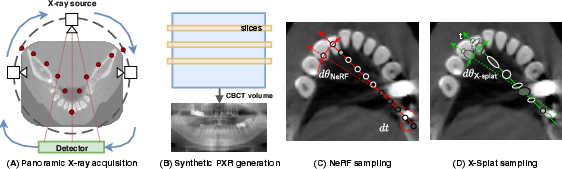
Figure 1: X-Splat leverages the known panoramic acquisition geometry, deploying learnable, anisotropic 3D Gaussians anchored along rays to recover dense 3D anatomy from 2D projections, in contrast to prior NeRF or voxel-grid approaches.
Methodology
Ray-Anchored 3D Gaussian Representation
At the core of X-Splat is the principle of initializing a dense, spatially-informed scaffold of anisotropic 3D Gaussian primitives directly along the acquisition rays of the panoramic X-ray scan. Each Gaussian’s parameters (displacement, orientation, scale, and density) are inferred in a single, feed-forward pass through a shared MLP, conditioned both on global image features (from a 2D U-Net encoder) and per-primitive positional encoding. Constraining Gaussians to move and rotate strictly within the axial plane of each acquisition ray not only enforces anatomical plausibility but also anchors geometric reasoning to physical imaging formation, discarding the unconstrained flexibility that leads to hallucinations in traditional generative models.
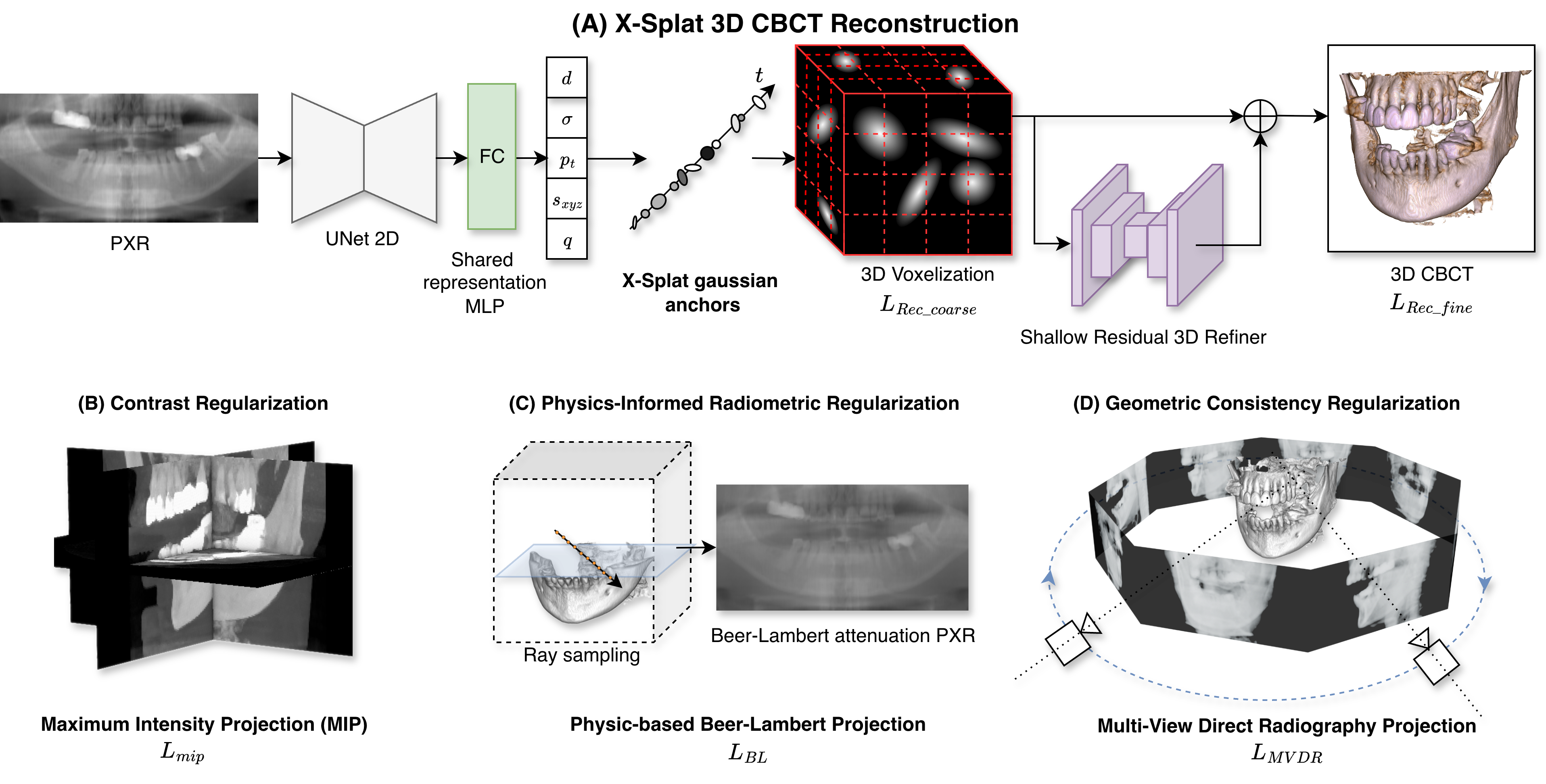
Figure 2: Pipeline for processing a single PXR with a U-Net encoder and shared MLP to predict 3D Gaussians, refined by a residual 3D U-Net, with multi-level physics and perceptual regularization.
Differentiable Rasterization and Volumetric Synthesis
The predicted Gaussians are voxelized into a coarse volumetric representation using a physics-corrected, radiative Gaussian splatting operator that integrates each primitive’s contribution according to Beer–Lambert law. This rasterization is fully differentiable and supports end-to-end gradient flow, allowing both explicit geometric and radiometric losses to shape the generative process.
Residual Refinement and Multi-View Consistency
Downstream, a lightweight residual 3D U-Net refiner operates on the coarse Gaussian-based volume. The model restricts refiner capacity, functioning solely as a minor anatomical prior injector rather than an unconstrained shape composer—this design decision prevents data-driven overfitting to population means and ensures that geometric details specified by the Gaussians are preserved rather than erased.
X-Splat’s training objective is composite, with dominant weight apportioned to multi-view geometric supervision through digitally reconstructed radiographs (DRRs) rendered at 31 azimuthal angles. This loss encourages depth and consistency impossible to obtain from the single-view input alone, sharply contracting the solution space toward anatomically plausible configurations. Additional terms include physics-driven reprojection losses, maximum-intensity projection constraints, and perceptual penalties drawn from deep features, operating at the level of both coarse and refined volumes.
Representation and Optimization Dynamics
A key feature of the approach is the dynamic capability of the Gaussian primitives: during inference, splats initialized along rays actively rotate and translate within their permitted local neighborhoods, aligning with tissue boundaries (e.g., tooth roots, cortical surfaces), with observed displacements up to 10 px in proximity to high-density structures.
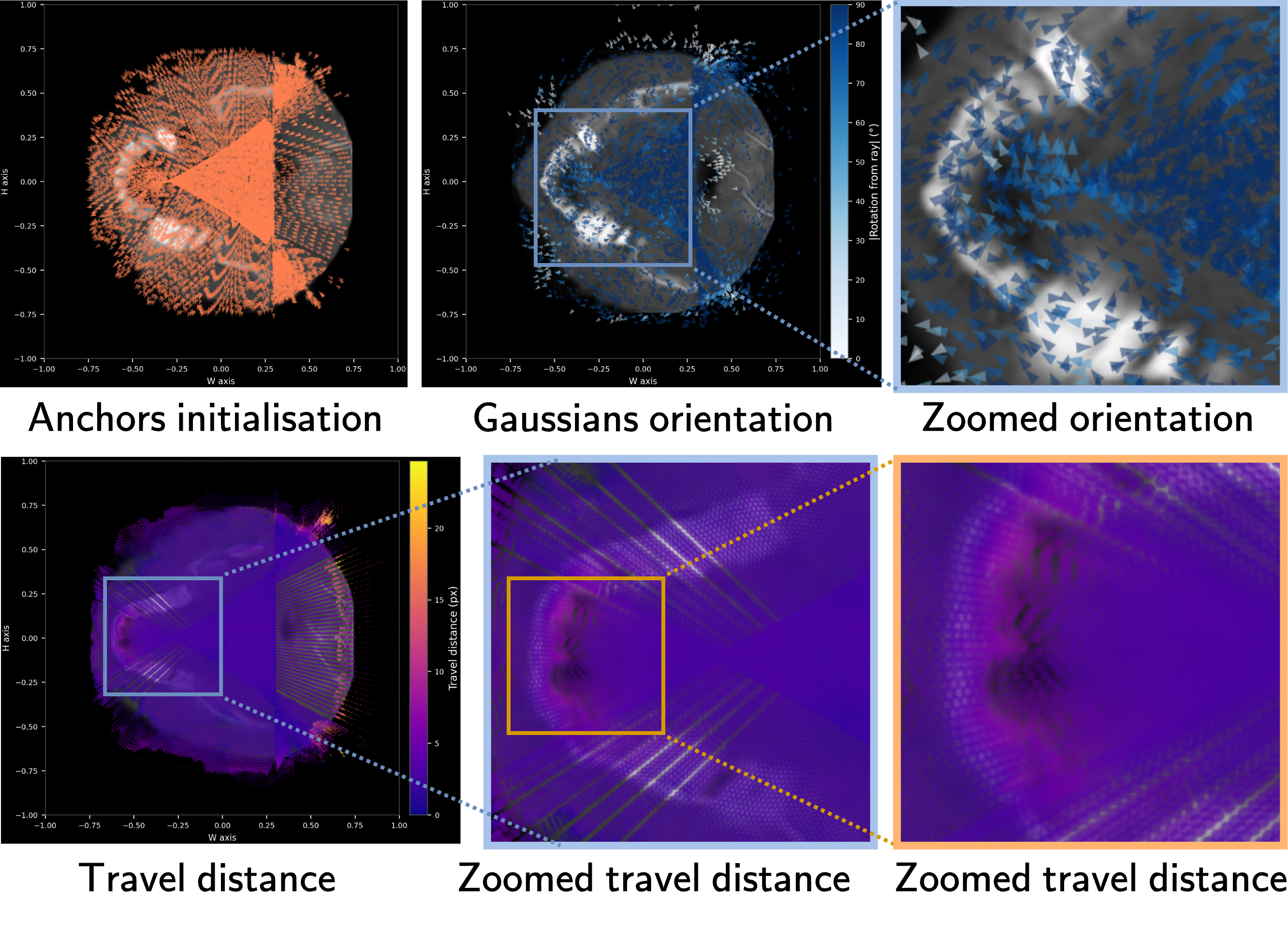
Figure 3: Gaussian primitive dynamics post-training, exhibiting rotation and translation along anatomical boundaries, demonstrating the model’s explicit geometric alignment capacity.
This local flexibility—paired with dense, acquisition-informed anchoring—enables X-Splat to efficiently and accurately fill inter-ray gaps that are otherwise prone to artifacts or blurring in conventional NeRF/implicit field models. Restricting both the spatial movement and possible scales of Gaussians to physically justified extents serves as a built-in regularizer, preserving anatomical structure even in the absence of volumetric cues.
Quantitative and Qualitative Results
Empirical evaluation is conducted on ToothFairy3—a public dataset with full arch maxillofacial CBCT and dense segmentation. The most critical advances manifest in explicitly geometry-aware metrics: Big Anatomy Average Surface Distance (BA-ASD), Teeth Volume Recall (TVR), Canal Volume Recall (CVR), and Hallucinated Volume (HV). While intensity-based scores such as PSNR and SSIM are competitive across methods, geometric recovery, as quantified by BA-ASD and CVR, reveals pronounced distinctions.
- X-Splat attains the lowest BA-ASD (2.39 mm), exceeding other non-oracle approaches by at least 4.4×.
- Canal recovery (CVR) is 67.3%, compared with 1.1% for NeBLa (implicit) and 27.6% for the best non-implicit competitor.
- TVR approaches 85%, indicating no substantial loss in overall dental completeness.
- HV is minimized, evidencing robust hallucination suppression.
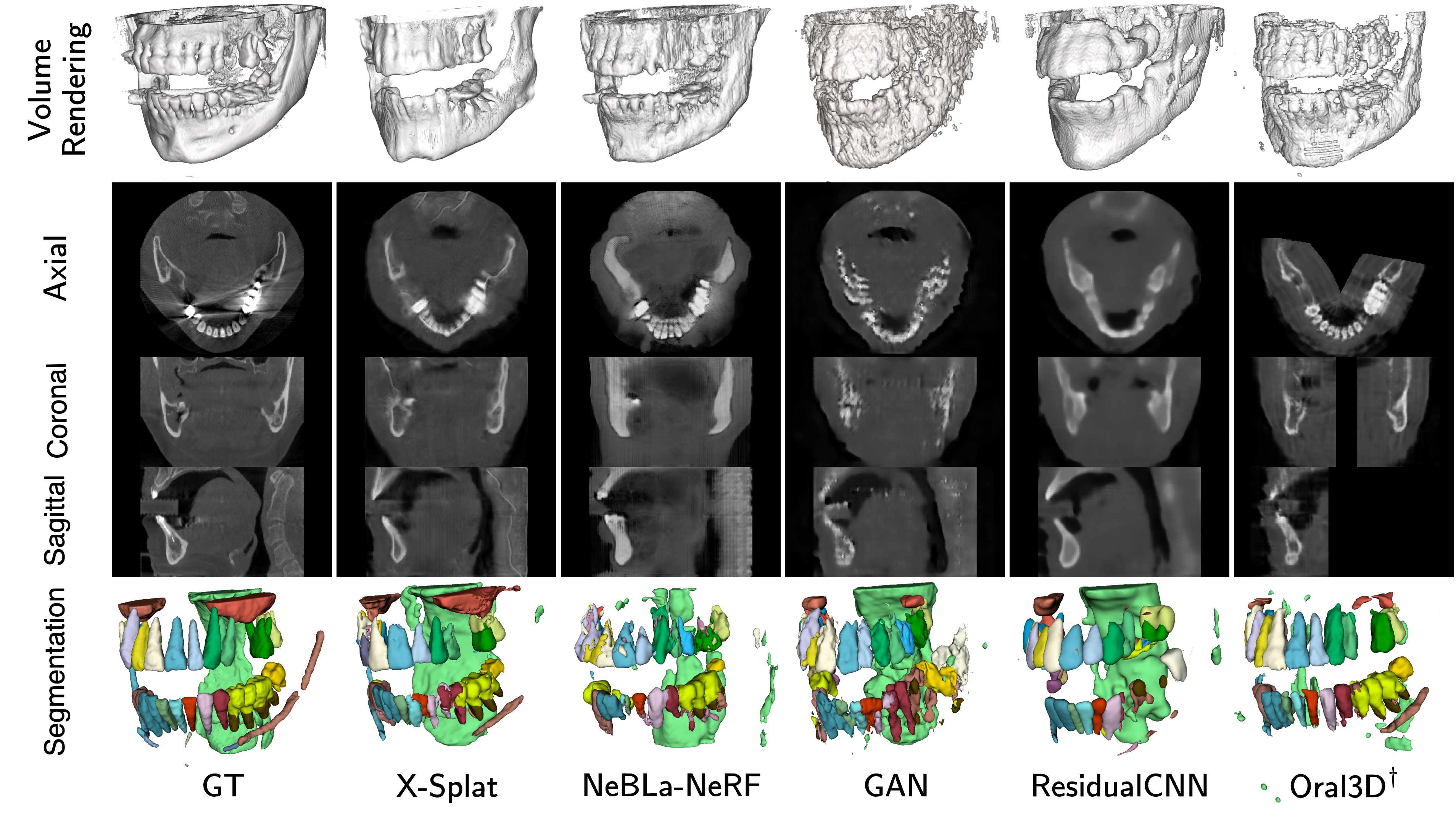
Figure 4: X-Splat recovers full 3D anatomy—cortical/trabecular bone, sinuses, mandibular canal, and avoids hallucinating absent teeth, outperforming prior work in structural fidelity.
Fine-grained qualitative analysis confirms these findings: X-Splat sharply delineates key bony and dental structures, reconstructs the mandibular canal as a continuous tube (a frequent failure point for all prior work), and refrains from hallucinating teeth in edentulous areas. Competing methods are variously over-smoothed, blur boundaries, or introduce high-frequency noise without anatomical support.
Cross-section comparisons further illustrate the model’s inductive bias: even before refinement, the Gaussian voxelizer alone yields a coarse volume that is spatially continuous, with pronounced dental arch localization and jaw curvature—whereas NeBLa’s coarse representations are sparse and structurally impoverished, relying entirely on the refiner.
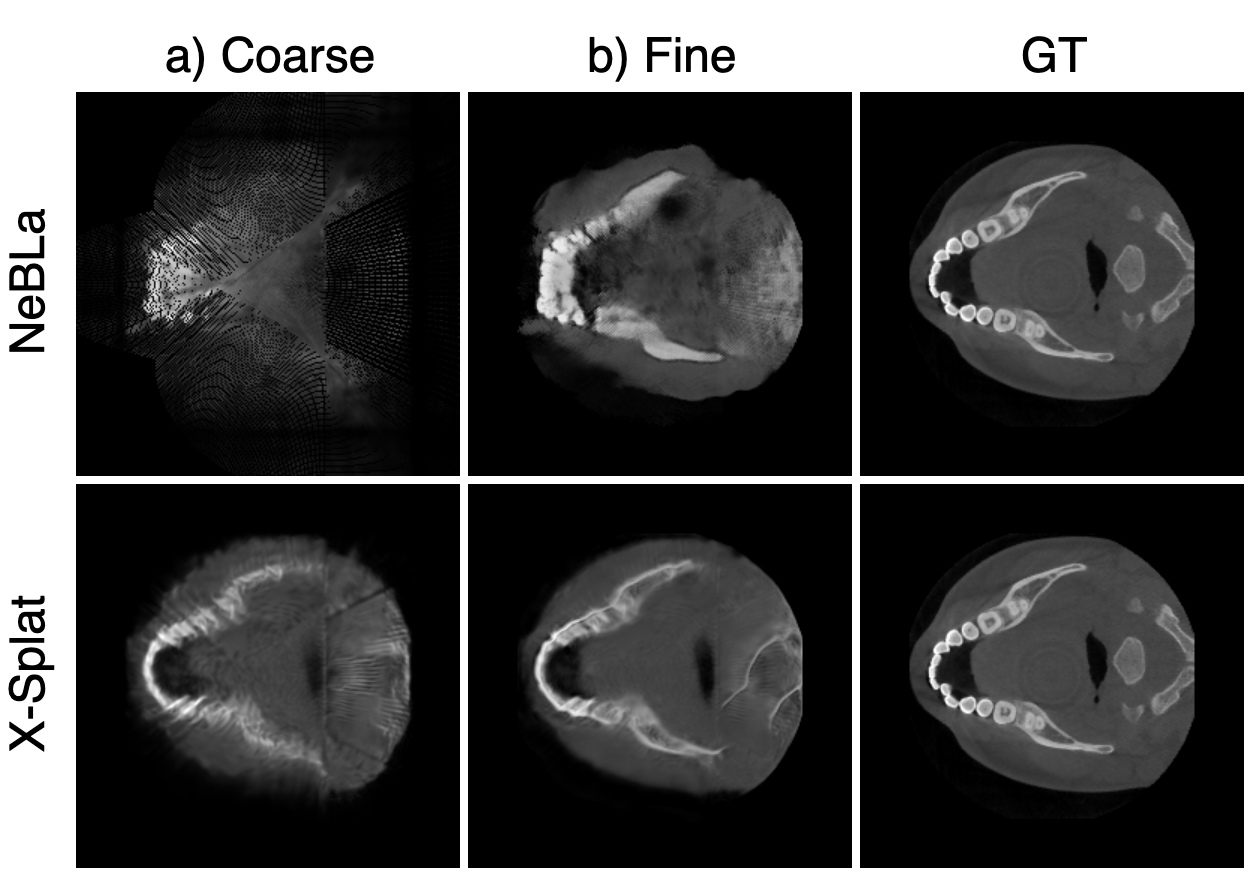
Figure 5: X-Splat’s coarse volume directly localizes major anatomical features, in contrast to implicit-field approaches where structure must be invented by the refiner.
Ablation and Representation Analysis
Ablation studies confirm that the transition from implicit fields to explicit, ray-anchored Gaussians delivers the bulk of geometry-aware accuracy improvements. The efficiency of geometric coverage is further modulated by the count and configuration of splats, with diminishing returns above ~6M Gaussian anchors. The addition of displacement (i.e., allowing travel along rays) and the introduction of multi-view DRR regularization yield quantifiable, independent benefits—each incrementally sharpening geometric localization, mitigating hallucinatory predictions, and enforcing clinical plausibility. Notably, increasing the density of rays/splats in the implicit setting does not fundamentally overcome their representational weaknesses.
Clinical and Theoretical Implications
X-Splat exemplifies a paradigm shift for single-view volumetric inference in medical imaging: explicit, acquisition-aware geometric scaffolding, physics-consistent data formation constraints, and lightweight statistical regularization yield volumetric predictions far superior in task-relevant anatomical fidelity than either purely implicit or generative data-driven frameworks. Particularly in applications where diagnostic accuracy hinges on the recovery of fine structures (e.g., surgical planning, implant design, or forensic estimation), this representation-driven philosophy is likely to catalyze new classes of efficient, trustworthy inverse architectures.
Future research directions may include the adaptation of X-Splat to heterogeneous real-world panoramic systems via domain adaptation and the integration of adaptive, anatomically-specific Gaussian densification. The approach itself portends practical transformation in settings with limited CBCT accessibility or strong cost/radiation constraints, opening 3D dental analytics to heretofore inaccessible cohorts.
Conclusion
X-Splat provides a rigorously geometric, physics-grounded solution for the single-view CBCT generation problem, decisively outperforming prior implicit and generative architectures in structurally critical clinical metrics. Its fusion of explicit ray-anchored Gaussians, differentiable rasterization, and multi-view consistency regularization constitutes a robust template for future 3D inference work in domains of sparse or underdetermined medical imaging, with broad methodological and translational relevance.