- The paper introduces prompt coverage adequacy as a metric that maps natural language prompts to structured requirements using LLM-based entropy reduction.
- It demonstrates that prompt coverage significantly enhances fault detection over traditional code coverage, validated on benchmarks like HumanEval+ and LiveCodeBench.
- It highlights practical integration into specification-driven assurance and LLM-guided test generation, offering robustness even for black-box and evolving implementations.
Prompt Coverage Adequacy: A Specification-Level Test Adequacy Criterion for LLM-Driven Development
Introduction
The paradigm shift toward LLM-driven software development has elevated prompts—natural language specifications—to primary artifacts, rendering the limitations of traditional code-centric testing methodologies increasingly apparent. Prompt Coverage Adequacy, as proposed in "Prompt Coverage Adequacy" (2607.02057), addresses this methodological gap by introducing a specification-focused coverage criterion. Prompt Coverage evaluates the extent to which a test suite exercises the requirements stated in prompts, thereby decoupling test adequacy from implementation structure and explicitly quantifying the behavioral completeness of testing with respect to user intent. The criterion operationalizes coverage at the prompt level through LLM attention mechanisms, serving as both a requisite tool for test quality assessment and a guide for test generation in natural language–driven software generation workflows.
Prompt Coverage is instantiated as a test adequacy metric that maps the semantics of code generation prompts to structured requirement sets R={R1,…,Rn}, each defining a distinct aspect of target behavior. A test suite T is evaluated for its coverage of each Ri by leveraging spotlighting: a dynamic steering of LLM attention toward a requirement span during test evaluation. Coverage is determined based on the reduction in LLM output entropy when a requirement is spotlighted—if the entropy decreases significantly, indicating reduced surprise, the corresponding test is deemed as covering Ri.
The overall prompt coverage score is the ratio of covered requirements to the total requirements in R, thus providing a prompt-level analog to traditional statement or branch coverage. The operational workflow includes automated prompt segmentation, LLM-based entropy calculation (potentially condensed to a single-token entailment assessment for stability), and threshold tuning to dissociate true alignment from attention-induced noise.
Experimental Evaluation
Prompt Coverage Adequacy was empirically evaluated across two canonical benchmarks—HumanEval+ and LiveCodeBench—spanning diverse task complexities and prompt archetypes. The methodology involved:
- Prompt Segmentation and Coverage Scoring: Mining prompts for atomic requirements and applying the proposed entropy-based coverage calculation.
- Baseline Comparisons: Contrasting prompt coverage with traditional code coverage (statement coverage via Python's coverage tool).
- Fault Detection Analysis: Assessing the association between coverage metrics and effectiveness of fault detection using both LLM-generated and crowd-sourced code implementations.
- Coverage-Driven Test Generation: Comparing test effectiveness when test augmentation for faulty code is guided by either prompt coverage or code coverage.
Key findings include:
Fault Detection and Complementarity
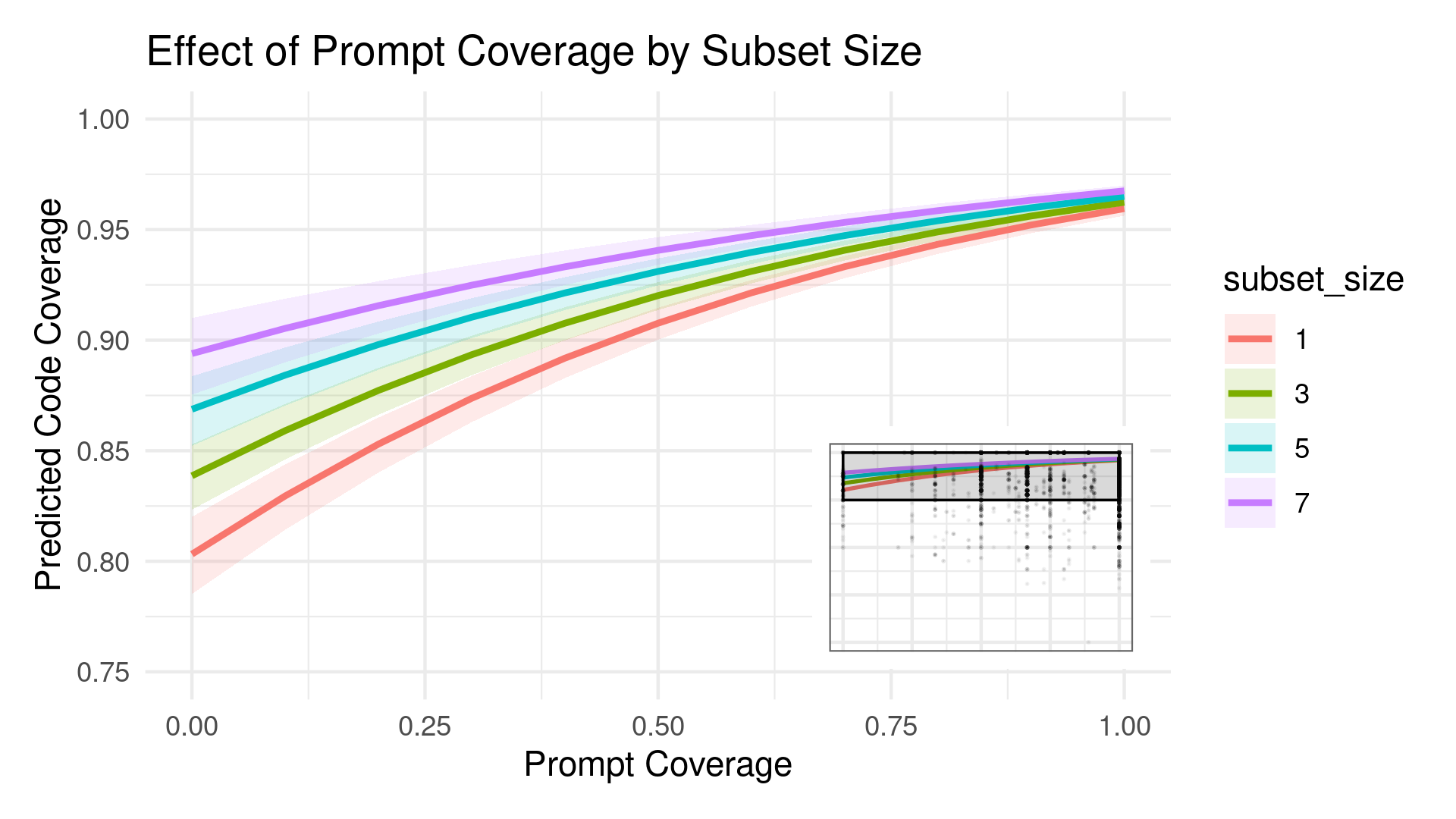
Fault detection performance is directly linked to the degree of prompt coverage, even when test quantity is controlled. Statistical models (Beta GLMM for code coverage and Binomial GLMM for fault detection) confirm that prompt coverage is a significant independent predictor of both implementation exploration and fault exposure.
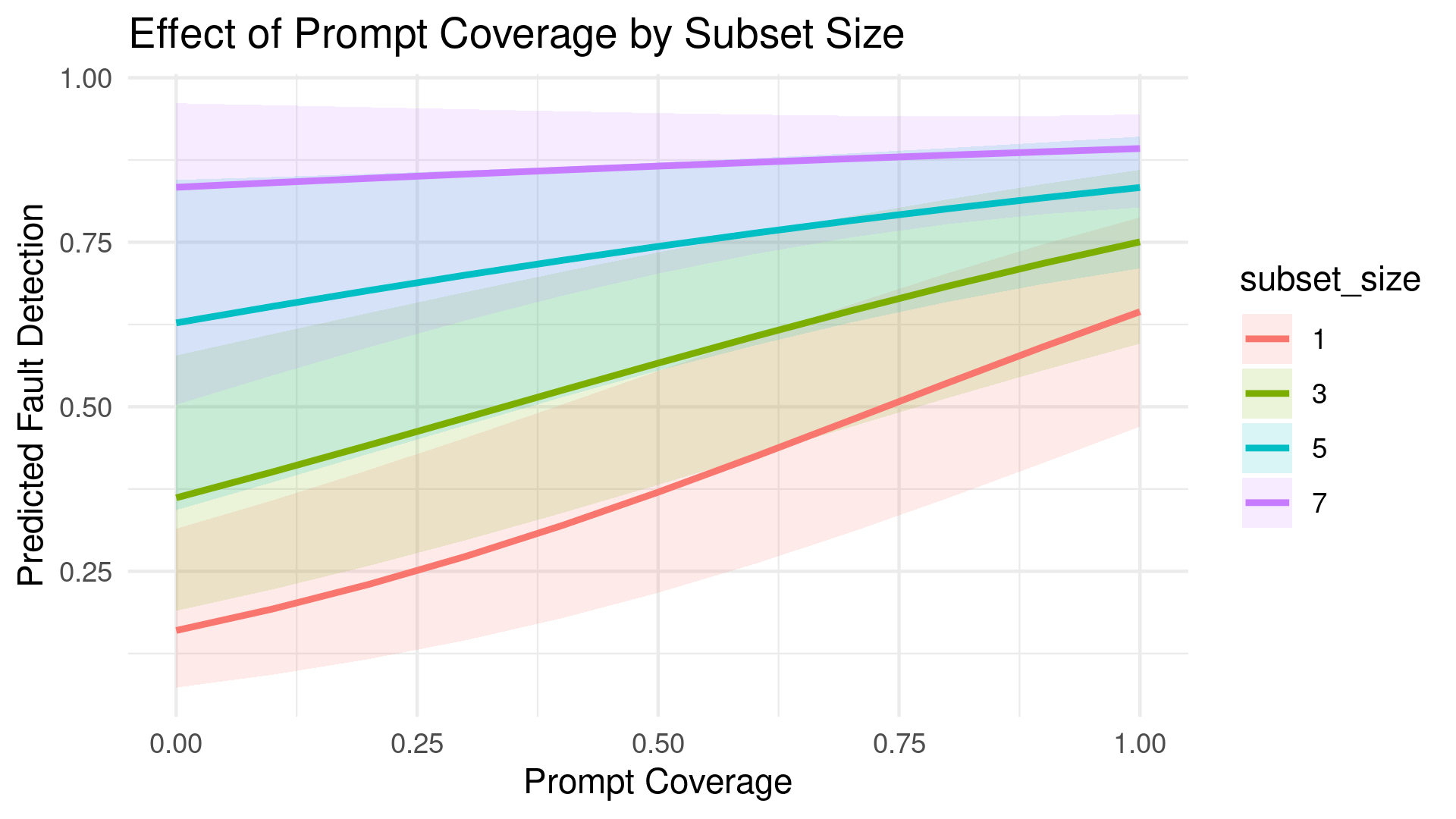
Figure 4: Fault detection rises with prompt coverage, showing diminishing gains as suite size expands.
Crucially, prompt coverage–driven guidance uncovers behavioral faults that statement coverage overlooks, especially those rooted in unimplemented or misinterpreted requirements. The complementarity of prompt- and code-driven strategies becomes evident through Venn analyses of detected faults.
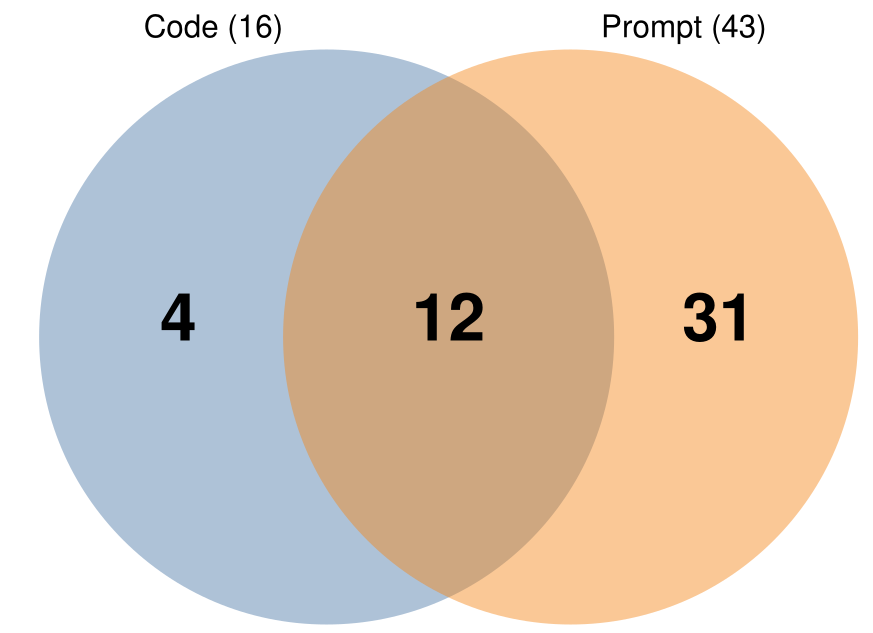
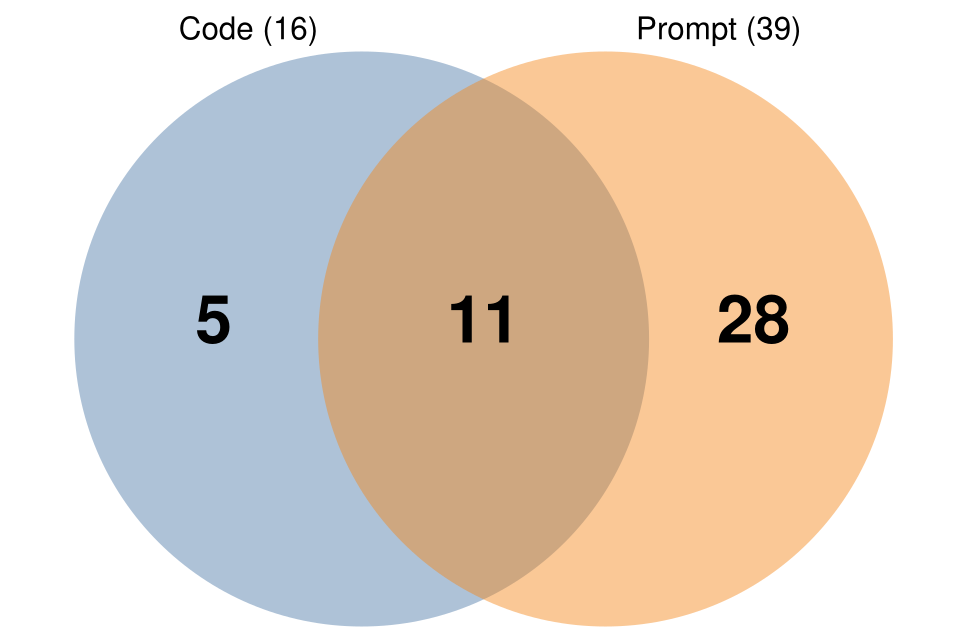
Figure 1: Faults detected exclusively by code-guided and prompt-guided strategies, alongside their intersection, for HumanEval+ and LiveCodeBench.
Implications and Future Directions
Prompt Coverage Adequacy embodies a pivotal reorientation: evaluating test adequacy with respect to user intent rather than implementation structure. The criterion is robust to implementation variability—a trait increasingly critical in iterative LLM-based code generation workflows where code structure may shift significantly while prompt semantics remains invariant.
Practical Implications:
- Specification-driven assurance workflows: Prompt Coverage establishes traceability links between requirements and test cases, facilitating transparency, auditability, certification, and stakeholder communication.
- LLM-driven test generation: Leveraging prompt coverage as a test guidance signal demonstrably improves effective behavioral space exploration and uncovers faults related to incomplete or incorrect requirement mappings.
- Applicability to black-box and evolving implementations: Since coverage is derived from prompts and LLM reasoning alone, it does not require access to source code, supporting scenarios where implementation is unavailable, obfuscated, or continuously evolving.
Theoretical Implications and Future Work:
Prompt Coverage opens avenues for hybrid coverage criteria that blend prompt and code signals; principled generalization to other NL-driven development artifacts (e.g., agent workflows, multi-turn specifications); and integration with formal traceability models. Its reliance on LLM attention further suggests broader applications for semantic alignment analysis and dynamic test case selection in AI-software co-engineering.
Conclusion
Prompt Coverage Adequacy constitutes a rigorous, LLM-centric reframing of test adequacy for the emerging paradigm of prompt-driven software development. Its specification-level focus aligns quality assurance practices with the abstraction level of modern, AI-powered developer workflows, bridging the gap left by traditional code-oriented metrics. Empirical results show not only a strong relationship between prompt and code coverage, but also a sizable advantage in practical fault detection—demonstrating that prompt coverage captures subtle behavioral requirements often missed by implementation-based criteria. Looking ahead, Prompt Coverage provides a foundation for a new generation of specification-aware, intent-oriented testing methodologies that are naturally compatible with the dynamics of LLM-centered engineering.