- The paper introduces a continuous-item IRT approach that decouples intrinsic condition difficulty from rider skill using physically anchored priors.
- The model employs marginal maximum likelihood with the EM algorithm and Gauss–Hermite quadrature to achieve strong numerical recovery and predictive performance.
- The framework produces a novel difficulty atlas for site-level risk assessment and supports personalized decision support while ensuring data privacy.
Inverse Suitability: Continuous-Item IRT for Separating Condition Difficulty and Rider Skill
Introduction and Motivation
Suitability scoring for outdoor activities, such as kitesurfing or paragliding, traditionally relies on expert-defined curves that map environmental variables to guidance decisions. These curves, by construction, conflate two semantically distinct latent variables: the intrinsic difficulty of a condition (e.g., 22 knots wind at location s) and the skill of the individual encountering it. This contextual confounding precludes the isolation of either construct and preempts precise, skill-adaptive guidance.
The paper "Inverse Suitability: Identifying Condition Difficulty and Rider Skill from Behavioural Outcomes via Continuous-Item Response Theory" (2607.01961) addresses this ambiguity by introducing a continuous-item IRT framework that disintangles these factors from binary behavioral outcomes. The proposed methodology assigns explicit, physically-anchored latent functions to both rider skill and condition difficulty, supporting well-identified model-based inference and quantifiable validation. This approach has implications both for operational decision support systems and for environmental decision science at large.
The core generative model is an extension of the two-parameter logistic IRT form to environmental domains with continuous-valued "items," here: environmental conditions parameterized by metrics such as wind speed (x) at site (s). Each observed outcome is a triple (r,x,y)—rider, condition, and binary result—and the outcome probability is factorized as:
P(y=1∣r,x,s)=σ(a(θr−δ(x,s)))
where θr captures latent rider skill, δ(x,s) is the intrinsic condition difficulty (a smooth function of x), and a is a discrimination parameter. In practice, a is taken as a scalar for identifiability at this development phase. x0 is not a mere free-form function but is anchored to a physics-based expert curve—a prior derived from domain expertise—ensuring interpretability in physical units and providing regularization for condition regimes with sparse data.
Crucially, the model generalizes the traditional suitability curve. Marginalizing the skill distribution yields the population-level suitability curve: the backward compatibility with classical approaches is exact, not approximate.
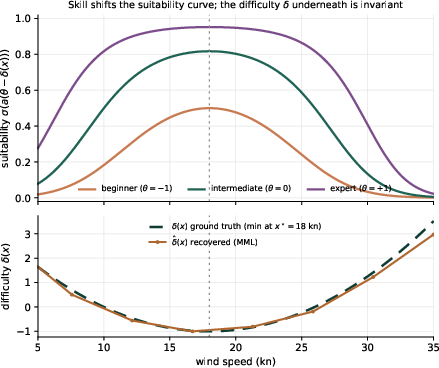
Figure 1: The bottom panel displays the intrinsic difficulty function x1 (dashed) and the recovered estimate x2; the top panel shows three skill-conditioned suitability curves (for beginners, intermediates, and experts), illustrating that skill level translates the suitability without altering underlying difficulty.
Identifiability and Estimation
Identifying skill and difficulty separately is nontrivial, due to inherent location/scale indeterminacies in the latent space. The model addresses these with two orthogonal conventions:
- Skill Distribution Anchoring: The latent skill distribution is standardized to x3, establishing identifiable location and scale.
- Physical Anchoring of Difficulty: The prior for x4 ties the function to interpretable physical quantities via the expert-derived curve, ensuring consistent units and supporting regularization.
Additionally, the model's identifiability is contingent upon the connectivity of the bipartite "incidence graph" spanning riders and observed condition bins. The estimator verifies this prerequisite before fitting; failure to satisfy the condition triggers a fallback to the classical, population-averaged suitability curve, thus avoiding spurious identification in underdetermined subspaces.
Estimation proceeds by classical marginal maximum likelihood, using the EM algorithm and Gauss–Hermite quadrature for marginalization over the skill distribution. Shrinkage to the prior handles both separation in the presence of outlier riders and sparsity across rare condition bins.
Synthetic Recovery and Numerical Results
Validation is conducted via a synthetic recovery study, circumventing confounds arising from real-world behavioral data. Synthetic cohorts are generated with known latent skill and a ground-truth difficulty function (parabolic in x5 space, with minimum at x6 knots).
Key strong numerical results include:
- Latent Skill Recovery: Pearson correlation between recovered and ground-truth skill: x7.
- Difficulty Minimum Localization: The minimum location x8 knots, within x9 knots of the true value.
- Discrimination Parameter Recovery: Recovered s0 compared to true s1.
- Predictive Performance: Held-out Brier Skill Score improvement of s2 over the single-curve baseline, indicating substantive predictive gain attributable to skill explicitness rather than overfitting.
All results are strictly reproducible: the codebase supports "one-command" reproduction of all reported outputs, reinforcing methodological rigor.
The Difficulty Atlas
The intrinsic difficulty function, aggregated across sites, constitutes a novel, anonymous "difficulty atlas"—a spatially joinable, site-level rating of intrinsic activity difficulty for given environmental conditions, decoupled from population skill mix or clientele effects. Meteorological and environmental archives do not provide any direct proxy for this construct; conventional suitability curves are unavoidably population-confounded.
Figure 1: The construct measured by the atlas; difficulty is separated from skill and visualized as a site-level function.
The atlas's properties—physical anchoring, anonymity, and compatibility with privacy requirements—support its potential as a durable and auditable public artifact, suitable for integration in operational systems and environmental datasets.
Governance: Reproducibility and Privacy
The design explicitly addresses governance through data provenance (content hash–keyed fits), deterministic estimation, and a dichotomous privacy regime: site-level difficulty atlases are fully anonymous, while per-rider skill posteriors are treated as sensitive data and are subject to GDPR-style hard-deletion upon user request.
Furthermore, skill-conditioned scoring is implemented as an input parameter rather than an inferred attribute, ensuring that scoring for "expert" conditions does not involve unrequested personal profiling.
Implications and Future Directions
Practically, the method enables personalized, skill-conditional decision support for outdoor activities, with strict backward compatibility to established systems. The formalization of an intrinsic difficulty atlas enables principled site-level risk assessments, of particular relevance to risk underwriting in parametric insurance for weather-dependent leisure, and for cross-site benchmarking.
Theoretical implications include a generalized, continuous-item extension of IRT to domains characterized by smoothly varying environmental "items," beyond the conventional discrete test item paradigm of psychometrics.
Limitations are transparently acknowledged: validation is synthetic, discrimination is taken as scalar, and extensions to multidimensional condition spaces and full Bayesian uncertainty quantification are specified as immediate avenues for development.
Conclusion
The proposed continuous-item IRT framework enables separate inference of condition difficulty and participant skill from binary behavioral outcomes, addressing a critical confound in suitability scoring for environmental decision support. The methodology achieves strong numerical recovery and interpretability, with built-in governance for privacy and auditability. The notion of an intrinsic difficulty atlas represents a theoretically and practically new construct for environmental sciences, pending future empirical validation on real behavioral cohorts.
Future work should focus on empirical deployments, multidimensional environmental modeling, and hierarchical Bayesian inference for richer posterior structure and uncertainty quantification.
Reference: "Inverse Suitability: Identifying Condition Difficulty and Rider Skill from Behavioural Outcomes via Continuous-Item Response Theory" (2607.01961).