- The paper introduces a holonomy-based diagnostic method to assess strain compatibility in stress-induced ferroelectric SrTiO3.
- It contrasts traditional local gradient measures with a closed-loop holonomy approach that captures non-integrable, path-dependent orientational features.
- The results reveal distinct spatial and temperature-dependent patterns that link strain incompatibility to domain evolution across phase transitions.
Holonomy-based Geometric Diagnostics for Strain Compatibility in Birefringence Imagery of Stress-induced Ferroelectric SrTiO3
Introduction
Birefringence imaging enables the real-space reconstruction of strain and polarization textures in ferroic materials, capturing domains, walls, and emergent inhomogeneities relevant to device applications and fundamental phase-transition mechanisms. Conventional analysis predominantly relies on local gradient (e.g., “grad”) metrics to characterize orientational variation in the director (optical fast axis), which lacks sensitivity to global, path-dependent features such as strain incompatibility and non-integrability. This study introduces and implements a holonomy-based diagnostic for birefringence-derived line fields in ferroelectric SrTiO3, conceptualizing the director as a field on RP2 and extracting a holonomy angle, ω, as the residual rotation over closed spatial loops. The methodology is contrasted with local gradient measures and applied across the cubic-to-tetragonal and ferroelectric transitions, with spatial and temperature dependence resolved at high fidelity.
The director field is reconstructed from polarization-resolved birefringence imaging, taking the Stokes vector at each pixel and defining a normalized director on RP2 (director ∼ −director). For each closed loop of size L×L, the minimal SU(2) rotations between adjacent pixels are composed into a loop quaternion, QL, whose axis-angle form yields the holonomy angle ωL as
30
where 31 and 32. This definition isolates strictly nonintegrable (path-dependent) orientational features; fields with finite gradients but globally compatible rotations exhibit vanishing holonomy by construction.
Application to 575 nm birefringence images of SrTiO33, stressed along [001], employs 34 as the nominal loop size, matching typical domain wall and flexoelectric texture scales. The holonomy maps 35 are aggregated in 5-K temperature intervals and compared to corresponding local gradient maps and ferroelectric transition temperature (36) fields derived from previous work.
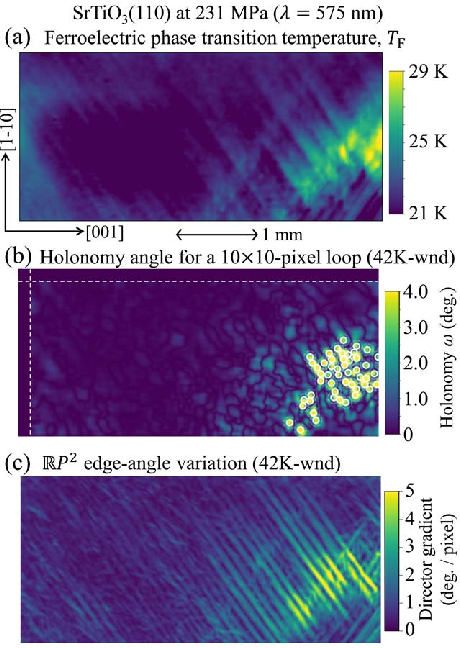
Figure 1: Real-space maps (302×140 pixels) of (a) the ferroelectric transition temperature 37, (b) the holonomy angle 38, and (c) the nearest-neighbor 39 edge-angle variation, for the (40.0K, 45.0K] interval.
Comparison with Local Measures and Statistical Characterization
The holonomy-based metric exhibits both spatial and statistical distinctiveness when compared to local gradient-based analysis. High-holonomy values are confined within clusters embedded in regions of elevated local gradient, but the two do not strictly overlap (intersection-over-union for top 10% pixels: 0.391), and correlation is moderate but far from deterministic for large values (Pearson RP20 for upper 10%). Holonomy reveals loop-level geometric incompatibility hidden within domains that appear as simple rapid orientational change by conventional (grad) measures.
The temperature evolution of holonomy is anomalous at both the cubic-tetragonal (RP21) and ferroelectric (RP22) transitions, with statistically significant peaks in the median of the top 10% of holonomy values per window. These responses are highly localized within the real-space map, with a majority of pixels near zero holonomy, underscoring the ability of holonomy to serve as a selective and sensitive diagnostic of loop-level director incompatibility.
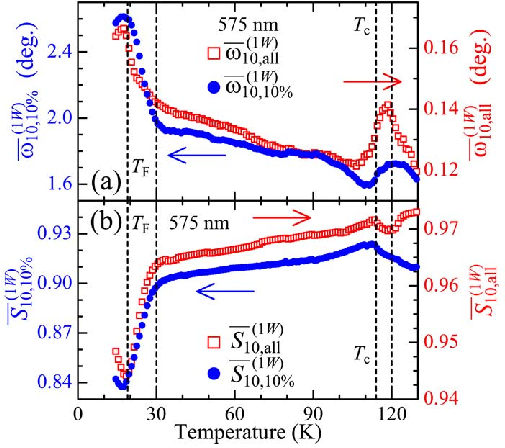
Figure 2: Temperature dependences for RP23 of (a) the holonomy angle RP24 and (b) the axis-alignment order parameter RP25 for all pixels and the upper 10% subset, revealing anomalies at RP26 and RP27.
Synthetic data tests reinforce the distinction between gradient and holonomy metrics. Integrable, smooth director fields present finite grad but zero holonomy. Domain walls and vortex-like defects (topological or geometric incompatibilities) yield locally intense, spatially confined holonomy peaks exactly where the closed-loop transport detects incompatibility.
Axis-alignment Structure and Cooling-induced Reorganization
The spatial organization of the holonomy rotation axes is probed using the maximum eigenvalue of the axis alignment tensor, yielding an order parameter RP28 that quantifies axis alignment. The high-holonomy (top 10%) regions universally show reduced axis alignment compared to the full field, attesting to greater rotational disorder in these areas. Cooling through RP29 and ω0 produces a non-monotonic temperature dependence: axis disorder increases toward the transition, recovers partially in the ferroelectric regime, but fails to fully regain the high-ω1 alignment, consistent with the absence of a single-domain state.
The spatial map of the change in alignment order, ω2, between reference high-ω3 and lower-ω4 windows exposes marked reorganization during cooling. Above ω5, stripe-like features reflect underlying stress and strain inhomogeneity. Below ω6, the spatial structure shifts, reflecting the superposition of domain-related configurational reordering onto strain-driven inhomogeneity.
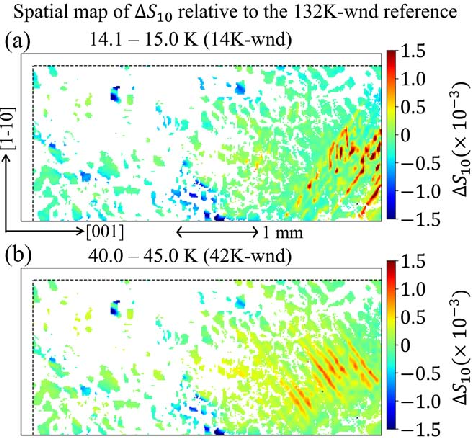
Figure 3: Maps of the change in the axis-alignment order parameter, ω7, for (a) 14K-wnd and (b) 42K-wnd, illustrating qualitative reorganization of axis order across and below the ferroelectric transition.
Systematic metrics for inter-window pattern reorganization (normalized RMSE, sign-flip rate, ω8, Pearson correlation) clearly outline three temperature regimes: substantial pattern evolution above ω9, a stable intermediate region, and reorganization at the ferroelectric transition. The composite RP20 peaks at RP21 and RP22, designating these as the primary loci for real-space electromechanical pattern reconfiguration.
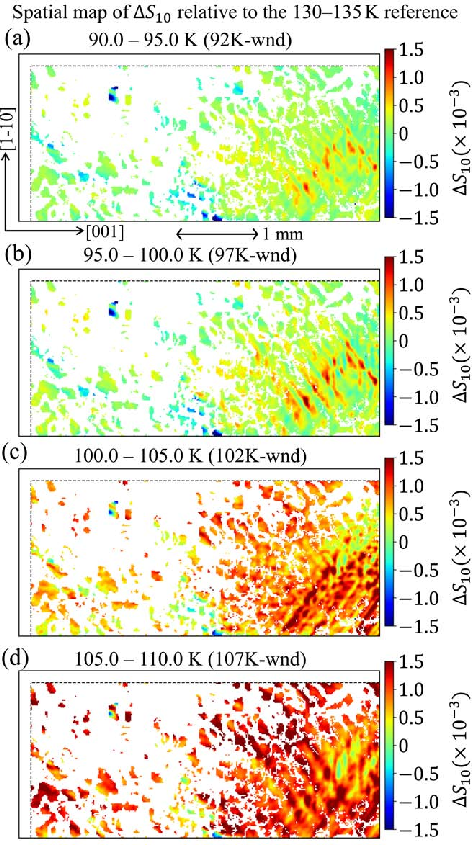
Figure 4: Temperature dependence of the RP23, quantifying the degree of real-space pattern reorganization of RP24 between adjacent temperature windows.
Implications and Future Directions
This work establishes holonomy as a robust geometric diagnostic of strain compatibility from birefringence-imaged director fields. Holonomy is strictly more discriminating than gradient magnitudes: it isolates path-dependent, loop-level incompatibility that could be associated with real, physical features such as inhomogeneous strain, flexoelectric effects, dislocations, or domain-wall arrangements. The analysis reveals both extended strain-related features and localized, domain-related rearrangements in the real-space texture associated with the electromechanical response across ferroelastic and ferroelectric transitions.
Practically, the approach admits straightforward extension to other ferroic systems and any real-space imaging context yielding director-like fields (e.g., nematic liquid crystals, domain engineering in oxides, patterned mesostructures). Unlike purely topological invariants, the holonomy angle described here is sensitive to geometric, non-topological incompatibility and can be applied in topologically trivial fields. This positions holonomy analysis as a general purpose, path-sensitive complement to local measures in orientational field imaging. A direction for development is deriving closer analytic connections between the holonomy of the optical director and the (in)compatibility tensors of elasticity theory.
Conclusion
Holonomy-based diagnostics extract loop-level (non-integrability) features from birefringence images of stress-induced ferroelectric SrTiORP25, enabling the identification of localized strain and electromechanical incompatibility not resolvable by gradient-based methods. The holonomy measure tracks reorganization of orientational structure across ferroelastic and ferroelectric transitions, mapping directly to spatial domains of strain and domain evolution. This work provides not only a geometric tool for analyzing director fields but also a substrate for future studies into the interplay of topology, elasticity, and electromechanics in complex ferroic materials.