- The paper establishes a statistically consistent LₕX–Lₙᵥ correlation across obscured AGN and blazar populations using Bayesian regression.
- It employs NuSTAR X-ray data and IceCube neutrino excess measures to derive empirical scaling factors and perform posterior-predictive tests.
- The study supports a photohadronic scenario where compact AGN regions serve as neutrino sources, while addressing sample size and systematic limitations.
Correlation Between X-Ray and Cosmic Neutrino Sources: From Obscured AGN to Blazars
Introduction and Motivation
The persistent tension in multi-messenger astrophysics concerning the origin of high-energy astrophysical neutrinos, particularly those observed by IceCube, motivates rigorous cross-correlation studies with photon emission in other energy regimes. While blazars, due to their relativistic jets, were previously prime candidates, recent neutrino associations with non-blazar active galactic nuclei (AGN) necessitate a re-examination of generic AGN environments as neutrino sources. This work investigates whether hard X-ray emission, as a tracer of compact photon-rich regions near the supermassive black hole (SMBH), is consistently correlated with neutrino luminosity across obscured AGN and blazar populations.
Methodology
Sample Construction and Spectral Analysis
The analysis builds on the LhX--Lν relation identified in six AGN with the highest IceCube significances, incorporating heavily obscured Seyfert galaxies and blazars. The central experiment investigates seven blazars with NuSTAR X-ray coverage and threshold-near IceCube excesses (i.e., n^s>0, typically local pre-trial significance $1$--2σ).
NuSTAR archival data were reduced and analyzed uniformly. The photon indices for the sample were in the range Γ∼1.4–2.4, with the 15--55 keV hard X-ray fluxes corrected for Galactic absorption. For blazars, the extinction correction is minor, in contrast to the heavily absorbed Seyfert calibration set. Luminosity distances employ a concordance ΛCDM cosmology, and X-ray and neutrino luminosities incorporate appropriate K-corrections.
Neutrino Luminosity Attribution
Muon neutrino and antineutrino fluxes are computed starting from IceCube’s reported best-fit n^s and γ^ν. An empirical scaling factor for log-space uncertainty compensates for the lack of public full likelihood profiles for the blazar sample, allowing consistent regression analysis across sources. This reduction is crucial for correctly quantifying predictive and observed correlations.
Posterior-Predictive and Null Consistency Analysis
A Bayesian regression (linmix implementation) with measurement errors on both axes is employed, calibrating the Lν0--Lν1 scaling on the high-significance AGN benchmark set. The posterior-predictive distribution for neutrino luminosity is then compared against the observed values in the test blazar set, assessing statistical consistency.
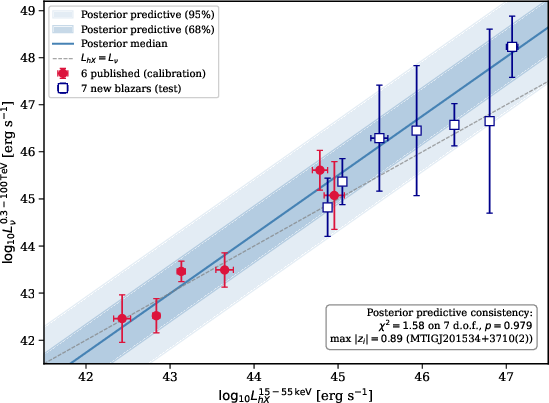
Figure 1: Posterior-predictive consistency test for the Lν2--Lν3 relation, with all seven new blazars lying within the 95% credible band defined by the calibration sample.
A null-injection test, using background-only Poisson realizations for Lν4, ascertains whether the observed consistency could arise from statistical background fluctuations in the IceCube data.
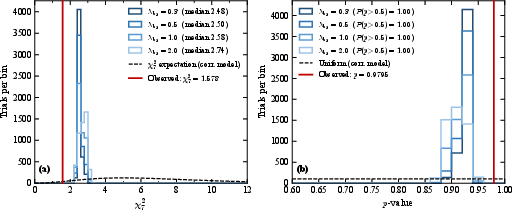
Figure 2: Null calibration of the posterior-predictive consistency test demonstrates that both genuine signal and selected background manifest similar low Lν5 values under current calibration uncertainties.
Distance-Free and Permutation Diagnostics
A source-frame, distance-free diagnostic based on Lν6 cancels the cosmological distance factor, isolating physical correlations independent of sample redshift distribution.
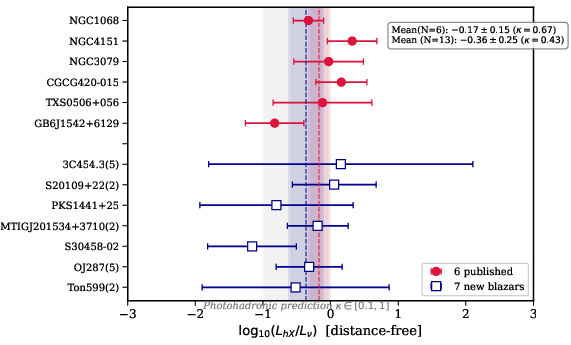
Figure 3: Distance-free Lν7 diagnostic shows both Seyfert and blazar populations clustering within the photohadronic band (Lν8).
A flux-space permutation test shuffles neutrino fluxes among the 13-source sample, recalculating Lν9 at the sources’ true redshifts, preserving distance bias but scrambling physical association. This assesses the observed correlation’s strength relative to a physically plausible null.
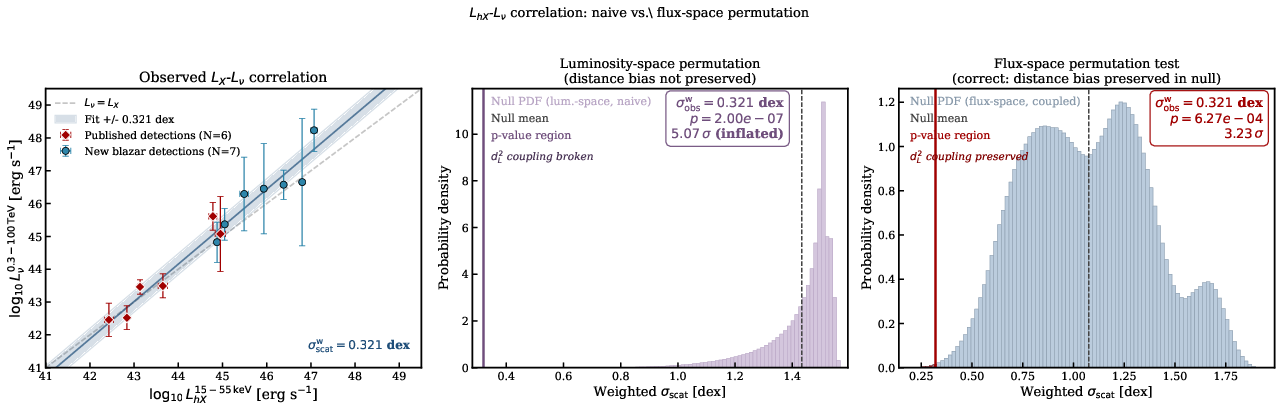
Figure 4: Flux-space permutation test reveals the observed sample is significantly more correlated than the randomized null, at n^s>00, even after controlling for distance biases.
Results
Numerical Outcomes
- The linmix-calibrated slope of the n^s>01–n^s>02 relation is n^s>03, fully consistent with a linear scaling (n^s>04) within n^s>05, and the intrinsic scatter remains sizable at n^s>06 dex.
- All seven new blazars are posterior-predictively consistent with the AGN population: no predictive n^s>07-score exceeds n^s>08, and the global n^s>09 ($1$0).
- Null calibration with background-only injections yields median null $1$1 between 2.5 and 2.7, with $1$2 always, indicating that the predictive band is not restrictive enough to exclude sophisticated background fluctuations.
- The distance-free diagnostic finds mean $1$3 values (hard X-ray to neutrino luminosity ratio) of 0.67 (calibration) and 0.43 (test), both within the photohadronic benchmark window; their difference of $1$4 is not statistically significant.
- The flux-space permutation test yields a weighted RMS scatter in the observed sample significantly below the null, with $1$5 ($1$6).
Physical Interpretation
Origin of the X-ray–Neutrino Correlation
This analysis supports the hypothesis that compact, photon-rich regions in AGN (hot corona and immediate surroundings) provide the target photon bath for $1$7 interactions, with the resultant pionic cascade X-rays and neutrinos depositing energy quasi-calorimetrically. The predicted relationship $1$8 with $1$9–1 is consistent with the observed values for both standard and jet-dominated AGN.
Implications for Emission Sites and AGN Unification
Both blazar and Seyfert populations exhibit similar correlations and X-ray/neutrino ratios, consistent with a model where the coronal environment, not the extended relativistic jet, is the dominant neutrino production site. The invariance of the intrinsic ratio under relativistic Doppler boosting further supports the universality of the 2σ0–2σ1 link.
Statistical Power and Caveats
There is insufficient statistical power with the current calibration sample to unambiguously identify low-level signals over selection-biased background, as confirmed by the null permutation and injected background tests. The regime with the strongest discriminating power is among sources with larger 2σ2, as those with marginal excesses have uncertainties too large to inform the consistency checks meaningfully. Distance, selection, and non-simultaneity systematics are addressed and found to play secondary roles at current sensitivity levels.
Multi-wavelength Context
The detailed Fermi-LAT (0.1--100 GeV) and NuSTAR (15--55 keV) light curves for several blazars illustrate the time dependence and multi-band correspondence of high-energy activity.
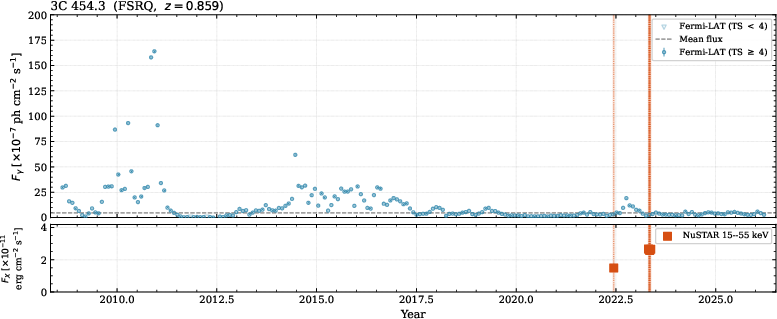
Figure 5: Monthly Fermi-LAT and NuSTAR light curves for 3C~454.3 illustrate photon variability around the NuSTAR observation epochs.
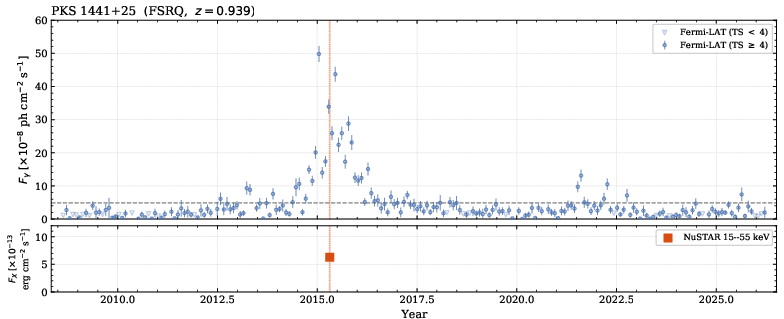
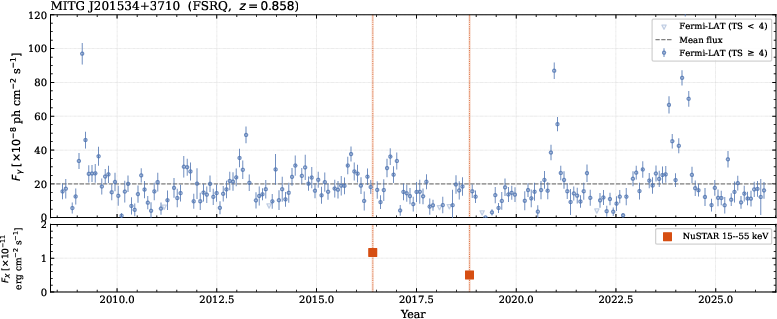
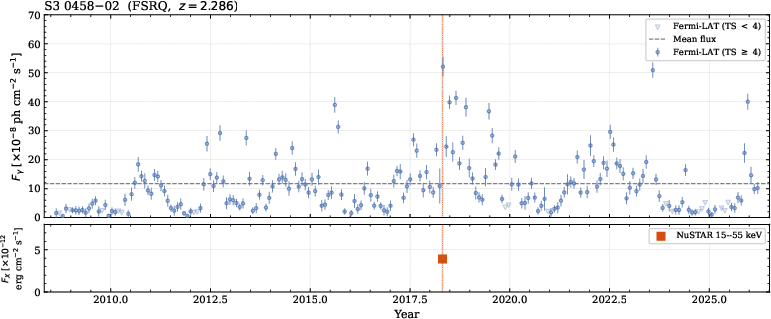
Figure 6: Representative multi-epoch light curves for three further blazars display coordinated hardness and flux variability.
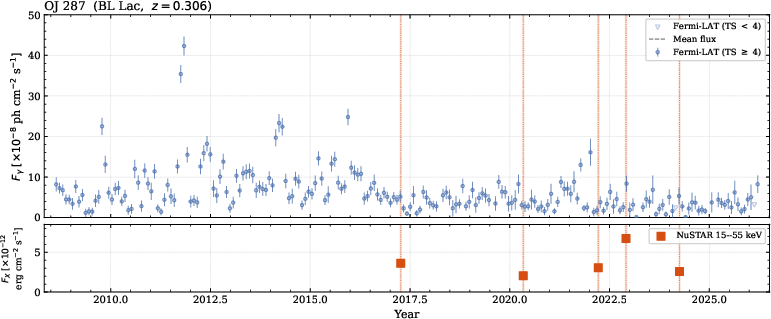
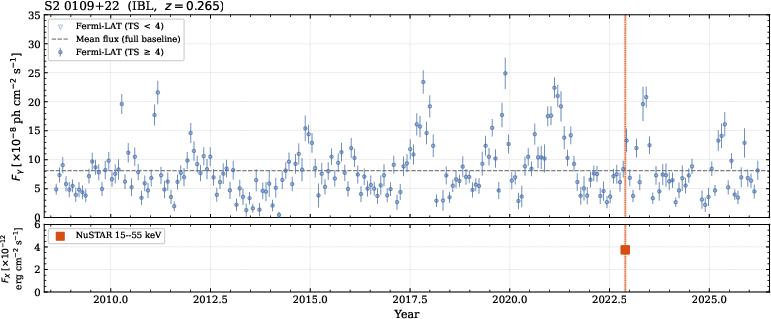
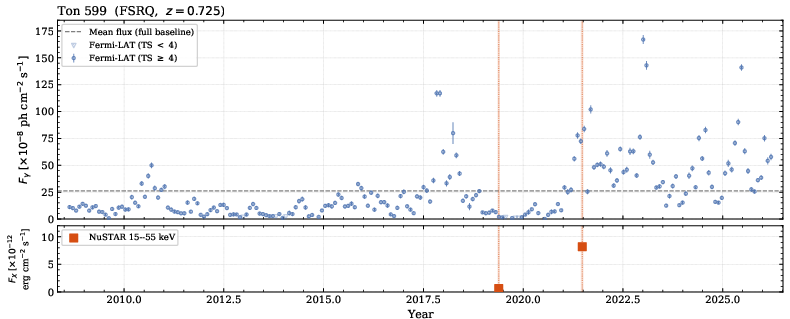
Figure 7: Light curves for OJ~287, S2~0109+22, and Ton~599 highlight temporal flux variations contextualizing IceCube exposures.
Conclusion
The study provides a formal, quantitatively robust test of the 2σ3–2σ4 correlation for threshold-near IceCube excesses in blazars, extending the photohadronic paradigm from obscured AGN to the Doppler-boosted population. While all observed blazars are fully consistent with extension of the relation established in high-significance AGN, the current calibration sample size and systematic error structure do not permit discrimination between signal and statistical background in IceCube data alone. Distance-free diagnostics and controlled permutation analyses further support an intrinsic, physically plausible correlation expected from compact AGN regions. Achieving detection-level power will require an expanded calibration sample, improved event-level neutrino likelihood availability, epoch-matched X-ray monitoring, and rigorous, model-weighted stacking analyses.
Future developments should prioritize (i) increasing the AGN calibration set size, (ii) coordinated multi-messenger observations for temporal correlation studies, and (iii) integrating event-level data and stacking analyses to enable decisive background rejection. These operational improvements will sharpen the capacity to utilize hard X-ray emission as a predictor or tracer for high-energy cosmic neutrino sources (2605.15360).