- The paper introduces VQSOP that leverages Sparse-Aware Vector Quantization to reduce communication by up to 82× while preserving key semantic details.
- It combines a dual-branch Adaptive Spatial Refinement module that fuses local and contextual features to enhance voxel accuracy and geometric precision.
- Experimental results show improved mIoU and BEV segmentation, establishing a scalable approach for collaborative autonomous perception.
Bandwidth-Efficient Collaborative 3D Semantic Occupancy via Sparse-Aware Vector Quantization
Introduction
3D semantic occupancy prediction has emerged as a critical capability for autonomous driving systems, enabling comprehensive scene understanding through per-voxel semantic labeling within an agent’s spatial environment. While collaborative perception utilizing Vehicle-to-Everything (V2X) communications offers substantial gains by sharing environmental observations between connected agents, it faces a stringent perception-communication trade-off, especially for high-dimensional 3D volumetric data. Existing approaches either induce geometric information loss by heavily compressing these features or maintain fidelity at the cost of prohibitive communication bandwidth requirements. The paper "Sparse-Aware Vector Quantization for Bandwidth-Efficient Collaborative 3D Semantic Occupancy Prediction" (2607.01928) proposes a novel solution—Vector Quantization Semantic Occupancy Prediction (VQSOP)—that combines a Sparse-Aware Vector Quantization (SAVQ) mechanism with a dual-branch Adaptive Spatial Refinement (ASR) module to simultaneously maximize performance and minimize communication overhead.
Methodology
Overview of the VQSOP Framework
The VQSOP framework consists of three main stages: (1) robust extraction of dense 3D spatial features from multi-view images, (2) bandwidth-efficient compression via SAVQ, and (3) message decompression and collaborative fusion followed by rigorous spatial refinement through the ASR module. The complete data flow and subsystem interactions are illustrated in (Figure 1).
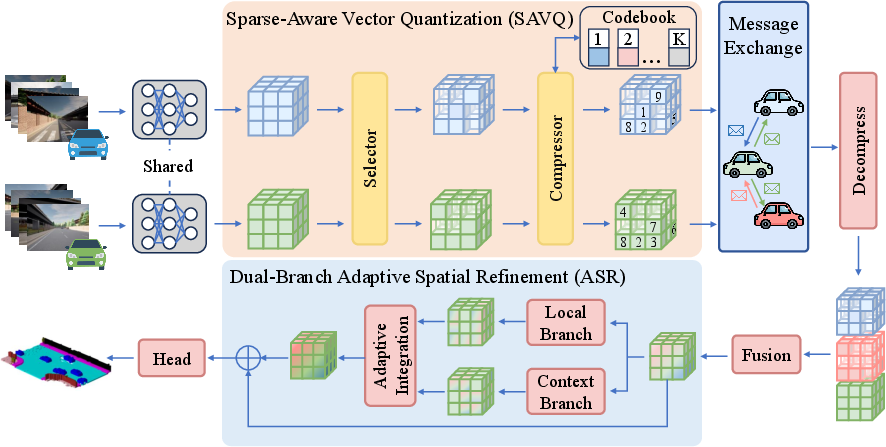
Figure 1: The VQSOP pipeline with SAVQ-based compression, message reconstruction and collaborative fusion, and ASR-based spatial refinement for semantic occupancy prediction.
Sparse-Aware Vector Quantization (SAVQ)
SAVQ exploits the inherent spatial sparsity of driving scenes: only a small subset of voxels contain informative semantic and geometric structure. A confidence-based selector retains only these relevant regions, which are then compressed via a codebook-quantization mechanism. Instead of transmitting full floating-point feature vectors, each salient voxel is represented by a compact discrete index referencing a learned codebook. This yields massive bandwidth savings—as low as 0.013 MB per agent, an up to 82× reduction compared to dense feature transmission—without discarding essential environmental information.
This approach is fundamentally different from prior paradigms such as transmitting orthogonal plane features (prone to spatial misalignment and major information loss) or 3D Gaussian parameterizations (where performance degrades rapidly with reduced transmission budget). The compactness and semantic fidelity of VQSOP’s code index messages are clearly contrasted in (Figure 2).
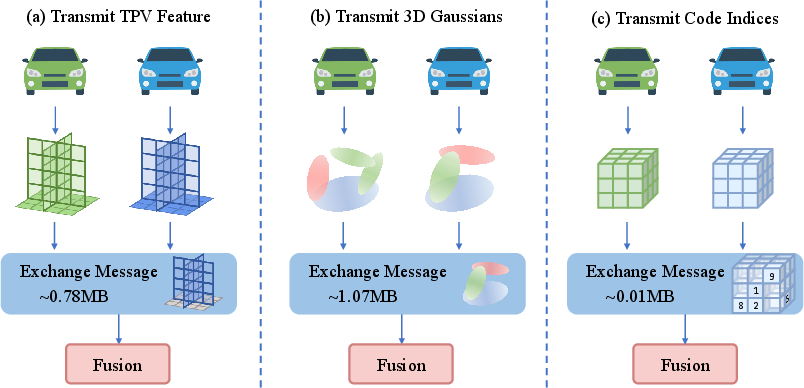
Figure 2: Comparison of feature sharing. (a) TPV: geometric detail loss; (b) 3D Gaussians: tight performance-bandwidth coupling; (c) VQSOP: compact, information-preserving discrete codes.
Dual-Branch Adaptive Spatial Refinement (ASR)
Collaborative aggregation can blur crucial geometric boundaries and fail to model long-range semantics. The ASR module addresses this by a dual-pathway design: a local branch employs standard 3D convolutions for fine detail preservation, while a context branch uses dilated convolutions to aggregate scene-level context. These features are combined at each spatial location via a learned, spatially-adaptive weighting, maximizing voxel-wise structural fidelity and semantic consistency.
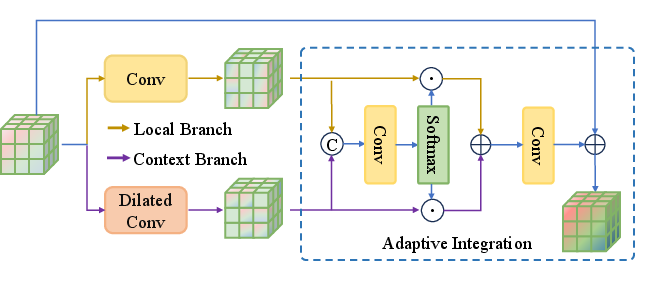
Figure 3: ASR module with independent local and context branches, each aggregated per-voxel with adaptive weights.
Experimental Results
Quantitative Results
VQSOP achieves new SOTA on the Semantic-OPV2V benchmark. In single-agent settings, it outperforms the best prior method by 4.41 points in mIoU. Under collaborative perception, the gains are even more pronounced, with 4.10 mIoU and 0.92 IoU improvements over prior art despite using orders-of-magnitude less communication bandwidth (see Method section, Table 1 in the paper). The model excels particularly at challenging, small, or thin classes (e.g., 21.70 IoU gain on guard rails, 17.02 IoU on bridges over previous best), due to the ASR’s refinement properties.
BEV segmentation (2D IoU) performance is also consistently superior under all collaborative agent counts, attesting to robust voxel-to-plane mapping and structural preservation.
Communication Volume
A central claim, robustly substantiated by ablations, is that communication efficiency is entirely decoupled from perception effectiveness in VQSOP. Prior 3D Gaussian methods suffer linear performance degradation as bandwidth is reduced, whereas SAVQ enables minimal transmission volumes without accuracy loss.
Ablation Studies
Component-wise ablations show that SAVQ independently provides a 562× compression ratio with only minimal loss, while the ASR module adds a critical 1.15 points to mIoU by enhancing geometric and semantic details. Only their combination yields both maximum efficiency and accuracy.
Varying the SAVQ selector’s confidence threshold demonstrates the trade-off between communication cost and accuracy, with an optimal regime identified at τ=0.8.
Qualitative Visualization
Qualitative comparisons highlight the ability of VQSOP with ASR to recover fine geometric structure, maintain boundary sharpness, and mitigate typical hole artifacts seen in baseline models.
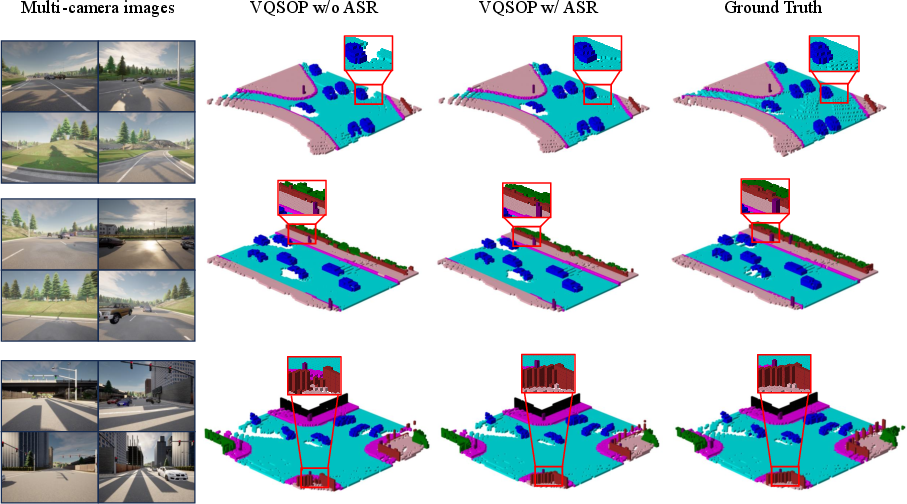
Figure 4: Column-wise input, naive model, full VQSOP output, and ground truth. VQSOP + ASR recovers fine boundary detail and object completeness.
Implications and Future Directions
VQSOP establishes a new operational regime for collaborative 3D scene understanding: high-fidelity semantic occupancy with drastically reduced communication demands, directly addressing the bottleneck for real-world deployment in autonomous vehicles. Theoretically, this decoupling between information gain and bandwidth cost opens opportunities for scaling cooperative perception to larger fleets and more complex scenes, potentially generalizing to other volumetric or high-dimensional communication-constrained scenarios.
Practical extensions include dynamic bandwidth adaptation per agent or scenario, joint learning with downstream planning/control stacks, and adapting the SAVQ codebook for unsupervised or domain-adaptive settings. The modular nature of VQSOP’s SAVQ/ASR stack also enables integration with future sensor/camera/LiDAR fusion backbones and offers a substrate for research into optimal graph-topology-aware information sharing.
Conclusion
VQSOP demonstrates that highly-efficient, information-preserving, collaborative 3D semantic occupancy prediction is feasible through sparse-aware vector quantization and adaptive dual-branch refinement. The methodology achieves both performance and communication efficiency unattainable with previous paradigms. This work advances collaborative perception towards practical, scalable deployment and motivates further study in codebook-based scene communication and joint perception-compression architectures for multi-agent autonomous systems.