- The paper introduces a fully sparse, query-centric framework that removes reliance on dense BEV grids for cooperative 3D perception.
- It employs geometry-guided query generation and transformer-based context-aware association to robustly detect and track objects even under significant localization noise.
- Experimental results demonstrate state-of-the-art performance, achieving over 3.6x improvement in detection at long ranges compared to prior approaches.
Long-SCOPE: A Fully Sparse Approach for Long-Range Cooperative 3D Perception
Introduction and Motivation
Cooperative 3D perception leverages the Vehicle-to-Everything (V2X) paradigm to address the inherent limitations of single-agent perception, particularly sensor field-of-view (FoV) constraints, occlusion resolution, and sensitivity to long-range targets. However, real-world deployment of cooperative perception is impeded by two core bottlenecks: the quadratic computational and communication cost scaling of dense Bird’s-Eye-View (BEV) representations and the fragility of association mechanisms confronted by observation imprecision and localization noise at extreme distances.
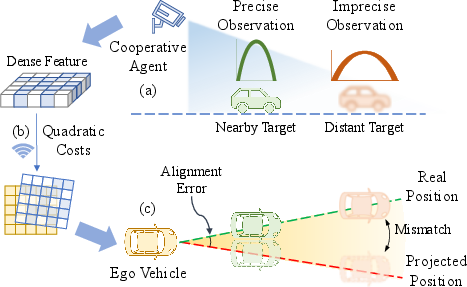
Figure 1: Core challenges in long-range cooperation: (a) observation imprecision for distant targets, (b) quadratic scaling costs of dense features, and (c) positional mismatch from alignment errors.
Existing solutions attempting to exploit sparse object-level communication typically still inherit BEV-based quadratic computation bottlenecks at the backbone stage. Furthermore, alignment errors and significant inter-agent localization noise undermine the reliability of simple fusion heuristics and pairwise matching, often resulting in degraded detection range and duplicate or missing object estimates.
Methodology: Long-SCOPE Architecture
Long-SCOPE introduces a fully sparse, query-centric cooperative perception framework that eliminates dependence on BEV grids at all stages. The architecture comprises two pivotal innovations: a Geometry-guided Query Generation (GQG) module and a Context-Aware Association (CAA) mechanism.
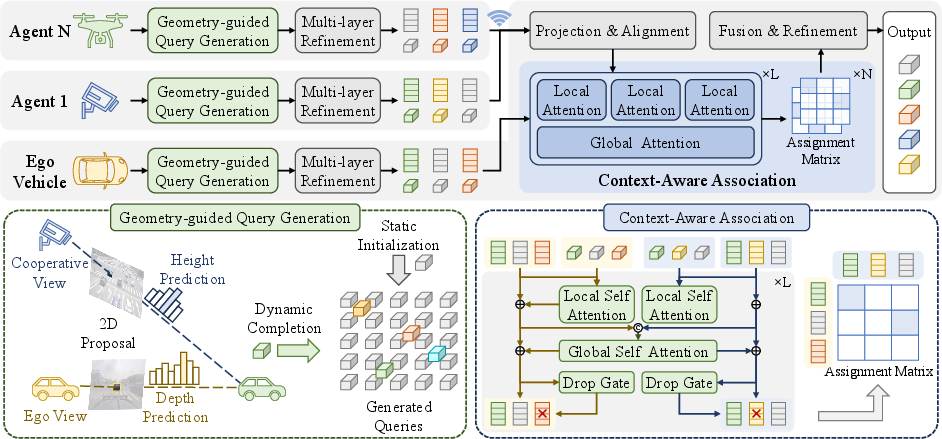
Figure 2: Overview of Long-SCOPE framework, highlighting the Geometry-guided Query Generation and the Context-Aware Association modules.
Geometry-Guided Query Generation (GQG):
Static query anchoring fails to adequately cover the non-uniform spatial distribution of distant, small objects, especially for high-vantage infrastructure or aerial agents. The GQG module introduces dynamic query proposal, leveraging lightweight monocular 2D detection and geometric priors for well-conditioned depth and global height estimation. For high-vantage agents, this estimation is reformulated as a height prediction problem, reducing ambiguity, while near-ground agents (e.g., vehicles) employ direct depth regression. These dynamically generated proposals are merged with static anchors, feeding a transformer-based decoder to obtain refined object states and descriptors.
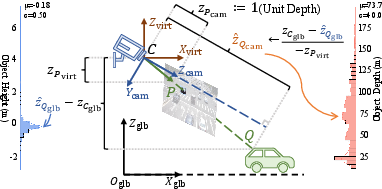
Figure 3: Depth derivation for high-vantage agents using stable global height statistics for improved 2D-to-3D localization.
Context-Aware Association (CAA):
Traditional query association utilizes fixed radius thresholds or Hungarian matching, both of which are fragile under severe positional noise and cannot scale to multi-agent settings or handle asymmetric ROI intersection (e.g., ego-invisible or missed targets). The CAA module employs multi-layer transformer attention for robust and scalable multi-way matching, with intra-agent self-attention encoding stable local spatial context and global, positional-invariant cross-agent attention enabling semantic and contextual query refinement. Assignment is performed via Sinkhorn-normalized affinity matrices with per-query matchability scoring, ensuring unmatched queries (indicative of unique information) are retained.
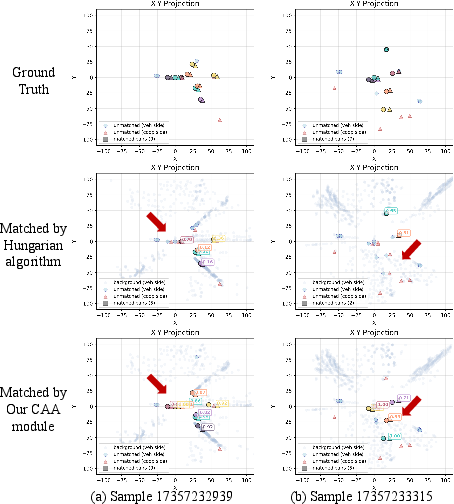
Figure 4: Qualitative performance under severe localization noise. CAA (bottom) surpasses the Hungarian algorithm (middle) by resolving ambiguous matches robustly using spatial neighborhood context and semantic similarity.
Experimental Results
Comprehensive empirical evaluation on V2X-Seq and Griffin-25m benchmarks demonstrates that Long-SCOPE achieves state-of-the-art (SOTA) detection and tracking performance under stretched distance regimes to 100–150 m, while maintaining practical inference time and communication cost budgets.
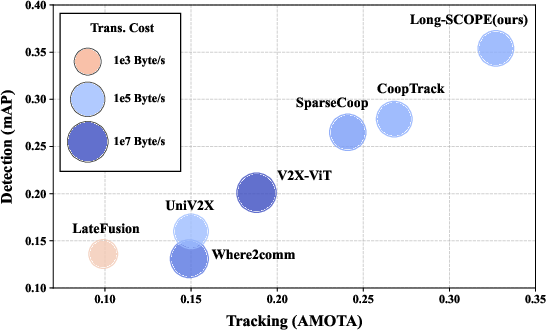
Figure 5: Performance comparison on Griffin-25m dataset. Communication efficiency correlates with improved perception metrics in Long-SCOPE.
On Griffin-25m, Long-SCOPE outperforms prior dense and sparse methods by substantial margins: e.g., achieving 0.354 AP overall, 8.9 points higher than the prior fully sparse baseline (SparseCoop). In the extended 50–100 m range, both tracking (AMOTA) and detection remain reliable, with alternatives collapsing precipitously.
In V2X-Seq evaluations, the gap widens further for 100–150 m, with Long-SCOPE maintaining 0.113 AP—more than 3.6x above competing sparse object query approaches—whereas dense BEV-based methods suffer from prohibitive computation and communication costs.
Robustness to Localization Noise
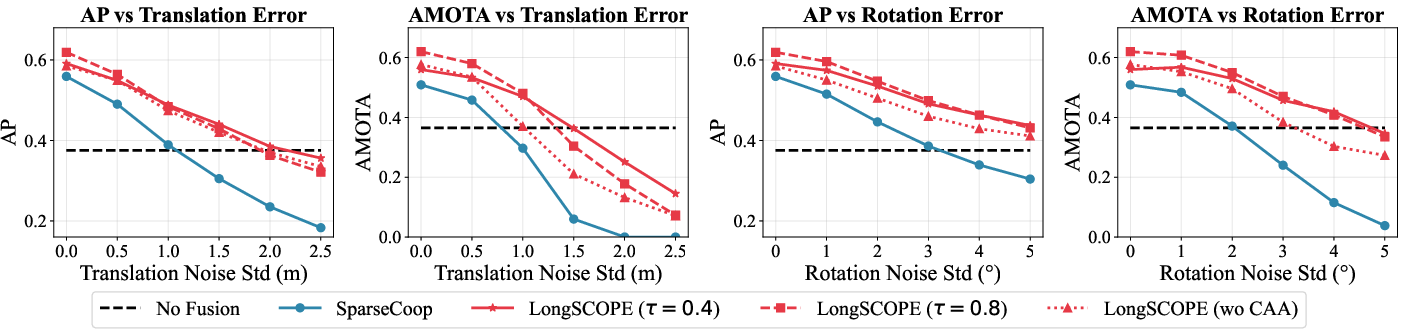
Real deployment scenarios exhibit nontrivial calibration errors and GPS/INS errors. Evaluation under synthetic translation and rotation perturbations confirms the CAA module’s efficacy:
Ablation: Analysis of Core Modules
Ablation results indicate the criticality of each proposed module:
- Removing CAA leads to a sharp performance collapse for detection and tracking beyond 50 m, confirming that heuristic matching is the critical prior failure mode.
- Excluding GQG degrades initial detection, especially for distant targets, due to the inability of static queries to adapt to scene geometry.
Implications and Future Directions
The study establishes that end-to-end sparsification, combined with context-driven query association, is not only computationally and communicatively efficient but also robust to real-world noise. As autonomous driving and intelligent transportation increasingly incorporate low-cost, wide-area visual sensors (e.g., infrastructure cameras, drones), frameworks such as Long-SCOPE provide a realistic path for deploying large-scale, long-range, multi-agent perception.
Future directions should focus on integrating multi-modal sensory cues (e.g., radar, LiDAR, event cameras) into the fully sparse paradigm, further bridging sim-to-real transfer, and dynamic agent coalition formation under communication constraints. Additionally, extending context-aware association to account for multi-object interactions and dynamic cooperative topologies represents a promising field for robust 3D world modeling at city scale.
Conclusion
Long-SCOPE defines a new class of fully sparse, contextually robust, long-range cooperative 3D perception frameworks. By eliminating dense BEV representations and heuristic association in favor of geometry-guided query proposal and transformer-based multi-agent matching, the approach establishes strong SOTA performance at extreme ranges and under severe localization noise. These results and design principles have substantial implications for practical large-scale V2X deployment and advance the theoretical limits of multi-agent perception under cost and reliability constraints (2604.09206).