- The paper introduces regression accumulation, showing how later code suggestions break earlier requirements in iterative LLM programming.
- It presents a comprehensive benchmark using 26,016 instances across six LLMs to analyze degradation trends and failure modes such as cross-turn conflicts.
- The study proposes mitigation strategies, with a verification gate proving most effective in reducing regressions and preserving code functionality.
Regression Accumulation in Multi-Turn LLM Programming Conversations: An Expert Analysis
LLMs are increasingly integrated into iterative software development workflows. However, existing evaluations predominantly focus on single-turn prompt completion, failing to account for the multistep nature of real-world iterative development where requirements evolve across multiple conversation turns. This paper introduces the concept of regression accumulation: in multi-turn coding dialogues, later model-generated code suggestions frequently break requirements established in earlier turns, leading to decreased reliability over time.
Study Design
The authors present a comprehensive, reproducible benchmark and experimental protocol to directly quantify regression accumulation and analyze its underlying causes. The benchmark synthesizes 542 Python tasks from HumanEval+ and MBPP+, instantiating each as a fixed eight-turn evolution chain representing canonical maintenance actions (e.g., adding validation, input generalization, caching, interface refactoring, performance optimization).
Each model-generated code suggestion at turn t is evaluated not only against the current requirement but also via a regression oracle comprising the benchmark tests for all previous requirements. Collected artifacts include code suggestions, per-turn pass rates, and detailed failure diagnostics.
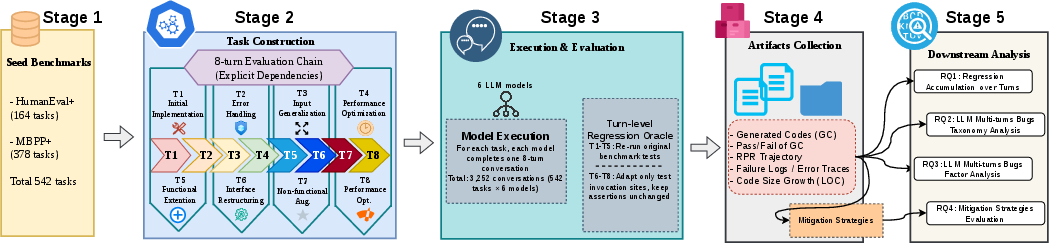
Figure 1: Overall study design and data flow: seed tasks are instantiated as 8-turn evolution chains, executed on each model, and evaluated against standardized test suites at every turn.
The experimental matrix comprises 26,016 turn instances (542×6×8) across six LLMs: GPT-4o, DeepSeek-V3, Qwen2.5-Coder-32B, Qwen3-32B, DS-R1-Distill-32B, and Llama-3.1-8B. This structure supports robust comparative analysis across model families, model scales, and code generation specializations.
Empirical Findings
Regression Accumulation Across Turns
Regression is ubiquitous across all models: by turn 8, 40–73% of tasks experience loss of previously correct behavior. Larger models (DeepSeek-V3, GPT-4o) are more resilient but not immune; open-source models, especially those with smaller parameter counts, deteriorate more rapidly in final-turn regression pass rate (RPR). Importantly, strong single-turn performance is not predictive of sustained performance in multi-turn settings—e.g., DeepSeek-V3 surpasses GPT-4o in final RPR despite initially trailing.
The most significant degradations arise following requirement changes that amplify cross-turn dependencies, such as error handling augmentation and input generalization. Once regression occurs, models seldom spontaneously recover, revealing a pronounced accumulation effect.
Failure Taxonomy and Bug Types
Manual annotation (four experts, κ=0.799) of 384 stratified failures yields a taxonomy centered on multi-turn failure modes. The dominant bug class is Cross-Turn Conflict (55.7%), with subtypes:
- Over-Guarding: Excessive validation invalidates previously legal inputs.
- Semantic Collision: New logic semantically contradicts prior correct logic.
Context-loss errors (e.g., forgetting earlier requirements) are present but account for a minority of failures (21.1%). Notably, accumulation-specific failures—such as Complexity Collapse (code truncation, syntax fragmentation due to excessive conversation state)—appear at non-trivial rates in long turn sequences.
Mitigation Strategies
Two interaction-level mitigation mechanisms are evaluated:
- Snowball Recap: Prepend deterministic summaries of all prior requirements to each prompt, curbing context drift.
- Verification Gate: After each turn, execute regression tests; if regression is detected, rollback to the last known-good state and retry the instruction.
Verification Gate is the only approach to consistently, substantially reduce regression accumulation across models. For DeepSeek-V3, it increased final-turn RPR from 75.8% to 87.9%, halving the proportion of tasks with regression. Snowball Recap yields marginal improvements, and combining both does not outperform the gate-only protocol. Lower-capacity models require more frequent intervention and nonetheless exhibit lower absolute quality.
Theoretical and Practical Implications
The study provides clear evidence that single-turn evaluation overestimates LLM reliability in iterative use cases. Reliability in LLM programming must be conceptualized as a preservation problem over an evolving sequence of interdependent requirements. Turn-local correctness is a necessary but not sufficient criterion; true robustness with LLM-assisted code generation emerges only when prior requirements are explicitly verified throughout the conversation.
For research: This work demonstrates the necessity of regression-aware metrics and evaluation protocols in multi-turn code generation studies. Prompt engineering targeting context retention is necessary, but not sufficient; architecture and training strategies must couple generation with explicit requirement preservation and verification mechanisms.
For tool development: Integration of verification gates—automated, test-driven rollbacks and retries after each conversational turn—should become standard in LLM-based programming assistants. This shifts interaction design from stateless prompt augmentation toward an acceptance test-driven loop, aligning more closely with human software engineering best practices (e.g., regression testing, code review, continuous integration).
For future models: Improving multi-turn resilience may require models explicitly designed for constrained code transformation over an evolving code base, not merely for compositional instruction following. Techniques such as fine-grained memory, architectural bias toward dependency tracking, or targeted reinforcement learning via regression-induced reward signals could be productive directions.
Limitations and Scope
The benchmark's strength lies in a controlled, reproducible setting (fixed 8-turn sequence, prompt templates, function-level Python tasks). This enhances validity for cross-model comparison but limits coverage of unbounded, contextually rich real-world maintenance scenarios and larger-scale codebases. Results are likely to understate, rather than overstate, the severity of regression in longer, less structured conversations.
Conclusion
This study establishes that regression accumulation is an intrinsic reliability challenge in multi-turn LLM programming conversations. Cross-turn conflicts, not mere context drift, are the leading source of multi-turn regression. Verification-aware intervention—specifically, an automated testing gate with rollback—is uniquely effective for mitigation. Progress in LLM code generation will depend on redesigning both evaluation protocols and assistance tools to prioritize requirement preservation, moving beyond the single-turn paradigm toward a continuous verification ethos.
Reference: "Regression Accumulation in Multi-Turn LLM Programming Conversations" (2607.01855)

