- The paper derives decentralized, network-state-dependent stability certificates using passivity and loop transformation methods for IBR-dominated grids.
- It rigorously links network stress metrics—such as phase angles and reactive mismatches—with admissible local controller gains, highlighting shrinking stability margins under stress.
- The approach underpins plug-and-play controller design via local certificate checks, offering a scalable framework for enhanced grid security.
Decentralized Stability Analysis in IBR-Dominated Grids: Network-State Dependence and Passivity-Based Certificates
Introduction
This paper addresses the pressing problem of small-signal instability in power grids with high penetrations of inverter-based resources (IBRs), particularly grid-forming (GFM) inverters. Such instability, often manifesting as unforced sub-synchronous oscillations (SSOs), poses significant challenges for power system security. Existing decentralized analytical techniques typically neglect how steady-state network stress — e.g., elevated reactive flows, large phase angles, or voltage drops — influence system stability margins. By explicitly constructing a decentralized passivity- and loop transformation-based framework, the authors reveal intrinsic couplings between network operating point and local IBR controller admissibility. This enables the derivation of decentralized stability certificates that are quantitatively sensitive to network state, in stark contrast to prevalent approaches that rely on restrictive steady-state assumptions.
Central to the formulation is the classic stability paradigm of feedback interconnections, as depicted in the canonical negative-feedback configuration between transfer matrices H1(s) and H2(s) Figure 1. The passivity theorem provides sufficient stability conditions, contingent upon passivity/strict passivity and small-gain requirements. When elements such as transmission lines are not passive — due, for example, to power flow–induced non-minimum phase phenomena — the loop transformation technique is employed to compensate for non-passive effects, thereby restoring conditions amenable to passivity-based analysis.
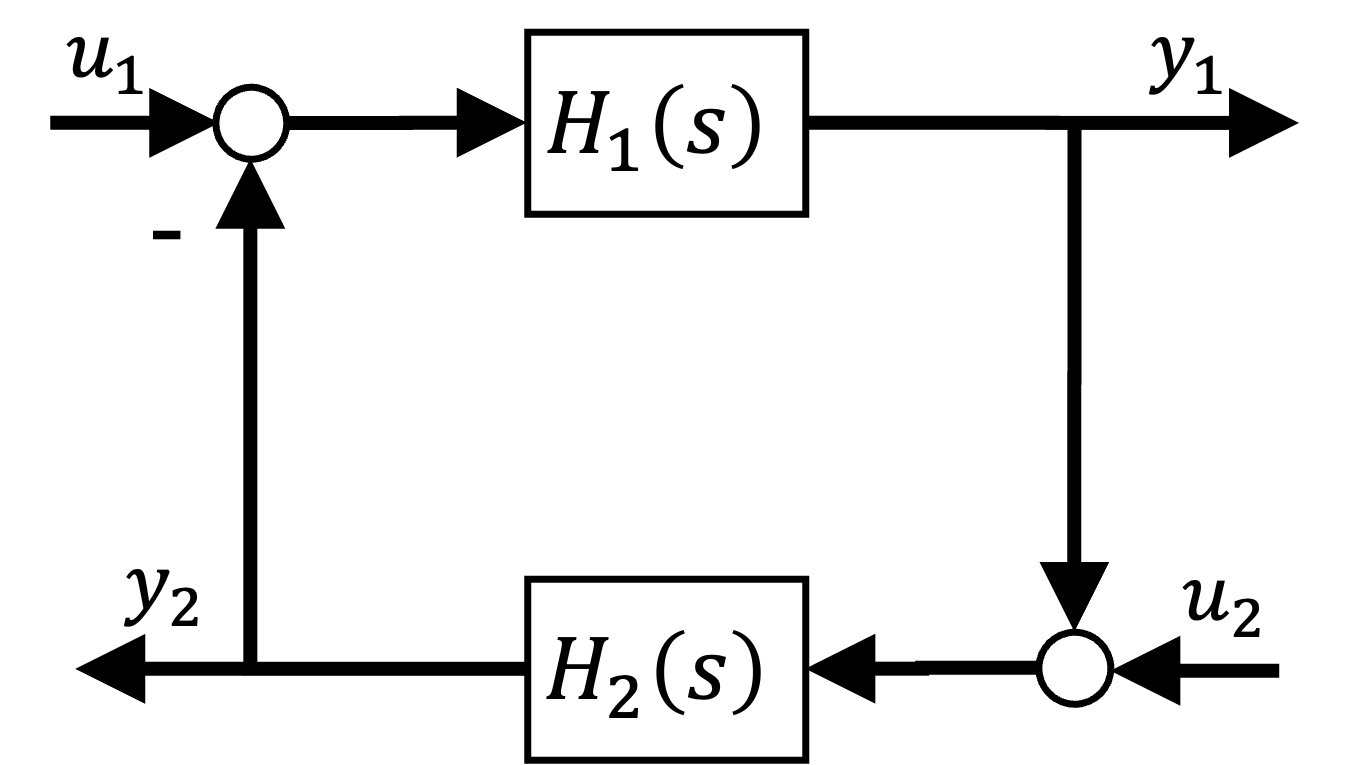
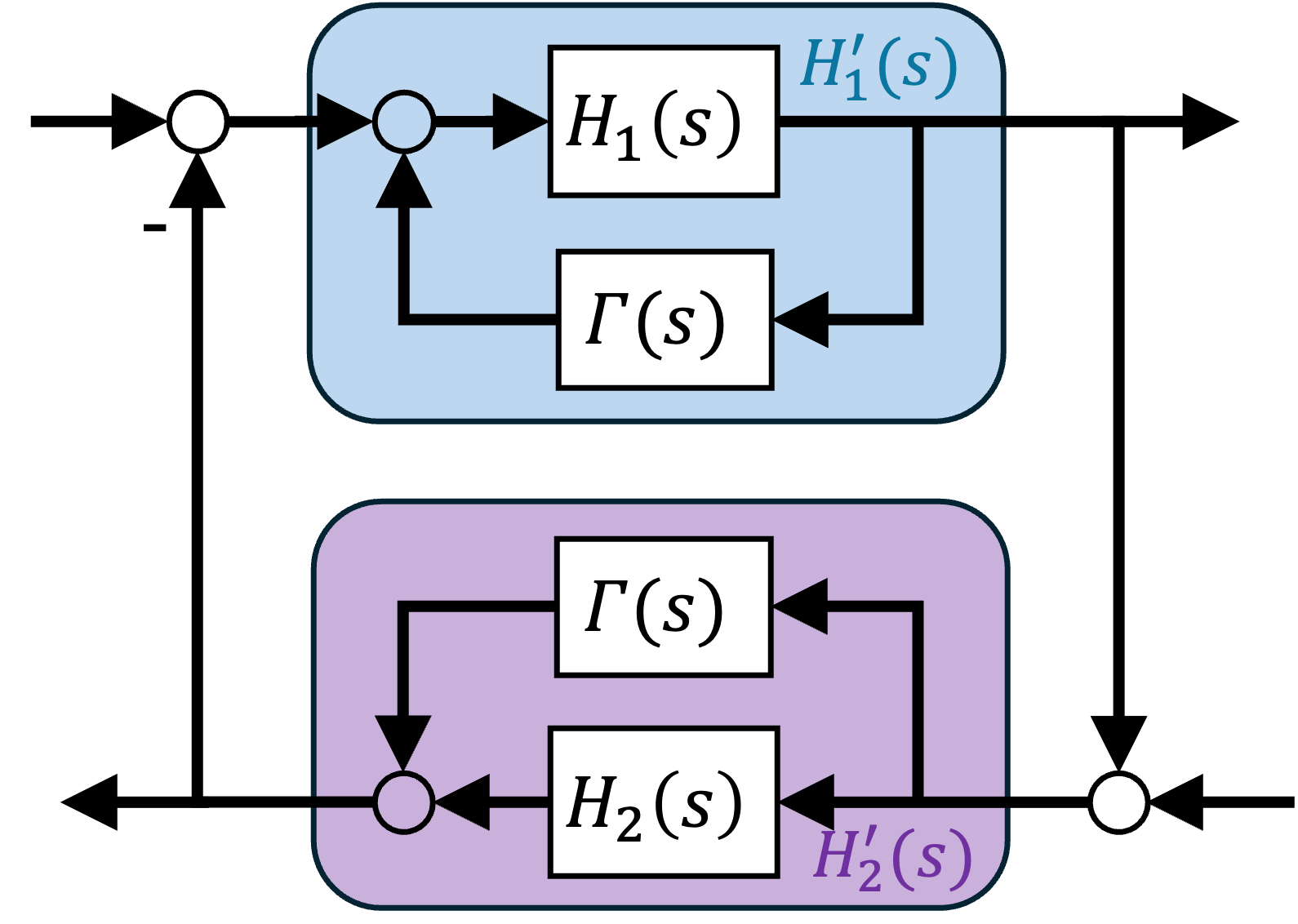
Figure 1: Negative feedback interconnection of H1(s) and H2(s).
Internal stability of such an interconnection is defined via the closed-loop pole placement of the full input–output transfer matrix. The rigorous use of loop transformations is justified through system-theoretic results (including precise handling of pole–zero cancellations on the imaginary axis), permitting changes in interconnection structure that preserve internal stability properties.
Network and Device Modeling
The analysis considers networks composed exclusively of GFM IBRs modeled via local active- and reactive-power droop control augmented with first-order lag dynamics. The linearized IBR device model couples incremental frequency/voltage dynamics to negative (feedback) active/reactive power signals with well-defined gain and time constants.
Transmission lines are modeled as quasi-stationary multi-port components, mapping deviations in bus phase and voltage to incremental real and reactive power flows. The linearized lossless AC interconnection leads to a global model in which system dynamics are decomposed into port-based device and network subsystems, interconnected via incidence matrix operators (M and M⊤) that formalize the mapping between nodal and line-end variables.
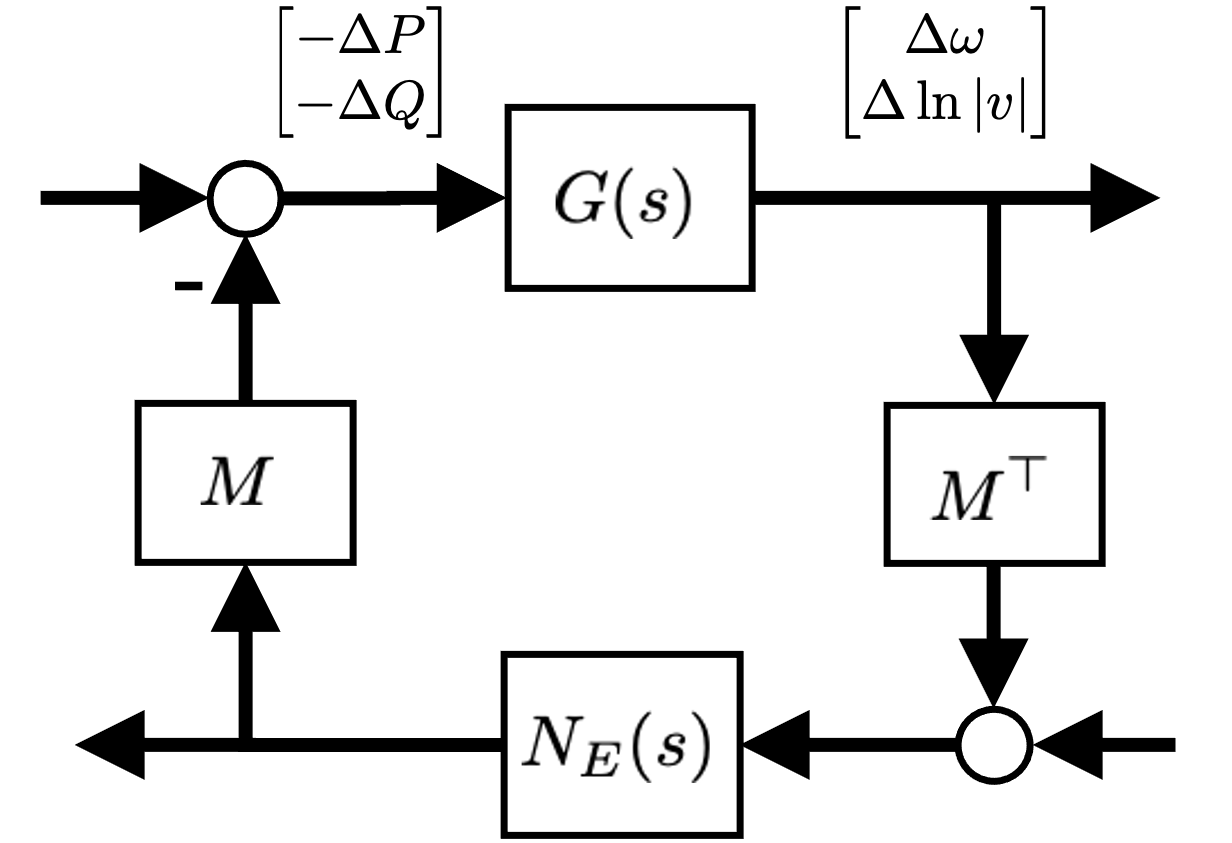
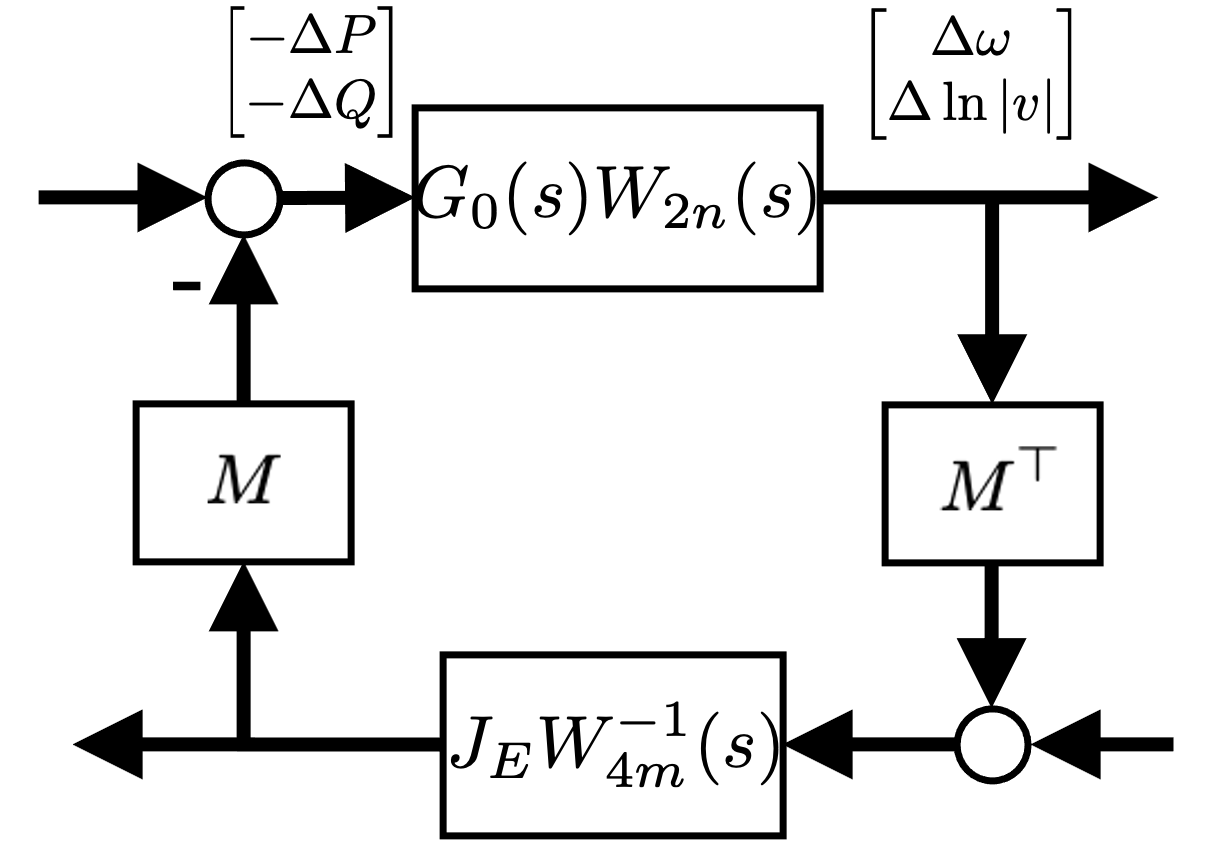
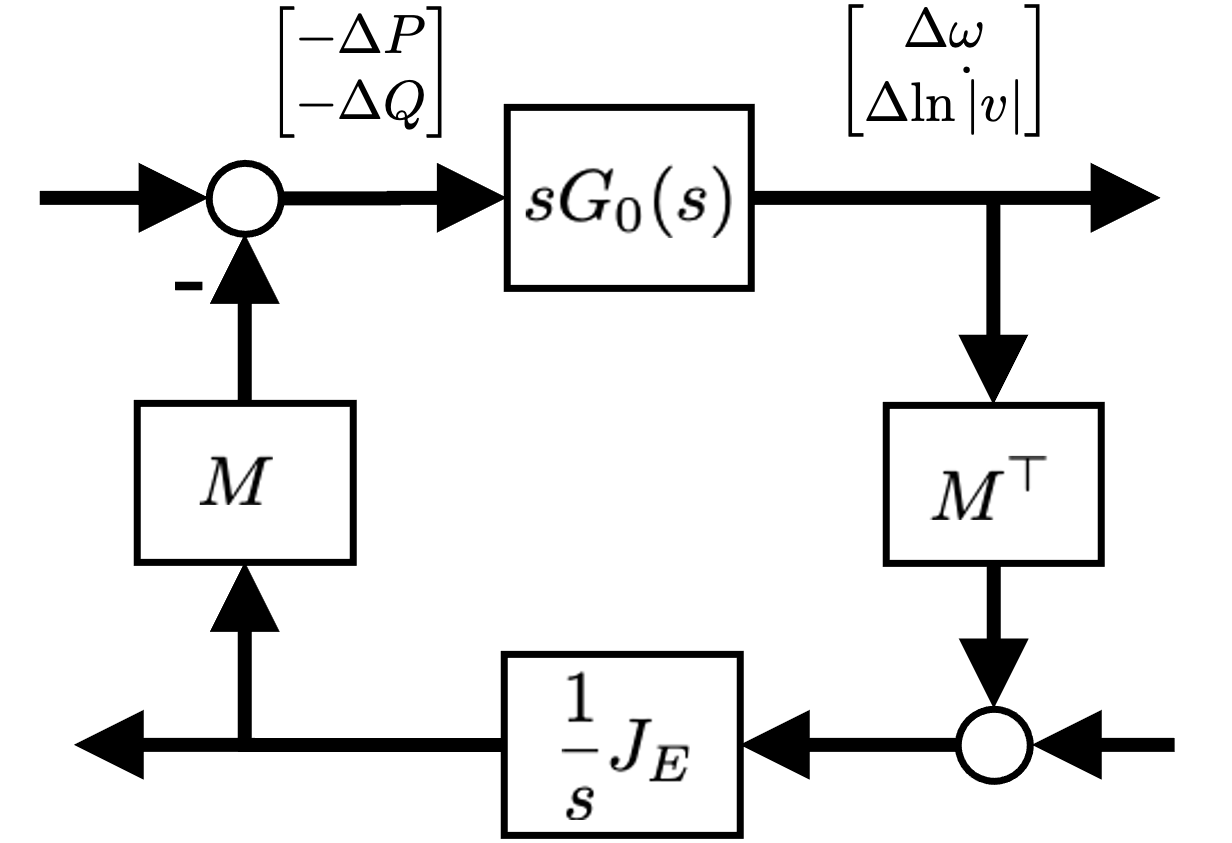
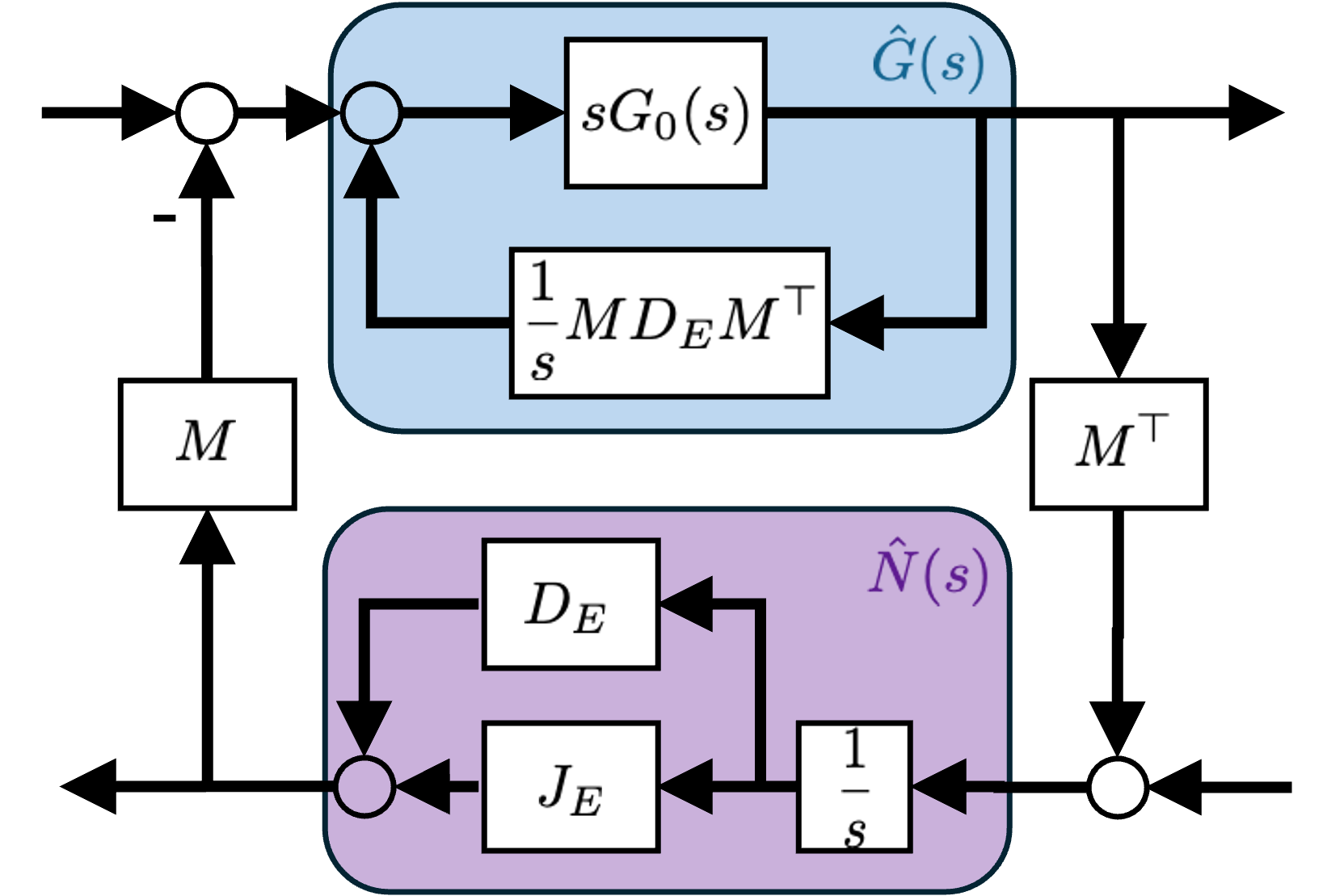
Figure 2: System G(s)#MNE(s), depicting the structured interconnection between IBRs and transmission lines via network incidence structure.
The explicit port-based representation (inspired by scalable analysis frameworks from prior work) enables a clear separation of local dissipation and network coupling effects, critical for the subsequent passivity-based analysis.
Decentralized Stability Certificate: Main Result
The primary contribution is a decentralized, explicitly network-state-dependent small-signal stability certificate for IBR-dominated grids. The certificate, formalized in Theorem 1, asserts that for each transmission line e={i,j}, there exists a line-specific parameter de (used for passivizing the line via loop shifting), such that a derived matrix inequality holds. This inequality encodes the effects of steady-state reactive power mismatches (Qij−Qji), line loading (via H2(s)0), voltage magnitudes, and controller voltage droop gains.
A crucial aspect is that as network stress increases (e.g., larger phase angle differences and reactive mismatches), the set of admissible (stabilizing) controller gains shrinks. Thus, the certificate's feasibility is directly and quantitatively linked to the instantaneous network state, unlike nominal-case or topology-agnostic analyses.
The proof, summarized in a systematic flow chart Figure 3, involves:
- Passivizing each system component (IBRs and lines) via loop transformation, resulting in strict passivity for devices and parametrized passivity for lines tied to H2(s)1 and network state;
- Block-diagonalization of the line Jacobian under new coordinates, allowing the derivation of explicit LMIs for passivity and thus stability in terms of local and network parameters;
- Careful handling of transfer function properties to ensure that internal stability is preserved and correctly characterized through the requisite loop transformation results.
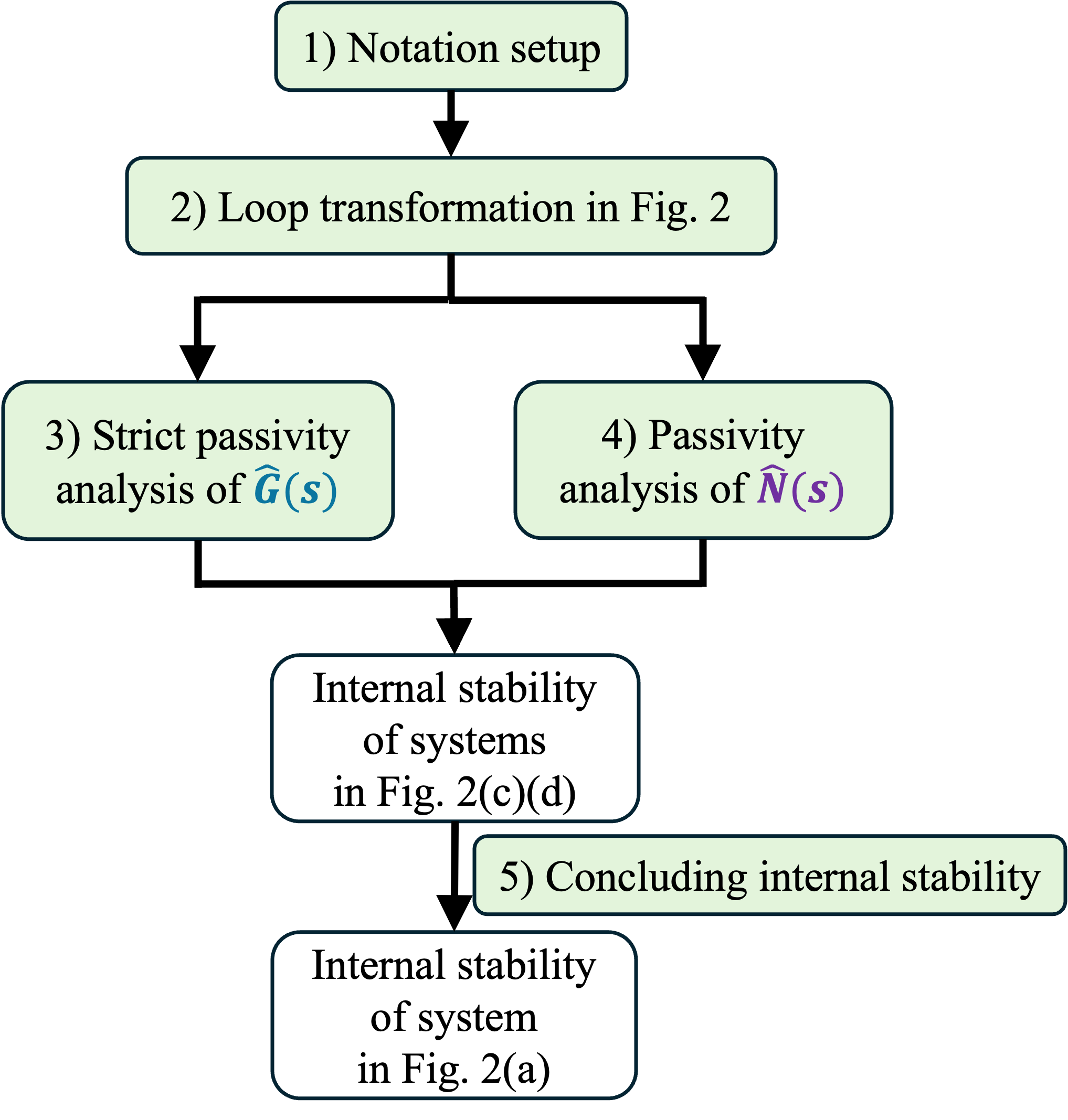
Figure 3: Flow chart summarizing the main steps of the proof of the decentralized stability certificate.
Network State Dependence: Quantitative Insights
The most salient analytical insight is the explicit demonstration that the network's steady-state -- particularly, line reactive mismatches and phase angle -- imposes hard limits on the stabilizing droop gain parameter space. As illustrated by level sets of H2(s)2 Figure 4, the maximum acceptable droop gain for each line is a monotonically decreasing function of the normalized reactive power disparity. The certificate thus rigorously quantifies the erosion of stability margin under increasing network stress.
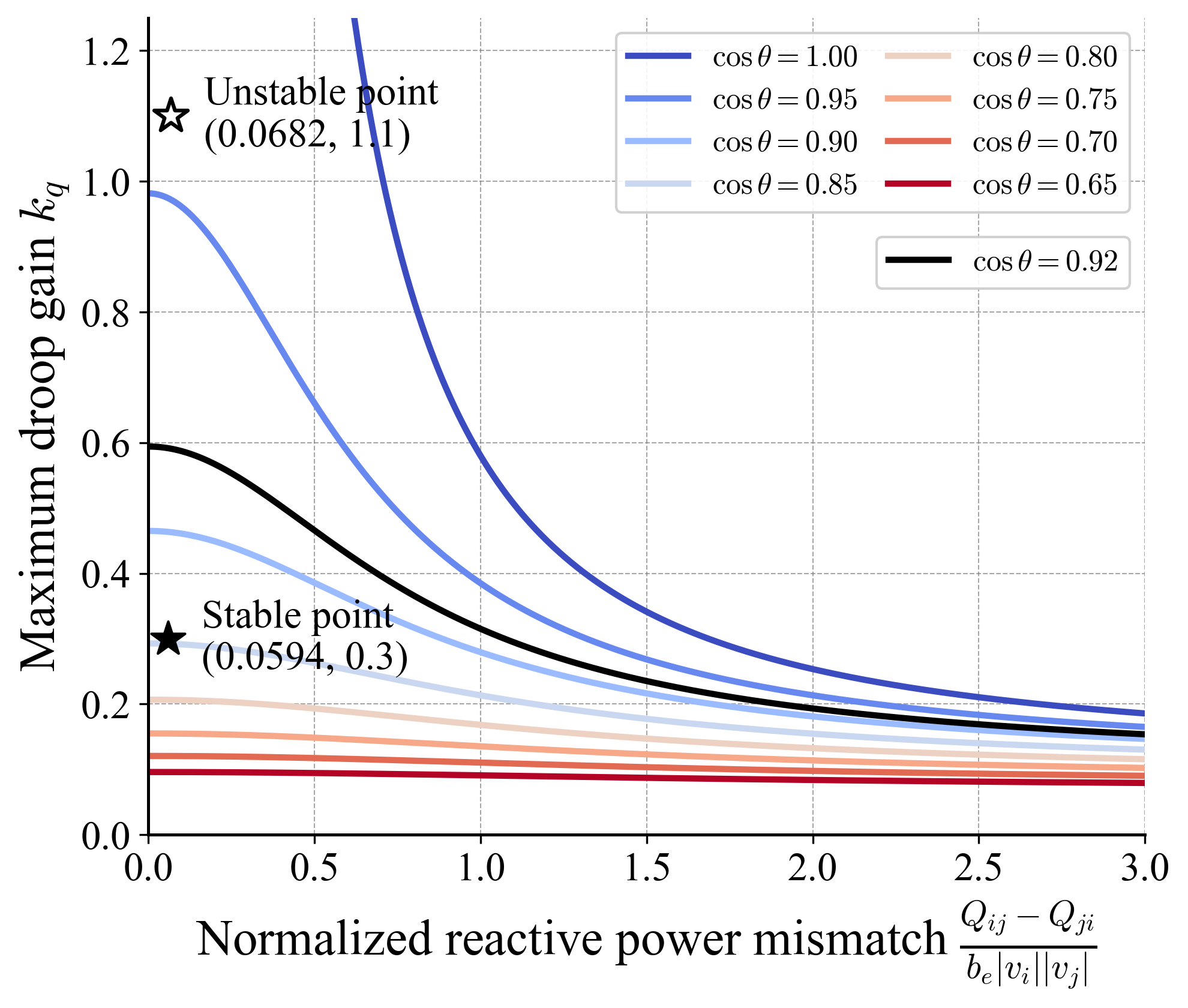
Figure 4: H2(s)3 level sets illustrating how maximum droop gain varies with normalized reactive power mismatch H2(s)4.
Numerical analysis on a two-bus test system further substantiates the result: parameter regimes that satisfy the decentralized certificate exhibit convergent voltage and frequency trajectories, whereas violation of the certificate predicts (and simulations confirm) the onset of sustained oscillatory instability Figure 5.
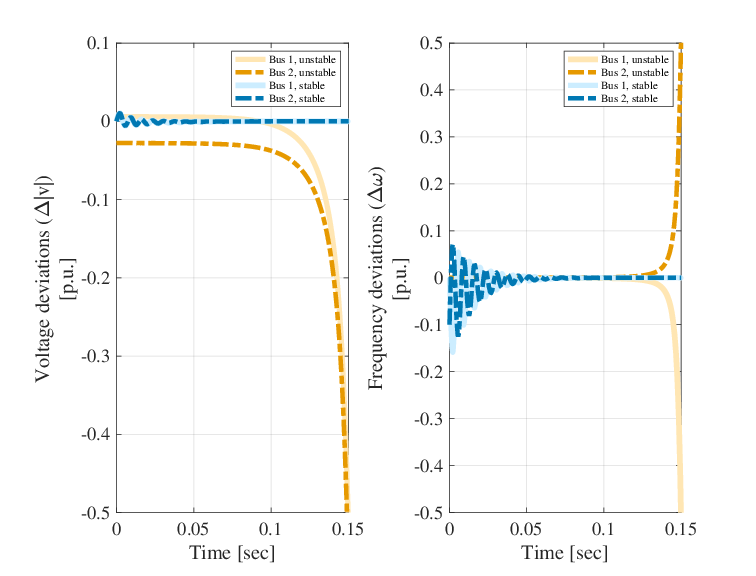
Figure 5: Dynamic response of the two-bus system under stable and unstable scenarios, highlighting voltage and frequency synchronization dynamics.
Practical and Theoretical Implications
From a practical perspective, the results provide a foundation for "plug-and-play" controller design: local certificate checks, given instantaneous network measurements, yield direct constraints on controller admissibility. This enables both automated controller re-tuning (e.g., gain adaptation under network stress) and operational planning (e.g., redispatch to avoid inadmissible operating points).
Theoretically, the framework challenges implicit assumptions in prior decentralized analyses by exposing the limitations of state-agnostic certificates. It strengthens the link between nonlinear power flow constraints, small-signal energy dissipation (passivity), and controller synthesis — opening avenues for further extensions involving dynamic lines, load-side dynamics, or higher-order IBR models.
Future Directions
Potential future research directions include:
- Extending the loop transformation and passivity framework to networks with non-ideal (lossy) lines or dynamic shunt/series compensation,
- Incorporating load dynamics or hybrid AC/DC interconnections,
- Developing real-time monitoring and fast certificate evaluation routines to support operating point–aware grid management,
- Integration with robust or adaptive control schemes that dynamically enforce network-state-dependent stability.
Conclusion
This work rigorously demonstrates that decentralized small-signal stability margins in IBR-dominated grids are fundamentally governed by instantaneous network state, particularly reactive power and voltage imbalances. By leveraging loop transformation and passivity analysis, the authors establish scalable, implementable certificates whose feasibility region shrinks with network stress. This result forms a principled basis for both operationally aware controller tuning and safe grid integration in high-IBR scenarios.
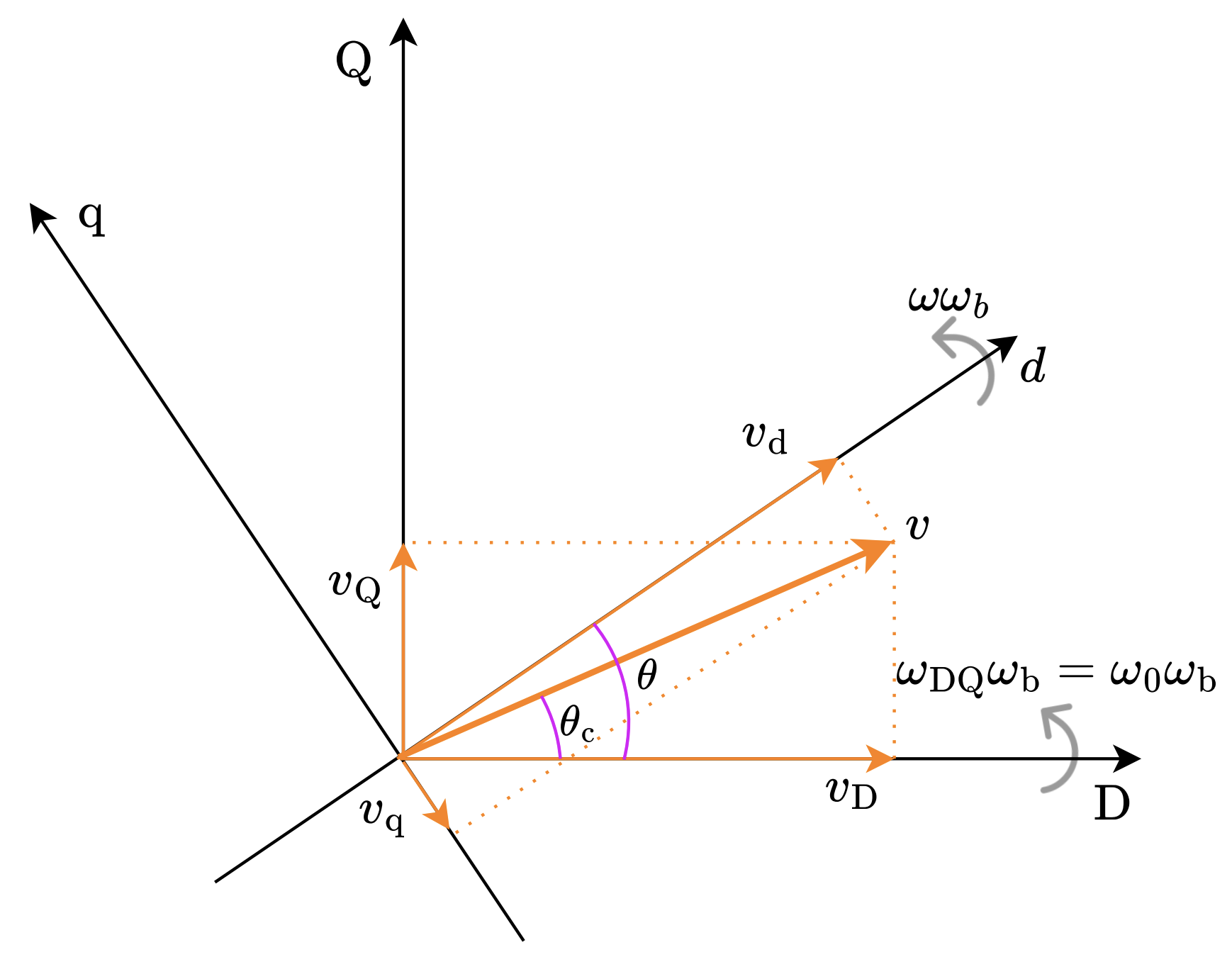
Figure 6: Phasor diagram and reference frames used in the GFM IBR modeling equations, clarifying the role of voltage and current variables under the adopted coordinate conventions.