- The paper presents a model-free framework using a zeroth-order optimizer with adaptive momentum to tune both grid-forming and grid-following IBR controllers.
- The approach achieves substantial transient performance improvements, evidenced by a 76% reduction in frequency deviation under load disturbances.
- High-fidelity EMT simulation is integrated to directly evaluate system responses, enabling scalable optimization for complex, high-penetration IBR grids.
Model-Free, Grid-Level Coordinated Optimization of IBR Controllers for Enhanced Transient Dynamics
Introduction
The ongoing transition toward high penetration of inverter-based resources (IBRs)—including photovoltaic, wind, and battery systems—substantially alters the dynamic behavior of power grids, fundamentally reducing system inertia and introducing complex, nonlinear control interactions. Effective tuning of control parameters for both grid-forming (GFM) and grid-following (GFL) inverters is critical for maintaining system stability and ensuring robust transient dynamic performance. Traditional approaches, primarily based on simplified or linearized dynamic models, are insufficient due to their inability to capture the full spectrum of nonlinear phenomena and tight controller interactions. Moreover, most data-driven and meta-heuristic control parameter optimization methods lack theoretical performance guarantees and generally overlook grid-level coupling among IBR facilities.
This paper presents a simulation-based, model-free framework for coordinated tuning of IBR control parameters, leveraging a projected multi-point zeroth-order optimizer with adaptive moment estimation (PMZO-Adam). By treating the power grid as a black-box system and integrating high-fidelity electromagnetic transient (EMT) simulation with parallelized zeroth-order optimization, the proposed method directly targets grid-level transient dynamic objectives. The approach effectively eliminates the need for explicit system models and supports flexible, holistic control parameter optimization across large, complex IBR-dominated grids (2603.29995).
Framework for Model-Free Grid Optimization
The architecture of the proposed simulation-based model-free grid optimization framework is summarized in Figure 1. Here, control parameters x of all IBR components in the network serve as decision variables, while d indexes the disturbance scenarios to be considered (e.g., load steps, contingencies). The high-fidelity simulator, operating as a black-box oracle, evaluates dynamic responses (e.g., frequency nadir, RoCoF, and phase angle extrema) for each candidate parameterization, permitting direct, simulation-based performance assessment. Decision variable updates follow a zeroth-order optimization routine, which requires only function evaluations, not analytic gradients.
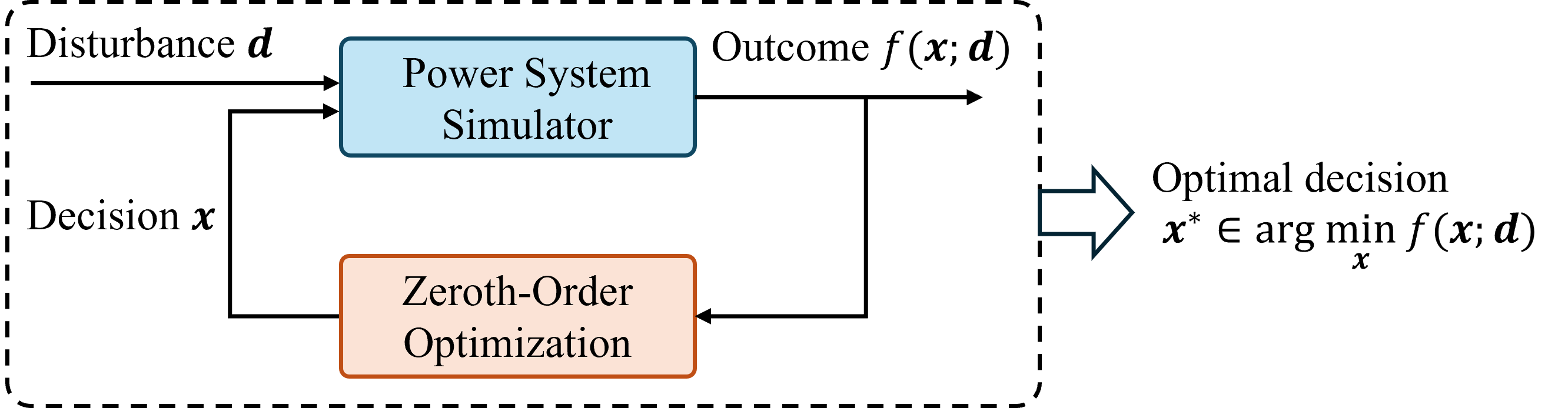
Figure 1: Schematic of the simulation-based, model-free grid optimization structure integrating decision parameter input and disturbance queries with a black-box simulator and gradient-free iterative optimizer.
Compared to small-signal or linearized system analysis, this framework natively accommodates arbitrary nonlinearities, physical constraints, and inter-IBR interactions. By avoiding restrictive modeling assumptions and enabling grid-level coordination, it provides a tractable solution paradigm for holistic IBR controller tuning.
IBR Control Architectures and Tunable Parameters
The grid testbed includes both GFL and GFM IBRs.
Grid-Following (GFL) Control
GFL inverters synchronize to grid voltage and frequency using cascaded loops comprising phase-locked loop (PLL), frequency-power droop, and current controllers. Critical tuning parameters include PLL gains (Kp,PLL, Ki,PLL), current controller gains (Kp,i,GFL, Ki,i,GFL), and the droop coefficient (DGFL), directly impacting dynamic synchronizing response and damping.
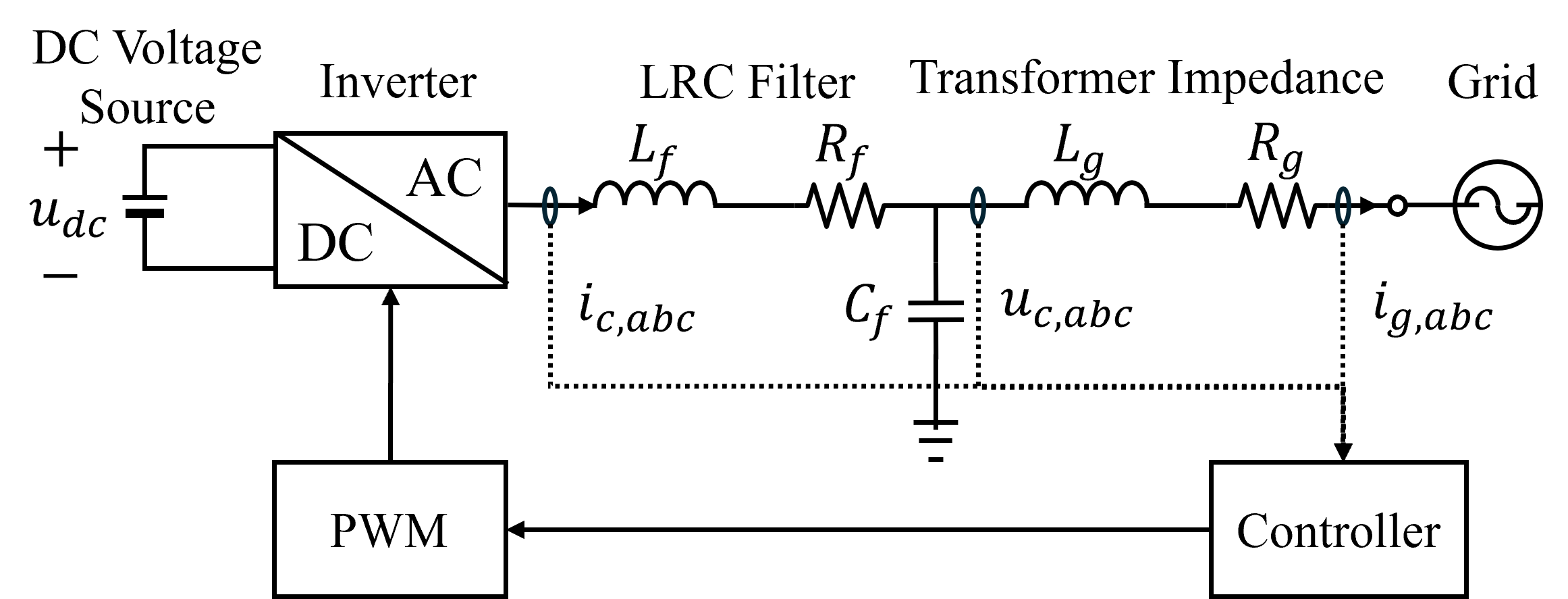
Figure 2: Configuration of a three-phase inverter grid connection and controller signal structure.
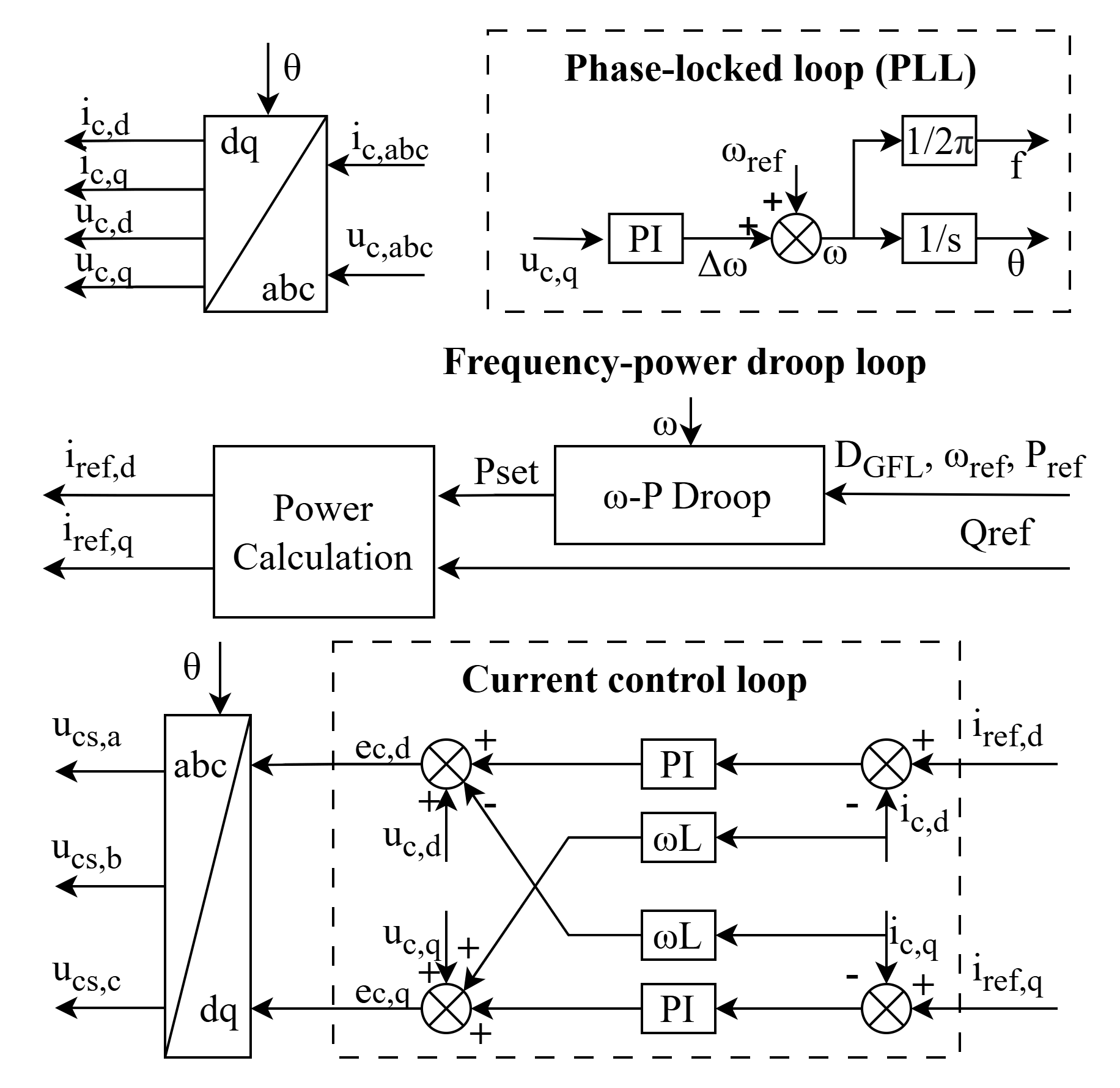
Figure 3: Controller block diagram for GFL inverters: PLL, droop, and current loops.
GFM inverters use virtual synchronous generator (VSG)-type controllers, establishing grid voltage and frequency set-points. Key tunable parameters include inertia emulation (MGFM), damping coefficients (DGFM), and voltage/current controller gains (Kp,v, d0, d1, d2). These settings dictate both the strength of grid support functions (synthetic inertia, damping) and the speed/robustness of voltage and current tracking.
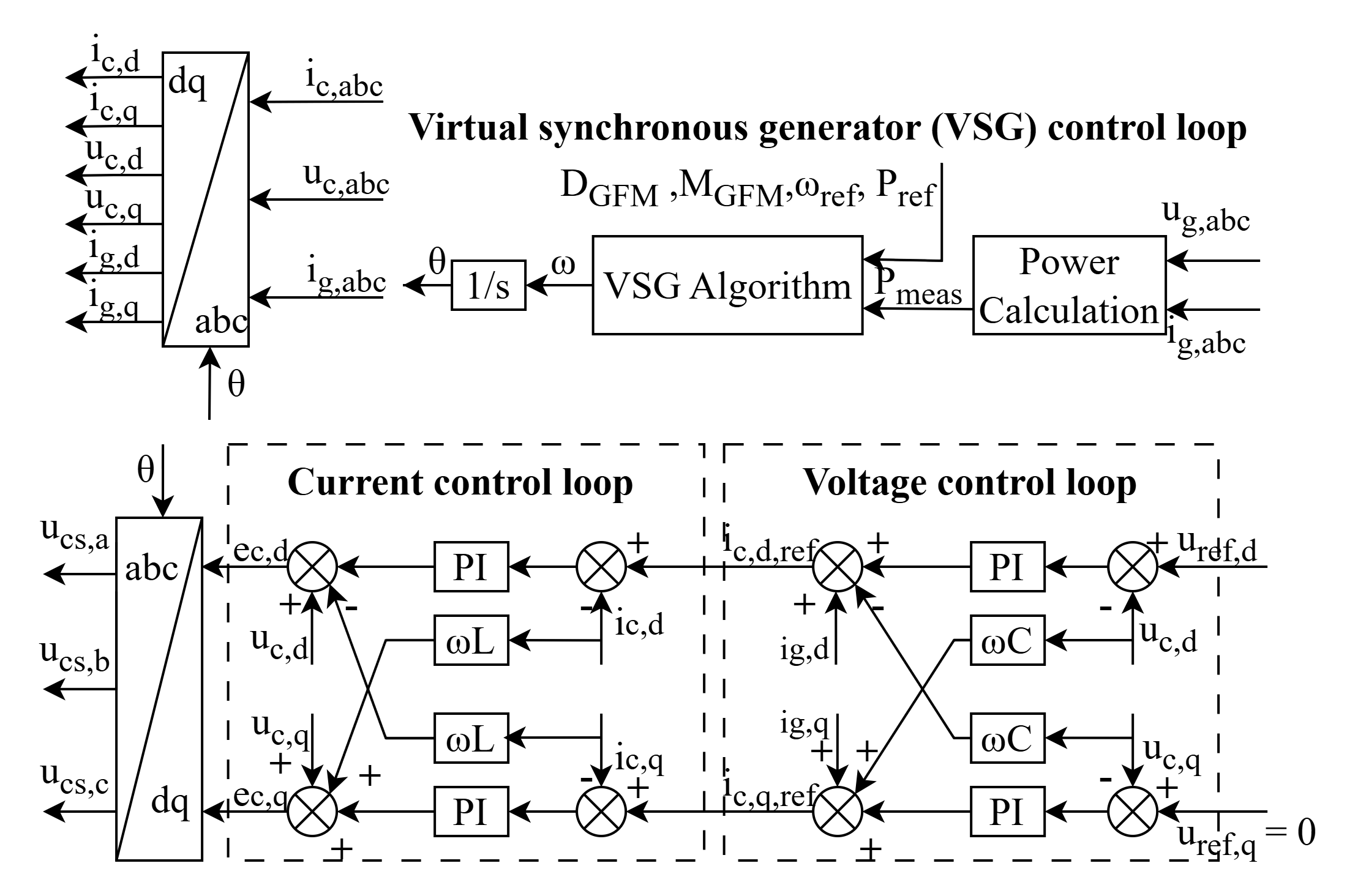
Figure 4: VSG-based GFM inverter architecture, showing synthetic inertia, damping, voltage, and current control inner loops.
Zeroth-Order Optimization with Adaptive Momentum
The PMZO-Adam optimization algorithm operates in a projected, parallel, multi-point two-sided zeroth-order configuration. In each iteration, batches of random perturbations are applied to the control parameter vector d3, and the corresponding objective values are obtained through EMT simulation for all disturbance scenarios. The finite-difference-based, perturbation-aggregate estimator forms a gradient surrogate, used with adaptive moments (Adam) for both descent direction and step-size modulation.
The optimization objective is a weighted function aggregating frequency nadir, zenith, and post-disturbance oscillation energy across a selected subset of buses and disturbances—directly reflecting practical grid stability criteria. Full enforcement of operational constraints is achieved via projection onto the physical feasible set for IBR parameters.
Large-Scale EMT Validation and Numerical Analysis
The EMT simulation testbed consists of a modified IEEE 39-bus network including ten IBRs (six GFL, four GFM). Each IBR has its independent parameter constraints, and the aggregate parameter space is high-dimensional. The PMZO-Adam algorithm is deployed in parallel across hundreds of simulation batch evaluations per iteration, exploiting parallel hardware execution.
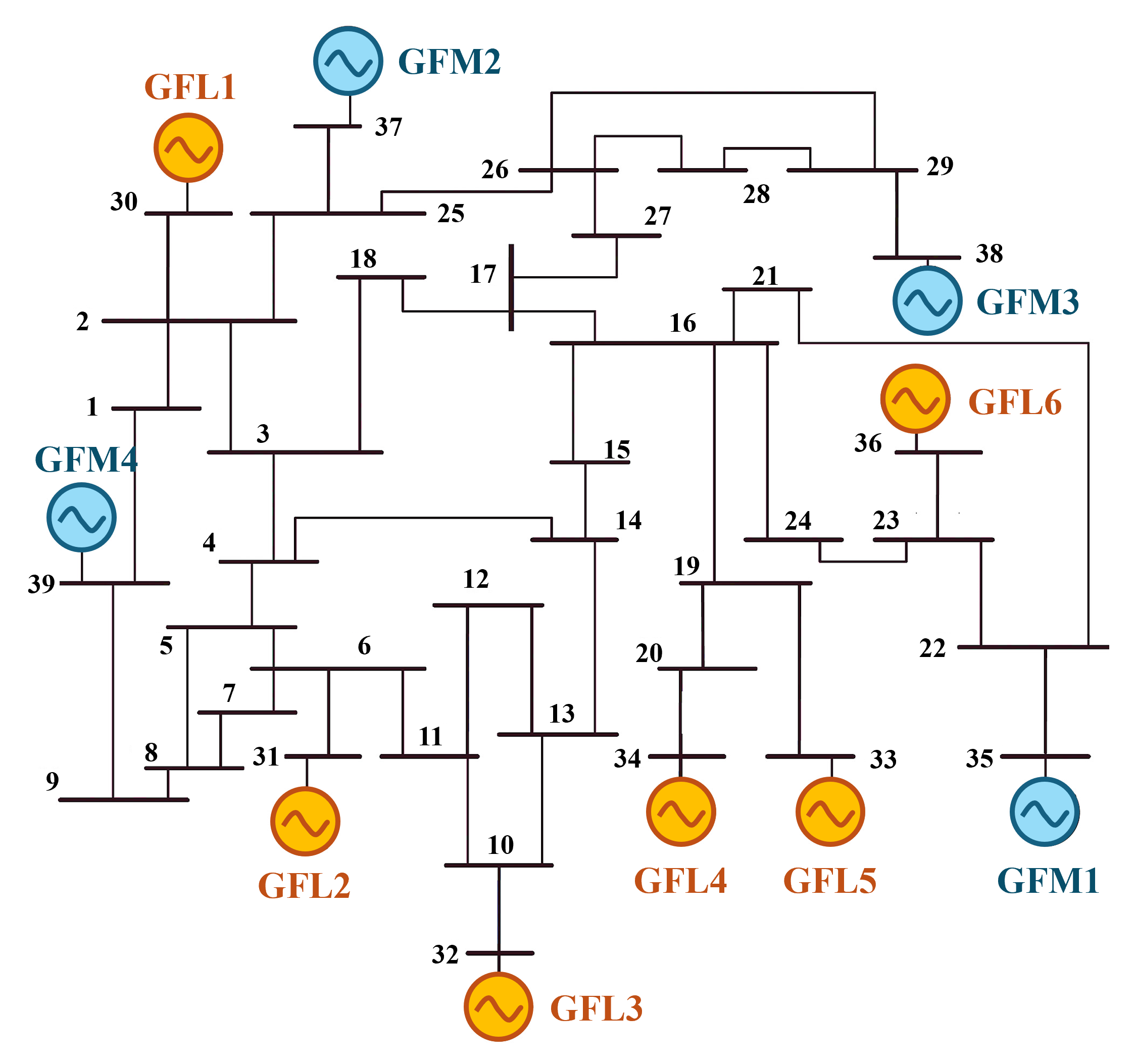
Figure 5: Topology and resource placement for the modified IEEE 39-bus test system.
Scenario 1: Sudden Load Increase
Application of a 1 GW step load at bus 26 tests the system’s ability to suppress large frequency deviations. The objective function displays rapid convergence (76% reduction; from 0.1751 to 0.0421), and post-optimization, frequency nadir and oscillation amplitude across impacted buses show substantial mitigation.
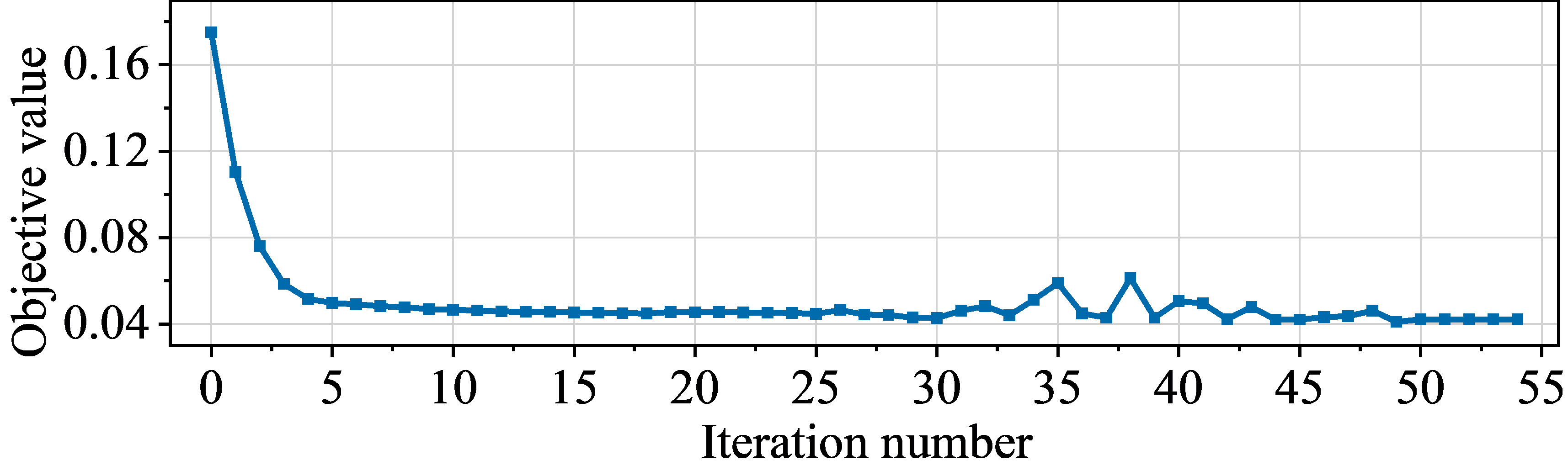
Figure 6: Objective function convergence in Scenario 1, evidencing rapid descent and stable final performance.
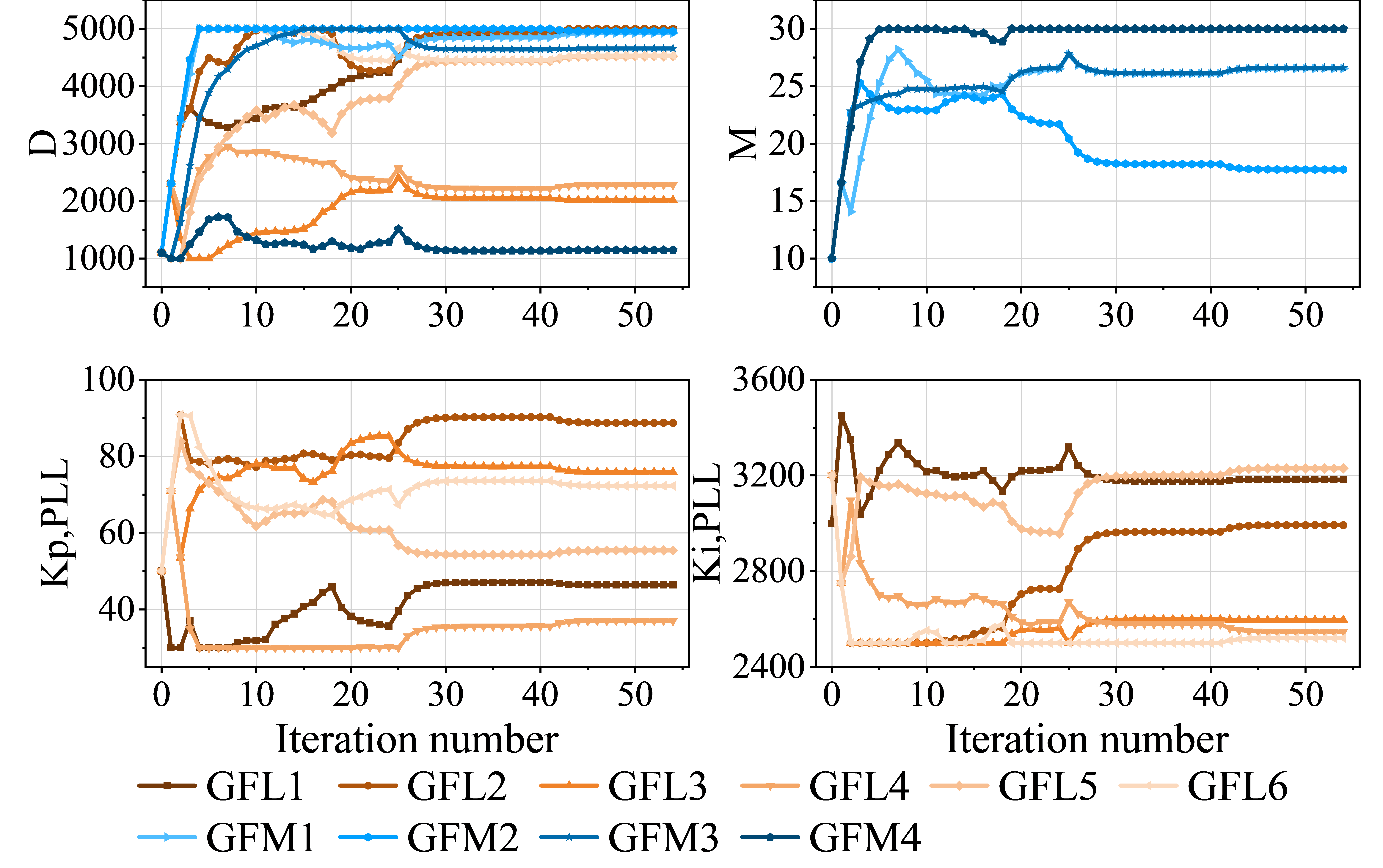
Figure 7: Evolution of critical IBR control parameters over iterations under load disturbance.

Figure 8: Bus frequency dynamics before and after coordinated parameter optimization; optimized set achieves markedly reduced nadir and oscillatory behavior.
Scenario 2: Line Contingency
Severing the line between buses 8 and 9 at d4s provokes significant frequency excursions. Coordinated optimization yields a 51.8% improvement in the objective metric. Simultaneous updates to VSG damping and GFL PLL gains are crucial to damping transient frequency swings.
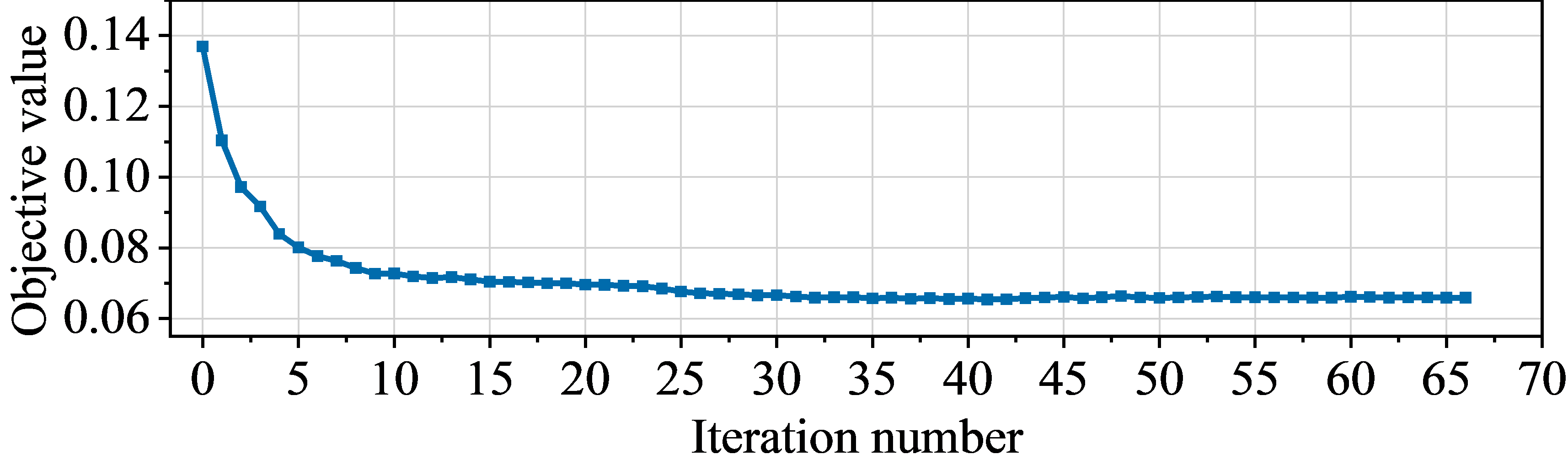
Figure 9: Objective function trajectory during optimization under a line contingency event.
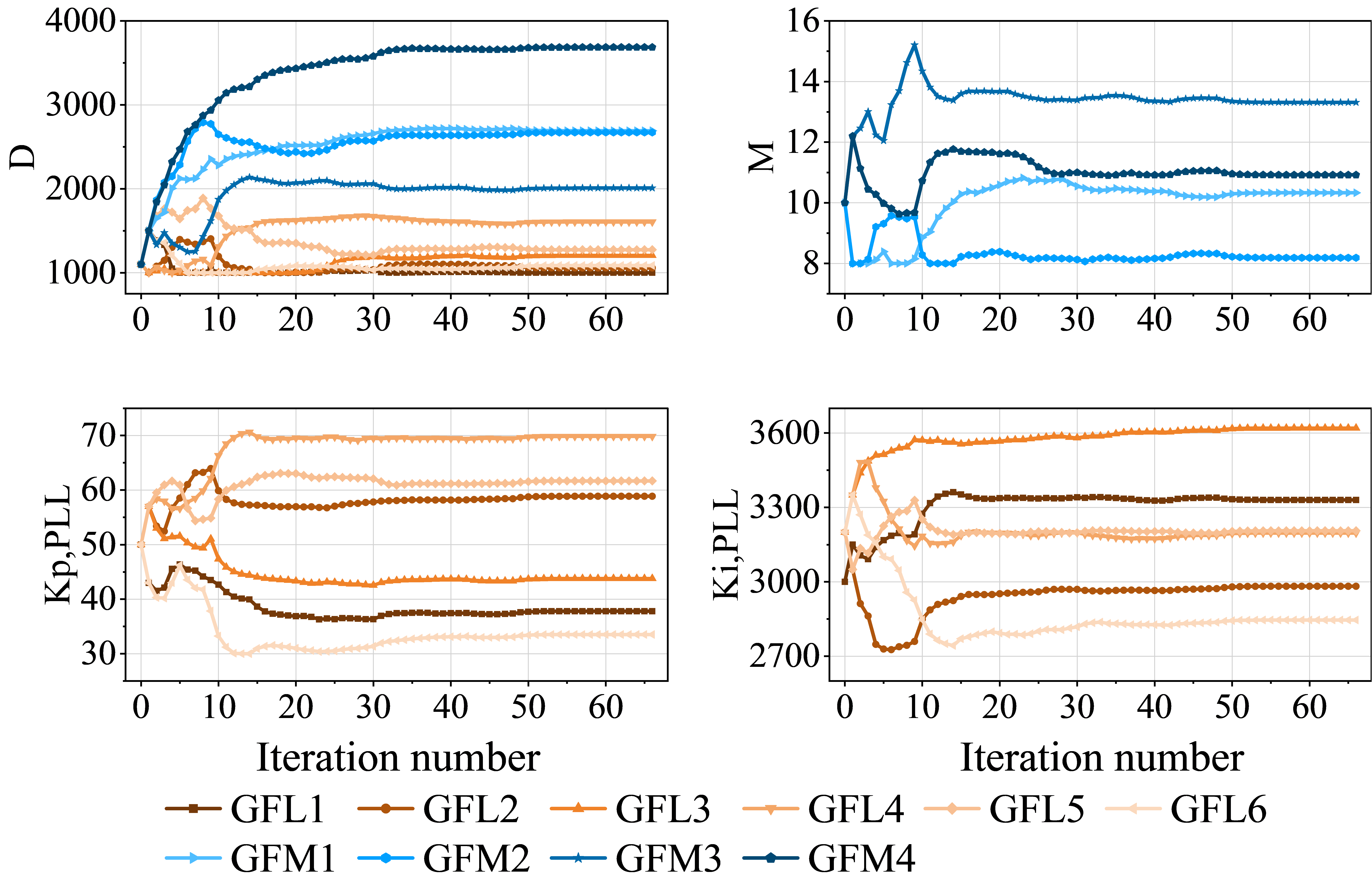
Figure 10: Parameter convergence for key IBR controllers under contingency conditions.

Figure 11: Impact of pre- and post-optimization tuning on bus frequency transient response; coordination suppresses both deviation and oscillation.
Algorithmic Sensitivity: Batch Size and Adaptive Momentum
Convergence properties are highly sensitive to zeroth-order estimator batch size (d5). Larger d6 reduces estimator variance, improving convergence speed and stability, though the high parallelizability nullifies computational cost. The incorporation of Adam for adaptive moment estimation yields superior convergence relative to vanilla gradient descent—in both speed and final attained objective value.
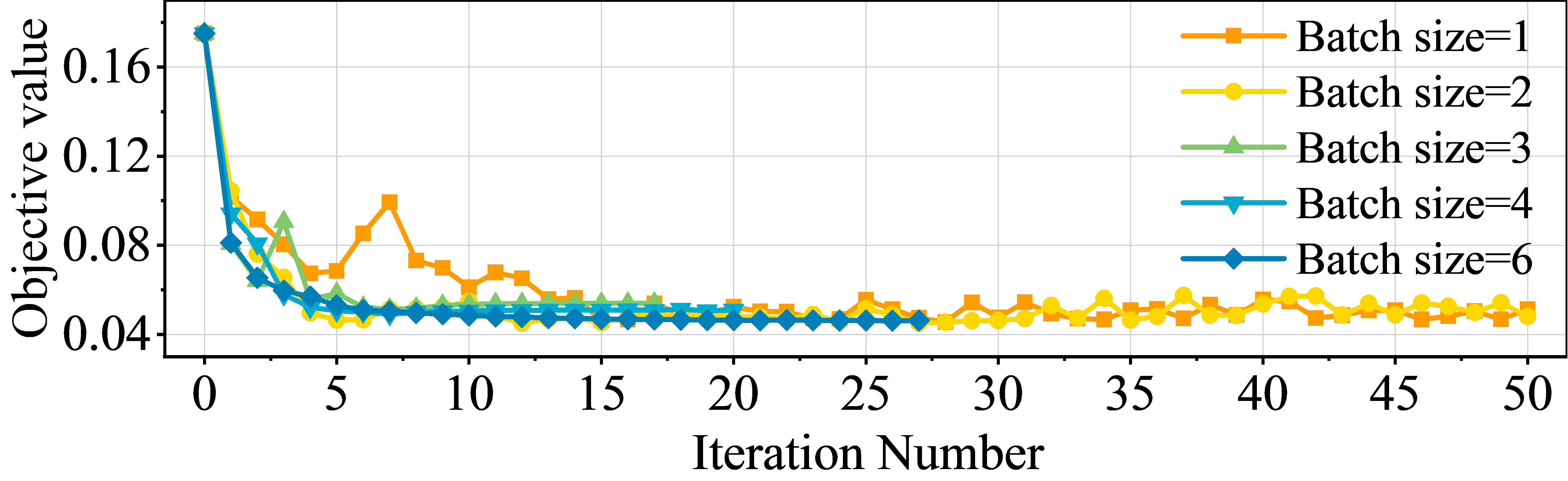
Figure 12: Effect of batch size on objective convergence dynamics; larger d7 affords more stable and faster descent.
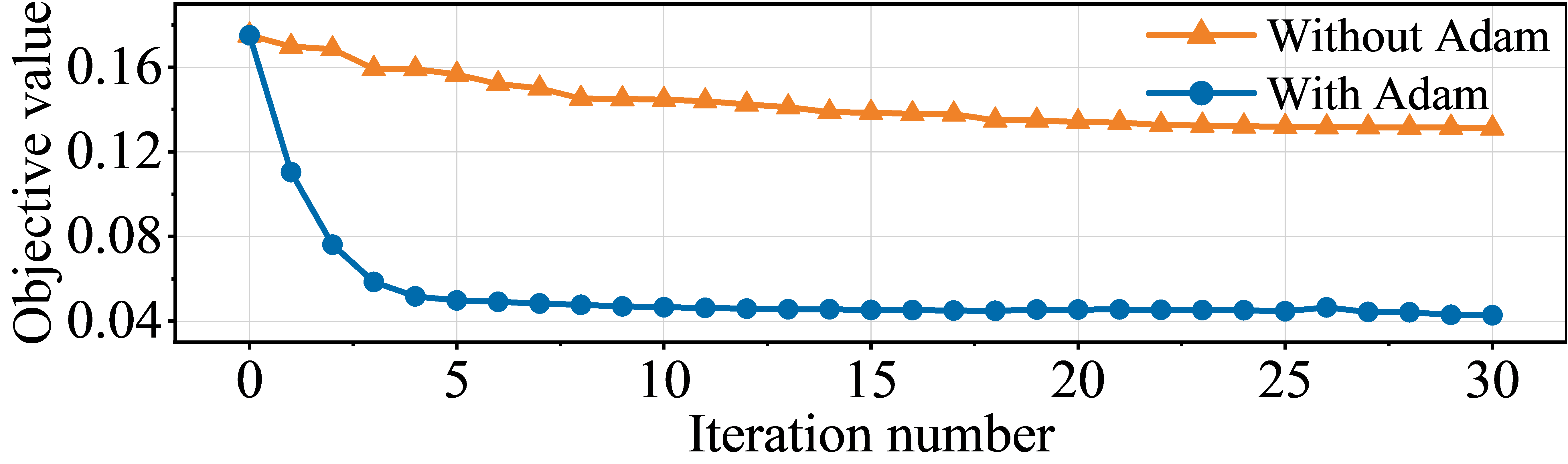
Figure 13: Comparative convergence with and without Adam; adaptive moments accelerate and stabilize optimization.
Implications and Future Directions
This work provides a scalable, model-free protocol for grid-level, system-wide coordinated tuning of IBR control loops. Notably, all strong numerical results—such as >75% improvement in transient frequency metrics—are attained without recourse to analytic models, relying solely on operationally available simulation infrastructure. The method’s flexibility admits arbitrary grid topologies, controller architectures, disturbance models, and objective criteria, making it universally applicable to EMT, phasor, or mixed simulation platforms.
From a theoretical perspective, the use of zeroth-order estimators with batched, adaptive-moment updates bridges the gap between data-driven controller search and the need for robust convergence guarantees—an approach extensible to online or real-time adaptation with further research.
On the practical side, the proposed methodology immediately supports offline parameterization for grid-forming and grid-following IBRs, with direct integration into current utility and system operator simulation workflows. Critical controller interactions and dynamic couplings—otherwise missed by isolated or model-based tuning—are automatically coordinated. Future developments may encompass on-line adaptation, constraint tightening for stability certification, and model-free robustification against adversarial disturbances or cyber-physical uncertainties.
Conclusion
The simulation-based, model-free, grid-level coordinated IBR controller optimization framework described in this paper leverages high-fidelity EMT simulation and advanced zeroth-order, Adam-accelerated optimization, achieving robust and substantial improvement in transient frequency response under large-signal disturbances. The approach avoids explicit system modeling, natively incorporates IBR control interdependence, and is directly extensible to large-scale, high-penetration inverter-dominated grids. Both theoretical and practical advancements arising from this research are poised to fundamentally enhance the secure, resilient operation of future power systems.