- The paper presents a formal risk architecture, scoring risk coverage across seven team profile dimensions and six failure mode clusters.
- It demonstrates a monotonic decline in risk coverage from pure software engineering to AI-native systems, with critical failures emerging at the boundary.
- The study proposes actionable organizational shifts in ownership, semantic escalation, and cross-boundary authority to close uncovered risk gaps.
The proliferation of agentic AI systems disrupts fundamental assumptions of legacy risk management frameworks in software engineering. Traditional paradigms, built for deterministic systems and discrete, auditable change events, falter when confronted by agentic, probabilistic, and continuously mutating architectures. Existing risk frameworks, such as NIST AI RMF and ISO/IEC 42001, operate at the policy level and are system-centric, whereas technical taxonomies (e.g., OWASP, CLTC) focus on threat surfaces but not on responsibility and escalation structures within engineering organizations. The critical "middle layer"—the operational practices of engineering managers (EMs) governing agentic systems—remains untheorized.
This paper formalizes the risk architecture for AI-native engineering teams, delivering both a conceptual taxonomy and a derivational methodology for scoring framework adequacy against a comprehensive failure-mode scenario set. Central to its thesis is the observation that the most severe and unmitigated risks are concentrated not intrinsically within AI-native teams but rather at the organizational boundary where their stochastic outputs are consumed by determinism-assuming systems.
Taxonomic Framework: Seven-Dimension Team Profile and Six-Cluster Failure Modes
The proposed team-profile taxonomy spans seven dimensions:
- Output Determinism: From pure deterministic outputs to entirely probabilistic behaviors.
- Action Autonomy: From human-triggered actions to autonomous multi-step agentic execution.
- Verification Model: From conventional test coverage to adversarial, distributional testing.
- Risk/Incident Ownership: From clear feature-team mapping to ambiguity across causal chains and boundaries.
- Escalation Trigger: From observable error rates to semantic predicates over action sequences.
- Data Surface: From static, schema-bound surfaces to runtime agent-determined data flows.
- Change Velocity: From discrete, auditable events to silent, continuous risk-surface mutation.
These are evaluated against a nuanced failure-mode taxonomy across six clusters—security, privacy, autonomy, change-induced, ownership/accountability, and the novel dependency-boundary determinism mismatch cluster—explicitly addressing failures at team and organizational boundaries.
Methodological Contributions
The paper introduces a synthetic, auditable pipeline to operationalize and score the adequacy of different risk architectures. Each profile is cast as a tuple R=⟨O,T,E,A,M⟩ (Ownership, Triggers, Escalation, Authority, Monitoring), and scenario coverage is graded via an ordinal rubric (detection, containment, escalation; scored 0–2 each).
The boundary setup, unique to this work, evaluates configurations with an AI-native producer and a consumer varying in input-expectation profile (determinism-assuming, variance-aware, or unaware), enabling explicit analysis of interface contract violations and asymmetric rollback failures.
Key Empirical and Derived Results
Derived coverage metrics exhibit a monotonic, roughly linear decline in median tier from pure software-engineering through hybrid to AI-native, with an abrupt, threshold-like appearance of high-consequence, uncovered failures at the AI-native transition.
(Figure 1)
Figure 1: Derived median coverage tier by team profile (computed by the released pipeline). The median declines monotonically and roughly linearly; the consequential change is the threshold appearance of uncovered (Low-band) cells at the AI-native step, where detection and escalation failures co-occur on the same scenarios.
The distribution of coverage loss is non-uniform, concentrating in specific clusters associated with autonomy, change, and boundary-dependent risks. Pure SE and hybrid teams show no Low-band (uncovered) failures, while AI-native teams exhibit multiple such cases.
(Figure 2)
Figure 2: Per-cluster median coverage band (L/M/H) by profile, emitted by the pipeline. Bands are flat for Clusters A and B but collapse across C, D, E, and the boundary cluster F; "n/a" denotes out-of-scope cells.
Most critically, the boundary configuration—where probabilistic outputs are supplied to determinism-assuming consumers—dominates the uncovered, high-consequence failure modes. Only "variance-aware" consumers (explicitly anticipating distributional inputs) recover high coverage in boundary scenarios; determinism-assuming and unaware consumers remain highly exposed.
(Figure 3)
Figure 3: Cluster~F median coverage tier by consumer input-expectation profile (AI-native producer held fixed). Coverage is a property of the boundary configuration: determinism-assuming and unaware consumers are Low, while a variance-aware consumer recovers High coverage.
Robustness analysis, including Monte Carlo perturbations on scenario requirements and direct manipulation of architecture tuples, shows that the findings are invariant except when AI-native teams are explicitly granted ownership of contract, causal-chain, and boundary surfaces—isolating a single actionable managerial intervention as sufficient to close the gap.
(Figure 4)
Figure 4: Monte-Carlo robustness. Survival rate of each claim as the scenario-requirement encoding is randomly perturbed. The cluster-concentration and boundary-configuration findings are near-invariant; the exact pure-SE/hybrid median ordering is encoding-sensitive (a near-tie) and is reported as such.
Coverage degrades monotonically as individual dimensions convert from SE to AI-native, with even partial adoption of agentic components introducing new, previously inapplicable failure surfaces (autonomy and boundary clusters).
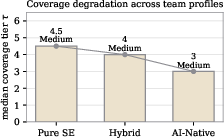
Figure 5: Coverage along the pure-SE → AI-native axis as dimensions are converted one at a time. Uncovered (Low-band) cells increase monotonically; a step appears at the first AI-native dimension, when the autonomy and boundary failure modes first come into scope.
Theoretical and Practical Implications
Organizational Structures and Accountability
The results demonstrate that classical risk primitives—ownership by component, escalation by observable severity, coverage by enumeration—are structurally insufficient for agentic AI. Three organizational shifts are required:
- Ownership assignment at new surfaces: Tool contracts, causal action chains, and the dependency boundary must each have named, accountable owners.
- Escalation triggers at the semantic level: Triggering must involve understanding the semantics of agent action traces and outputs, not just raw errors.
- Authority for cross-boundary rollback and reconciliation: Teams must explicitly design containment mechanisms spanning organizational boundaries.
A minimal "reference risk architecture" is proposed that specifies, for each previously uncovered surface, owners, triggers, and authorities, and this artifact is validated within the derivational model as fully closing uncovered high-consequence failures.
Change Management
Change management practices based on tracking discrete events break down in settings where the risk surface mutates silently (model drift, contract updates, agentic state accumulation). Change event detectors—continuous monitoring and mutation detection—replace the traditional change event record.
Relationship to Technical Countermeasures
Organizational gaps in risk coverage directly correspond, at a higher level of abstraction, to technical vulnerabilities closed by contract-based tool reliability, causal-chain gating, and effect-integrity enforcement in agentic systems (Iyer et al., 11 Jun 2026, Iyer et al., 17 Jun 2026, 2606.15508). Effective risk governance requires both organizational realignment and technical reinforcement.
Future Directions
Empirical validation of behavioral adoption and effectiveness of proposed structures remains open. Expansion of the taxonomy to include operational governance, e.g., cost and toolchain standardization for large enterprises, as an eighth axis is identified as an important next step. The released pipeline and instrument enable extension and testing under additional scenarios by the wider research community.
Conclusion
The paper delivers a formal, auditable architecture for reasoning about AI-native system risk at the organizational level—directly addressing the gap between high-level policy/governance and technical threat frameworks. The results highlight that high-consequence, unmitigated failures are not intrinsic properties of AI-native systems per se but are tightly linked to organizational misalignment at new risk surfaces, especially at the boundaries between AI-native and conventional teams. Remediation is both actionable and structurally pinpointed: assignment of ownership, semantic escalation, and boundary-spanning authority at precisely those newly emergent surfaces completes the organizational transition to robust agentic system governance.