- The paper establishes that band topology and bulk criticality in quadratic bosonic systems decouple, in stark contrast to fermionic cases.
- It employs a two-parameter interpolation model, analogous to a bosonic SSH chain, to analyze dynamical stability and topological transitions.
- Robust edge modes persist even in dynamically unstable regimes, offering new avenues for topological photonic and bosonic device design.
Decoupling of Band Topology and Criticality in Bosonic Quadratic Systems
Introduction
The established framework of the tenfold way classifies quadratic fermionic Hamiltonians (QFHs) according to symmetry and dimensionality, tightly linking topological invariants, gap closings, and critical behavior at quantum phase transitions [Kitaev 2009, Ryu 2010]. In free fermionic systems, topological phase transitions coincide with bulk criticality, with spatial correlations in the ground state diverging at band-closing points. The present work investigates whether an analogous linkage exists in quadratic bosonic Hamiltonians (QBHs), focusing on the interplay between band topology, criticality in the bosonic quasiparticle vacuum (QPV), and dynamical stability (2607.01334).
Here, the authors provide a rigorous theoretical and computational analysis, using a two-parameter family of QBHs interpolating between dimerized and Su-Schrieffer-Heeger-type bosonic chains, to show that, unlike fermionic systems, band topology and bulk criticality in bosons generically decouple. This decoupling traces back to fundamental differences in bosonic dynamics, which are governed by non-Hermitian, pseudo-Hermitian dynamical matrices, leading to a richer structure of criticalities and topological transitions.
Model Construction and Symmetry Landscape
The starting point is a bosonic chain with two flavors per site (aj, bj), where the Hamiltonian interpolates between different dimerized structures with pairing terms that break U(1) symmetry but preserve a chiral pseudo-symmetry:
H(2n)≡j∑(κaj+n†bj+δaj+n†bj†+H.c.),
with interpolation parameter s and pairing strength δ. The resulting model generalizes the bosonic SSH chain, and can be viewed as a function of (s,δ), with either open or periodic boundary conditions (see schematic below).
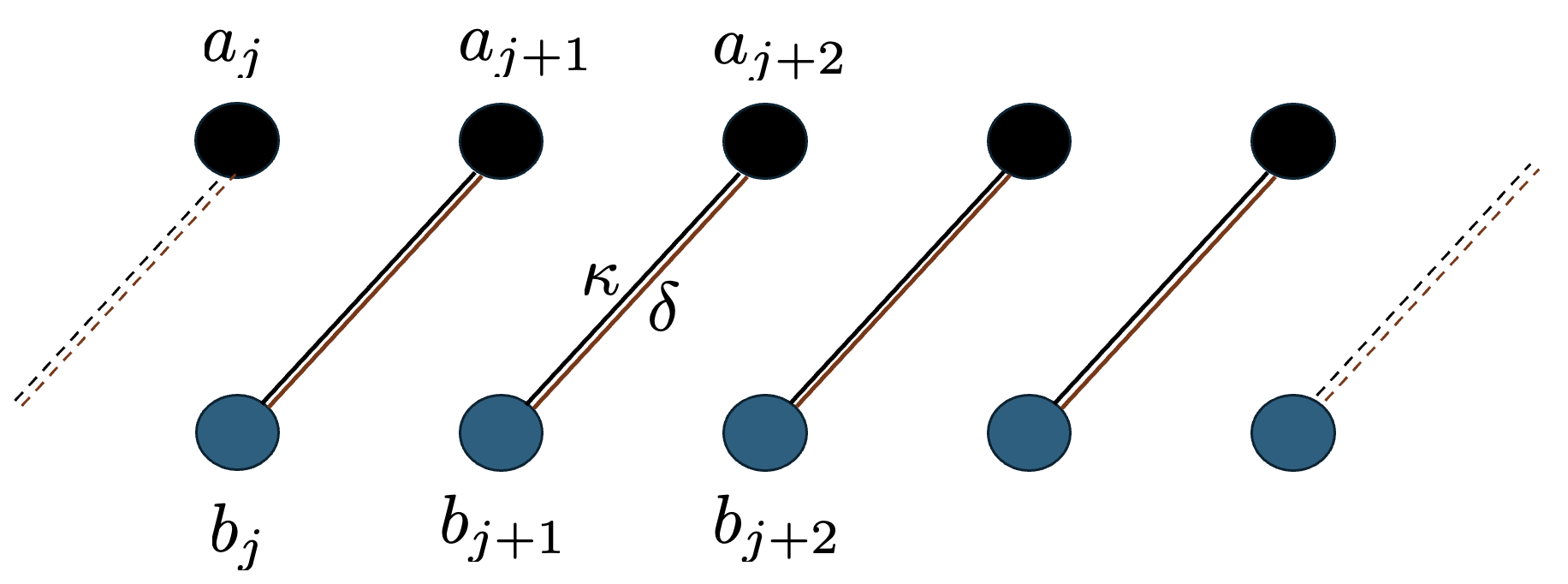
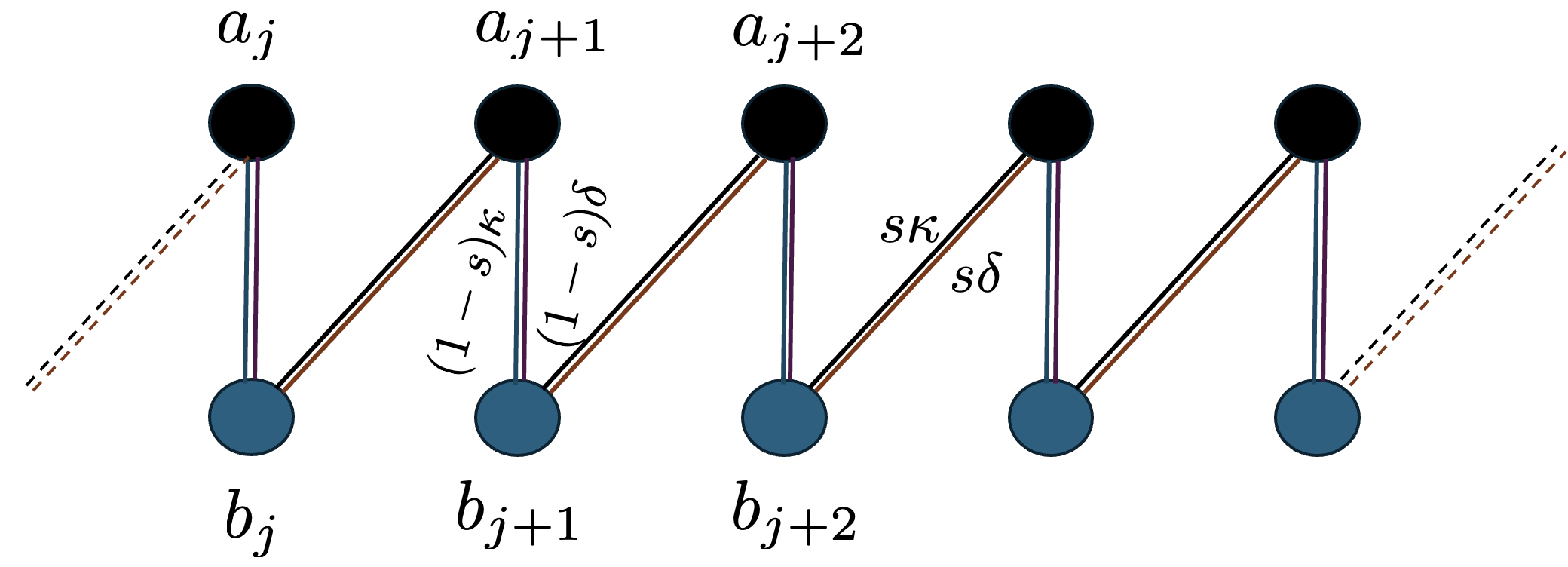
Figure 1: Pictorial representation of dimer and interpolation QBHs. The interpolation parameter s continuously deforms the chain between two distinct dimerizations.
The dynamical matrix G governing time evolution is pseudo-Hermitian due to bosonic commutation relations, and possesses both a true symmetry (many-body symmetry from operator S) and a chiral pseudo-symmetry (bj0) that generalizes the fermionic BDI class. The interplay of these symmetries is crucial for topological classification and for determining the existence of edge-localized zero modes.
Band Structure, Dynamical Stability, and Topological Invariants
In the bulk, the band structure is analytically tractable and depends parametrically on bj1:
- For bj2: The spectrum of bj3 is real and diagonalizable—dynamical stability prevails.
- At bj4: Exceptional points emerge, marking the onset of dynamical instability—bands coalesce and become non-diagonalizable.
- For bj5: The spectrum is generically complex; dynamical instability dominates.
Crucially, the topological phase transition occurs at bj6, signaled by a closing of the band gap at zero energy, i.e., a Krein collision. The band topology is characterized by a symplectic Berry phase adapted to the indefinite metric inherited from bosonic structure [Peano 2015]. The symplectic Berry phase (for a canonical gauge of Krein eigenvectors) jumps between quantized values at bj7, delineating trivial and nontrivial topological sectors.
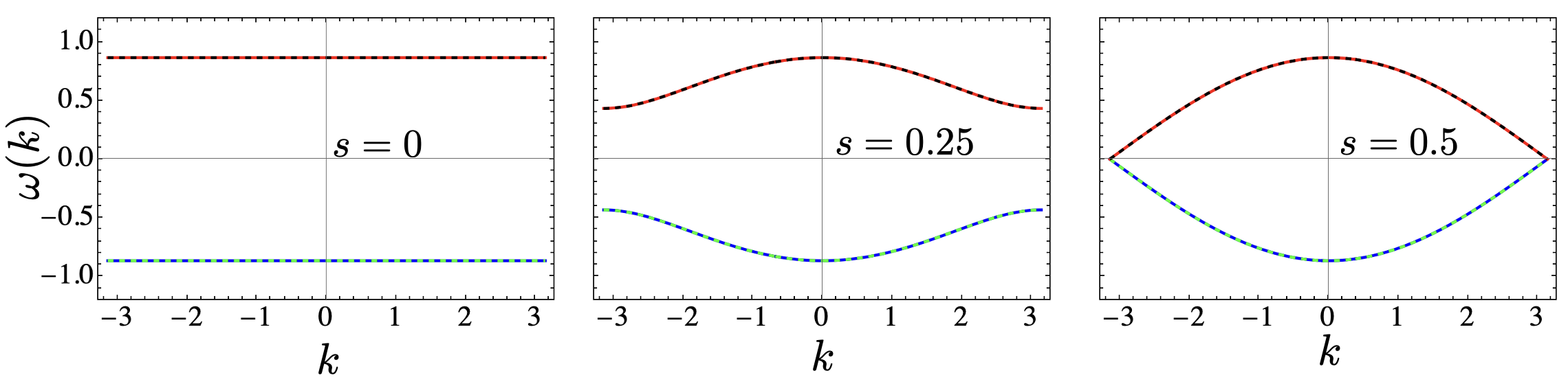
Figure 2: Band structure of the interpolation model as a function of bj8 for fixed bj9. The band gap closes at U(1)0, marking the topological transition.
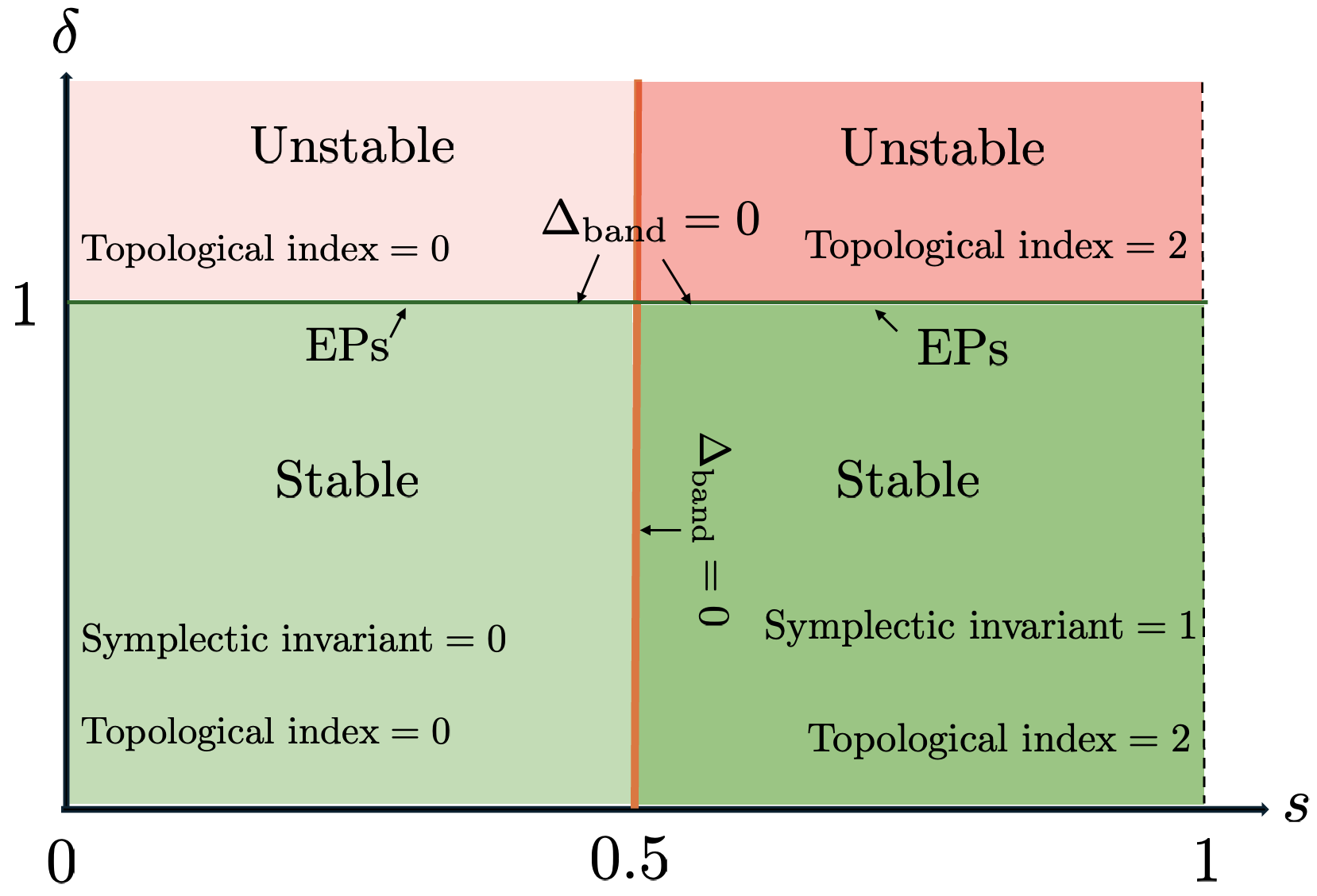
Figure 3: Combined dynamical stability and topological phase diagram in U(1)1-space, showing the orthogonality of the topological and dynamical-stability transition lines.
Boundary Zero Modes and Bulk-Boundary Correspondence
Analyzing open boundary conditions, the spectrum of the dynamical matrix reveals a sharp transition at U(1)2:
- For U(1)3, no boundary zero modes exist, and the gap does not close at zero energy.
- For U(1)4, exponentially localized boundary zero modes emerge; their number and behavior are determined by the winding number of the lower block of the chiral dynamical matrix.
The localization length U(1)5 of these edge states diverges as U(1)6, independently of U(1)7, and the zero modes remain robust (topologically protected) even in the dynamical instability regime, provided the chiral pseudo-symmetry is preserved.
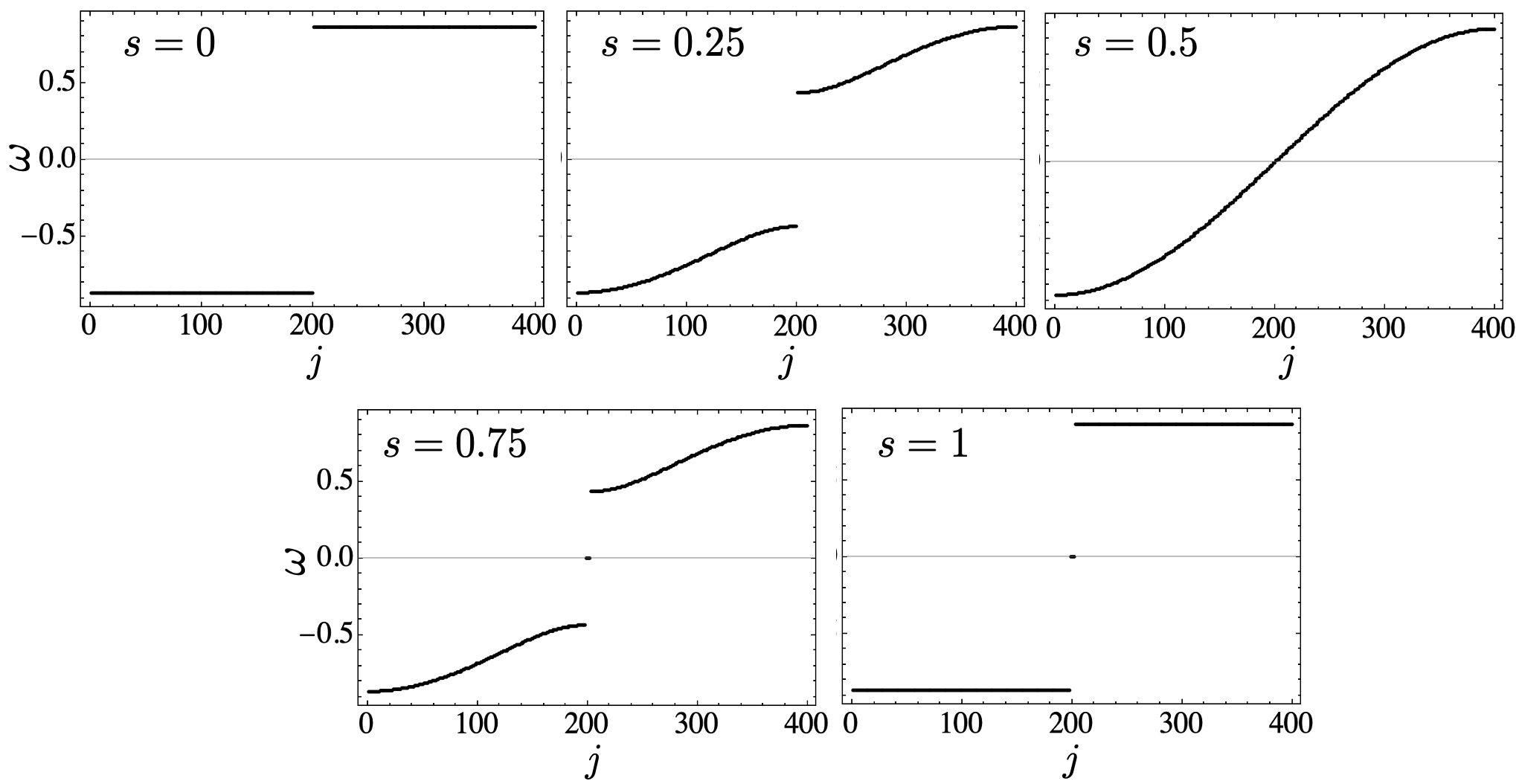
Figure 4: Spectrum of the dynamical matrix under open boundary conditions, showing the emergence of zero-energy edge modes for U(1)8.
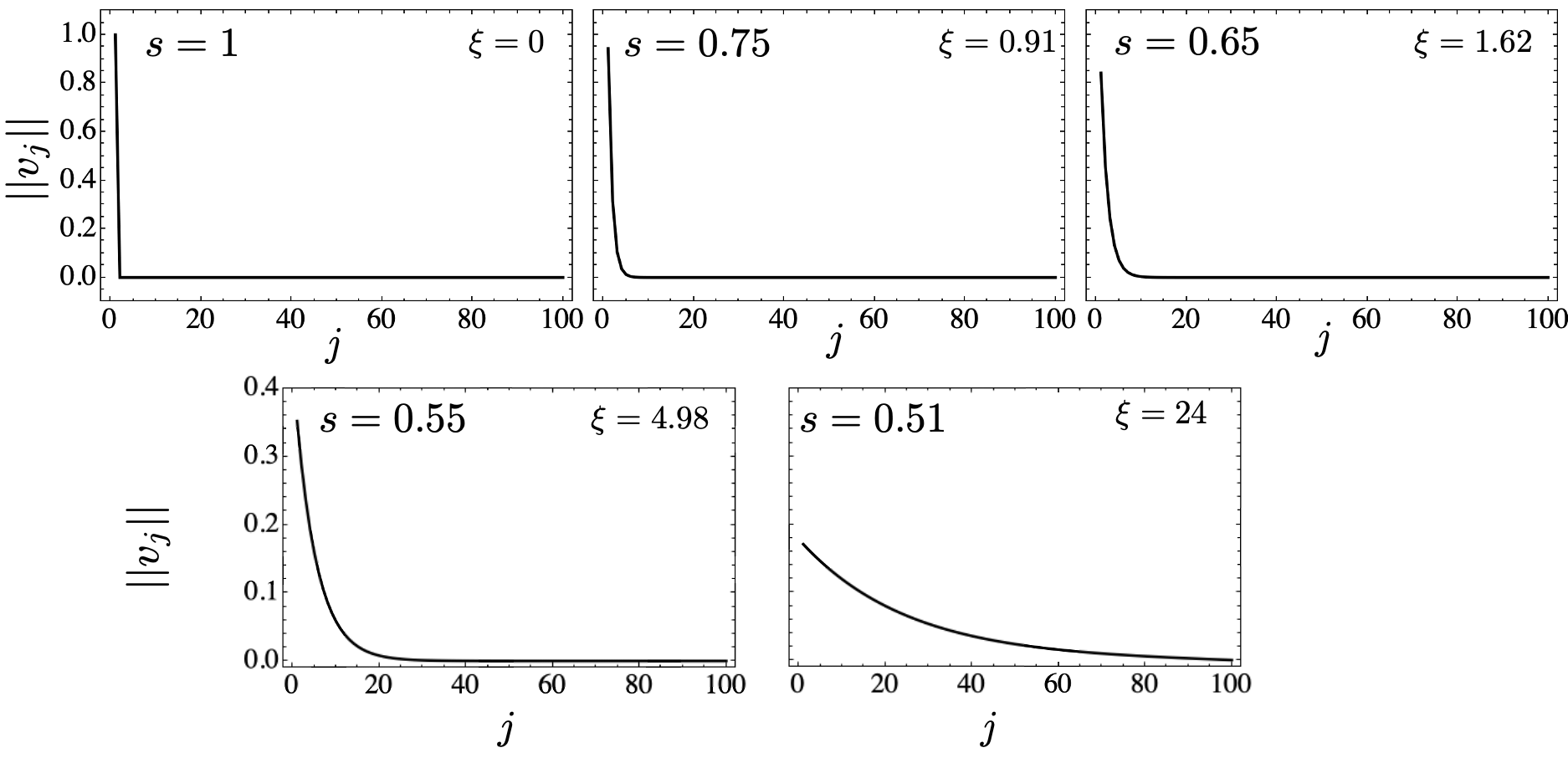
Figure 5: Localization length U(1)9 of the boundary zero modes diverges as the system approaches the topological transition at H(2n)≡j∑(κaj+n†bj+δaj+n†bj†+H.c.),0, demonstrating bulk-boundary correspondence.
This robust bulk-boundary correspondence is formalized via the index theorem for Toeplitz operators, guaranteeing that the number of boundary zero modes cannot fall below the magnitude of the bulk topological invariant, provided the gap at zero is maintained.
Correlation Functions and the Decoupling of Criticality
The analysis of the QPV covariance matrix (CM) demonstrates that, throughout the dynamically stable region, the CM is fully independent of the topological parameter H(2n)≡j∑(κaj+n†bj+δaj+n†bj†+H.c.),1. Thus, the bulk correlation structure—whether long- or short-range—is set not by proximity to the topological transition, but by the spontaneously chosen QPV from a non-unique (degenerate) manifold, a direct consequence of the vanishing Krein gap. Long-range correlations arise only at dynamical-stability phase boundaries (exceptional points), which are not generically where topological transitions occur.
This stands in sharp contrast to the fermionic case, where topological transitions and criticality in the ground state are inseparable. Numerically, near the dynamical instability line at H(2n)≡j∑(κaj+n†bj+δaj+n†bj†+H.c.),2, the covariance matrix diverges, reflecting genuine critical behavior, but this is unrelated to the change in topological invariant at H(2n)≡j∑(κaj+n†bj+δaj+n†bj†+H.c.),3.
Topology in Dynamically Unstable Regimes
The topological classification via the chiral pseudo-symmetry and corresponding winding numbers persists beyond the dynamically stable regime, even when covariance-based diagnostics are ill-defined. The index-theoretic approach remains robust, identifying distinct topological sectors in both dynamically stable and unstable phases.
Implications and Future Directions
This work demonstrates with explicit computation and theoretical argument that, for quadratic bosonic systems, the tenfold-way paradigm of tightly coupled criticality and topology must be revised. Bosonic topology, defined via (pseudo-)symmetry-protected edge modes and bulk invariants, is generically decoupled from thermodynamic or dynamical criticality in the QPV. The findings directly impact the classification of photonic topological insulators, magnonic crystals, and other bosonic analogs of electronic topological phases.
Practical implications include:
- The design of topological bosonic devices where robust edge states persist even in regimes devoid of critical bulk correlations.
- Opportunities for realizing topological protection in dissipative or dynamically unstable settings, relevant for topological photonics and non-Hermitian quantum systems.
Theoretical implications suggest:
- Topological phases can span both dynamically stable and unstable regions, raising the question of transitions in and out of criticality without changes at the boundary.
- The index-theoretic approach provides a universal tool for topological classification, unifying stable and unstable regimes where spectral-gap-based invariants fail.
Future avenues include: extension to disordered systems, interaction effects, and exploring the relationship between bosonic Hamiltonian topology and Lindbladian (open-system) topology [Bosoranas, PostBosoranas].
Conclusion
The decoupling of band topology from bulk criticality in bosonic systems is established both analytically and numerically. Topological edge phenomena in quadratic bosonic chains proceed independently of the QPV's critical signatures, contrasting sharply with the fermionic paradigm. The rigorous index-theoretic bulk-boundary correspondence in the chiral pseudo-symmetry class unifies stable and unstable bosonic phases. These results underscore a fundamental difference in the role of symmetry, topology, and criticality between bosonic and fermionic free systems, with broad ramifications for condensed matter and quantum engineered platforms (2607.01334).