- The paper introduces a framework linking non-Hermitian topological invariants with steady-state bosonic correlations, revealing robust long-range order via singular value decomposition.
- It employs quantum Langevin formalism to derive analytic and numerical insights into frequency-resolved correlations and edge-localized modes across dissipative bosonic chains.
- The study shows that disorder-resistant long-range order and Gaussian decay in equal-time correlators support the feasibility of topological probes in open quantum systems.
Topologically Protected Long-Range Correlations in Driven-Dissipative Bosonic Chains
Overview
The paper "Topologically protected long-range correlations in steady states of driven-dissipative bosonic chains" (2605.18394) addresses the characterization of topological phases in open quantum systems governed by quadratic Liouvillians. It develops a general framework linking non-Hermitian topological invariants to steady-state bosonic correlations, specifically focusing on the spatial extent and robustness of two-point correlations. The central claim is that non-Hermitian topology, via the singular value decomposition (SVD) of the dynamical matrix, manifests directly in experimentally measurable steady-state correlations—with topological phases exhibiting robust long-range order (LRO) in frequency-resolved observables and distinctive Gaussian spatial decay in equal-time correlators. The work provides analytic and numerical insights into these phenomena and demonstrates their disorder robustness.
Driven-Dissipative Model Construction
The study considers two classes of dissipative bosonic chains—homogeneous and dimerized—both described by a Lindblad master equation, with quadratic Hamiltonian and both local and collective dissipation. The non-Hermitian dynamical matrix H emerges from the non-jump Liouvillian terms and incorporates parameters such as tunneling (J), parametric couplings (gs, gc), and local/collective loss (γ, P). The topology arises from the interplay between coherent dynamics and engineered dissipation.
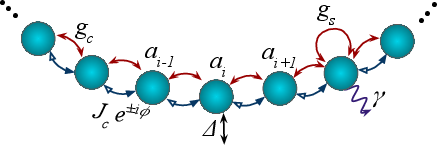
Figure 1: Schematic illustration of the bosonic Kitaev chain model, emphasizing local dissipation γ, parametric terms gs, and complex hopping Je±iϕ.
The dimerized variant induces collective gain via adiabatic elimination of auxiliary fast-decaying sites, enabling access to higher winding numbers in the topological invariant and broader classes of nontrivial phases.
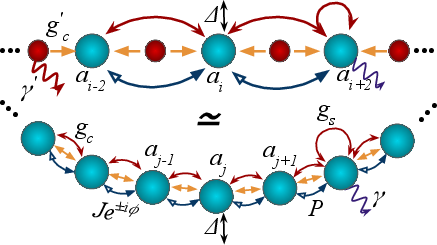
Figure 2: Dimerized chain schematic, with nonlocal pumping realized via collective gain from eliminated auxiliary modes.
The analysis employs the quantum Langevin formalism to solve the Lindblad equation and expresses the Green's function in terms of the SVD of ω1−H. Right singular vectors (J0) dictate spatial correlation structure, while singular values (J1) encode amplification channels. In driven-dissipative BdG systems, topological zero singular values yield edge-localized modes, dominating the Green's function and leading to observable amplification and LRO.
Topological Invariants and Phase Classification
The framework extends the notion of adiabatic deformation from closed Hamiltonian systems to quadratic Liouvillians. Topological equivalence between open systems is defined by the invariance in the number and character of singular value gap closings across the frequency axis. This classification leads to a vector-valued winding-number array J2, whose components correspond to the spectral winding number in each frequency interval separated by gap closings.
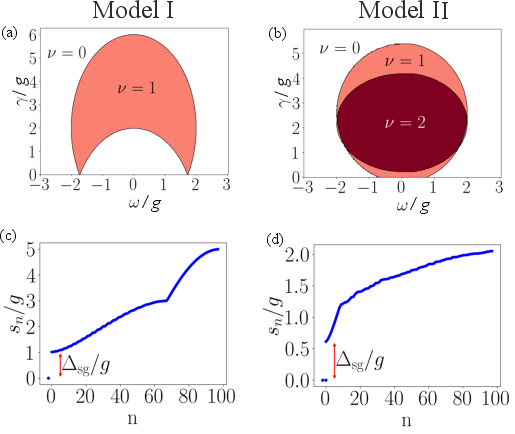
Figure 3: Topological phase diagrams for Model I and II, with winding-number arrays characterizing distinct phases and transitions.
The winding-number array serves as a robust topological invariant, encoding the existence of dominant zero singular values and thus predicting observable amplification and steady-state LRO.

Figure 4: Comparative schematic of adiabatic deformation and topological equivalence for closed and open systems, emphasizing the role of winding-number arrays.
Correlation Manifestations of Topological Protection
Frequency-Resolved Long-Range Order
When the system resides in a topological phase with winding number J3, frequency-resolved two-point correlations are dominated by a single edge singular vector. The normalized frequency-resolved correlator J4 remains finite even at large distances, marking true LRO. In phases with higher winding numbers, several singular channels may compete, but typically one mode dominates due to separation in singular value magnitude.
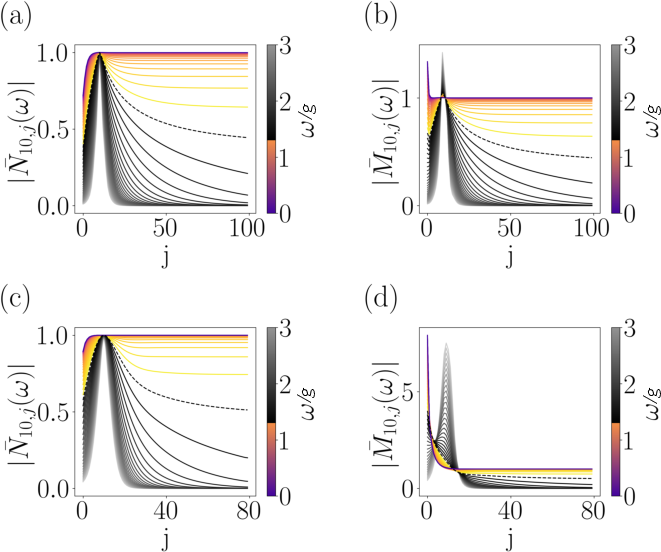
Figure 5: Normalized frequency-resolved correlations, demonstrating non-decaying behavior in topological regimes and rapid suppression in trivial phases.
A global LRO parameter J5 is introduced to quantify the spatial extension, yielding a clear correspondence with nontrivial topological regions.
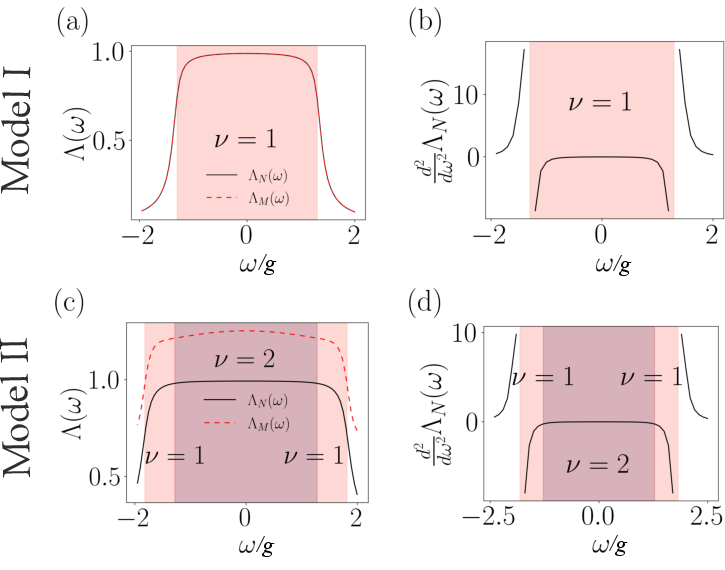
Figure 6: LRO parameter versus frequency, with sharp correspondence to topological phase boundaries and transitions.
Disorder Robustness
A central result is that the LRO of frequency-resolved correlations survives up to a critical disorder strength, provided the singular value gap remains open. Numerical analysis establishes scaling relations for disorder with respect to the gap, and correlators transition from nonstandard decay (convex, non-exponential) in the protected phase to exponential suppression above the critical disorder.
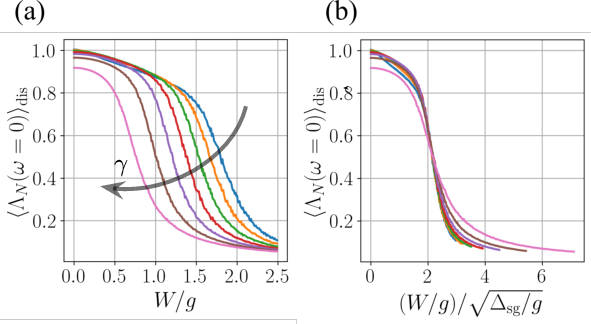
Figure 7: Averaged LRO parameter under increasing disorder, with scaling collapse when disorder is normalized to the singular gap.
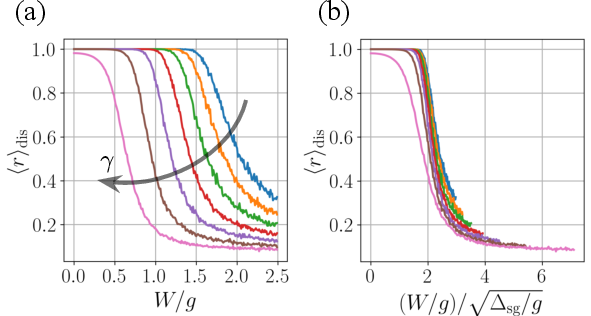
Figure 8: Disorder scaling of the J6-parameter, quantifying singular value gap closure and phase transition.
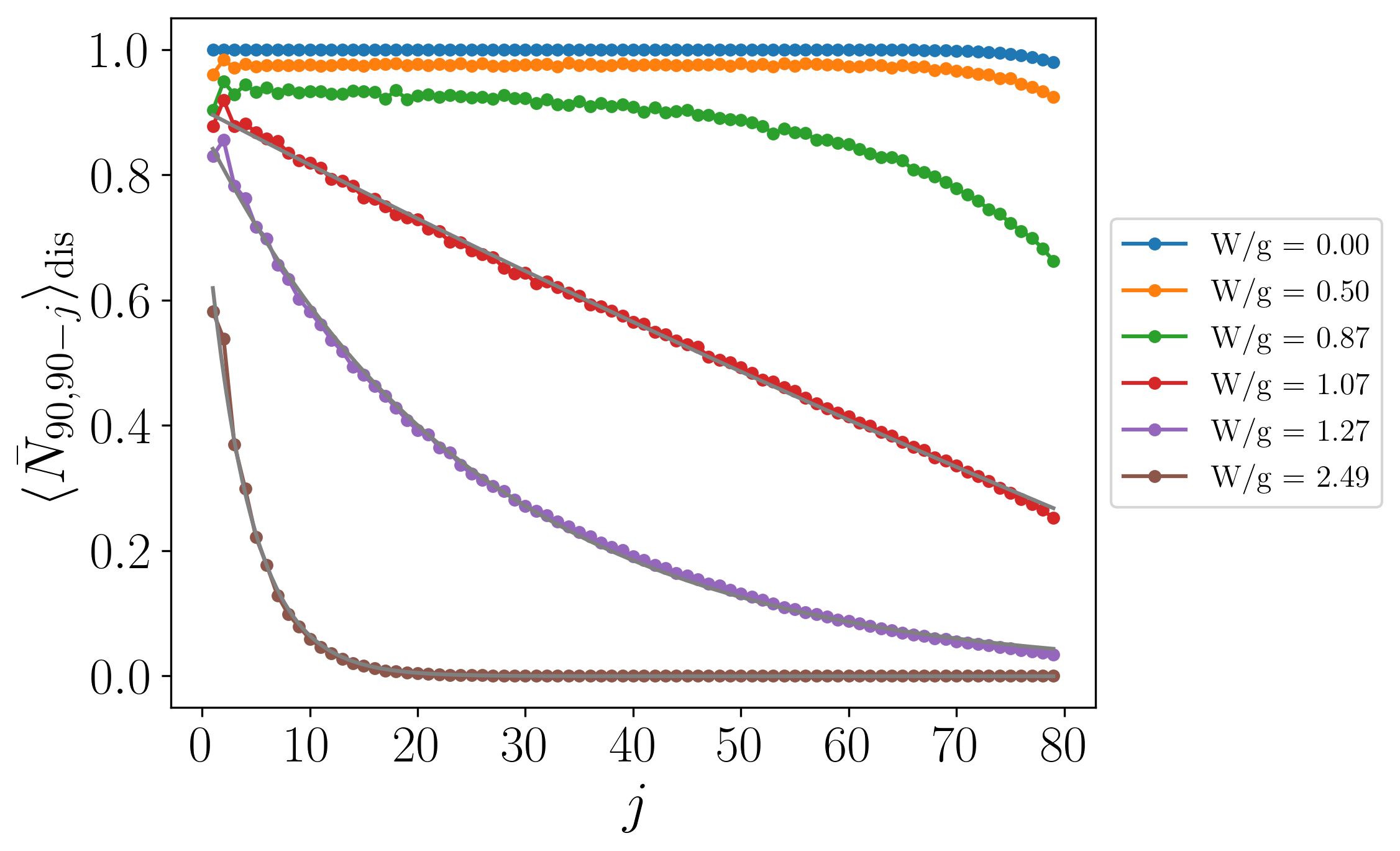
Figure 9: Spatial decay of normalized correlations under strong disorder, transitioning to exponential form.
Renormalized effective parameters derived analytically (via Born approximation) match numerical results in weak disorder regimes.
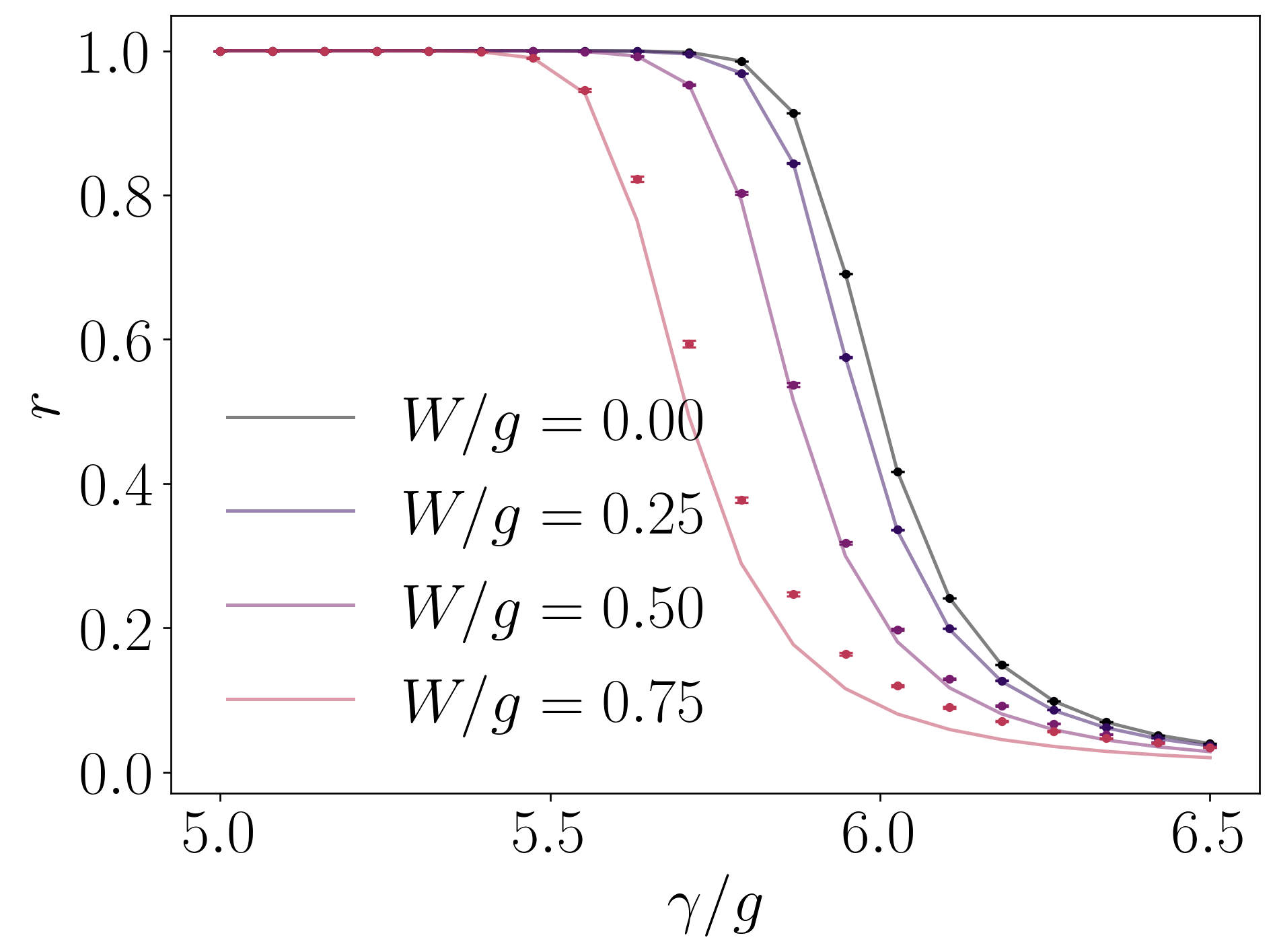
Figure 10: Comparison between simulated and analytic J7-parameter under renormalized disorder.
Equal-Time Correlations: Gaussian Spatial Decay
While frequency-resolved correlations show genuine LRO, equal-time two-point correlators display a Gaussian spatial decay in the topological phase, in contrast to exponential suppression in trivial regimes. This Gaussian profile originates from destructive interference in the frequency integration process and reflects the dominance of a single collective mode.
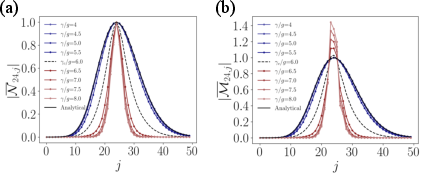
Figure 11: Model I normalized equal-time correlations, demonstrating Gaussian decay in the topological phase and exponential suppression in the trivial regime.
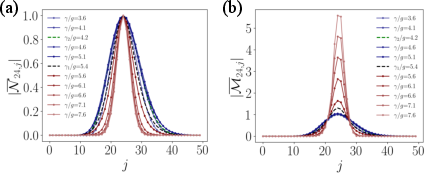
Figure 12: Model II correlations showing Gaussian profiles across multi-channel topological phases.
A global LRO parameter for equal-time correlations exhibits abrupt change at topological phase transitions.
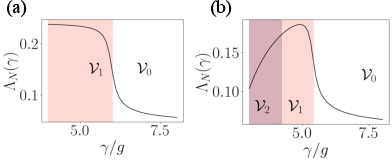
Figure 13: LRO parameter for equal-time correlations as a function of dissipation, marking phase boundaries.
Analytic Results: Edge Singular Vectors and Finite-Size Effects
The paper derives analytic forms for edge singular vectors and their localization properties in the semi-infinite chain limit, with boundary conditions yielding precise characterizations. The dependence of the zero singular value on system size is exponential, consistent with topological protection and numerically validated.
Practical and Theoretical Implications
The results establish steady-state correlations as intrinsic, experimentally accessible observables that encode topological information without external input or probe signals. This unlocks new avenues in quantum sensing, correlation engineering, and photonic device design. Importantly, disorder robustness is numerically and analytically characterized, validating practical feasibility for implementations in platforms such as trapped ions and superconducting circuits.
Theoretically, the paper demonstrates a direct operational connection between non-Hermitian topology (in quadratic Liouvillians) and measurable correlation functions, generalizing the bulk-boundary correspondence to open system steady states. The approach provides a new paradigm for detection and utilization of topological phases in open quantum systems, including applications in quantum information and amplification devices.
Conclusion
This work establishes a rigorous framework connecting non-Hermitian topological invariants in quadratic Liouvillians to intrinsic steady-state bosonic correlations, characterized by robust LRO in frequency-resolved observables and Gaussian spatial profiles in equal-time correlators. The phenomenology is analytically tractable and numerically validated across parameter regimes and under disorder, providing both experimental and theoretical justification for utilizing correlations as topological probes in open quantum matter. Future research directions include analysis of interacting systems, nonlinearities, and quantum entanglement in topological driven-dissipative systems.