From Approximation to Emergence: A Theory of Deep Learning
Abstract: Deep learning has outgrown any single mathematical explanation. From Approximation to Emergence develops a unified, proof-oriented account of modern deep learning theory, tracing a path from the classical foundations of approximation, optimization, and generalization to the contemporary mechanisms of overparameterization, robustness, generative modeling, transformers, in-context learning, scaling laws, interpretability, alignment, and emergence. Rather than presenting isolated results, the book organizes a broad literature into a coherent research narrative: each theory is examined through the object it controls, the assumptions that make it valid, and the phenomena it leaves unexplained. Written for researchers, graduate students, and mathematically trained practitioners, this monograph offers a rigorous map of deep learning theory as it stands today: powerful, incomplete, and increasingly centered on the question of how learned mechanisms arise from scale, data, architecture, and training.
- Mathematical theory of deep learning (2024)
- Beyond the Black Box: Theory and Mechanism of Large Language Models (2026)
- Conjugate Learning Theory: Uncovering the Mechanisms of Trainability and Generalization in Deep Neural Networks (2026)
- There Will Be a Scientific Theory of Deep Learning (2026)
- Deep Learning as Neural Low-Degree Filtering: A Spectral Theory of Hierarchical Feature Learning (2026)
- Statistical Properties of Training & Generalization (2026)
- Algorithmic Foundations of Deep Learning: Complexity-Theoretic Rates and a Characterization of Universal Approximation (2026)
- Born Discrete, Made Smooth: Variational Formulation of Shallow Neural Networks (2026)
- Deep Neural Variation Spaces: A Unifying Perspective on Depth and Complexity (2026)
- On Explicit Super-Expressive Approximation for Neural Networks (2026)
Summary
- The paper unifies deep learning theory by integrating approximation, optimization, generalization, and emergent behavior into a coherent mathematical framework.
- It details expressive capacity, depth separation, and the tradeoffs in kernel versus feature learning regimes, emphasizing implicit regularization.
- The work bridges theory and practice, providing insights into network design, stability, and the applicability of classical bounds in overparameterized settings.
From Approximation to Emergence: A Synthesis of Deep Learning Theory
The monograph "From Approximation to Emergence: A Theory of Deep Learning" (2607.01311) offers a comprehensive, systematic synthesis of the mathematical foundations underlying modern deep learning theory. This work organizes disparate results into a coherent narrative spanning approximation, optimization, generalization, robustness, and emergent properties in deep learning systems, with careful attention to modeling assumptions and theoretical boundaries.
Theoretical Framework and Problem Structure
Deep learning is formalized as the study of learning systems parameterized by high-dimensional, often highly overparameterized, compositional non-linear models. The core analytical framework is centered around four foundational questions:
- Expressive Capacity: What classes of functions can deep architectures approximate efficiently, especially in relation to depth-vs-width?
- Optimization and Selection: Why and under what conditions can (stochastic) gradient-based methods find useful solutions in nonconvex, overparameterized networks? What is the implicit bias of training dynamics?
- Generalization and Stability: How do high-capacity models generalize in practical settings, defying naive complexity-based bounds, and what mechanisms explain controlled generalization gaps?
- Modern Mechanisms: Which new theoretical tools are needed for robustness, generative modeling, scaling laws, in-context learning, interpretability, and phase transitions in emergent behaviors?
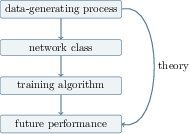
Figure 1: A useful theory must connect the data-generating process, the model class, the training algorithm, and performance on future data.
The monograph emphasizes that these questions must be examined in concert, as each reveals distinct mechanisms and limitations of deep learning through its own lens.
Approximation Theory: Universal Approximation and Barron's Theorem
The text initiates its analysis from the approximation-theoretic perspective, highlighting both qualitative and quantitative results.
- Universal Approximation Theorem: Shallow networks with non-polynomial activation (depth-two) are dense in C(K) for compact K⊂Rd (Cybenko, Hornik), implying that arbitrary continuous functions can be approximated when width is unbounded.
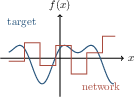
Figure 2: Approximation compares a target function with functions generated by a network class.
- Curse of Dimensionality: Naive constructions, such as grid-based piecewise constant functions, have width exponential in input dimension for uniform error guarantees: (ρ/ε)d for ρ-Lipschitz functions and uniform error ε. This renders universality practically vacuous in high dimensions without further structure.
- Barron's Theorem: Provides dimension-friendly approximation rates for functions with bounded Fourier first moment (the Barron seminorm):
B(f)=∫Rd∥ω∥2∣f(ω)∣dω
Shallow networks achieve L2 error O(1/k) in the number k of hidden units for Barron-class functions, with constants independent of ambient dimension (up to domain normalization factors), provided the spectrum is concentrated at low frequencies.

Figure 3: The Barron seminorm penalizes Fourier mass far from the origin.
This framework is formalized as two stages: (1) infinite-width integral representations using ridge functions, followed by (2) sparsification to finite sums using Maurey's lemma or Frank-Wolfe, yielding explicit rates.
Notably, high-frequency components are expensive in Barron's seminorm, reflecting fundamental impossibility for spectral generality but extreme efficiency for structured targets (e.g., Gaussians). However, the existence of an efficient shallow approximation does not guarantee that such representations are readily discoverable by optimization.
Architectural Expressivity: Depth Separation and Function Classes
While shallow networks are universal, depth provides exponential gains in expressive efficiency for specific function families. Telgarsky's construction, using repeated compositions of "tent map" ReLU modules, demonstrates functions that can be computed exactly by deep networks with width and depth O(L2), but for which any shallower network requires exponentially more units to achieve constant K⊂Rd0 error.
These results make explicit that:
- Depth enables compositional/hierarchical representations: Deep networks exploit repeated feature reuse, unattainable by width alone for certain tasks.
- Depth separation is constructive, not universal: It is not merely the existence but the constructed family of functions for which depth is provably exponentially more efficient.
- Optimization-theoretic and generalization-theoretic implications remain unresolved: Expressivity does not guarantee efficient learnability or good generalization, especially when dynamics are nonconvex.
Optimization Theory: Kernel Regimes and Implicit Regularization
Gradient-based optimization in overparameterized settings is nonconvex, yet modern architectures routinely converge to zero (or near-zero) training error. The monograph treats this analytically by distinguishing regimes:
- Neural Tangent Kernel (NTK) Regime: At large widths, neural network evolution under gradient descent linearizes around initialization; the tangent kernel remains nearly fixed, and training dynamics reduce to kernel regression. The convergence rate is controlled spectrally by the minimum eigenvalue of the NTK Gram matrix on the training data.
- Feature Learning Regimes: When parameter drift is non-negligible, NTK assumptions break, and representation learning emerges, which is not captured by fixed-feature or random-feature analyses.
The monograph systematically contrasts these two viewpoints, delineating the assumptions where NTK explains optimization and where it fundamentally cannot, particularly as width becomes finite or representations change substantially during training.
- Implicit Regularization: The optimizer's path in parameter space selects among the manifold of interpolating solutions, imparting an implicit bias. For example, vanilla gradient flow in least-squares regression selects the minimum-norm interpolator. In non-Euclidean settings (e.g., via mirror descent), different parameterizations induce selection of different implicit regularizers (e.g., K⊂Rd1 vs. K⊂Rd2 or margin-maximizing solutions).
Generalization, Stability, and Double Descent Phenomena
Traditional generalization theory relies on classical capacity measures (VC dimension, Rademacher complexity). However, overparameterized networks present scenarios where empirical risk minimization achieves zero training error, yet generalization error remains controlled—contradicting classical bias-variance intuition.
- Generalization in Overparameterized Regimes: Deep networks can fit random labels, indicating extremely high (VC-dimension-based) capacity. Yet, on natural data, they generalize well due to factors not captured by worst-case uniform convergence bounds. The text surveys margin-based, compression-based, and PAC-Bayes bounds as more refined alternatives.
- Algorithmic Stability: Stability measures how prediction or loss changes upon example replacement in the training set. Algorithms with strong convexity, explicit regularization, or implicit stochastic regularization (e.g., early stopped SGD) can be shown to be stable, thereby guaranteeing generalization even with large capacity.
- Double Descent: In linear models and neural networks, risk curves can "double-descent" as model complexity exceeds sample size, with test error peaking at the interpolation threshold (K⊂Rd3) and then decreasing as effective regularization (e.g., minimum-norm selection) controls instability in the overparameterized regime.
Distributional and Computational Assumptions
The monograph discusses the sharp distinction between worst-case and distributional learning:
- Distributional Assumptions Enable Tractability: Under product inputs (Boolean cube or Gaussian), Fourier analysis and noise-stability supply tools for sample-efficient learning of function classes (e.g., intersections of halfspaces) via low-degree truncations.
- Statistical Query (SQ) Lower Bounds: SQ and correlational-SQ models restrict learners to statistical averages (e.g., population gradients). Families of parity functions on the Boolean cube (and corresponding shallow neural architectures under Gaussian input) are shown to be hard for any SQ/CSQ learner, with lower bounds scaling as K⊂Rd4 for queries or K⊂Rd5 for tolerances, where K⊂Rd6 is network width.
- Noisy Gradient Coupling: Noisy population gradient descent (GD with Gaussian noise at each step) can be coupled to a CSQ algorithm. Thus, parity-type and CSQ lower bounds transfer to this subclass of optimization algorithms, but not to all forms of SGD (sample-level algorithms can exploit information beyond robust statistical queries).
- Proper vs. Improper Learning: The monograph emphasizes that improper learners can bypass computational hardness of proper learners by moving to a larger output class, thereby trading computational hardness for higher sample-complexity; cryptographic hardness results (e.g., for intersections of halfspaces) survive even against improper learners for certain data distributions.
Practical and Theoretical Implications
The analysis in this text impacts both theory and AI practice:
- Theory: By separating approximation, optimization, and generalization, and identifying the mathematical objects (spectral properties, geometry, noise stability) that govern each, the monograph clarifies which explanatory mechanisms illuminate which phenomena—and where theoretical understanding remains incomplete. Theoretical progress is tightly bound to modeling assumptions (distribution, architecture, dynamics).
- Practice: Insights on the limitations of fixed-feature and kernel methods justify empirical practices favoring overparameterization, depth, and architecture-specific inductive biases. The recognition of implicit regularization mechanisms helps inform optimizer and initialization choices. Explicit recognition of double descent and algorithmic stability compels practitioners to reconsider the tradeoffs between capacity, trainability, and generalization across domains and scales.
- Future Directions: The emergence of phenomena not reducible to classical triad (robustness, interpretability, emergent behaviors) signals directions for further theoretical development—necessitating new abstractions, e.g., mechanistic interpretability, scaling laws, alignment, and novel classes of generalization and optimization theory.
Conclusion
"From Approximation to Emergence" (2607.01311) provides a deeply analytical, proof-oriented roadmap through foundational and current problems in deep learning theory. Its systematic synthesis demarcates the boundaries of expressivity, optimization, generalization, and computational tractability, and carefully distinguishes between what is explained by current mathematical apparatus and what remains out of reach. By articulating precise links between approximation rates (Barron theory), landscape geometry, algorithmic bias, data distribution, and model complexity, the monograph establishes a coherent technical foundation for future developments at the intersection of mathematics, optimization, and large-scale AI systems.
Paper to Video (Beta)
No one has generated a video about this paper yet.
Whiteboard
No one has generated a whiteboard explanation for this paper yet.
Paper Prompts
Sign up for free to create and run prompts on this paper.
Top Community Prompts
Open Problems
We haven't generated a list of open problems mentioned in this paper yet.
Continue Learning
- How does the paper reconcile classical approximation theory with modern deep learning practices?
- What implications does the depth separation result have for practical neural network architecture design?
- In what ways do kernel regimes and feature learning theories differ in explaining training dynamics?
- How are implicit regularization and double descent phenomena addressed to explain generalization in overparameterized networks?
- Find recent papers about generalization in neural networks.
Tweets
Sign up for free to view the 2 tweets with 11 likes about this paper.

