- The paper presents the first JWST transmission spectrum of a temperate exo-Neptune, confirming a CH4-dominated, H2-rich atmosphere with percent-level CO2.
- It employs dual-instrument observations and independent pipelines to address systematic uncertainties and validate atmospheric retrievals across 0.65–5.2 μm.
- The findings benchmark TOI-1231 b as a deep atmospherically complex sub-Neptune, challenging shallow envelope models and guiding future exoplanet studies.
Transmission Spectrum Analysis of TOI-1231 b: The Benchmark Temperate Exo-Neptune
Introduction and Motivation
The atmospheric characterization of sub-Neptunes remains a critical frontier in exoplanetary science due to their ambiguous internal structures and the potential implications for planet formation, atmospheric evolution, and habitability. Sub-Neptunes, particularly those in the temperate regime (Teq<400 K), present significant challenges and opportunities: their densities are consistent with diverse compositions, including mini-Neptunes, hycean worlds, and gas dwarfs. TOI-1231 b is an ideal empirical benchmark. Its high precision mass and radius (∼3.65R⊕, ∼15.4M⊕) unambiguously require a thick, deep H2-rich envelope. Characterizing its atmosphere thus critically tests predictions for deep versus shallow atmospheric regimes and serves as a keystone for interpreting other sub-Neptunes. This work provides the first JWST near-infrared transmission spectrum of a temperate exo-Neptune, leveraging NIRISS and NIRSpec coverage (0.65–5.2 μm).
Observational Strategy and Data Processing
Two full primary transits of TOI-1231 b were observed at different epochs with JWST/NIRISS SOSS and NIRSpec G395H, yielding continuous spectral coverage and redundancy for systematic control. Data reduction was performed with two independent pipelines, JexoPipe and JExoRES, enabling assessment of pipeline-dependent systematic uncertainties and their propagation into retrieval outcomes. White light curves produced with both pipelines exhibit evident spot crossing events, necessitating careful treatment of star spots and potential unocculted photospheric heterogeneity.
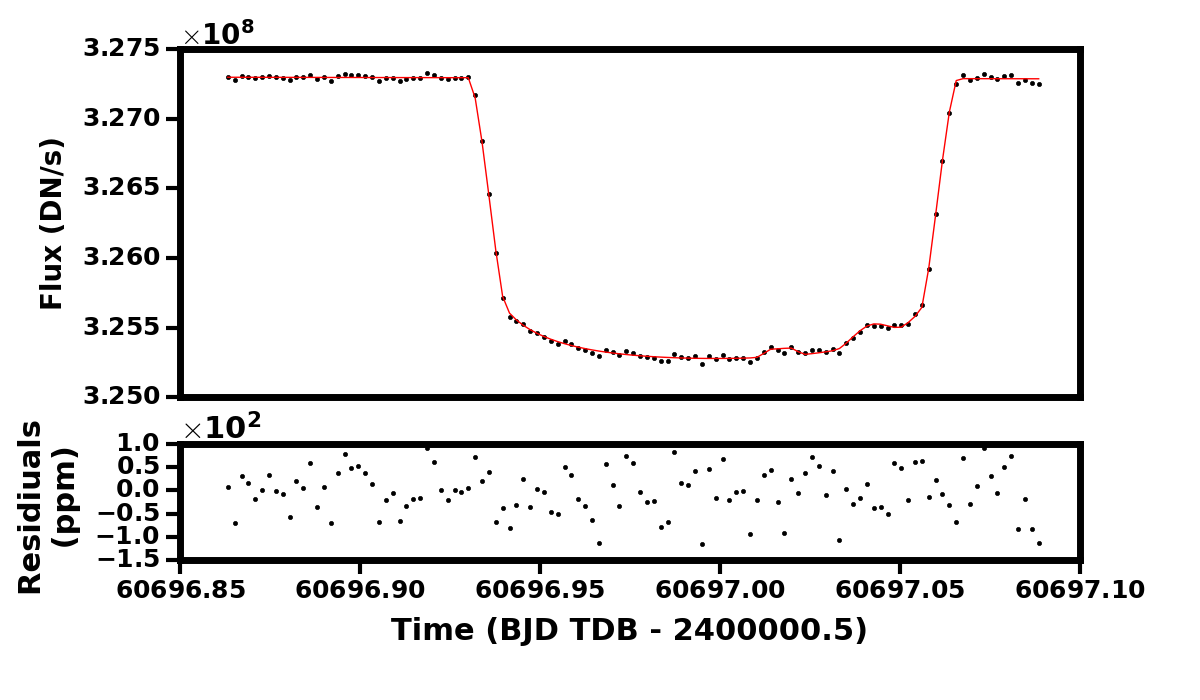
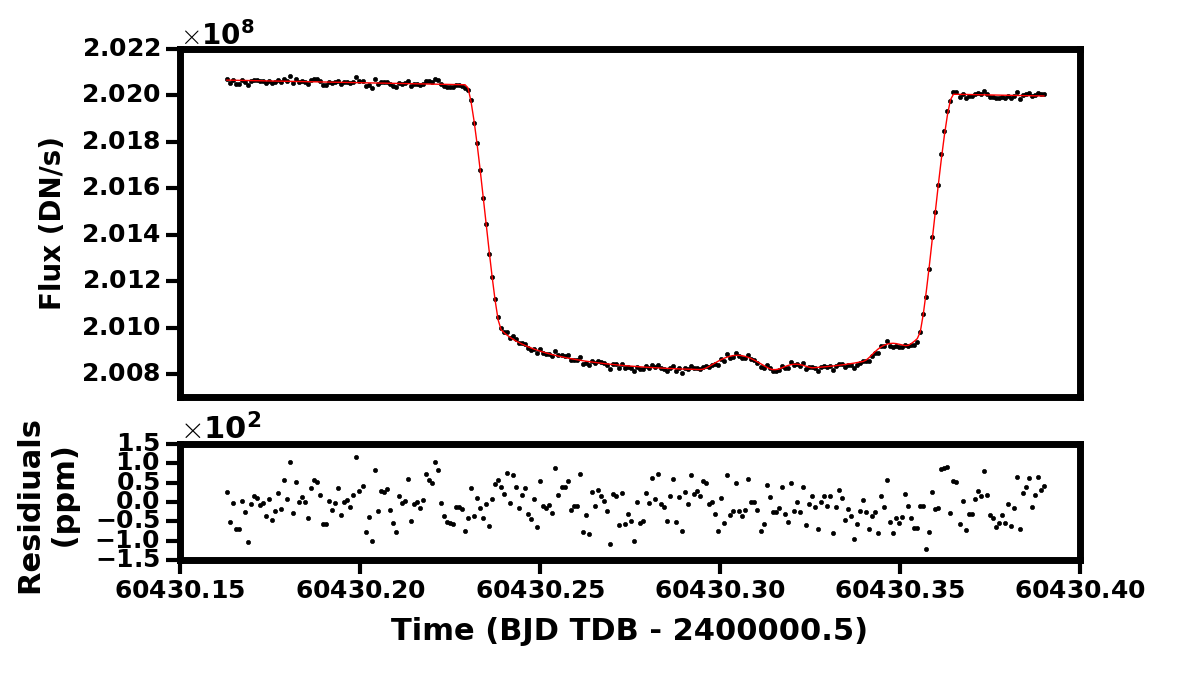
Figure 1: White light curves of TOI-1231 b transits with JWST NIRISS (left) and NIRSpec (right); spot crossing anomalies are visible as deviations from the best-fit model.
The final transmission spectra from NIRISS and NIRSpec are in close agreement across both pipeline reductions, with the JexoPipe product chosen for primary retrievals. Spectral uncertainties exceed photon noise by ∼20–60% due to detector systematics, background subtraction challenge, spot correction, and residual correlated noise.
Retrieval Framework and Model Selection
Atmospheric retrievals utilized the POSEIDON nested sampling framework. The primary model incorporated six expected CNO species (CH4, CO2, CO, H2O, NH3, HCN), a flexible P-T parameterization, inhomogeneous clouds/hazes, and free inter-instrument offsets. Stellar heterogeneity (unocculted spots/faculae) was included as a model option. Model selection was driven by Bayesian evidence (∼3.65R⊕0) with uncertainties ∼3.65R⊕1.
Key model selection conclusions:
- At least one inter-instrument offset is required (∼3.65R⊕2 vs. zero-offset).
- Stellar heterogeneity is not required in the JexoPipe analysis and only modestly favored with JExoRES.
- Non-isothermal P-T profiles are not preferred over isothermal for current data (∼3.65R⊕3).
Atmospheric Composition Results
Key Detections
Robust detection of CH∼3.65R⊕4: Across all model and pipeline variants, CH∼3.65R⊕5 is detected with ∼3.65R⊕6–∼3.65R⊕7, at ∼3.65R⊕8 (i.e., ∼3.65R⊕9 volume mixing ratio), among the highest retrieved in any exoplanet atmosphere to date.
CO∼15.4M⊕0 evidence: CO∼15.4M⊕1 is detected at moderate significance (∼15.4M⊕2–∼15.4M⊕3) with ∼15.4M⊕4 (∼15.4M⊕5 vmr).
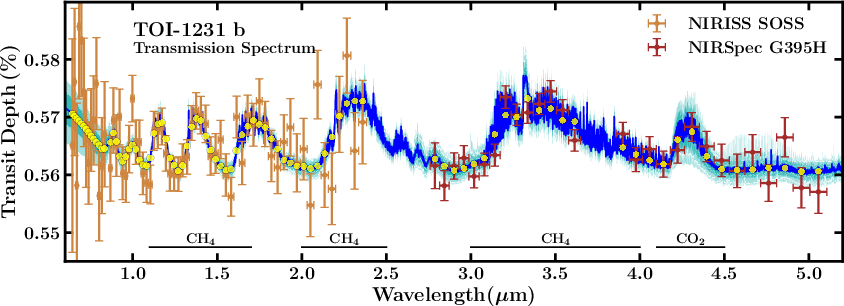
Figure 2: JWST transmission spectrum of TOI-1231 b and the best-fit atmospheric model including six major CNO molecules and a single offset.
No other molecule (NH∼15.4M⊕6, H∼15.4M⊕7O, CO, HCN) is detected at ∼15.4M⊕8 confidence, although upper limits remain high and compatible with substantial abundances: e.g., ∼15.4M⊕9 (95\% CL), 20, 21.
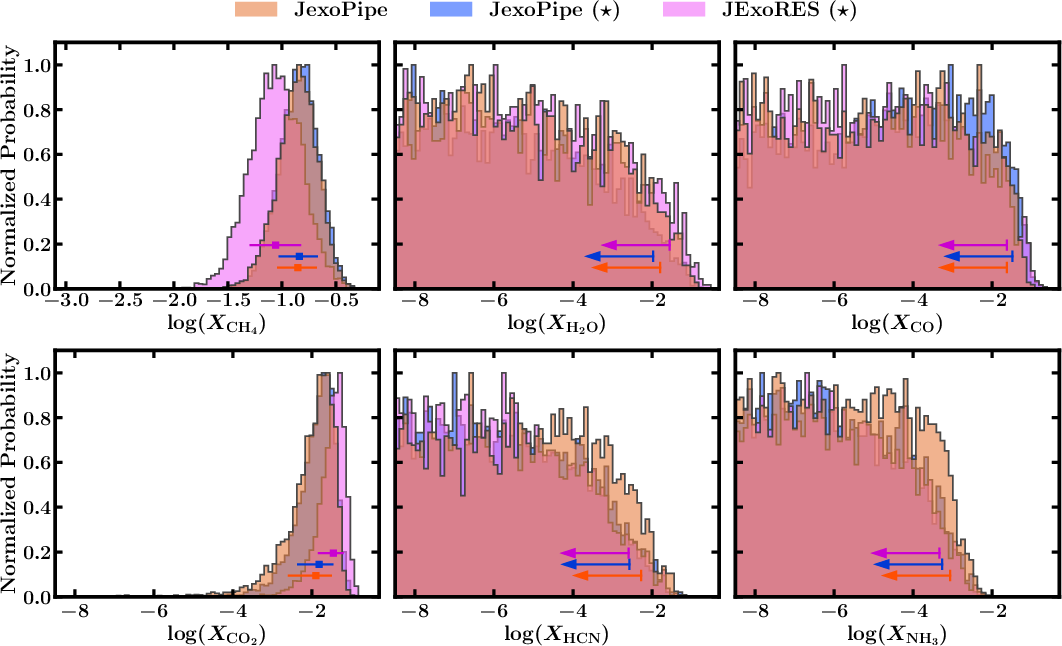
Figure 3: Posterior distributions for mixing ratios of the six targeted CNO molecules, showing strong support for CH22 and moderate support for CO23 only.
Extended retrievals incorporating 11 species—including biosignature candidates and sulfur/organic compounds—do not favor any additional absorber (all 24), and a systematic sweep over 201 trace molecules yields no robust preferences exceeding moderate statistical significance, particularly when robustness against pipeline systematics is required.
Physical and Comparative Interpretation
Atmospheric Regime and Model Consistency
The inferred composition—dominant CH25, percent-level CO26, high allowed NH27—is consistent with thermochemical equilibrium in a deep, high-metallicity, H28-rich envelope without a distinct surface. The measured transmission spectrum is inconsistent with a shallow H29 envelope overlying a high mean-molecular-mass interior or a water layer, as inferred for lower-mass hycean candidates.
Clouds and hazes are required to fit the spectral continuum (μ0 over clear), consistent with expectations for irradiation and possible photochemical haze formation in temperate Neptunes.
Benchmarking Against Other Sub-Neptunes
Compared to K2-18 b and TOI-270 d, both of which have ambiguous or shallow Hμ1 envelopes with suppressed CHμ2 and NHμ3, TOI-1231 b stands as an unambiguous empirical benchmark for deep Neptune-like atmospheres. The much tighter upper limits for NHμ4 and CO in K2-18 b (μ5 vmr) imply significant differences in interior-atmosphere coupling and recycling efficiency.
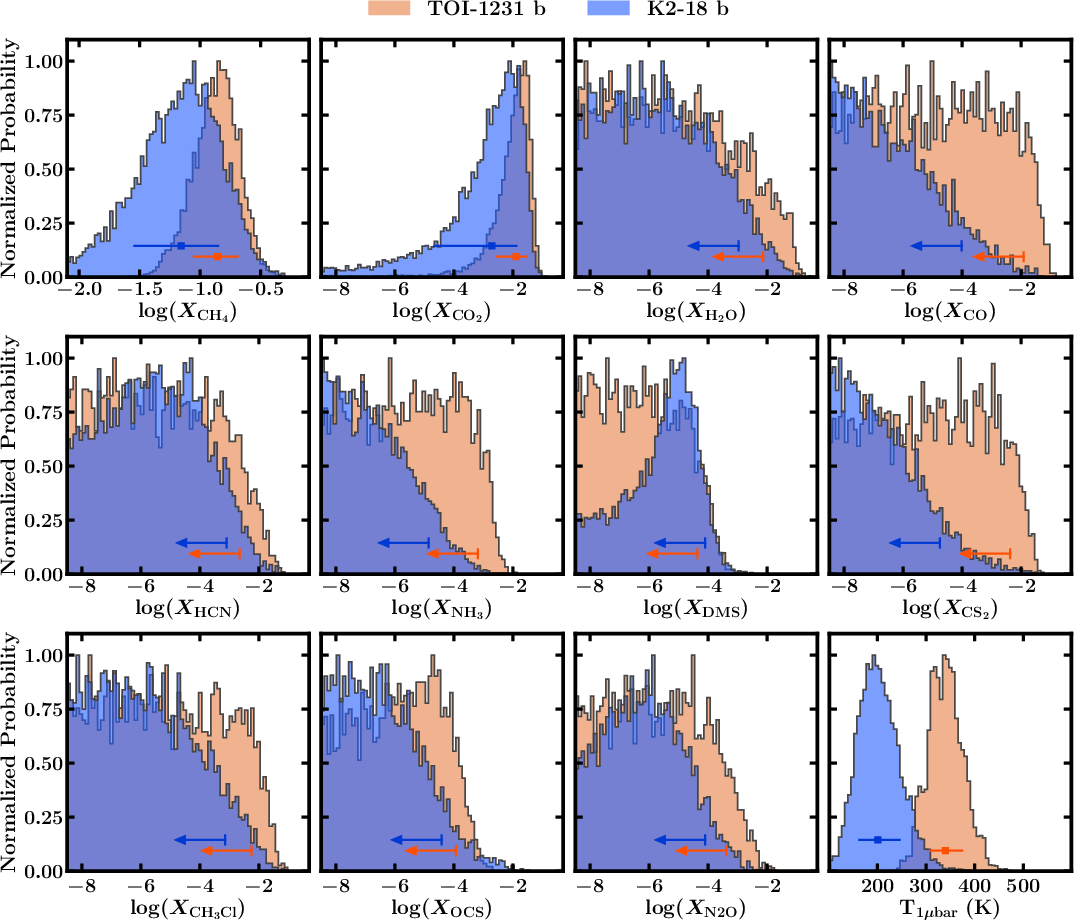
Figure 4: Comparison of retrieved posteriors for 11 molecular species in TOI-1231 b and K2-18 b, illustrating divergent upper limits (especially for CO and NHμ6), but overlapping CHμ7 and COμ8 detection ranges.
Warm Neptunes (e.g., GJ 3470 b, LTT 9779 b) show suppressed CHμ9, elevated CO, and cloud-masked features, as predicted by thermochemistry at higher ∼0.
Sulfur and Nitrogen Chemistry
Despite expectations for detectable sulfur photochemical products, no robust detection is obtained for H∼1S or CS∼2, with high upper limits persisting. The absence is plausibly explained by photochemical destruction, sequestration in deep cloud layers, or masking by haze opacity—further high SNR observations are needed to test these limits. Non-detection of NH∼3 is not constraining due to current sensitivity.
Observational and Methodological Implications
This study demonstrates the necessity of multi-instrument, multi-epoch coverage, rigorous pipeline cross-validation, and comprehensive model/parameter marginalization for robust atmospheric inference from JWST spectra. The lack of sensitivity to model details (e.g., number of offsets, completeness of P-T parameterization, explicit stellar heterogeneity) for the detection of CH∼4 and CO∼5 underscores the high SNR and constraining power of these data. However, the inability to robustly constrain or exclude other major chemical species highlights the need for higher SNR and broader wavelength coverage.
Future Prospects in Exoplanet Atmospheres
TOI-1231 b will serve as a reference point for the atmospheric taxonomy of sub-Neptunes, informing the classification of other temperate planets observed by JWST and future missions. As the spectroscopic census of sub-Neptunes grows, including future MIRI spectroscopy and ground-based high-resolution follow-up, TOI-1231 b enables the calibration of retrieval degeneracy between atmospheric depth, recycling efficiency, and bulk density.
The persistent model degeneracies for trace absorbers also raise important theoretical challenges, including the role of atmospheric metallicity, vertical mixing, sulfur/nitrogen sequestration, and haze/cloud microphysics, all of which must be refined to exploit next-generation spectroscopic datasets.
Conclusion
The transmission spectrum of TOI-1231 b constitutes the first definitive characterization of a deep, temperate Neptune-like atmosphere and empirically confirms the expectation of CH∼6 dominance and percent-level CO∼7 in high-metallicity, H∼8-rich envelopes. The robust exclusion of shallow/hycean scenarios in this case provides a critical anchor for interpreting more ambiguous sub-Neptunes. These results establish new empirical constraints on atmospheric composition, chemical recycling, and irradiation-driven photochemistry in the temperate regime, underpinning future population-level inference and the search for secondary and biosignature gases with increased SNR and wavelength coverage (2607.00973).

