- The paper demonstrates that LOCC protocols can activate hidden nonlocality and incompletability in quantum state discrimination tasks.
- It uses explicit bipartite constructions and sequential local projective measurements to transform completable product state sets into strictly incompletable ones.
- The study links state discrimination with resource theories by showing how LICC restrictions on coherence impose structural limits that relate to both nonlocality and incompletability.
Hierarchy of Hidden Nonlocality and Activation of Incompletability
Introduction and Motivation
The discrimination of orthogonal quantum states by local operations and classical communication (LOCC) is a fundamental problem in quantum information theory. While entanglement is a well-established marker of nonlocality, there are non-entangled (product) state sets exhibiting LOCC-indistinguishability, demonstrating "nonlocality without entanglement." Unextendible product bases (UPBs)—incomplete orthogonal sets not completable to a full product basis—play a crucial role in revealing connections between local indistinguishability, incompletability, and nonclassical correlations. This paper introduces and systematically analyses the phenomenon of activation of incompletability, placing it in a hierarchy with activation of nonlocality in the context of local discrimination tasks.
Activation Phenomena and Definitions
The authors formalize several activation phenomena relevant to state discrimination:
- Nonlocality Activation: A set of orthogonal states, initially LOCC-distinguishable and free from local redundancy, can become LOCC-indistinguishable after an LOCC protocol (specifically an orthogonality-preserving measurement).
- Incompletability Activation: A stronger phenomenon, in which a completable, LOCC-distinguishable set can be converted into a strictly incompletable set (i.e., a set not completable to an orthonormal product basis) via LOCC.
These activation processes are illustrated schematically, with incompletability activation being a strictly stronger property; it implies nonlocality activation, but not vice versa.
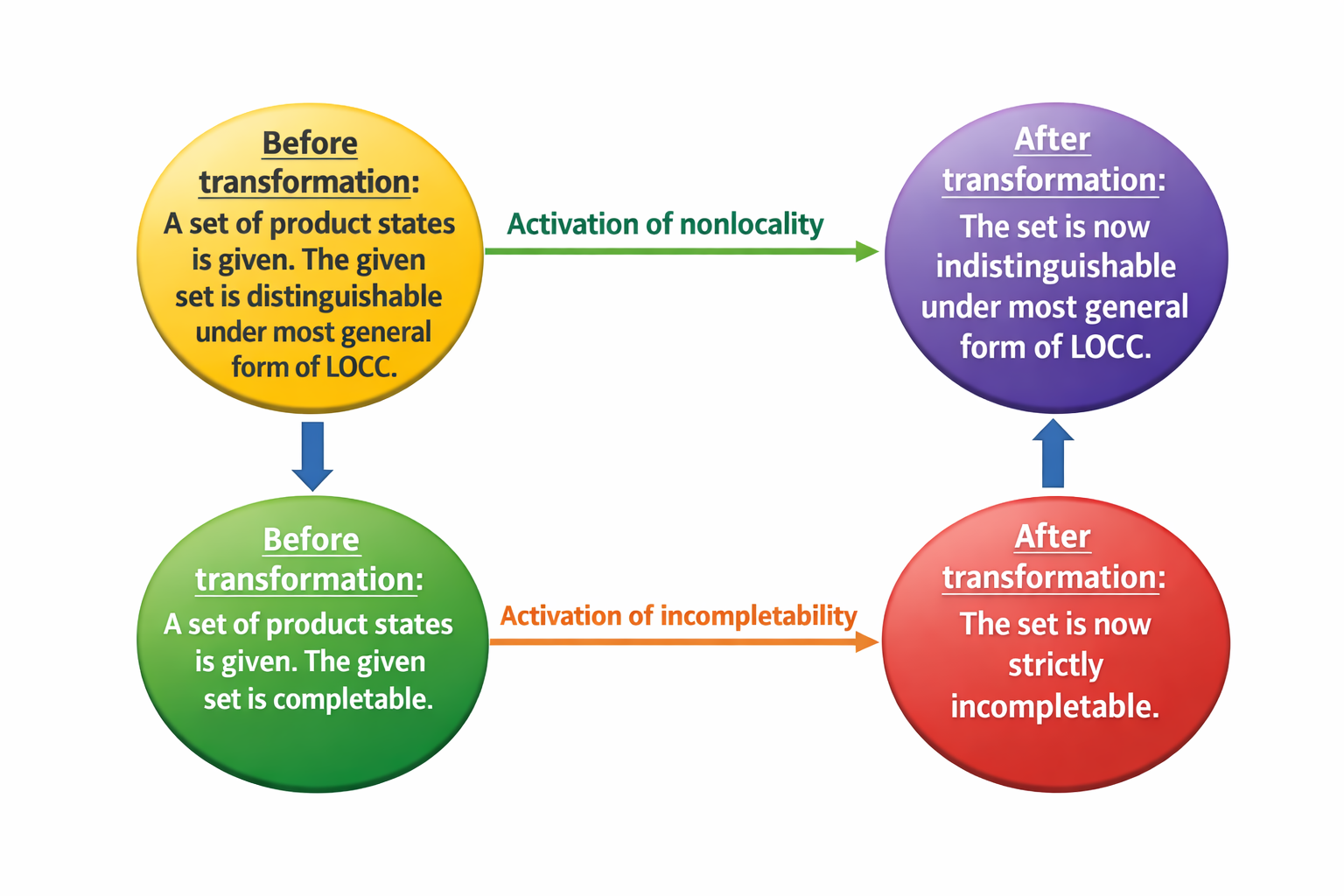
Figure 1: Schematic illustration of the activation transformation—from a LOCC-distinguishable, completable product state set to a strictly incompletable, LOCC-indistinguishable set, activating both incompletability and nonlocality.
Explicit Constructions and Hierarchical Separation
The paper provides explicit bipartite examples that demonstrate both activation phenomena. For nonlocality activation, the authors present a set in C2⊗C4 that is free from local redundancy and LOCC-distinguishable, but after a specific sequence of local projective measurements, reduces to sets that are locally indistinguishable (e.g., subsets equivalent to the indistinguishable Bell basis in C2⊗C2).
For activation of incompletability, the construction involves a ten-state set of product vectors in C6⊗C6. The set is LOCC-distinguishable and completable; however, upon sequential application of carefully chosen local projective measurements, each post-measurement branch yields subsets isomorphic to the canonical UPB ("tile"), which are strictly incompletable in C3⊗C3.
This operational process strictly separates the two phenomena: while all incompletability-activable sets are also nonlocality-activable, the paper supplies counterexamples (such as a nine-state set in C6⊗C6) that exhibit nonlocality activation but do not induce incompletability post-measurement. This establishes a strict inclusion hierarchy.
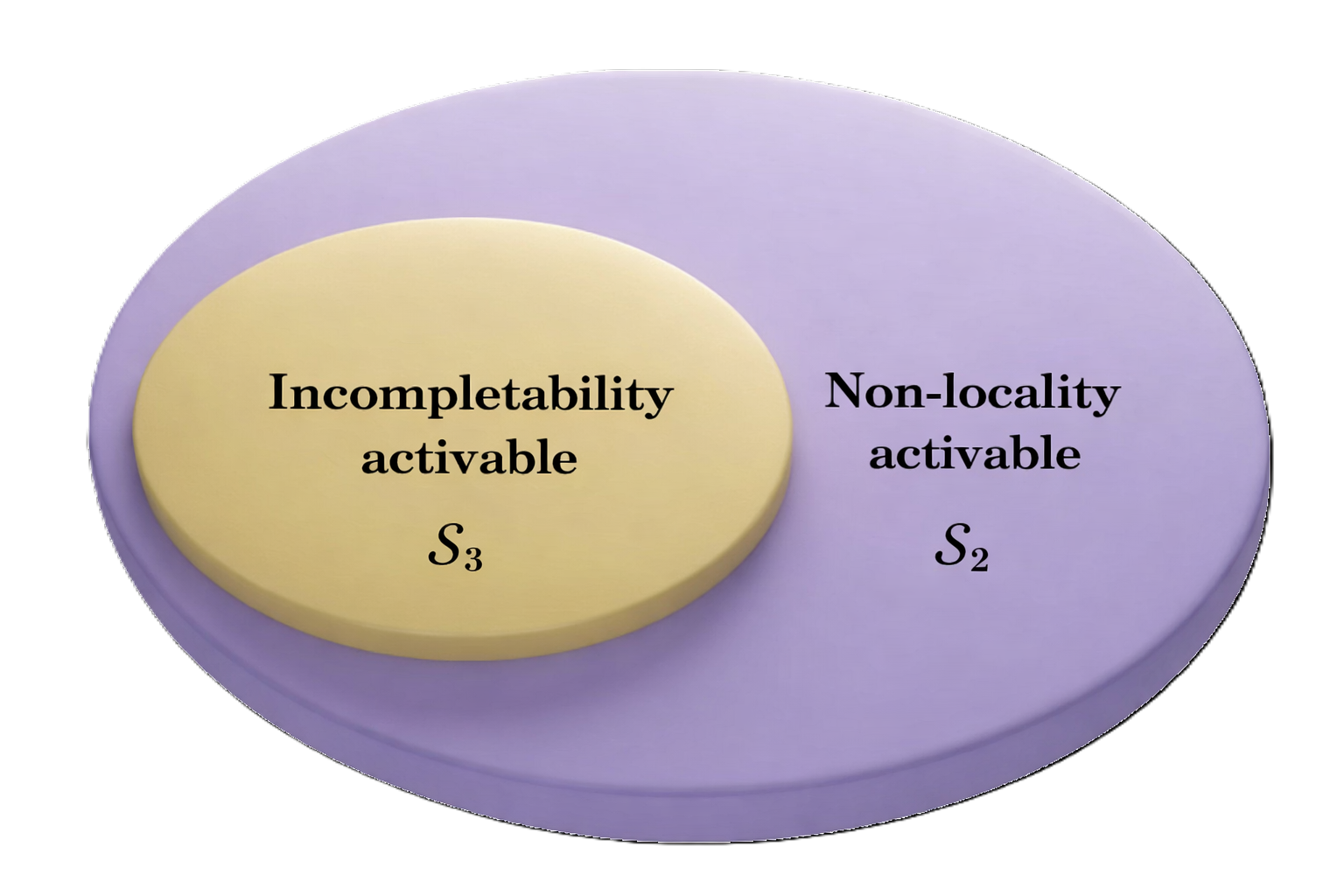
Figure 2: Depiction of the hierarchy—activation of incompletability (yellow) is a subset within the broader phenomenon of nonlocality activation (purple).
Theoretical Implications and LICC Constraints
Beyond LOCC, the authors investigate the consequences of restricting operations to Local Incoherent Operations and Classical Communication (LICC). Incoherent operations, defined by Kraus decompositions that preserve basis incoherence locally, restrict the ability to increase coherence through LOCC protocols.
The paper proves that for any set exhibiting incompletability activation via LICC, there always exists a completion to a full orthonormal basis; however, this completed basis cannot be LOCC-distinguished—thus linking incompletability activation to fundamental constraints enforced by the resource theory of coherence. Notably, the post-activation sets cannot increase coherence, in accordance with LICC's operational restrictions.
The results further cement the interaction between nonlocality, incompletability, and local quantum coherence: strict activation phenomena reveal nonclassical structure inaccessible by product, locally accessible means, and that local coherence serves as an obstacle to basis extension and discrimination under physically realistic measurement constraints.
Practical and Theoretical Implications
The paper's results have significant implications for quantum information processing tasks that rely on state discrimination, data hiding, and secret sharing. They provide operational criteria for distinguishing between forms of hidden nonclassicality, and enable a finer resource-theoretic classification of quantum ensembles beyond entanglement.
On the theoretical front, the establishment of this hierarchy contributes to a deeper understanding of the subtleties underlying LOCC and LICC protocols and their interplay with the resource theories of entanglement and coherence. The explicit constructions and activation protocols open avenues for further generalization to multipartite systems and for the exploration of activation structures in higher-dimensional or resource-constrained settings.
Conclusion
The paper introduces activation of incompletability as a genuine and strictly stronger form of nonlocality activation in the context of quantum state discrimination. By providing explicit constructions and rigorous proofs, it establishes a nontrivial hierarchy between the two phenomena. The work also elucidates how additional local restrictions—particularly LICC—impose structural constraints on the completion and LOCC-distinguishability of quantum state sets, thereby highlighting a profound connection between local distinguishability, incompletability, nonlocality, and coherence. Future investigations may further extend these results to multipartite systems and uncover deeper links between resource theories and activation phenomena in quantum information science.