- The paper shows that complete orthogonal product bases remain locally distinguishable under any orthogonality-preserving local projective measurements.
- Activation of nonlocality without entanglement is achieved only when the initial product set is incomplete, leading to evolution into unextendible product bases.
- Rigorous analysis across bipartite and multipartite settings clarifies operational boundaries for quantum state discrimination and resource conversion.
Incompleteness and the Activation of Nonlocality Without Entanglement
Introduction
This work rigorously investigates the operational and mathematical constraints underlying the activation phenomenon of nonlocality without entanglement (NLWE), focusing on the role of completeness in orthogonal product bases under LOCC and LPCC frameworks. The central result establishes that the activation of NLWE is fundamentally tied to the incompleteness of the initial orthogonal product set: complete orthogonal product bases (COPBs) that are initially locally distinguishable cannot be rendered locally indistinguishable via any orthogonality-preserving local projective measurements, even in the presence of classical communication. Consequently, incompleteness is a necessary condition for the activation of hidden nonlocality in unentangled quantum systems.
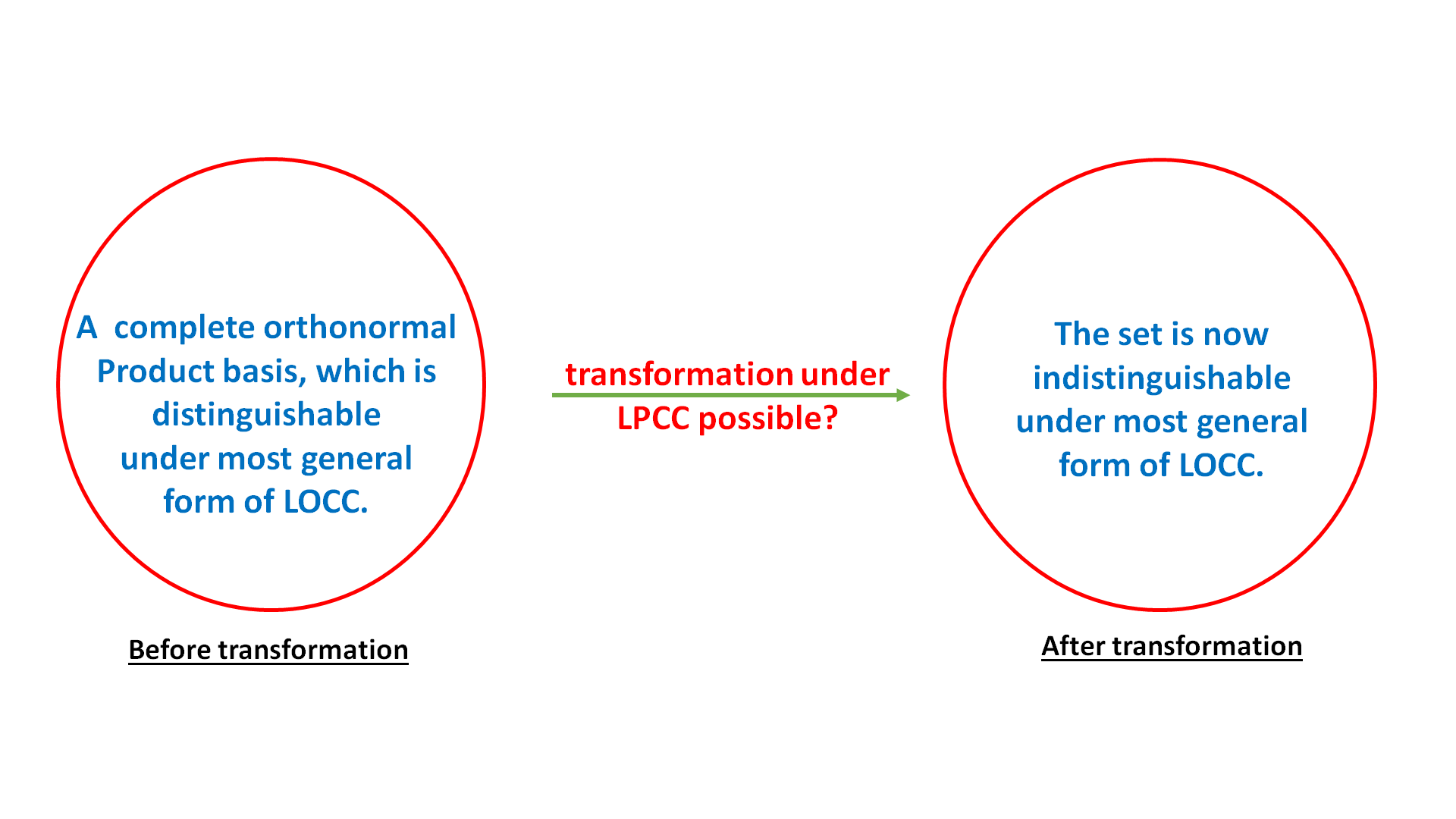
Figure 1: Statement of the activation problem: can a set of locally distinguishable orthogonal product states be transformed into a locally indistinguishable set via orthogonality-preserving local projective measurements?
Background and Motivation
The LOCC paradigm encapsulates physically allowable local discrimination protocols in quantum information, with strong restrictions in both bipartite and multipartite settings. It is elementary that entanglement is not a prerequisite for the exhibition of nonlocal features—indeed, unextendible product bases (UPBs) and related constructions gave rise to the concept of NLWE. Recent work has expanded focus to the dynamical activation of nonlocality—determining whether locally distinguishable, orthogonal product sets can be converted, via local actions, into LOCC-indistinguishable ones.
Importantly, local projective measurements (as in LPCC) represent an experimentally feasible and structurally significant subset of LOCC. Activation of nonlocality in this stricter setting reveals deeper structural properties constraining quantum state discrimination, data hiding, and secret sharing schemes.
Main Results
Structural Rigidity of Complete Orthogonal Product Bases
The paper's central theorem asserts that any complete orthonormal product basis that is initially distinguishable by LOCC remains so under any sequence of orthogonality-preserving local projective measurements and classical communication (OP-LPCC). The post-measurement states are always confined to the original basis set; no new product vectors are structurally accessible, and no protocol using such operations can activate a nonlocal response.
Explicitly, for any nontrivial OPLPM acting on a complete basis, the only possible post-measurement outcomes are either the complete elimination or survival (up to proportionality) of basis vectors—the action cannot induce new orthogonal product directions. This is shown rigorously for both bipartite and multipartite systems and holds across all possible bipartitions (strong locality).
Contrasting Behavior for Incomplete Product Sets
In contrast, for incomplete orthogonal product sets, the action of a nontrivial OPLPM may yield new product vectors outside the initial set, rendering activation possible. Concrete examples demonstrate that suitable projective measurements can deterministically evolve an initially distinguishable set into an unextendible product basis (which is locally indistinguishable), underscoring the operational significance of incompleteness. This demarcates a sharp boundary between strong locality (incomplete sets) and the emergent activation of hidden NLWE.
Strong Locality in Multipartite Settings
The strong locality property of complete product bases is preserved in all multipartite scenarios: no bipartition or grouping of subsystems can facilitate activation through OP-LPCC. This invariance under partitioning solidifies the role of completeness as a structural invariant.
Illustrative Examples
The theoretical results are underpinned by explicit constructions.
- For the COPB S1⊂C3⊗C3, no orthogonality-preserving local protocol can induce activation; all surviving states post-measurement are drawn from S1.
- For the incomplete set S2⊂C3⊗C6, an LPCC protocol exists such that the post-measurement set augments into an LOCC-indistinguishable UPB. This demonstrates that activation is viable if and only if the initial basis is incomplete.
Discussion and Implications
The results elucidate a fundamental geometric and operational dichotomy in the landscape of quantum state discrimination: the possibility of activating hidden NLWE is exclusive to incomplete product sets. Complete orthogonal product bases—the backbone of many quantum algorithms and information tasks—are structurally immune to such evolution under OP-LPCC. This rigidity further clarifies the operational boundary between LOCC and the broader class of separable or PPT measurements, and enables a finer taxonomy of product-set-based quantum protocols.
Practical implications include:
- Quantum Data Hiding: Only incomplete sets are candidates for decomposable data hiding schemes leveraging activation.
- Secret Sharing: The activation boundary provides precise conditions under which secret-reconstruction protocols can transition from local to nonlocal regimes without invocation of entanglement.
- Quantum Resource Theory: The results position completeness as an intrinsic barrier for certain resource conversions under local projective protocols.
Theoretical implications include:
- The structural results invite further exploration into catalytic and assisted transformations, particularly where local ancilla or generalized measurements are allowed.
- There is scope to systematically classify all incomplete sets (up to local unitaries) which are amenable to activation, leading potentially to a "taxonomy of activable sets".
Future Directions
The necessity of incompleteness for activation opens several research pathways:
- Characterization and enumeration of all nontrivial activable incomplete sets in higher dimensions and multipartite systems.
- Investigation of the interplay between activation phenomena and robustness to noise, error correction, and operational imperfections.
- Extension of the analysis to broader classes of local operations (e.g., non-projective POVMs, limited-entanglement assistance).
Conclusion
This work rigorously establishes that completeness is a structural invariant preventing activation of nonlocality without entanglement under OP-LPCC. Incompleteness is strictly necessary for such activation. This distinction crystallizes important operational, theoretical, and resource-theoretic boundaries for quantum protocols relying on product state discrimination, and motivates further refinement of nonlocality-related phenomena in multipartite quantum information processing.
Reference: "Incompleteness is necessary for activation of nonlocality without entanglement" (2605.29775).