- The paper introduces local state antimarking (LSAM) as a novel LOCC-based task that reveals nonlocality without entanglement through exclusion strategies.
- It establishes operational hierarchies linking LSAM, local state antidistinguishability, and traditional state discrimination, highlighting distinct exclusion regimes.
- Numerical and analytical results demonstrate activation phenomena and inequivalences between marking and exclusion tasks in quantum product state ensembles.
Local State Antimarking: Nonlocality Without Entanglement
Introduction
The paper "Local state antimarking : Nonlocality without entanglement" (2605.09710) explores new paradigms in quantum nonlocality, specifically within the context of product states that are not entangled. The work builds upon the informational variant of quantum nonlocality identified by Peres and Wootters and Bennett et al., where local operations and classical communication (LOCC) do not achieve the maximal discrimination power available globally. The central construct is the notion of antidistinguishability and a new operational task termed "local state antimarking" (LSAM). Antidistinguishability generalizes quantum state exclusion and expands the hierarchy of nonlocal tasks beyond state discrimination and marking.
Antidistinguishability and Local Tasks
Antidistinguishability is characterized by the existence of a Positive Operator-Valued Measure (POVM) such that, given an ensemble S, one can always rule out at least one candidate state with certainty, while guaranteeing all measurement outcomes are relevant for at least one state. The strong variant, requiring each outcome to target exclusion of a unique state, is operationally distinct from weak antidistinguishability, which allows redundancy in excluded states. Analytical conditions for antidistinguishability are established for ensembles of pure states via pairwise overlaps.
This paradigm is extended to local antidistinguishability (LSAD), where spatially separated parties use only LOCC to perform exclusions. The paper demonstrates that ensembles such as the Bell states, while locally inconclusive or indistinguishable in standard discrimination, are locally perfectly antidistinguishable. The celebrated Bennett et al. product states, which are locally indistinguishable in conventional measures, also admit local antidistinguishability.
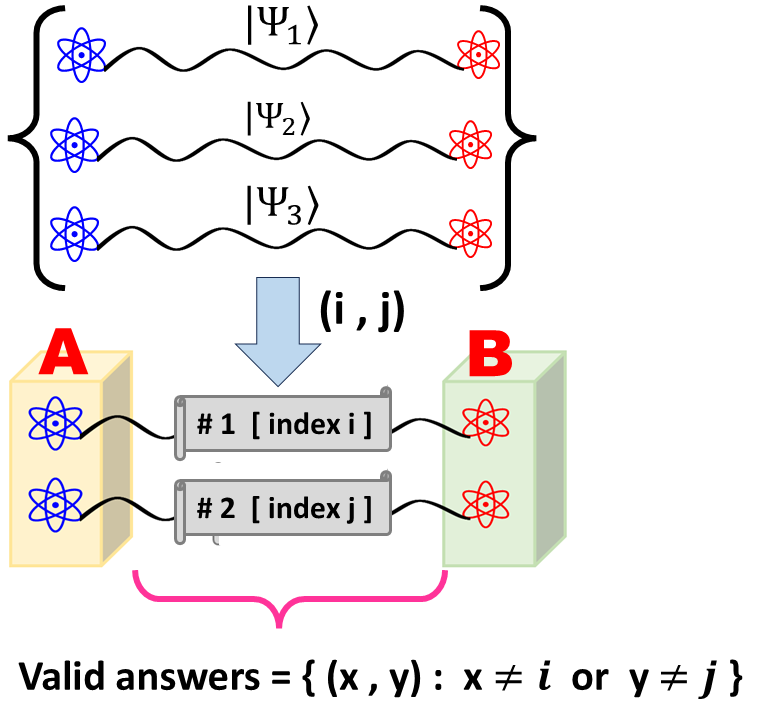
Figure 1: Visualization of the bipartite LSAM task for n=2—parties must eliminate at least one ordered sequence from distributed, non-repetitive states.
Remarkably, every set of mutually orthogonal multipartite pure states is locally antidistinguishable, a result constructed via LOCC protocols exploiting the structure established by Walgate et al. The operational hierarchy thus places LSAD below state discrimination (LSD), but above more general exclusion paradigms.
Local State Antimarking (LSAM)
The paper introduces LSAM as an exclusion-variant of local state marking (LSM). In LSAM, multiple non-repetitive states are distributed simultaneously; parties are tasked to exclude at least one permutation from possible assignments using only LOCC. LSAM is strictly weaker than both LSD and LSAD: any ensemble not admitting LSAM also fails marking, antidistinguishability, and discrimination via LOCC.
The authors establish an implication chain:
LSD⟹LSM⟹LSAM,LSD⟹LSAD⟹LSAM
Ensembles nonlocal in the LSAM sense therefore exhibit the strongest "nonlocality without entanglement," marking a genuinely new operational regime.
Activation phenomena emerge: ensembles not globally antidistinguishable can become so when analyzed via their sequence permutations in LSAM, yet no LOCC protocol permits the task, demonstrating hidden nonlocality.
Operational Hierarchies and Equivalences
A systematic comparison between LSAD, LSAM, conclusive local state discrimination (CLSD), and conclusive local state marking (CLSM) is provided. Ensembles are constructed where no strict hierarchy exists between LSAD and CLSD—some product state ensembles permit one task while forbidding the other. Classical examples like Bennett's product states lose their nonlocality under LSAD, whereas the Duan states retain it. Conversely, some ensembles, such as anti-parallel double-SIC, permit LSAD but not CLSD, demonstrating the diagnostic power of the new exclusion framework.
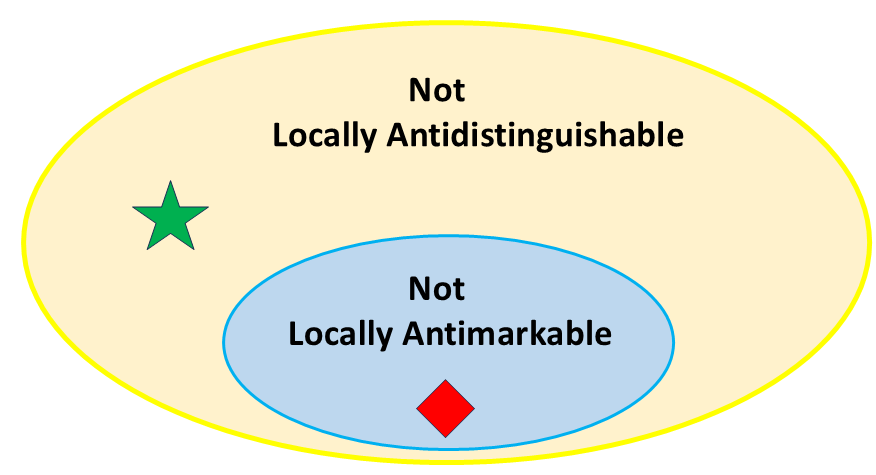
Figure 2: Explicit demonstration of the strict hierarchy: SNL1 is not locally antidistinguishable but is (2,1)-antimarkable.
An analogous analysis with CLSM and LSAM reveals no strict operational hierarchy. Ensembles are found which are nonlocal in one regime but not the other, demonstrating deep inequivalences between the paradigms.
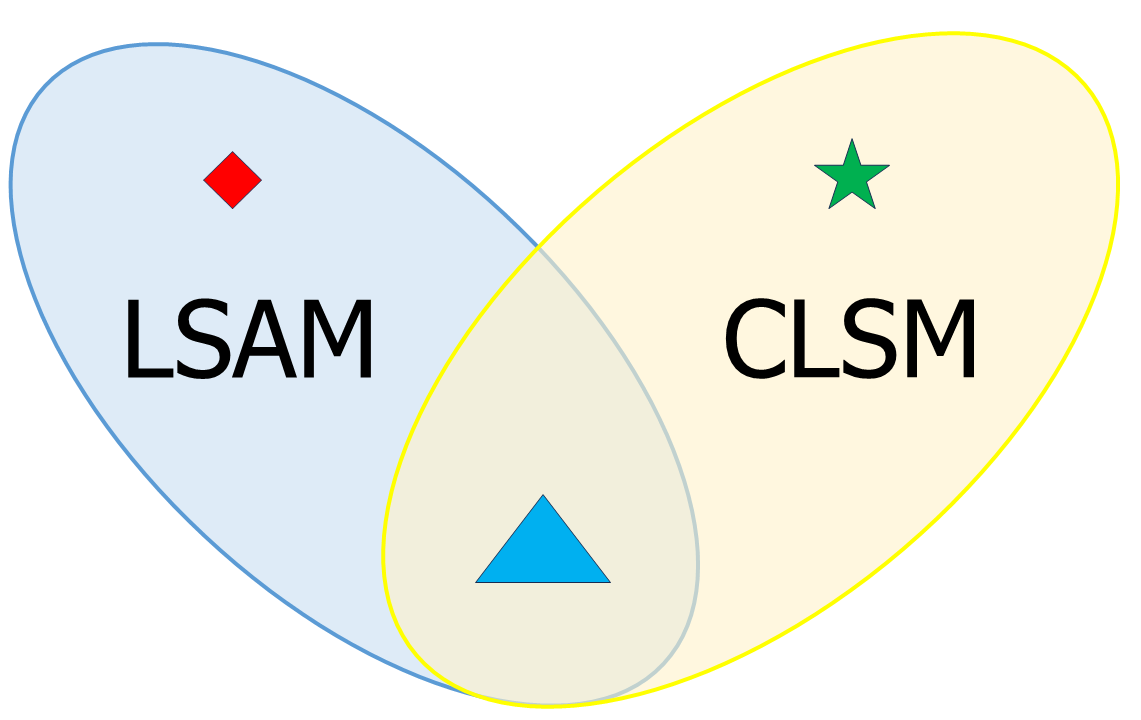
Figure 3: Explicit demonstration of no hierarchy between LSAM and CLSM—distinct ensembles exhibiting divergent operational behavior.
Numerical results highlight parameter-dependent nonlocality in tripartite examples: ensembles are globally antidistinguishable yet not (2,1)-LSAM for certain ranges, even though they are conclusively markable, exposing further separation between marking and antimarking regimes.
Activation and Superactivation
The paper observes activation-like phenomena in LSAM. Ensembles not globally antidistinguishable, when explored through their possible sequence permutations, exhibit global antimarkability; however, the same is not achievable with LOCC. This "superactivation" reveals new layers of hidden nonlocality in product-state ensembles.
Implications and Perspectives
The mechanisms of local state antimarking delineate strong nonlocality—one that is informational and operational rather than statistical (Bell). LSAM exposes subtle distinctions in the discrimination power of LOCC, even among product, non-entangled states, yielding new criteria for cryptographic protocols, data hiding, and foundational studies.
Theoretical implications include: (i) the classification of nonlocality strength via operational tasks, (ii) the construction of ensembles with maximally separated local and global exclusion properties, and (iii) possible links to mixed-state antidistinguishability. Practically, such findings inform quantum communication schemes where LOCC constraints are paramount, including secret sharing and secure transmission.
The paper suggests future research avenues include finding ensembles of mutually orthogonal mixed states failing local antidistinguishability, and refining constructs in the bipartite regime validating stronger nonlocality via LSAM.
Conclusion
This work establishes local state antimarking as a uniquely powerful operational task, enabling new forms of nonlocality without entanglement. The activation and hierarchy analyses underscore how exclusion paradigms sharply refine the landscape of nonlocality among product states. The revealed inequivalences between marking, discrimination, and exclusion tasks reflect deep structural subtleties in quantum information theory, encouraging further exploration of their theoretical and practical ramifications.