- The paper introduces a frame-based AFDM-ISAC design that integrates chirp-enabled pulse compression to overcome self-interference and high-mobility challenges.
- It employs an analog-domain chirp mixing with low-pass filtering alongside GCE-BEM and KF-BEM for low-complexity channel estimation and robust radar parameter extraction.
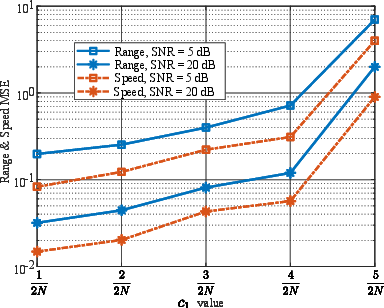
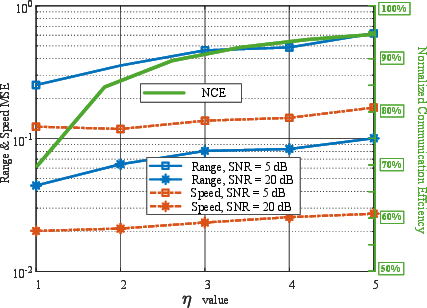
- Numerical results demonstrate superior range and velocity RMSE as well as favorable BER performance, highlighting effective throughput-sensing trade-offs.
Introduction and Motivation
This work presents a comprehensive design for integrated sensing and communications (ISAC) utilizing affine frequency division multiplexing (AFDM) with a practical, frame-based waveform structure endowed with chirp-enabled pulse compression (2607.00632). The central motivation lies in addressing the limitations of classical OFDM and OTFS ISAC schemes under high mobility and stringent simultaneous radar-communication requirements—in particular, self-interference cancellation (SIC) complexity in monostatic settings, underexploited chirp compression gain, and high computational overhead in delay/Doppler channel estimation.
By proposing a novel AFDM-ISAC frame structure with judicious allocation of subcarriers for sensing (as single-chirp pilot subcarriers, SPS) and communication, the scheme leverages AFDM’s flexibility in delay-Doppler resilience and pulse compression. An analog-domain sensing receiver facilitates efficient hardware realization, mitigates SIC constraints through low-pass filtering (LPF), and exploits parameter-guided digital domain fusion for robust radar estimation. For communication, low-complexity channel estimation is achieved via a generalized complex exponential basis expansion model (GCE-BEM) and a Kalman filter (KF-BEM) for frame-based tracking.
AFDM-ISAC Frame Structure and Signal Model
The AFDM-ISAC frame is composed of periodically interleaved ISAC symbols and pure data symbols. Each ISAC symbol dedicates the central (N/2-th) subcarrier as the SPS for sensing and channel estimation, with guard and additional pilot subcarriers to shield communication subcarriers from high-frequency interference and mitigate Doppler-induced inter-carrier contamination.

Figure 1: Illustration of (a) wrapped AFDM subcarriers (K=2) and (b) the proposed AFDM-ISAC frame structure.
By exploiting the complete AFDM bandwidth via SPS, the approach achieves full-range radar resolution with minimal communication overhead. The parameter η controls the ISAC/data symbol ratio, which governs the trade-off between communication and sensing (higher η enhances throughput at the cost of sensing resolution and unambiguous velocity detection).
Chirp-Enabled Analog Sensing Receiver
Traditional monostatic ISAC systems are encumbered by SIC challenges. The paper proposes a receiver in which the received echo is mixed with a conjugated local SPS chirp, followed by a well-designed LPF and ADC. This approach enables isolation of the intermediate frequency (IF) signal associated with sensing, while substantially attenuating interference from communication subcarriers and on-board transmitter leakage—circumventing the need for full-duplex hardware. The local reference delay parameter allows control of the maximum sensing range window without communication resource sacrifice.
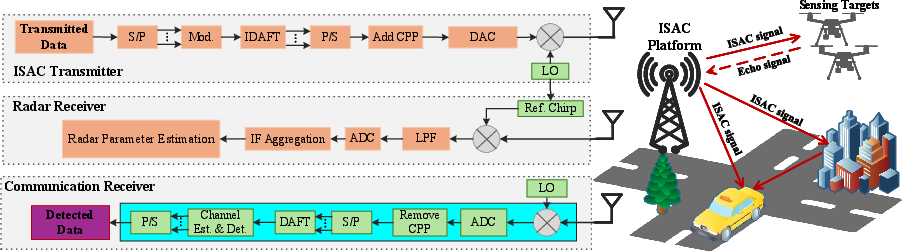
Figure 2: The proposed AFDM-ISAC signal processing.
The beat frequency (BF) after dechirping is directly related to target range and velocity, with the design ensuring minimal ADC rate (proportional to maximal BF, not AFDM bandwidth), drastically reducing hardware complexity.
AFDM Parameter-Guided Sensing: Phase Hopping and Fusion
A major challenge in AFDM-based ISAC is phase discontinuity (hopping) across concatenated chirp sweeps within symbols, caused by spectrum wrapping. The paper analyzes the IF signal mathematically, revealing the structure of phase discontinuities and proposes parameter-guided fusion. By aggregating chirp components with consistent Doppler and BF dependencies, robust range and velocity estimation is achieved via 2D-FFT or ESPRIT, even in the presence of spectrum wrapping and phase hopping.
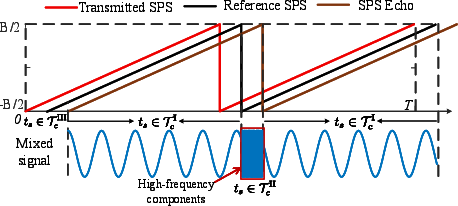
Figure 3: Illustration of the transmitted SPS, the corresponding received echo, and the IF signal with K=2.
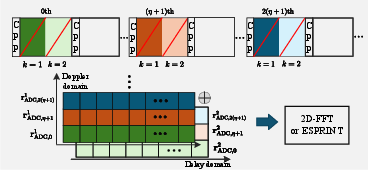
Figure 4: Illustration of the proposed AFDM-oriented parameter estimations.
Low-Complexity Channel Estimation: GCE-BEM and KF-BEM
The scheme employs GCE-BEM to model time-varying multipath propagation with reduced parameterization, allowing efficient LMMSE channel estimation using pilot subcarriers in ISAC symbols. A power allocation optimization between pilot and data subcarriers is formulated, maximizing SINR and yielding strong BER performance, especially under high mobility.
To further mitigate channel prediction error for pure data symbols lacking pilots, a Kalman-filter-based BEM (KF-BEM) fuses noisy observations and temporal dynamics within the frame, providing robust channel tracking.
Numerical Sensing Results
Channel Estimation and Throughput
- Simulation shows that BER performance of the proposed GCE-BEM and KF-BEM channel estimation schemes closely approaches that of perfect CSI at high mobility (Figure 8, Figure 9).
- The scheme demonstrates negligible degradation even up to 600 km/h UE speed, outperforming EPA-RC and ECE benchmarks.
- As K=21 increases, less pilot power is necessary, facilitating greater power allocation to data and improving BER (Figure 10).
- The proposed frame-based architecture enables flexible throughput/sensing trade-offs: throughput approaches the pure-communication bound with increasing K=22 (Figure 6), while sensing error remains bounded for moderate K=23.
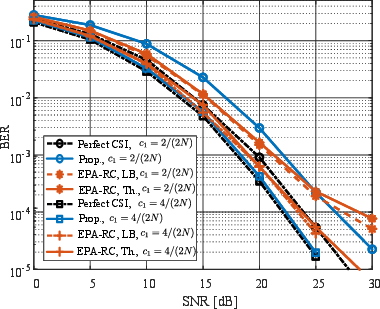
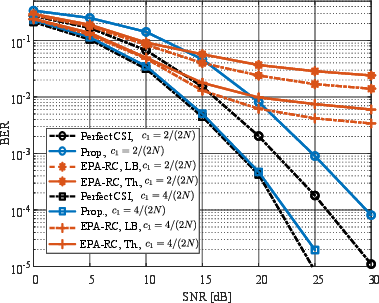
Figure 8: BER for user speed 160 km/h versus SNR, illustrating robustness of GCE-BEM/KF-BEM.
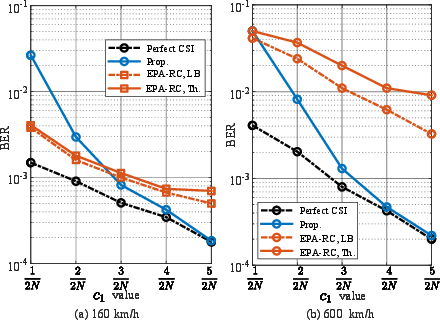
Figure 10: BER as a function of K=24 for SNRK=25 dB, showing superiority of BEM-based approaches at moderate to large K=26.
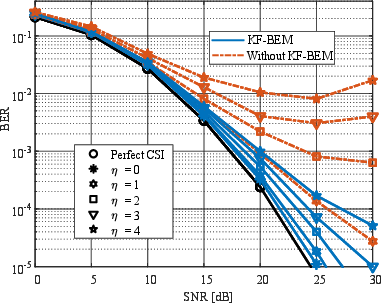
Figure 9: BER performance of the proposed KF-BEM for different K=27.
Implications and Future Research
The AFDM-ISAC framework provides a highly practical scheme for next-generation airborne and terrestrial ISAC in scenarios such as aerial networks and vehicular sensing. The analog-domain chirp mixing and LPF technique sidesteps the full-duplex hardware demands and supports high-mobility channel estimation at reduced complexity and power consumption. The frame structure and parameterization allow for adaptable trade-offs, suitable for diverse SNR, mobility, and throughput requirements.
Open directions include extending the framework to MIMO-ISAC for 3D angle/range/velocity estimation, more complex bistatic/multistatic topologies, and real-world prototyping with Doppler and hardware nonlinearities. The parameter-guided sensing fusion paradigm is directly portable to other chirp-based or affine-domain multicarrier systems.
Conclusion
The paper establishes a robust, low-complexity, and highly flexible design for AFDM-based ISAC, combining frame-based waveform structuring, analog-domain pulse compression, and model-based channel/tracking estimation. Strong numerical results confirm its superiority over classical and recent ISAC methods, particularly in high-mobility and hardware-sensitive scenarios. The methodology generalizes to future ISAC systems seeking to maximize flexibility, spectral efficiency, and hardware tractability.