- The paper presents AFBM, a new 6G ISAC waveform that integrates affine precoding and filter-bank processing to achieve reduced PAPR and OOBE.
- It employs pruned DAFT precoding with per-subcarrier filtering, yielding approximately a 2 dB PAPR reduction relative to conventional methods.
- The design includes low-complexity GaBP and EM-assisted PDA receivers, enabling efficient joint communication and high-resolution radar sensing over doubly-dispersive channels.
Introduction and Motivation
The paper introduces Affine Filter Bank Modulation (AFBM), a new waveform architecture for 6G Integrated Sensing and Communications (ISAC) systems. AFBM is designed to address the limitations of existing multicarrier waveforms—such as OFDM, OTFS, and AFDM—when operating over doubly-dispersive (DD) channels typical in high-mobility and high-frequency scenarios. Specifically, AFBM targets the simultaneous reduction of Peak-to-Average Power Ratio (PAPR) and Out-of-Band Emission (OOBE), while maintaining robustness to DD impairments and enabling efficient joint communication and sensing.
AFBM leverages concepts from classical Filter Bank Multicarrier (FBMC) theory and recent advances in chirp-domain waveforms, particularly AFDM. The architecture integrates pruned Discrete Affine Fourier Transform (DAFT) precoding with a filter-bank structure, resulting in quasi-orthogonal subcarriers and per-subcarrier filtering for enhanced spectral containment.
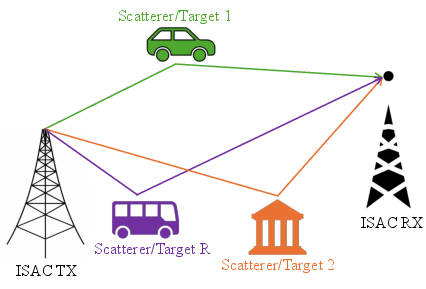
Figure 1: Illustration of an AFBM ISAC scenario, showing the dual roles of the receiver in data decoding and target parameter estimation.
System Model and Modulation Architecture
AFBM operates in a point-to-point ISAC setting with single-antenna transceivers over DD channels. The modulation process involves several key stages:
- Symbol Mapping and Guard Bands: Data symbols are mapped onto the first and last L/4 positions of a L×K resource grid, with half the subcarriers reserved as guard bands to prevent inter-filter interference.
- Filter Compensation and DAFT Precoding: A diagonal compensation matrix Cf restores complex orthogonality, followed by pruned DAFT precoding to spread symbols in the affine domain.
- Prototype Filtering: The precoded signal is convolved with a well-localized prototype filter (e.g., Hermite or PHYDYAS), implemented via a block Toeplitz filter matrix.
- Zero-Padding and IDAFT: Frequency-domain zero-padding is applied to control bandwidth, and the IDAFT is used for domain transformation.
The overall transmit signal is expressed as:
s=G(IK⊗QPCf)Ξx
where G is the filter matrix, QP is the modified IDAFT matrix, and Ξ is the symbol mapping operator.
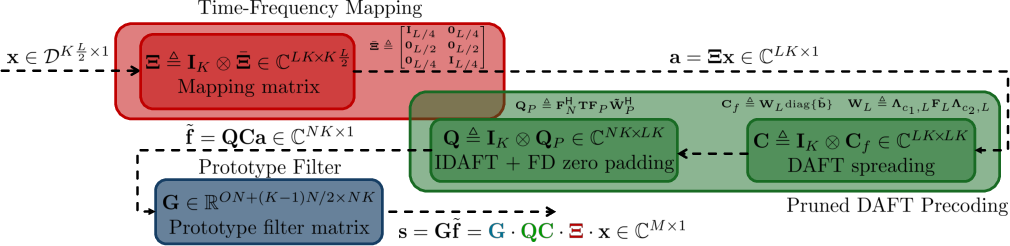
Figure 2: Visualization of the AFBM modulation procedure, highlighting the integration of DAFT precoding and filter-bank processing.
Channel Characteristics and Effective Channel Analysis
AFBM's robustness to DD channels is achieved by spreading the band-diagonals of the channel matrix via affine-domain modulation. The intermediate effective channel after filtering and IDAFT/DAFT processing exhibits deterministic diagonal shifting according to path delay and Doppler indices, analogous to AFDM but with improved sideband structure due to filter design.
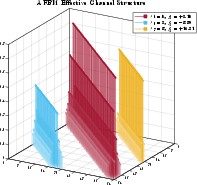
Figure 3: 3D illustration of a three-path AFBM intermediate effective channel, showing diagonal spreading for delay and Doppler diversity.
Gram matrix analysis reveals that the hybrid filtered time-domain (TD) observation matrix approaches a diagonal structure in high-dimensional AFBM systems, minimizing instantaneous correlations and enabling efficient Bayesian inference for both communication and sensing receivers.
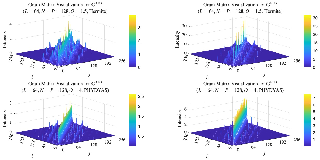
Figure 4: Gram matrix structure of effective channels with various prototype filters, demonstrating reduced off-diagonal correlation in the filtered TD domain.
PAPR, OOBE, and Ambiguity Function Analysis
AFBM achieves a PAPR reduction of approximately 2 dB compared to AFDM and OFDM, attributed to its single-carrier-like structure and affine extension of pruned DFT-spread FBMC. The choice of chirp parameter c2 is critical; optimal values yield the lowest PAPR, while suboptimal choices can degrade performance.
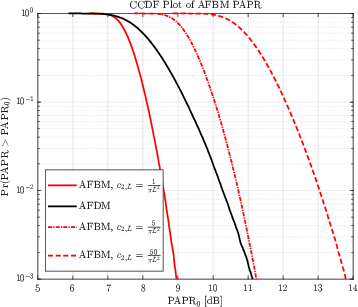
Figure 5: PAPR performance comparison between AFDM and AFBM, showing significant reduction for AFBM.
AFBM exhibits strong OOBE suppression due to per-subcarrier filtering. The use of longer prototype filters (e.g., PHYDYAS) further enhances spectral containment, while shorter filters offer reduced latency at the expense of weaker localization.
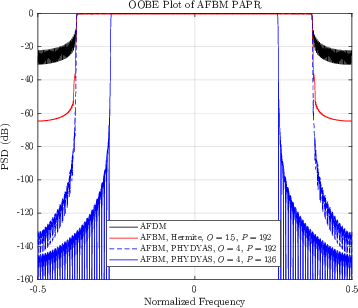
Figure 6: OOBE performance of AFDM and AFBM with different prototype filters, highlighting the spectral advantages of AFBM.
Ambiguity Function
The ambiguity function of AFBM closely matches that of AFDM, with improved sidelobe suppression when using well-localized filters. This translates to enhanced sensing accuracy in radar parameter estimation.
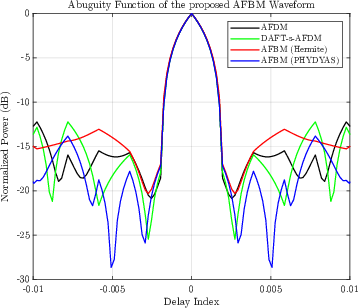
Figure 7: Delay ambiguity function performance for AFDM and AFBM, demonstrating sidelobe reduction with PHYDYAS filtering.
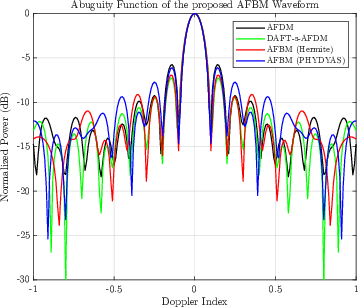
Figure 8: Doppler ambiguity function performance for AFDM and AFBM, confirming robust Doppler resolution.
Low-Complexity GaBP-Based Communication Receiver
AFBM enables a tailored Gaussian Belief Propagation (GaBP) receiver for symbol detection. The receiver operates in the filtered TD domain, exploiting the near-diagonal Gram matrix for efficient message passing. The algorithm iteratively performs soft interference cancellation, belief generation, and Bayes-optimal denoising, with per-iteration complexity O(NK⋅K2L), significantly lower than LMMSE detection.
Simulation results demonstrate that AFBM with GaBP outperforms AFDM by approximately 2 dB at a BER of 10−3, with consistent performance across different prototype filters and bandwidth settings.
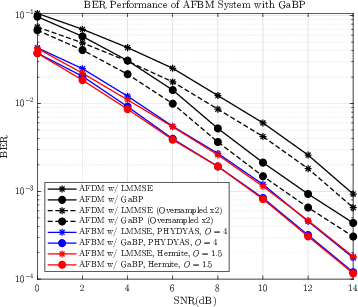
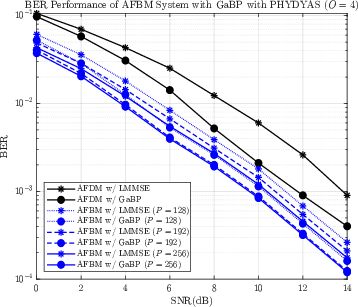
Figure 9: BER performance of GaBP-based detection for AFDM and AFBM, showing superior error rates for AFBM.
EM-Assisted PDA-Based Sensing Receiver
For radar parameter estimation, the paper proposes an Expectation-Maximization (EM)-assisted Probabilistic Data Association (PDA) algorithm. The method models the sparse channel vector as Bernoulli-Gaussian, iteratively updating beliefs and distribution parameters via message passing and EM. The dominant complexity is O(N3), independent of the delay-Doppler grid size, enabling high-resolution estimation.
AFBM achieves comparable or slightly improved RMSE in range and velocity estimation relative to AFDM, consistent with its ambiguity function characteristics.
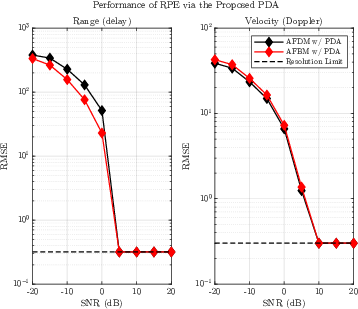
Figure 10: RMSE performance of the proposed PDA-based estimator for AFBM and AFDM, indicating high-accuracy sensing capabilities.
Implementation Considerations and Trade-offs
- Computational Complexity: AFBM introduces manageable overhead relative to AFDM, primarily due to per-subcarrier filtering and DAFT operations. Efficient implementation is feasible via polyphase networks and FFTs.
- Parameter Selection: Optimal chirp parameters and filter lengths are essential for balancing PAPR, OOBE, and latency.
- Receiver Design: The choice of signal domain (filtered TD vs. affine domain) is critical for low-complexity Bayesian inference.
- Scalability: The architecture supports large resource grids and high-resolution sensing without prohibitive complexity.
Implications and Future Directions
AFBM represents a unified waveform solution for 6G ISAC, combining communication reliability, sensing accuracy, and spectral efficiency. The architecture is well-suited for high-mobility, high-frequency scenarios, and fragmented spectrum access. Future research should address adaptive channel estimation, robustness under extreme mobility, and native chirp-parameter optimization for further PAPR and OOBE reduction.
Conclusion
The AFBM waveform integrates affine-domain precoding and filter-bank processing to achieve low PAPR, reduced OOBE, and robust performance over DD channels. The proposed GaBP-based communication receiver and EM-assisted PDA-based sensing receiver exploit the unique properties of AFBM for efficient joint communication and sensing. Analytical and numerical results confirm clear advantages over AFDM in key metrics, positioning AFBM as a strong candidate for next-generation 6G ISAC systems.

