NeuroCogMap Reveals Cognitive Organization of Large Language Models
Abstract: Understanding how complex cognitive functions are organized within artificial systems is central to interpreting LLMs and relating them to biological cognition. Yet although LLMs exhibit broad cognitive-like behaviours, it remains unclear whether their internal representations form reproducible functional systems that explain behaviour, failure and links to human cognition. Here we present NeuroCogMap, a cognitive neuroscience-inspired framework that organizes internal features of LLMs into functional parcels and links them to interpretable functions, cognitive capabilities and a cognitive hierarchy. These parcels form a stable and semantically coherent organization that is partly conserved across models and functionally linked to model outputs. Within this organization, major LLM failures, including hallucination, bias, refusal failure and sycophancy, correspond to distinct disruptions in representational and behavioural-control systems, yielding internal signatures for mechanism-guided detection and targeted intervention. Beyond model behaviour, NeuroCogMap improves prediction of human cortical responses during naturalistic language comprehension, with the strongest correspondence in higher-order association cortex. At the cognitive level, its internal signatures expose latent strategies that guide refinements of classical models of human decision-making. Together, these findings establish NeuroCogMap as a system-level framework for mapping functional organization in artificial systems and for relating this organization to human cortical function and cognitive behaviour.
Paper Prompts
Sign up for free to create and run prompts on this paper using GPT-5.
Top Community Prompts
Explain it Like I'm 14
Overview: What is this paper about?
This paper introduces NeuroCogMap, a simple idea with a big job: make a “map of the mind” inside LLMs like the ones that power chatbots. The map finds groups of internal signals that act like “neighborhoods” with specific jobs, shows how these neighborhoods connect, links them to human-like skills, and stacks them into levels from basic perception to advanced thinking. The authors use this map to:
- explain how LLMs organize their “thinking”
- spot where and why they go wrong (like making things up)
- connect LLM activity to human brain activity
- improve how we model human decision-making
The big questions the paper asks
Here are the main questions the researchers wanted to answer in simple terms:
- Do LLMs have organized “parts” inside, the way different brain areas do different jobs?
- Can we label these parts with understandable functions like “fact checking” or “entity recall”?
- Do these parts combine into bigger skills and form a step-by-step hierarchy (from recognizing words to planning and applying knowledge)?
- When LLMs fail—like hallucinating facts or failing to refuse harmful requests—can we see the breakdown inside this map and fix it?
- Do these internal structures line up with how the human brain works during real language understanding?
- Can these insights help improve classic models of how people think and decide?
How they did it (in everyday language)
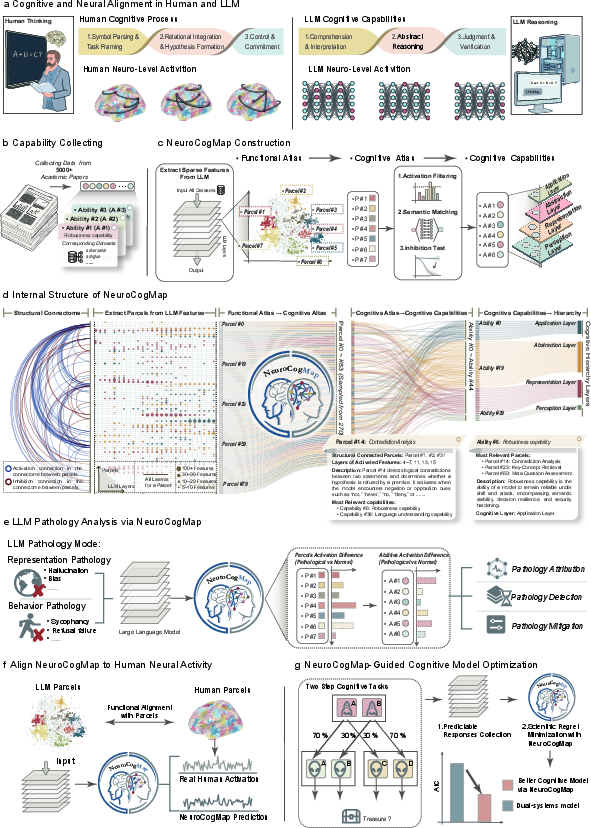
Think of an LLM as a huge orchestra with thousands of instruments playing together. We usually hear the final music (the output text), but we don’t easily know which instruments (internal features) play which part of the score. NeuroCogMap builds a “seating chart” and “score notes” for this orchestra.
What the team did:
- Found repeatable internal signals: They used a technique called a sparse autoencoder (you can think of it as a “feature finder” that spots simple, reusable patterns in the model’s hidden activity). These patterns are like musicians that “light up” for certain tasks.
- Grouped features into “parcels”: They clustered related features into “parcels”—like neighborhoods in a city—each with a consistent role (for example, “country identification” or “veracity check”).
- Built a “cognitive atlas”: They gave each parcel a plain-language description of what it seems to do, using how it activates across many tasks and texts.
- Drew the “roads”: They mapped how parcels influence each other across layers in the model (a bit like a road or wiring diagram).
- Linked parcels to skills and a hierarchy: They connected parcels to larger skills (like information retrieval or verification), and organized these into four levels: 1) Perception (taking in words and patterns) 2) Representation (building meaning and facts) 3) Abstraction (reasoning and combining ideas) 4) Application (following instructions, safety, social interaction)
- Tested cause and effect: They gently “turned up” or “turned down” parcels to see if outputs changed in the way expected—like nudging the violin section and listening for a change in the melody.
- Checked with humans: They compared LLM parcel activity to human brain responses measured by fMRI while people listened to stories. fMRI is like a camera that shows where blood flow increases in the brain, which relates to neural activity.
What they found and why it matters
Here are the main findings the authors report:
- LLMs have stable, meaningful “neighborhoods” inside
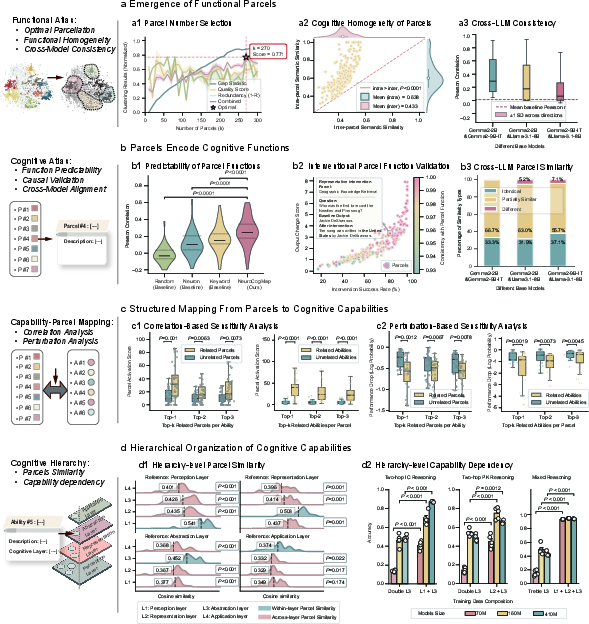
- The best “zoom level” was an atlas of about 270 parcels. Each parcel grouped signals that activate together and focus on similar content. Many parcels appeared across different LLMs, showing the organization isn’t random.
- Plain-language descriptions of parcels (like “binary fact check” or “entity recall”) predicted when those parcels would activate on new examples.
- When the team nudged specific parcels, the model’s output changed in ways that matched those parcel descriptions—evidence these parcels really do those jobs.
- Parcels assemble into skills and a step-by-step hierarchy
- Parcels linked selectively to larger capabilities (for example, specific parcels consistently support “verification” more than “story generation,” and vice versa).
- These capabilities aligned with a four-layer hierarchy (perception → representation → abstraction → application).
- Training experiments showed that lower-level supports (like better retrieval) improved higher-level reasoning—suggesting the hierarchy acts like “prerequisite skills.”
- The map explains different kinds of hallucinations—and helps fix them
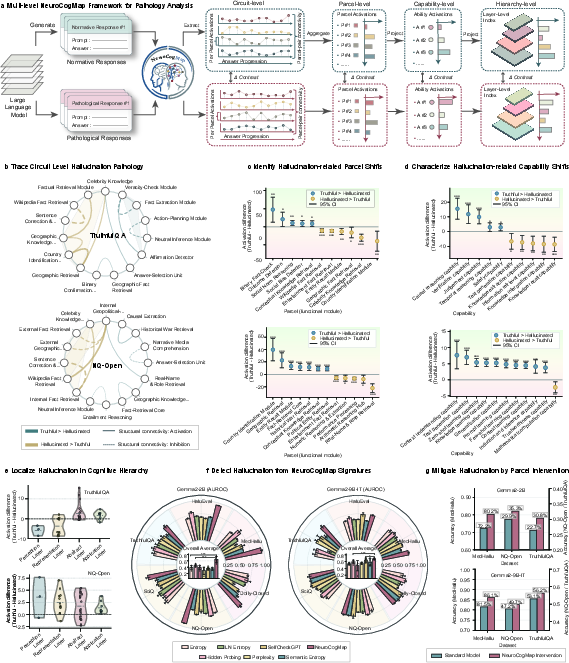
- Not all hallucinations are the same:
- Misleading-question hallucinations (like those in TruthfulQA) reflect a lack of higher-level “monitoring” and “verification,” so the model retrieves associations but doesn’t check them against the question’s trickiness.
- Straight factual questions (like in NQ-Open) can fail because the model’s retrieval systems don’t coordinate well into a single, grounded answer.
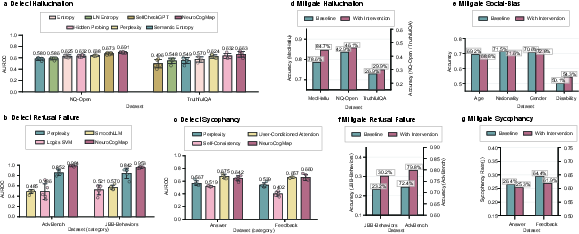
- Using NeuroCogMap, they built detectors that beat common baselines at identifying hallucinations.
- They also reduced hallucinations by turning up helpful parcels (like verification) and turning down overactive ones (like ungrounded lookups).
- The map explains refusal failures—and helps fix them
- When a model should refuse a harmful request but doesn’t, it’s not usually because it misunderstood the content. Instead, control systems shift from “monitor and negate” to “plan and execute,” leading to a harmful step-by-step answer.
- NeuroCogMap detected these failures very accurately and guided interventions that increased correct refusals, especially when base safety wasn’t already near perfect.
- The map aligns with human brain activity during stories
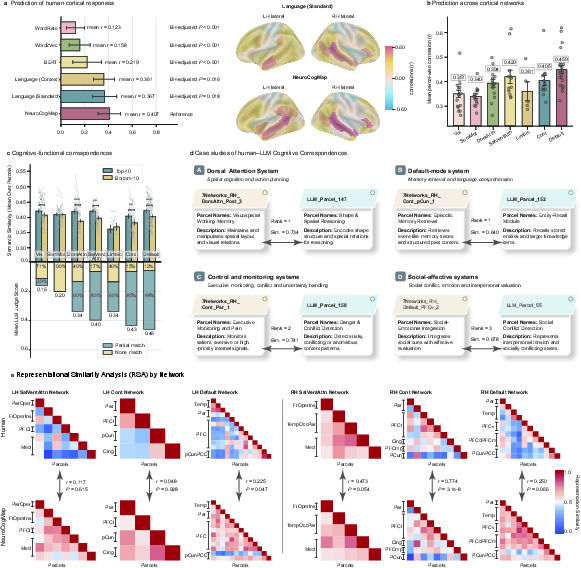
- Parcel activity from NeuroCogMap predicted people’s brain responses (fMRI) during story listening better than standard LLM features and word embeddings.
- The strongest matches were in higher-level brain networks involved in language, memory, and control—not in basic sensory regions—suggesting the map captures meaningful, high-level processing.
- The best-matching LLM parcels also carried similar functional meanings to those human brain areas (for example, parcels related to “entity recall” aligning with brain areas linked to memory retrieval).
- Even the pattern of relationships among parcels resembled the pattern among brain regions within some networks, hinting at shared organizational principles.
- It helps refine models of human decision-making
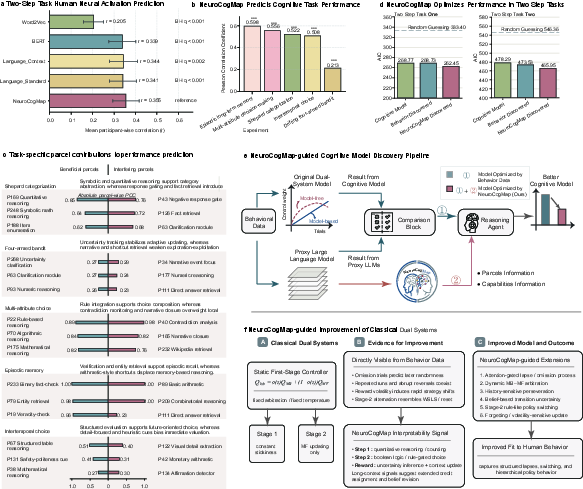
- By reading the LLM’s internal “strategy signatures,” the authors adjusted classical cognitive models of human decision-making.
- These refined models fit people’s choices better in held-out tests, suggesting LLM maps can inspire better theories of how humans think.
Why this is important
- A clearer view inside LLMs: Instead of treating the model as a black box, NeuroCogMap shows “who does what” inside—making behavior more explainable.
- Better safety tools: If we can see exactly where decision-making or verification breaks down, we can detect risky outputs earlier and steer models toward safer behavior.
- Brain–AI links: The map provides a structured way to compare LLMs to the human brain. That doesn’t mean LLMs are brains—but it does mean we can use shared patterns to learn about both.
- Smarter theories of thinking: Insights from LLM strategies can guide better cognitive models for humans, improving how we design experiments and interpret behavior.
In short
NeuroCogMap is like a city map for the “thinking” inside LLMs. It finds neighborhoods with clear jobs, shows how they connect, stacks them from simple to complex, and uses this structure to diagnose and fix problems. It also lines up surprisingly well with how parts of the human brain respond to stories, and it helps improve theories about how people make decisions. This makes NeuroCogMap a powerful tool for understanding, comparing, and improving both artificial and human cognition.
Knowledge Gaps
Knowledge gaps, limitations, and open questions
Below is a consolidated, actionable list of what remains missing, uncertain, or left unexplored in the paper, organized by theme to support follow-up research.
Methodology and interpretability assumptions
- Quantify how parcelization depends on the sparse autoencoder (SAE) design (layer choice, training corpus, sparsity penalty, architecture, initialization) and assess cross-seed stability; report robustness of the 270-parcel solution to these choices.
- Compare parcelization against alternative factorization/interpretability methods (e.g., NMF/ICA, dictionary learning, subspace clustering, probing-based feature discovery, causal tracing) to test whether the same functional units and hierarchy emerge.
- Evaluate whether functional descriptions depend on the specific LLM used to generate them (circularity risk); incorporate expert annotation and inter-rater agreement to validate function labels independent of LLM judgments.
- Test how much the joint granularity score (clustering quality, description quality, non-redundancy) changes when computed on unseen datasets or different capability subsets to rule out overfitting of atlas granularity to the curated task set.
- Specify and validate the procedure for estimating the “structural connectome” and directed cross-layer connections from transformer weights; compare to attention/MLP pathway analyses and causal scrubbing to support directionality claims.
- Report how many layers and tokens are instrumented by SAEs and whether conclusions change when expanding to more layers, earlier tokens, or long-context inputs.
Causality and intervention validity
- Establish stronger causal evidence that parcels implement the claimed functions (beyond correlation and simple scaling interventions), e.g., through targeted feature ablation, causal patching, pathway-level knockout/activation, and double-randomization controls.
- Test for on-manifold vs off-manifold effects of parcel scaling (does steering induce distributional artifacts?); add placebo parcels and matched random controls to confirm intervention specificity.
- Quantify side effects of interventions (e.g., global performance regressions, increased latency, degradation on unrelated capabilities, harmful over-refusal) and report safety–utility trade-offs.
Generalization across models, training, and decoding
- Assess cross-model stability across much larger and different architectures (e.g., Llama-70B/405B, Mixtral/MoE, Qwen2.5, RLHF-heavy vs base, decoder-only vs multi-encoder-decoder) and different tokenizers; test whether parcel identities and functions persist.
- Track how the parcel atlas and hierarchy evolve across training stages/checkpoints (developmental dynamics) and after instruction-tuning/RLHF; quantify parcel birth/merge/split events and functional drift.
- Evaluate sensitivity to decoding strategies (temperature, nucleus sampling, beam search) and prompt formatting/system prompts; determine whether pathology signatures and interventions transfer across decoding regimes.
- Extend analyses to multilingual/multimodal models and non-English tasks to test language- and modality-agnosticity of the atlas and hierarchy.
Capability space and hierarchy
- Provide an explicit, exhaustive list of capabilities and mapping criteria; evaluate coverage gaps (e.g., tool use, program synthesis, formal math, long-context reasoning, planning & multi-step tool orchestration).
- Validate the four-layer hierarchy (perception → representation → abstraction → application) on real-world benchmarks (not only synthetic) and test alternative hierarchies or continuous complexity measures; probe whether prerequisite effects hold in naturalistic datasets.
- Measure how parcel–capability links update when adding new capabilities or after finetuning; propose a procedure for atlas maintenance/versioning as capability sets evolve.
Pathologies: scope, robustness, and transfer
- Expand beyond the four pathologies studied (hallucination, bias, refusal failure, sycophancy) to include toxicity, prompt injection, jailbreak variants, data exfiltration, long-context failures, tool-use errors, chain-of-thought derailment, and calibration errors; test whether the representational vs control dichotomy still holds.
- Stress-test hallucination/refusal detectors under domain shift and adversarial distribution shift; report precision–recall, calibration, and worst-case performance, not just AUROC.
- Validate whether detection/mitigation signatures transfer to unseen datasets, tasks, and model families without re-tuning; quantify cross-dataset and cross-model generalization gaps.
- Investigate whether refusal-oriented interventions increase false positives (over-refusal of benign requests) or degrade helpfulness; report fine-grained safety metrics and trade-offs.
Human–LLM alignment claims
- Replicate brain-alignment results across multiple neural datasets (different stories, tasks, languages), measurement modalities (MEG/ECoG), and parcellations (e.g., HCP-MMP1.0), and evaluate subject-level variability and out-of-sample generalization.
- Improve temporal modeling (hemodynamic lag, variable speech rate) and assess whether parcel activity aligned at earlier tokens or across time improves cortical prediction.
- Reduce dependence on description-based RSA using LLM embeddings (risk of semantic circularity); complement with RSA on activation geometries and cortical representational spaces (e.g., time-lagged encoding/decoding RSA).
- Clarify functional correspondence evaluation with human-validated mappings (beyond LLM-judge) and report inter-rater reliability; test whether the same parcels align across tasks (task-invariant correspondence).
Evaluation metrics and statistical rigor
- Report effect sizes alongside P-values for numerous parcel-wise tests and ensure rigorous multiple-comparisons control across all analyses; include sensitivity analyses for sample size and power.
- Benchmark parcel-guided detection and steering against strong baselines tailored to each task family (e.g., advanced uncertainty estimation, multi-sample self-consistency with content filtering, state-of-the-art jailbreak detectors).
- Use task success metrics (accuracy, F1, calibration) in addition to ground-truth log-probability changes for perturbation studies to better reflect user-relevant performance.
Practicality and deployment
- Address feasibility for closed-source/black-box models where internal activations are inaccessible; explore proxy signals or distillation to a steerable student model that preserves parcel structure.
- Quantify compute and data requirements for training SAEs and building the atlas at scale; provide guidance for resource-constrained settings and incremental updates.
- Investigate training-time integration (regularizers or objectives that encourage parcel interpretability and stability) vs test-time steering; assess long-term stability of interventions under continued finetuning.
Conceptual framing and taxonomy
- Re-examine the representational vs behavioral-control dichotomy with intermediate categories (e.g., evaluation, planning, gating) and test whether category boundaries are supported by causal evidence.
- Evaluate the risk of anthropomorphic or overly granular labels; propose a standardized ontology for parcel functions with measurable criteria and uncertainty scores.
Reproducibility and openness
- Provide detailed protocols for SAE training, clustering, parcel matching, and connectome estimation; release code, trained SAEs, and parcel atlases for multiple models and seeds to enable independent replication.
- Include systematic cross-seed and cross-corpus reproducibility reports for parcel identities, functions, and hierarchy assignments.
Cognitive-model discovery (decision-making)
- Validate that LLM-derived latent strategy signatures improve human behavioral fits across diverse tasks, laboratories, and preregistered datasets; test robustness to overfitting and ecological validity outside the two-step task.
- Compare against state-of-the-art cognitive models (model-based/model-free hybrids, hierarchical Bayesian variants) and quantify incremental explanatory power contributed by NeuroCogMap signatures.
- Explore whether identified strategy parcels map to specific, causally testable computations (e.g., eligibility traces, uncertainty-driven arbitration) and design targeted human experiments inspired by those signatures.
Practical Applications
Immediate Applications
The following applications can be deployed now, using the paper’s released methodology and empirical findings (parcel discovery from SAEs, parcel–capability mapping, pathology signatures, and parcel-level interventions). Each item names likely sectors, concrete tools/workflows, and key dependencies.
- Bold: Observability and debugging for LLM developers
- Sectors: software/AI platforms, MLOps
- What: Integrate NeuroCogMap dashboards to visualize parcel activations, capability recruitment, and hierarchy routing per prompt. Identify where pipelines fail (e.g., retrieval vs. verification vs. behavioral-control).
- Tools/workflows: “NeuroCogMap Dashboard” for feature timelines; parcel-level saliency overlays; structured logs of capability engagement per request.
- Dependencies/assumptions: Access to internal activations or SAE features; mapping from model to NeuroCogMap parcels; added latency/compute overhead.
- Bold: Real-time hallucination detection in enterprise assistants
- Sectors: healthcare, finance, legal, customer support, education, search
- What: Deploy AUROC-validated detectors that score responses by alignment with truthful vs. hallucination signatures (parcel/capability/hierarchy patterns).
- Tools/workflows: “Hallucination Sentinel” API; gated generation (flag, defer to retrieval/verification, or require human review); log-level alerting.
- Dependencies/assumptions: Signature generalization to deployed model/version/domain; calibration per domain (medical vs. general QA); trade-off between false positives and latency.
- Bold: Refusal-failure and jailbreak monitoring
- Sectors: trust & safety, platform policy, robotics/tool-use agents
- What: Detect when control is shifting from monitoring/negation to procedural execution, before unsafe action is produced; near-ceiling AUROC reported on AdvBench/JBB-Behaviors.
- Tools/workflows: “Refusal Monitor” preflight check; runtime blocklists triggered by control-pathway inactivity; incident replay to inspect control parcels.
- Dependencies/assumptions: Reliable mapping of safety/control parcels in target model; robustness to adversarial prompt variants; access to intermediate states.
- Bold: Parcel-level mitigation/steering to reduce hallucination and enhance refusal
- Sectors: general-purpose assistants, safety-critical domains
- What: Light-touch interventions that up-weight under-recruited evaluative parcels and down-weight over-recruited associative/procedural parcels; measurable gains on TruthfulQA, NQ-Open, MedHallu, and AdvBench.
- Tools/workflows: “Parcel-Steering Controller” layer; policy routing that conditionally engages evaluation/verification parcels; RLHF/AIF training augmented with parcel-level rewards.
- Dependencies/assumptions: Stable steering hooks; careful validation to avoid performance regressions; governance for targeted manipulation of internal states.
- Bold: Capability-aware benchmarking and model selection
- Sectors: procurement, model governance, platform marketplaces
- What: Compare models via parcel–capability maps and hierarchy coverage rather than raw task scores; surface partial cross-model conservation of parcels as evidence of functional maturity.
- Tools/workflows: “Cognitive Map Model Card” with parcel inventory, capability heatmaps, hierarchy balance, and known pathology signatures.
- Dependencies/assumptions: Comparable SAE feature spaces across candidate models; standardized mapping procedure; version drift handling.
- Bold: Prompt and tool-routing optimization via cognitive signatures
- Sectors: software, multi-agent systems, RAG/tool-use platforms
- What: Choose prompts or toolflows that maximally recruit verification and judgment parcels for high-stakes tasks; avoid patterns that over-activate associative retrieval without control.
- Tools/workflows: A/B prompt testing with parcel-selectivity metrics; “Router by Capability” that dispatches to retrieval, verification, or planning agents based on early-layer signatures.
- Dependencies/assumptions: Consistent prompt-to-parcel recruitment; low-latency readout; training alignment of router thresholds.
- Bold: Curriculum and dataset design grounded in cognitive hierarchy
- Sectors: model training, edtech
- What: Use L1→L3 prerequisite results to stage training/evaluation (perception/representation before abstraction); augment reasoning corpora with retrieval/recall scaffolds.
- Tools/workflows: “Hierarchy-Aware Data Builder”; evaluation suites stratified by layer.
- Dependencies/assumptions: Transferability of synthetic prerequisites to real data; avoidance of overfitting to staged curricula.
- Bold: Neuroscience research tooling for naturalistic language
- Sectors: academia (cognitive neuroscience, neurolinguistics)
- What: Improve fMRI encoding of story comprehension with NeuroCogMap parcels; test correspondence in Default/Control networks; run description-based RSA for hypothesis generation.
- Tools/workflows: Encoding pipelines using parcel activations as regressors; cognitive-profile matching between Neurosynth and parcel descriptions.
- Dependencies/assumptions: Access to BOLD datasets; preprocessing alignment; ethical data-sharing/IRB compliance.
- Bold: Cognitive-model refinement in behavioral science
- Sectors: academia (cognitive psychology, decision science), UX research
- What: Use latent “strategy signatures” from parcel profiles to refine classical decision models and improve behavioral fit on held-out subjects/tasks.
- Tools/workflows: “Strategy Signature Extractor” linking parcel activation to model parameters (e.g., arbitration, verification, monitoring).
- Dependencies/assumptions: Interpretability of signatures across tasks; avoidance of anthropomorphic overreach; preregistered confirmatory studies.
- Bold: Pedagogy and transparency materials
- Sectors: education, policy communication
- What: Visual explanations of how LLMs organize functions; show where bias/hallucination/refusal failures originate and how mitigations work.
- Tools/workflows: Interactive visualizations of parcels/capabilities/hierarchy; case-based walkthroughs.
- Dependencies/assumptions: Simplifications remain faithful to empirical signatures; updates track model evolution.
- Bold: End-user safety features in writing/search assistants
- Sectors: daily life, productivity apps
- What: On-device or service-side “Credibility Meter” that highlights responses with hallucinatory patterns and suggests verify/lookup actions.
- Tools/workflows: Browser or editor plugins that query a light NeuroCogMap detector; one-click external verification.
- Dependencies/assumptions: Lightweight inference from hidden states or from proxy representations; acceptable latency budget.
Long-Term Applications
These applications will likely require further research, scaling, standardization, or broader ecosystem cooperation.
- Bold: Cognitive-structure-aware training objectives
- Sectors: AI model development
- What: Regularize training to strengthen evaluative/control parcels and healthy inter-parcel connectivity; add parcel-level reward models for RLHF that penalize pathology signatures.
- Tools/products: “Parcel-Regularized Pretraining” and “Control-Consistency RLHF.”
- Dependencies/assumptions: Stable parcel discovery during training; differentiable/efficient parcel objectives; no degradation of general capabilities.
- Bold: Runtime cognitive controllers for tool use and robotics
- Sectors: robotics, autonomous systems, industrial automation
- What: Gate high-risk actions on evidence of control-parcel engagement; interrupt execution if signatures indicate procedural shift without risk evaluation.
- Tools/products: “Cognitive Safety Supervisor” sitting between planner and actuator/tool APIs.
- Dependencies/assumptions: Reliable low-latency readout; robust under distribution shift; formal verification of controller policies.
- Bold: Cross-model Cognitive Map standards and audits
- Sectors: policy, compliance, third-party assurance
- What: Standardize parcel/capability taxonomies and reports to support attestations (“this model engages verification parcels on medical QA”); independent audits of pathology susceptibility.
- Tools/products: Open Cognitive Map Schema; audit benchmarks and signature test suites.
- Dependencies/assumptions: Community consensus; cooperation from closed-model vendors; governance to prevent disclosure of exploitable details.
- Bold: Sector-specific safe copilots with cognitive guarantees
- Sectors: healthcare, finance, legal, government, scientific writing
- What: Assistants that must activate verification/judgment parcels before output; hard failover to human review when signatures are risky; longitudinal compliance logs tied to cognitive evidence.
- Tools/products: “Verification-First Copilot” with signature-based SLAs.
- Dependencies/assumptions: Domain-calibrated thresholds; liability frameworks; integration with EHRs/CRMs/DMS with privacy safeguards.
- Bold: Brain–AI co-modeling for clinical research
- Sectors: healthcare research, neurotech
- What: Use aligned parcels to generate mechanistic hypotheses about language/comprehension disorders; explore patient-specific deviations in Default/Control network alignment.
- Tools/products: Clinical encoding suites; parcel-based biomarkers for trial stratification.
- Dependencies/assumptions: Large, shared neuroimaging datasets; rigorous validation; caution against over-interpretation of correspondences.
- Bold: Human cognitive-model discovery at scale
- Sectors: academia, edtech, UX optimization
- What: Mine latent strategies from LLM simulations aligned to NeuroCogMap to propose refinements for human decision-making models; test in preregistered human studies.
- Tools/products: “Strategy Mining Lab” linking parcel dynamics to candidate cognitive mechanisms.
- Dependencies/assumptions: Transferability from artificial to human cognition; ethical study design; reproducibility across labs.
- Bold: Multi-agent “capability routing” ecosystems
- Sectors: software platforms, enterprise AI
- What: Agents advertise parcels/capabilities they can provide (verification, retrieval, planning); a coordinator composes them based on the hierarchy required by a task.
- Tools/products: Capability Routers; Parcel-Aware Agent Registries.
- Dependencies/assumptions: Standard APIs for capability descriptors; overhead vs. benefit trade-offs; robust routing under noisy signals.
- Bold: Multimodal NeuroCogMap (vision, audio, action)
- Sectors: robotics, AR/VR, media
- What: Extend parcellation and hierarchy to vision-language-action systems; detect cross-modal pathology (e.g., visual misinterpretation compensated by language hallucination).
- Tools/products: Unified Multimodal Parcel Library; cross-modal intervention controllers.
- Dependencies/assumptions: SAE-quality features across modalities; scalable clustering and connectome inference.
- Bold: Privacy-preserving edge detectors
- Sectors: mobile, on-device AI
- What: Lightweight, distilled pathology detectors that run without full activation access; approximate parcel scores from embeddings or low-rank projections.
- Tools/products: Tiny “Signature Heads” for edge models.
- Dependencies/assumptions: Proxy features correlate strongly with full signatures; tight memory/compute budgets.
- Bold: Education and adaptive tutoring grounded in cognitive signatures
- Sectors: education
- What: Tutors that bias toward retrieval-before-reasoning flows when signatures predict abstraction failure; scaffolded feedback aligned to the hierarchy.
- Tools/products: “Hierarchy-Aware Tutor” integrating RAG, verification, and step-wise reasoning.
- Dependencies/assumptions: Validity of signatures for student-facing reasoning; fairness and accessibility considerations.
- Bold: Policy toolkits for risk forecasting and red-team planning
- Sectors: regulators, standards bodies, platform safety
- What: Use signature analytics to forecast where models are most jailbreakable or hallucinatory; craft targeted red-team scenarios; track improvements after mitigations.
- Tools/products: Cognitive Risk Observatory; Signature Drift Monitor.
- Dependencies/assumptions: Access to evaluation sandboxes; cross-model comparability; ongoing updates as models evolve.
Cross-cutting assumptions and dependencies
- Access to internals: Many applications assume access to hidden states or SAE-derived features; closed models may require vendor cooperation or proxy approximations.
- Model drift: Parcel maps and signatures can shift across versions/fine-tunes; continuous revalidation and monitoring are needed.
- Calibration: Thresholds for detectors/steering must be domain- and risk-calibrated to balance false positives/negatives.
- Compute/latency: Real-time readout and control add overhead; edge/low-latency scenarios need distilled detectors.
- Generalization: Signatures were shown across several models but still require validation in new architectures, languages, and domains.
- Safety and ethics: Interventions must respect governance, avoid covert manipulation, and ensure human oversight for high-stakes uses.
- Data privacy: Brain-alignment applications require strict adherence to privacy regulations and IRB standards.
Glossary
- AdvBench: A benchmark of adversarial prompts used to test models’ refusal and safety behavior. "by comparing successful-refusal and refusal-failure responses on AdvBench"
- Area under the receiver operating characteristic curve (AUROC): A scalar performance measure for binary classifiers capturing the trade-off between true- and false-positive rates. "measured by AUROC across hallucination benchmarks in Gemma2-2B and Gemma2-9B-IT"
- Benjamini--Hochberg correction: A multiple-comparisons procedure that controls the false discovery rate. "All comparisons against NeuroCogMap were significant after Benjamini--Hochberg correction"
- blood-oxygen-level-dependent (BOLD) responses: The fMRI signal reflecting changes in blood oxygenation as an indirect measure of neural activity. "we mapped cortical blood-oxygen-level-dependent (BOLD) responses"
- Cognitive Atlas: A curated ontology/resource of cognitive concepts used for meta-analytic functional profiles. "across Cognitive Atlas terms"
- cognitive hierarchy: A multi-level organization of capabilities (e.g., perception to application) reflecting prerequisite structure. "a cognitive hierarchy spanning perception, representation, abstraction and application"
- cortical parcel: A region of the cortex defined by a parcellation scheme for analysis. "across 10 language-related cortical parcels"
- Default network: A large-scale brain network implicated in internally oriented cognition and semantic integration. "the largest gains were concentrated in language-relevant Default network regions"
- directed cross-layer structural connections: Directional links inferred between units across layers within a structural graph. "We then estimated directed cross-layer structural connections among parcels"
- Dorsal Attention network: A large-scale brain network supporting top-down attentional control. "including Dorsal Attention, Salience/Ventral Attention, Frontoparietal Control and Default networks"
- encoding model: A predictive model that maps stimulus/features to neural responses for held-out data. "we first evaluated this correspondence using encoding models of naturalistic language comprehension"
- Fisher-z transform: A variance-stabilizing transformation applied to correlation coefficients. "Bars show Fisher-z-transformed mean parcel-wise correlations"
- functional atlas: A map of functionally defined units (parcels) and their organization. "a functional atlas of parcels"
- functional parcellation: Dividing a system into functionally homogeneous regions based on activity or representational profiles. "Functional parcellation, representational mapping, hierarchical abstraction and pathology-based inference"
- fMRI: Functional magnetic resonance imaging; a neuroimaging method for measuring brain activity via BOLD signals. "the LeBel story-listening fMRI dataset"
- Frontoparietal Control network: A brain network associated with cognitive control and flexible task set maintenance. "Accuracy was highest in Default, Frontoparietal Control and Salience/Ventral Attention networks"
- ground-truth log probability: The model’s log-probability assigned to the correct output tokens. "measured as the drop in ground-truth log probability"
- hallucination (LLM context): Generation of ungrounded or false content not supported by input or knowledge. "Hallucination arises through distinct representational routes"
- Holm correction: A step-down multiple-testing procedure controlling the familywise error rate. "two-sided paired Wilcoxon signed-rank tests with Holm correction"
- in-context regime: A setting where models perform tasks using contextual examples without updating parameters. "In the in-context regime, adding lower-level retrieval support improved two-hop reasoning"
- JBB-Behaviors: A dataset from JailbreakBench evaluating model behavior under jailbreak attacks. "Across AdvBench and JBB-Behaviors"
- LeBel story-listening fMRI dataset: An fMRI dataset where participants listen to autobiographical narratives. "Using the LeBel story-listening fMRI dataset"
- Neurosynth: A platform for meta-analytic synthesis of fMRI literature linking terms to brain activity. "semantic similarity between Neurosynth-derived human parcel profiles"
- NQ-Open: The Natural Questions (Open) dataset of factoid questions for open-domain QA. "and NQ-Open, which consists of direct factual queries"
- parcel (LLM functional parcel): A coherent functional unit derived from clustering sparse model features. "used to identify parcels that define a functional atlas"
- parametric reasoning: Reasoning that relies on knowledge internalized in model parameters rather than context alone. "adding lower-level knowledge-recall support similarly improved parametric reasoning"
- Representational Similarity Analysis (RSA): A method comparing representational geometries via similarity matrices. "description-based Representational Similarity Analysis (RSA)"
- ridge regression: Linear regression with L2 regularization used to prevent overfitting. "entered jointly into ridge-regression encoding models"
- Salience/Ventral Attention network: A brain network involved in detecting salient events and switching between brain states. "Accuracy was highest in Default, Frontoparietal Control and Salience/Ventral Attention networks"
- Schaefer cortical atlas: A widely used parcellation of cortex into functionally defined parcels. "onto the 100-parcel Schaefer cortical atlas"
- SelfCheckGPT: A self-consistency-based method for detecting LLM hallucinations. "exceeding SelfCheckGPT"
- sparse autoencoder (SAE): An autoencoder with sparsity constraints to extract interpretable latent features. "extracting sparse autoencoder (SAE) activations"
- structural connectome: The graph of structural connections (edges) among units (nodes) in a system. "linking parcel-level features and the structural connectome to the functional atlas"
- sycophancy: A failure mode where the model agrees with or flatters the user regardless of correctness. "including hallucination, bias, refusal failure and sycophancy"
- task-evoked coupling: Functional connectivity between units estimated from their co-activation during tasks. "Circuit connectivity refers to task-evoked coupling among functional parcels"
- TruthfulQA: A benchmark designed to elicit and measure truthful versus misconception-driven responses. "on two complementary datasets: TruthfulQA"
- Welch's two-sample t-test: A variant of the t-test that does not assume equal variances between groups. "Welch's two-sample -tests"
- Wilcoxon signed-rank test: A nonparametric test for paired samples comparing median differences. "two-sided paired Wilcoxon signed-rank tests"
- Yeo seven-network organization: A canonical division of cortex into seven large-scale functional networks. "according to the Yeo seven-network organization"
Collections
Sign up for free to add this paper to one or more collections.