- The paper presents an exponential low-regularity integrator (ELRI) as a novel coarse propagator in parareal algorithms for NLS equations.
- It demonstrates linear convergence with error contraction proportional to the coarse step size even for low-regularity initial data.
- It validates the method’s performance against classical integrators across quadratic, cubic, and quintic NLS models through thorough numerical experiments.
Exponential Low-Regularity Parareal Algorithms for Nonlinear Schrödinger Equations
Introduction and Motivation
This work addresses the numerical solution of the nonlinear Schrödinger equation (NLS), an archetype of non-diffusive, time-dependent PDEs with applications across nonlinear optics, Bose–Einstein condensates, and fluid dynamics. Classical time integration for NLS relies on sequential stepping, presenting a severe bottleneck in the era of large-scale parallel computing. The parareal algorithm, a parallel-in-time (PinT) method, offers a route to time-domain parallelization by iteratively refining a coarse global prediction with localized fine solves. However, for non-diffusive and highly nonlinear problems such as the NLS, classical choices of coarse propagators (CPs)—such as Lie/Strang splitting or low-order exponential Runge–Kutta—lead to slow convergence or instability due to the lack of smoothing and sensitivity to phase errors across Fourier modes.
The paper introduces a convergence framework for parareal methods, built upon exponential low-regularity integrators (ELRIs) as CPs, rigorously demonstrating linear convergence for NLS problems even with low-regularity data. This framework is the first to establish error contraction proportional to the coarse time step size for NLS without requiring high-regularity assumptions or derivative loss in the analysis (2607.00384).
Theoretical Framework and Algorithm Design
Parareal Method for NLS
Given an NLS of the form
i∂tu=−Δu+F(u,u),
the parareal method partitions (0,T) into Nc coarse intervals. Each iteration alternates between updating with a coarse propagator G and applying a correction from the fine (here, assumed exact) propagator F. The key update is
Un+1k+1=G(Unk+1)+[F(Unk)−G(Unk)].
A central requirement for robust convergence is that both stability and local truncation error control for G must hold uniformly on bounded sets of Sobolev space Hr (r>d/2), without loss of regularity.
Exponential Low-Regularity Integrators (ELRIs)
Traditional exponential integrators approximate the mild solution using Taylor or frozen-coefficient expansions, which can induce a derivative loss and require high data regularity. ELRIs—by leveraging problem-specific adaptations of the Duhamel formula and twisted approximations—achieve optimal time-stepping order with no loss of spatial derivatives. For instance,
u(Tn+1)≈eiΔΔtu(Tn)−i∫0Δtei(Δt−s)ΔF(eisΔu(Tn),e−isΔu(Tn))ds.
Such integrators have been constructed for quadratic, cubic, and higher-order NLS, as well as other dispersive models. The main theoretical contribution is verifying that ELRIs, serving as coarse propagators (0,T)0, satisfy the required stability and consistency conditions on the full range of admissible initial data.
Convergence Analysis
The core theoretical result demonstrates, under the above construction and regularity assumptions, that the (0,T)1-th iterated parareal error satisfies
(0,T)2
where (0,T)3 is proportional to the coarse step (0,T)4, making the error contractive as (0,T)5. This guarantee does not hold for classical propagators, which may stagnate or diverge in this non-smoothing, nonlinear setting.
Numerical Results and Empirical Validation
Quadratic NLS: Effectiveness of ELRI Coarse Propagators
The comparative performance between ELRI, Strang splitting, and exponential Runge–Kutta CPs is analyzed for quadratic NLS with both low and higher-regularity initial data. The use of ELRI as the coarse solver yields error decay rates of (0,T)6 in the iteration index, validating the geometric convergence predicted by theory, while standard methods stagnate regardless of iteration count for rough data.
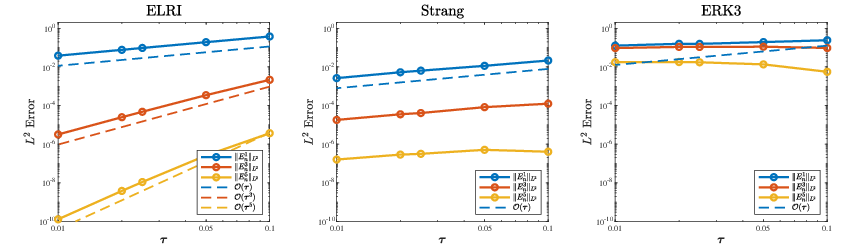
Figure 1: (0,T)7 error versus coarse time step for the parareal applied to quadratic NLS using (left) ELRI, (middle) Strang splitting, and (right) ERK3 as coarse propagators.
Iterative Convergence Across Coarse Steps and Iterations
For more regular initial data, the ELRI-based parareal still greatly outperforms all classical schemes in terms of iteration-wise error reduction, consistently achieving linear convergence with a contraction factor controlled by the step size.

Figure 2: (0,T)8 error versus iteration (0,T)9 for the parareal applied to quadratic NLS with multiple coarse propagators and varying step size.
Cubic NLS in 1D and 2D
For the physically central cubic NLS, robust linear convergence is observed when the parareal is equipped with an ELRI coarse propagator, both for low- and moderate-regularity initial conditions.
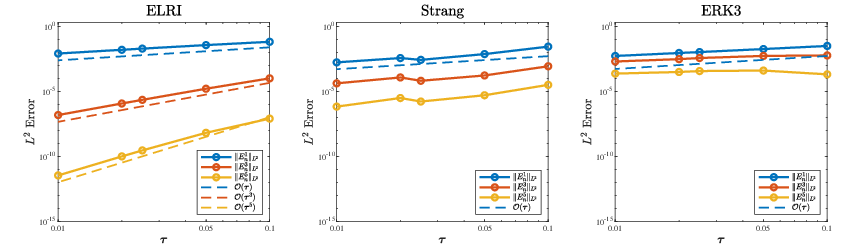
Figure 3: Nc0 error versus time step for the parareal method applied to the cubic NLS, comparing various coarse propagators.
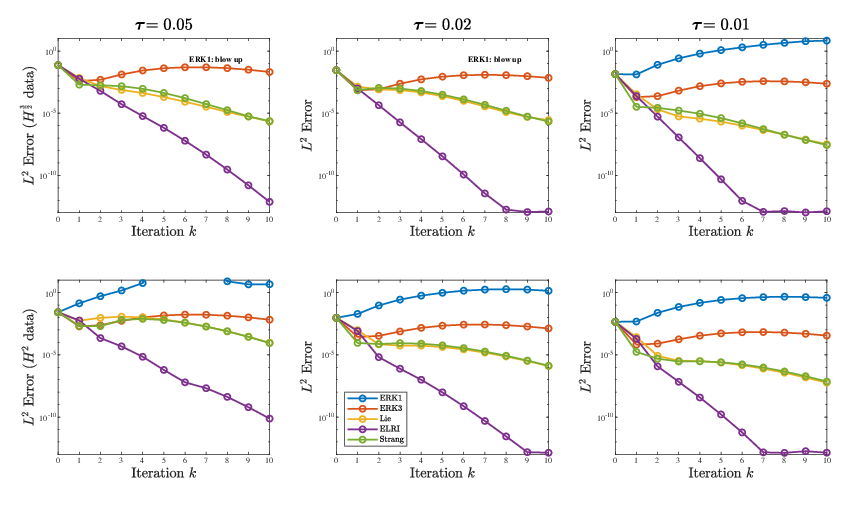
Figure 4: Nc1 error during parareal iterations for 1D cubic NLS with Nc2 initial data and ELRI coarse propagator.
Further, the method demonstrates efficacious performance even for the challenging 2D cubic NLS.
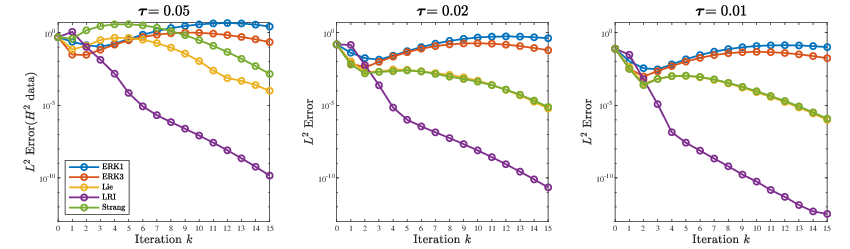
Figure 5: Nc3 errors of parareal iterations for 2D cubic NLS with Nc4 initial data.
Quintic NLS
The scheme's applicability extends to quintic nonlinearities, outside the purview of the theoretical results. Empirically, ELRI-based parareal maintains rapid convergence, unmatched by classical alternatives.
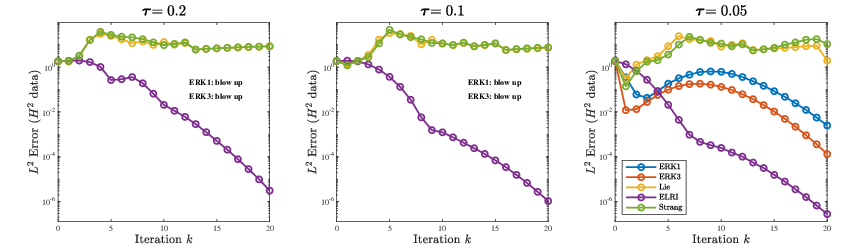
Figure 6: Nc5 errors of parareal iterations for the one-dimensional quintic NLS with Nc6 initial data.
Discussion, Implications, and Future Prospects
This paper establishes, with full rigor and comprehensive empirical validation, that exponential low-regularity integrators serve as mathematically optimal coarse propagators in parareal algorithms for NLS equations in both quadratic and cubic forms, even at low initial regularity. The strong theoretical guarantee of linear convergence with a contraction factor scaling linearly in the coarse time step is a significant advancement over prior art, which could only assure convergence for diffusive settings or under high regularity (2607.00384).
The findings have several immediate implications:
- Practical parity with spatial parallelism: When spatial parallelization is saturated, time-parallelism via this approach offers an effective mechanism for scaling NLS simulations.
- Robustness for rough data: Unlike classical integrators, ELRIs enable effective time-parallel integration for solutions below traditional regularity thresholds.
- Broader applicability: Preliminary experiments show that the methods generalize to higher-order nonlinearities and higher spatial dimensions, although further theoretical work is warranted.
- Opportunity for further advancement: Extending rigorous analysis to higher-dimensional PDEs and broadening the weak-norm error control to relax regularity assumptions are open research fronts. Also, design of ELRIs for other non-diffusive dispersive systems (e.g., KdV, Klein–Gordon) remains compelling for the time-parallel community.
Conclusion
This study provides a rigorous convergence theory and conclusive numerical evidence for using exponential low-regularity integrators as coarse propagators in parareal algorithms for the nonlinear Schrödinger equation (2607.00384). The results establish that, with appropriate coarse solvers, parareal achieves provably contractive, robust, and efficient parallel-in-time integration for non-diffusive, nonlinear models even with low-regularity initial data—far surpassing state-of-the-art alternatives and opening new directions for time-parallel computation in nonlinear dispersive PDEs.

