- The paper establishes a rigorous finite-iteration convergence framework by recasting time-parallel algorithms as contraction mappings for chaotic and nonlinear systems.
- It derives explicit operator-norm bounds with quadratic scaling for Runge–Kutta based Parareal methods, decoupling error control from simulation length.
- It introduces a chaos-aware proximity function that aligns convergence with statistical attractors, ensuring robust scalability in chaotic simulations.
Finite-Time Convergence Guarantees for Time-Parallel Methods
Introduction: The Challenge of Time-Parallelism for Chaotic Systems
Time-parallel methods such as Parareal have achieved significant success for linear IVPs and PDEs, but their persistent limitation for nonlinear and chaotic systems is the absence of rigorous, practically useful convergence theory. The exponential sensitivity to initial conditions—embodied by positive Lyapunov exponents—renders standard residual convergence checks futile for long time integrations, as numerical errors grow superexponentially. This paper formalizes a precise, finite-time convergence framework aimed at resolving this bottleneck. The authors recast time-domain decomposition algorithms as contraction mappings, establish explicit finite-iteration convergence guarantees, and introduce a chaos-aware proximity function that aligns the algorithmic notion of convergence with the structural statistical invariants of chaotic dynamics.
Geometric Framework: Outer and Inner Ball Contraction
The paper advances a fixed-point analysis of time-parallel algorithms, specifically characterizing Parareal as an iterative map Uk=Uk−1+v(Uk−1) for the full space-time trajectory. For linear systems, the global basin of attraction is convex; in nonlinear and chaotic settings, as demonstrated numerically for the Lorenz-63 attractor, the basin becomes fractal and riddled with instability.
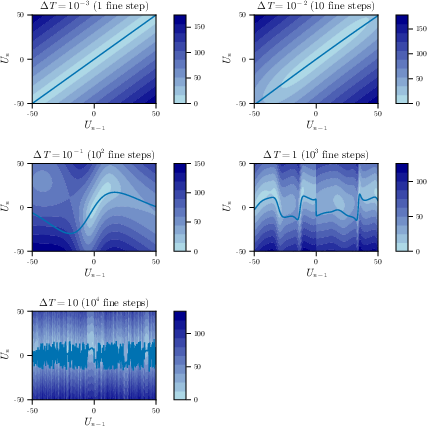
Figure 1: Structure of the basin of attraction for the Lorenz-63 system; the complex, fractal geometry of the error landscape rapidly emerges as the time step is increased.
To ensure robust finite-time convergence, the authors introduce the concept of outer and inner balls: an initial guess within an explicitly computable radius R (outer ball) around U∗ is guaranteed, via contraction, to reach a tolerance ball of radius r (inner ball) in a predictable finite number of iterations K. Their framework rigorously relates R, r, K, and the contraction factor β (which they explicitly bound for general nonlinear systems and Runge–Kutta methods) by recursive estimates on the error propagation.
Explicit Bounds: Quadratic Scaling for Runge-Kutta Parareal
A substantial theoretical advancement in the paper is the derivation of explicit operator-norm bounds for the contraction factor β for Parareal with general Runge–Kutta fine and coarse solvers. In the regime of uniform grid refinement, this factor satisfies
R0
as the fine step size R1 essentially decoupling the error control from the overall simulation window R2 as long as the coarse propagator is sufficiently accurate and stable.
The error constant admits a computably explicit form, decomposing into (i) a transport term accounting for the exponential accumulation of errors through coarse update chains and (ii) a source term quantifying the local mismatch between fine and coarse propagators. The detailed decomposition of error—internal stage coupling, time variation of local Jacobian, and curvature mismatch—supports methodical coarse solver design for targeted contraction.
Beyond Pointwise Convergence: Proximity Functions and Statistical Attractors
For strongly chaotic systems, rigorous pointwise convergence to the reference fine solution R3 is physically meaningless for R4 (Lyapunov time), as all nearby trajectories diverge exponentially fast. The Lax equivalence theorem is thus fundamentally reframed: the goal is to recover a solution on the correct statistical attractor—i.e., the invariant measure and its associated statistics, not the specific trajectory.
The authors introduce a proximity function R5 which weights the macro-trajectory discontinuities at each time slice boundary by an exponentially decaying factor tied to the maximal Lyapunov exponent R6 or to the fine solver's Lipschitz constant. They give a comprehensive theoretical justification demonstrating that convergence in this weighted-metric is equivalent to statistical correctness, and show that the resulting stopping criterion (as opposed to the standard unweighted residual) is both robust and effective for large-scale, strongly chaotic simulations.
Numerical Validation: Decoupling Iteration Count from Problem Scale
The numerical experiments target three problems: the scalar logistic ODE (dissipative, non-chaotic), Lorenz-63 (low-dimensional chaos), and Lorenz-96 (R7, high-dimensional extensivity). Consistent with the theory:
- For the non-chaotic logistic problem, the classical residual and weighted proximity criteria deliver identical, rapid linear convergence.
- For Lorenz-63 and Lorenz-96, the standard residual check fails dramatically—iteration counts R8 scale linearly with simulation window R9, and parallel efficiency collapses.
- In contrast, the chaos-aware proximity check maintains a strictly bounded, nearly constant number of iterations U∗0 independent of U∗1 or U∗2 (number of time chunks), and accurately recovers statistical invariant measures (measured via Wasserstein metric).

Figure 2: The number of Parareal iterations U∗3 to convergence plotted against simulation window size or processor count for Lorenz-63; weighted proximity functions yield constant U∗4, while standard checks cause U∗5 to scale linearly.

Figure 3: Effective serial work (U∗6) is bounded and decoupled from U∗7 for the weighted proximity function, illustrating true algorithmic scalability; unweighted residuals fail to parallelize in chaotic regimes.
The results demonstrate strict algorithmic scalability of Parareal under the proposed framework, as the effective serial bottleneck remains bounded even as both problem size and integration time grow.
Implications and Open Directions
This work sets a rigorous foundation for the design and deployment of scalable time-parallel integration methods for turbulent and chaotic systems. The introduction of a proximity-based, physics-informed stopping criterion is a crucial innovation, formally justified and empirically validated in both low- and high-dimensional chaos. The explicit contraction estimates further allow for informed coarsening and error control in Parareal and, in principle, in other multilevel-in-time schemes (e.g., MGRIT, PFASST).
Potential future directions include:
- Sharpening the conservatism of the explicit bounds on U∗8 by leveraging attractor-averaged or ergodic properties.
- Integration with adaptive moving-window parallelism, where contraction and weighting parameters are dynamically tuned according to estimated local Lyapunov exponents or statistical stationarity.
- Extending the analysis and methodology to systems with inhomogeneous or nonstationary stiffness, hybrid operators, or explicit PDE structure.
Conclusion
This paper delivers a mathematically rigorous and practically actionable framework for finite-time convergence of Parareal and, by extension, contraction-based time-parallel methods in the presence of strong nonlinearity and chaos (2604.00855). By explicitly decoupling iteration complexity from the length of the integration window, the method reconciles algorithmic design with the underlying ergodic/statistical structure of dynamical systems—a step that is essential for the scalability of parallel-in-time integration on exascale computing architectures.

