Lift4D: Harmonizing Single-View 3D Estimation for 4D Reconstruction In-the-Wild
Abstract: Reconstructing dynamic non-rigid objects from monocular video requires integrating visual cues from direct observations with data-driven priors over geometry and appearance. Prior approaches either learn to directly predict 4D representations from visual input or initialize a 3D representation that is subsequently deformed and refined based on video evidence. However, the former are constrained by the scarcity of 4D training data, while the latter leverage priors only for the initial reconstruction and rely solely on video supervision thereafter; neither handles complex in-the-wild scenarios with large deformations and occlusions well. We present Lift4D, a test-time optimization framework that addresses both limitations. First, we adapt an existing single-view 3D reconstruction model to yield temporally consistent per-frame predictions via causal latent conditioning, providing a coherent initialization for a deformable 3D Gaussian Splatting representation. We then ``sculpt'' this representation to match the input video through an occlusion-aware optimization that faithfully recovers visible surface details while completing unobserved regions using a view-conditioned diffusion prior. We demonstrate that Lift4D clearly improves over prior 4D reconstruction methods, particularly on challenging in-the-wild sequences with severe occlusions and non-rigid motion.

Paper Prompts
Sign up for free to create and run prompts on this paper using GPT-5.
Top Community Prompts
Explain it Like I'm 14
What is this paper about?
This paper introduces Lift4D, a computer method that builds a complete “4D” model of an object from a single everyday video. 4D here means 3D shape + how it changes over time. Imagine watching a rhino walk in a short clip and then being able to spin the rhino around, see all sides (even parts the camera never saw), and watch it move realistically—Lift4D tries to do exactly that.
What questions were the researchers asking?
They focused on three main questions:
- How can we turn a regular video (from one camera) into a full 3D object that also moves correctly over time?
- How can we keep the object’s shape consistent from frame to frame, instead of it wobbling or changing in strange ways?
- How can we “fill in” the parts the camera never saw or the parts that were blocked (occluded) by other things, so the model still looks complete and realistic?
How does Lift4D work? (Simple explanation of the approach)
Think of the problem like making a moving sculpture from a video. The video only shows some views, sometimes with obstacles in the way, so the sculpture has missing pieces. Lift4D solves this in three main stages:
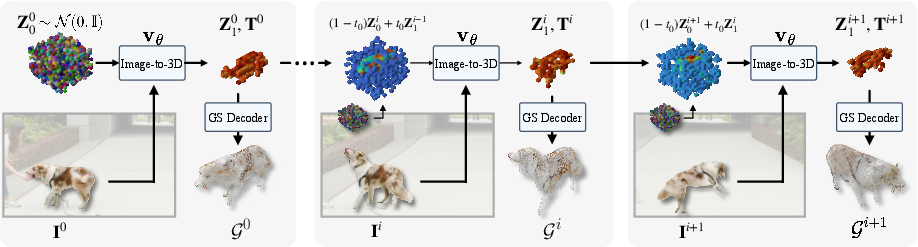
- Stage 1: Build a per-frame 3D “first guess” with memory
- The system starts by using a strong “image-to-3D” tool that can turn a single image into a rough 3D model. Doing this separately for each video frame makes the shape jump around. So the authors add “causal latent conditioning,” which is like letting the system carry a memory from one frame to the next. This keeps the per-frame 3D guesses consistent over time, like tracing over a previous sketch so the drawing doesn’t wobble.
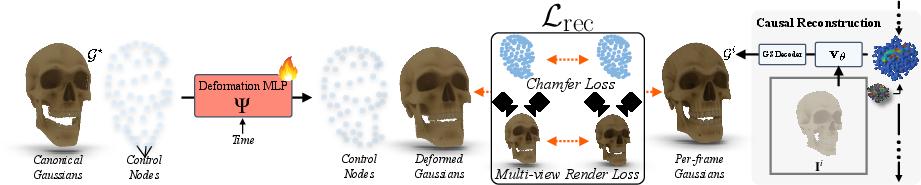
- Stage 2: Create one master 3D model that can deform over time
- Instead of treating every frame’s 3D shape as separate, Lift4D builds a single “canonical” 3D model made of many tiny soft blobs (this is called 3D Gaussian Splatting—imagine filling the object with lots of fuzzy marbles that are easy to render). It then adds a small set of “control points” (like simple bones in an animation rig) that can bend and move the canonical model to match each frame. This step “sculpts” and aligns the master model so it explains all frames smoothly.
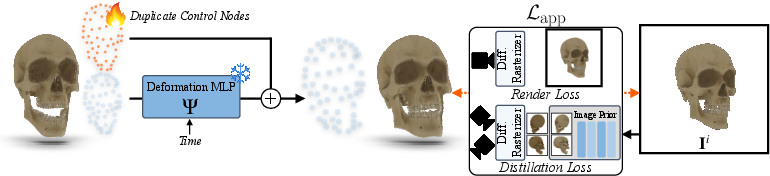
- Stage 3: Fix colors and fill in missing parts (even the unseen ones)
- Real videos often have occlusions (like a hand covering part of a shirt). Lift4D detects which pixels are blocked and avoids punishing the model for not matching those spots.
- For the blocked or never-seen areas, Lift4D uses a powerful image diffusion prior (think of it as an AI that’s good at imagining plausible appearances). It guides the model to paint believable textures where the camera offers no details, while keeping the visible areas faithful to the video. Before doing this, it color-matches the rendered model to the video frame so the look stays consistent.
Put together:
- The image-to-3D tool provides strong geometry (shape).
- The “memory” trick keeps that geometry consistent across time.
- The deformable master model gives one coherent 4D object.
- The occlusion-aware supervision avoids mistakes from blocked pixels.
- The diffusion prior fills in what the camera never saw, so the final 4D model looks complete from any angle.
What did they find, and why does it matter?
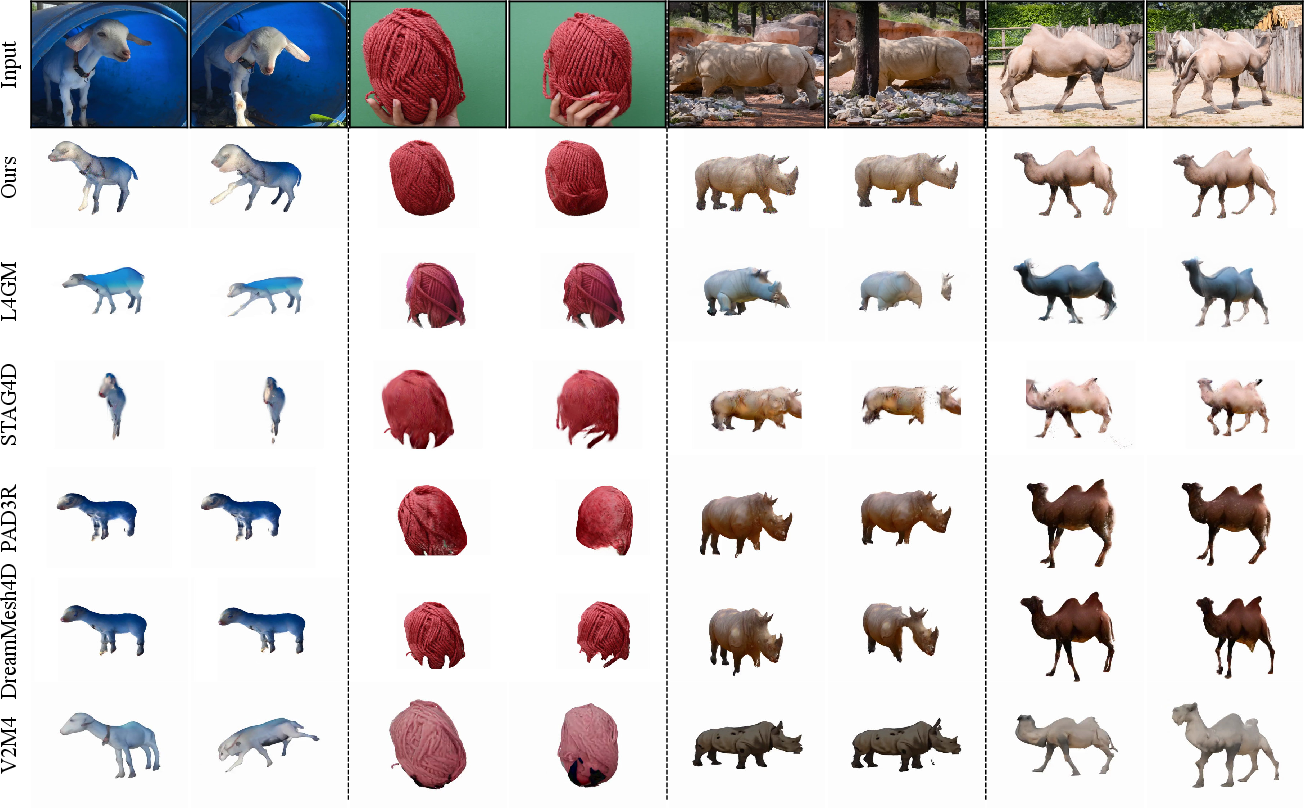
On both synthetic tests and real “in-the-wild” videos (like stock clips with cluttered backgrounds, moving subjects, and occlusions), Lift4D:
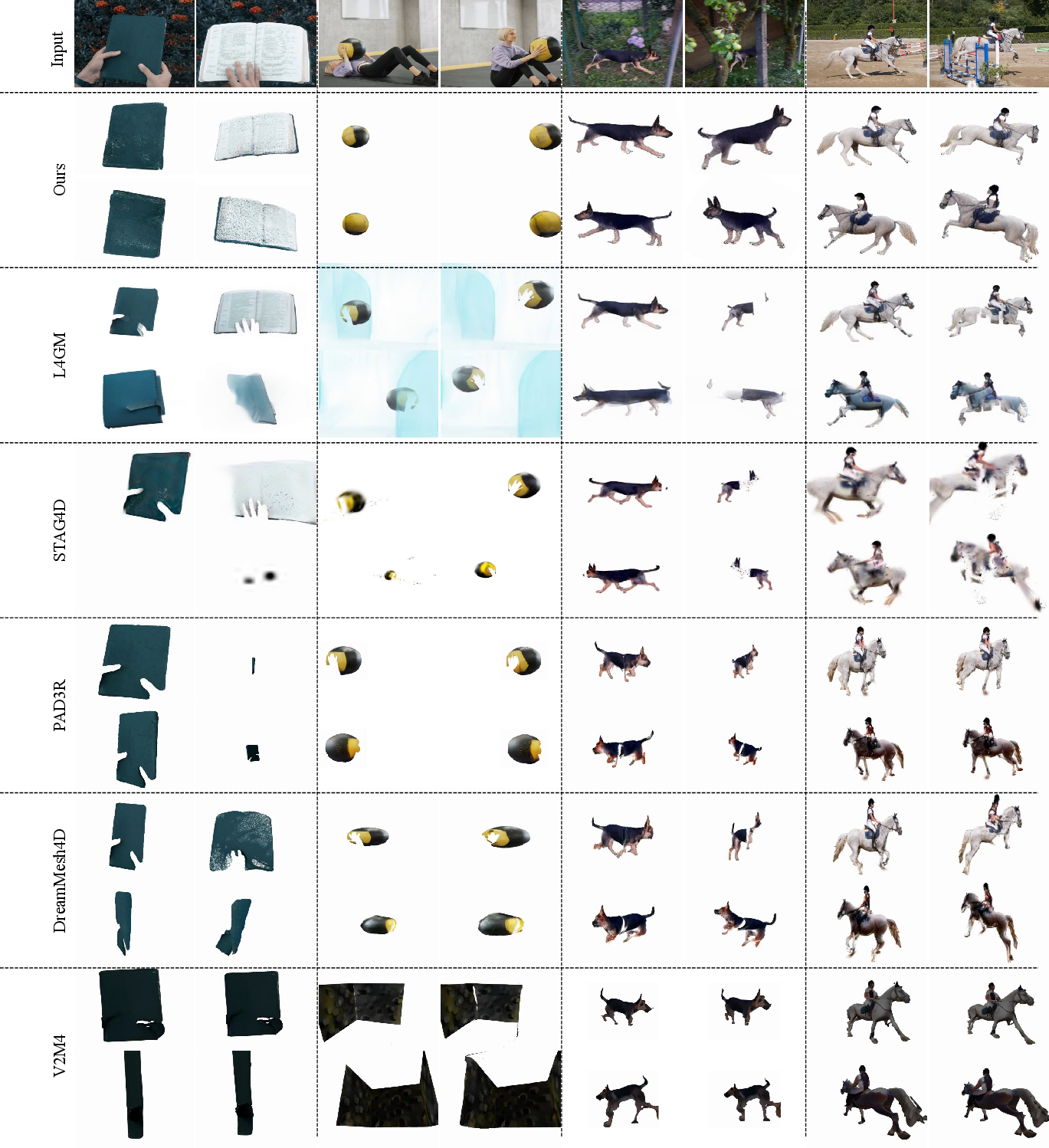
- Reconstructed more accurate and cleaner 3D shapes over time than previous methods.
- Produced more realistic textures and filled in occluded or unseen areas better.
- Tracked motion more precisely, meaning points on the object moved where they should from frame to frame.
In standard evaluations:
- It achieved better scores for visual quality and semantic alignment (how well the result matches what the video shows).
- It showed lower motion error, meaning the model’s movement over time matches the video more accurately.
Why this matters:
- Most videos are not shot with multiple cameras from all angles. Being able to recover a full, moving 3D model from a single casual video opens doors for creative tools and scientific analysis.
What are the bigger implications?
- Easier 3D content creation: Artists and game developers could turn regular videos into 3D animations usable from any angle, speeding up production for films, games, and AR/VR.
- Better video editing and effects: Editors could re-light, re-pose, or re-shoot scenes virtually, because they have a complete 3D moving model.
- Robotics and understanding motion: Robots and research tools could better understand how objects move in the real world using regular cameras.
- Education and science: Complex motions (like animal movement) could be studied in 3D using common video clips.
Limitations and future improvements:
- Lift4D relies on the quality of the initial single-image-to-3D predictions; if those are wrong, errors can carry through.
- The authors suggest improving that first stage and handling even more complex interactions (like detailed human grasping) in future work.
In short, Lift4D is like a smart sculptor that watches a video and builds a complete, animated 3D version of what it sees—filling in the gaps thoughtfully and keeping everything consistent over time.
Knowledge Gaps
Knowledge gaps, limitations, and open questions
Below is a focused list of concrete gaps and open questions that remain unresolved by the paper and could guide future research.
- Dependence on single-view 3D prior quality: Performance is tightly coupled to SAM3D’s per-frame reconstructions and object-to-camera transforms; how to robustly handle (or jointly correct) systematic SAM3D errors and category-specific biases during test-time optimization is not addressed.
- Causal-only temporal conditioning: Latent propagation enforces forward-time consistency but lacks backward or global smoothing; the impact of bidirectional conditioning or joint optimization of all frame latents on long-term drift remains unexplored.
- Sensitivity to hyperparameters: The warm-start parameter , number/placement of control nodes, and the curriculum switch point () are fixed; there is no method to automatically tune or adapt these per video, nor an analysis of their sensitivity/robustness.
- Reliance on external segmentation and depth: The pipeline requires SAM3 masks and Depth Anything 3 monocular depths; failure modes under segmentation leaks, missing parts, or depth mis-ordering (especially around boundaries and thin structures) are not characterized or mitigated.
- Occlusion mask reliability: Occlusion detection via scene-depth vs. rendered-depth and mask XOR can be brittle with noisy monocular depth or self-occlusions; integrating learned occlusion reasoning, uncertainty, or temporal consistency is left open.
- Color matching under complex lighting: Per-channel histogram matching assumes global color shifts; spatially varying illumination, shadows, and strong specularities are not modeled, raising the need for explicit lighting/BRDF estimation or spatially adaptive color calibration.
- View-dependent appearance and relighting: The 3DGS appearance is effectively view-independent; handling specular/transparent materials or significant view-dependent effects (and relighting) is not addressed.
- Consistency of diffusion-guided completions: View-conditioned 2D diffusion is used to fill unobserved regions after geometry is fixed, but the multi-view and temporal consistency of hallucinated textures is not guaranteed or evaluated; 3D-aware or multi-view consistent diffusion priors remain an open direction.
- Identity/style drift from diffusion priors: How to prevent diffusion guidance from altering subject identity, style, or fine semantics across frames and novel views is not investigated.
- Deformation capacity and topology changes: The sparse control-node LBS parameterization may struggle with highly articulated, non-isometric, or topology-changing deformations (e.g., cloth, hair, opening/closing structures); adaptive node placement, piecewise deformation models, or physics-informed priors are not explored.
- Multi-object, interactive scenes: The method targets single objects; joint 4D reconstruction with multiple interacting objects (mutual occlusions, contact, grasping) and shared occlusion constraints is not supported.
- Camera trajectory and scale ambiguity: Object-to-camera transforms are taken from the prior rather than jointly estimated from the video; a principled joint estimation (object motion + camera motion) to resolve scale and trajectory drift is missing.
- Long videos and scalability: Runtime (~30 minutes for 32 frames on an H200) may not scale to long or high-FPS videos; streaming/incremental optimization, keyframe selection, or amortized distillation to speed up inference is unaddressed.
- Robustness to fast motion and sensor artifacts: The effects of motion blur, rolling shutter, low frame rate, or abrupt viewpoint jumps on latent propagation and deformation stability are not analyzed.
- Global trajectory consistency: Per-frame alignment transforms () correct drift locally, but a global trajectory constraint (e.g., bundle-adjustment-like) to ensure coherence across the full sequence is absent.
- Uncertainty estimation: The framework provides no uncertainty or confidence measures for geometry/appearance in unobserved or weakly observed regions, limiting principled stopping criteria and user feedback.
- Evaluation of completions: There is no metric or benchmark assessing the plausibility and consistency of hallucinated unseen geometry/texture; controlled multi-view datasets or synthetic occlusion benchmarks could quantify completion fidelity.
- Dependence on pseudo-GT tracks: The EPE metric uses CoTracker3 outputs as pseudo-ground truth; the reliability of this proxy and its bias on reported motion accuracy are not validated against true 3D motion ground truth.
- Mask refinement and background spill: Joint refinement of masks during optimization (e.g., via render-and-compare) to correct background spill or missing thin parts is not considered.
- Scene-level 4D reconstruction: The approach segments out subjects and does not reconstruct dynamic backgrounds or full scenes; extending to full, compositional 4D scenes remains open.
- Failure with challenging materials/structures: Transparent, reflective, translucent, or very thin structures are not explicitly addressed; occlusion handling and appearance modeling for such cases remain open problems.
- Reproducibility and prior diversity: Results hinge on specific priors (SAM3D, SAM3, Depth Anything 3, a particular diffusion model); the impact of swapping priors, and how to design a prior-agnostic interface, is not studied.
- End-to-end or joint training: The paper avoids retraining priors; whether lightweight finetuning (e.g., LoRA) or joint test-time optimization of the image-to-3D backbone could improve consistency and reduce error propagation is untested.
Practical Applications
Practical Applications of Lift4D
Below are concrete, real-world applications that follow from the paper’s findings and innovations (causal latent conditioning for temporally coherent single-view 3D, deformable 3D Gaussian Splatting with sparse control nodes, and occlusion-aware appearance reconstruction guided by a view-conditioned diffusion prior). Each item indicates target sectors, plausible tools/products/workflows, and key assumptions or dependencies that influence feasibility.
Immediate Applications
- 4D assetization from a single video for VFX/postproduction
- Sectors: media/entertainment, advertising
- Potential tools/products/workflows:
- “Video-to-4D” DCC plug‑ins (Blender, Houdini, Unreal, Nuke) that ingest a handheld clip, run Lift4D offline, export deformable Gaussians or bake to meshes/animated textures for editing, relighting, and compositing
- Shot cleanup aids using the occlusion-aware pipeline (generate occluder masks, color-matched references for compositing)
- Assumptions/dependencies:
- Offline GPU resources (≈30 minutes per 32-frame object on an H200; longer on smaller GPUs)
- Quality segmentation (e.g., SAM3) and monocular depth (e.g., Depth Anything 3)
- Single prominent object with a reasonably clean mask; complex multi-object interactions remain challenging
- Hallucinated unobserved regions are visually plausible but not ground-truth accurate
- Rapid AR/VR content capture with a phone
- Sectors: AR/VR, gaming, metaverse
- Potential tools/products/workflows:
- Mobile capture app + cloud processing to turn casual clips into dynamic 4D assets for AR try-ons, interactive scenes, or in-game props
- Export to USD/GLTF with baked animations or to Gaussian renderers for real-time preview
- Assumptions/dependencies:
- Cloud inference or powerful desktop GPU; on-device constraints limit immediate real-time use
- Need to convert Gaussians to meshes for broad engine interoperability, which can reduce fidelity
- E-commerce 360° product visuals with motion
- Sectors: retail/e-commerce
- Potential tools/products/workflows:
- Merchant workflow: record short product videos, auto-generate 360° spin with simple motions (e.g., opening lids, flexing materials), publish to product pages
- Assumptions/dependencies:
- Visual plausibility is strong, but exact material/geometry accuracy in unseen areas is not guaranteed
- Best for non-regulatory use (marketing visuals vs. precise measurement/specification)
- Digital fashion look development and garment motion previews
- Sectors: fashion tech, virtual try-on content creation
- Potential tools/products/workflows:
- Capture of drape and deformation from runway/backstage clips; generate dynamic 4D garments for look dev and virtual catalogues
- Assumptions/dependencies:
- Not physically validated cloth simulation; suitable for visual preview, not engineering-grade fit or stress analysis
- Sports and wildlife visualization from broadcast or field videos
- Sectors: sports media, natural history, education/outreach
- Potential tools/products/workflows:
- Create dynamic 4D reconstructions of athletes/animals for broadcast enhancements, museum displays, or educational AR experiences
- Assumptions/dependencies:
- Occlusions and fast motion may require careful masking and stable depth; generated geometry in unseen regions is plausible, not metrically accurate
- Academic dataset augmentation for 4D correspondence, tracking, and novel view synthesis
- Sectors: academia, ML research
- Potential tools/products/workflows:
- Use emergent dense 4D correspondences and deformable reconstructions to produce pseudo-labels, synthetic multi-view sequences, or training priors
- Ablation-friendly pipeline to study effects of priors (image-to-3D vs. diffusion) on reconstruction quality
- Assumptions/dependencies:
- Pseudo-labels contain hallucinations where views are missing; must be flagged when used for training or evaluation to avoid bias
- Robotics research assets and simulation props
- Sectors: robotics (research), simulation
- Potential tools/products/workflows:
- Generate approximate dynamic object models from a single monocular log for simulation environments or perception pretraining
- Assumptions/dependencies:
- Not metric-accurate or real-time; unsuitable for closed-loop control or safety-critical planning without additional sensing/verification
- Video editing aids using occlusion-aware masks and color matching
- Sectors: postproduction, social content creation
- Potential tools/products/workflows:
- Reuse the paper’s occlusion mask derivation (scene depth vs. rendered object depth) to guide object removal/insertion and consistent color matching across shots
- Assumptions/dependencies:
- Requires reliable monocular depth and object masks; failure in depth estimation will degrade mask quality
- Low-effort 3D printing and concept prototyping
- Sectors: maker community, product concepting
- Potential tools/products/workflows:
- Convert the reconstructions to watertight meshes for quick mockups or decorative prints
- Assumptions/dependencies:
- Meshing of Gaussians may smooth or distort fine details; surfaces in unseen regions are inferred, not measured
Long-Term Applications
- Real-time or near-real-time 4D capture for live telepresence and virtual production
- Sectors: live events, telepresence, virtual production
- Potential tools/products/workflows:
- Low-latency pipelines with causal conditioning and lightweight diffusion guidance; live 4D avatars or props composited into virtual sets
- Assumptions/dependencies:
- Significant model compression, algorithmic acceleration, and streaming architecture; robust multi-object handling and temporal stability
- On-robot 4D perception for manipulation and forecasting
- Sectors: robotics, industrial automation
- Potential tools/products/workflows:
- Use in-the-loop 4D reconstruction to predict occluded geometry and deformations for grasp planning and manipulation of deformables
- Assumptions/dependencies:
- Requires metric accuracy, calibrated cameras, uncertainty estimates, and robust generalization; current hallucinations are unacceptable for safety-critical use
- Clinical and sports biomechanics from monocular videos
- Sectors: healthcare, sports science
- Potential tools/products/workflows:
- Patient- or athlete-specific dynamic 3D reconstructions for visualization, rough kinematic analysis, or remote assessments
- Assumptions/dependencies:
- Regulatory validation, accuracy benchmarking against gold standards, bias assessment; robust human-specific priors and consent/PHI protections
- Digital twin creation from sparse, in-the-wild footage
- Sectors: AEC/operations, enterprise training/simulation
- Potential tools/products/workflows:
- Generate dynamic digital twins of equipment or processes captured casually, for training and what-if analysis
- Assumptions/dependencies:
- Requires multi-object, scene-level 4D, scale recovery, CAD alignment, and reliability guarantees beyond current test-time optimization
- Autonomous driving and surveillance analytics (4D human/object modeling from monocular feeds)
- Sectors: transportation, public safety
- Potential tools/products/workflows:
- Enhanced tracking and intent modeling via 4D reconstruction of dynamic agents from dashcams or fixed cams
- Assumptions/dependencies:
- Ethical, legal, and privacy considerations; real-time constraints; multi-object occlusions; high robustness and calibration
- Industrial inspection and QA of deforming parts/materials
- Sectors: manufacturing, materials
- Potential tools/products/workflows:
- Monitor deformation behavior from a single camera (e.g., belts, hoses) to flag anomalies early
- Assumptions/dependencies:
- Requires accurate, repeatable measurements; the current diffusion-based completion of unseen regions is unsuitable without metrology-grade validation
- Content authenticity, IP, and policy tooling
- Sectors: policy/regulation, platforms, legal
- Potential tools/products/workflows:
- Watermarking or provenance metadata in video-to-4D pipelines; licensing checks for inputs; detectors that flag hallucinated/uncertain regions in 4D assets
- Assumptions/dependencies:
- Cross-ecosystem standards for provenance; platform support; legal clarity on reconstructing protected content from public videos
- Turnkey cloud APIs and SDKs for video-to-4D at scale
- Sectors: software platforms, creative tooling
- Potential tools/products/workflows:
- Managed services that accept a video, return an animated 4D asset and correspondences; SDKs for integration in creative suites and mobile apps
- Assumptions/dependencies:
- Cost controls (GPU time), SLA/performance guarantees, data privacy/retention policies, export formats (Gaussian-to-mesh conversion), and robust handling of difficult footage
Cross-Cutting Assumptions and Dependencies
- Core technical dependencies:
- Strong single-view 3D prior (e.g., SAM3D or equivalent), reliable segmentation (SAM family), and monocular depth (Depth Anything 3 or similar)
- GPU compute (test-time optimization; speed varies substantially with hardware)
- Conversion pipelines (deformable Gaussians to meshes/skeletons) for downstream tool interoperability
- Scene and content constraints:
- Designed for object-centric reconstructions with masks; multi-object, long, or highly cluttered scenes are harder
- Unobserved/occluded regions are plausibly completed (via diffusion), not guaranteed accurate; avoid use where measurements or safety are critical
- Legal/ethical considerations:
- Rights to process and redistribute inputs and outputs; consent for people/animals; disclosure of synthetic/hallucinated content
- Potential for misuse (e.g., deceptive 3D replicas); recommend provenance and transparency mechanisms
- Reliability factors:
- Quality of priors (image-to-3D, diffusion) and their biases
- Hyperparameters (e.g., causal latent blending t0) affect temporal stability vs. per-frame fidelity
- Occlusion mask quality depends on depth estimation and consistent masks; failure cases impact appearance reconstruction
These applications reflect what can be built today with offline pipelines and what becomes feasible as Lift4D-style methods mature toward real-time, multi-object, metrically accurate 4D perception and content creation.
Glossary
- 3D Gaussian Splatting (3DGS): A real-time rendering and reconstruction technique that represents scenes as collections of textured 3D Gaussians for differentiable rendering. "3D Gaussian Splatting (3DGS)~\cite{kerbl20233gaussian}"
- 4D Reconstruction: The recovery of a dynamic 3D object and its temporal evolution (geometry and appearance over time) from visual input. "4D Reconstruction from Monocular In-the-Wild Video."
- Canonical representation: A time-invariant reference shape or space to which time-varying deformations are applied for consistency across frames. "distilled into a canonical representation (\cref{sec:deform})"
- Causal latent conditioning: Conditioning each frame’s reconstruction on previous frames’ latents to improve temporal consistency without retraining. "via causal latent conditioning, providing a coherent initialization"
- Chamfer Distance (CD): A symmetric distance between two point sets used to align reconstructed geometry in 3D. "The Chamfer term aligns positions"
- Control nodes (sparse): A compact set of points used to parameterize deformations, reducing complexity by controlling many Gaussians via few nodes. "We initialize sparse control nodes "
- D-SSIM: A differentiable structural similarity metric used as a perceptual loss for rendered images. "D-SSIM~\cite{kerbl20233gaussian, huang2023sc}"
- Deformation fields: Functions that map points from a canonical space to their deformed positions over time to capture non-rigid motion. "augment Gaussians with learned deformation fields or canonical-space representations"
- Deformation MLP: A neural network that predicts per-frame transformations of control nodes to drive object deformations. "A deformation MLP predicts each node's time-varying transformation"
- End-Point Error (EPE): A metric measuring the average 2D/3D endpoint distance between predicted and reference tracks or flows, used for motion accuracy. "better motion accuracy (EPE) on challenging in-the-wild videos."
- Gaussian splat decoder: The network component that converts a denoised latent into a set of renderable 3D Gaussians. "decoded by the gaussian splat decoder into per-frame gaussians"
- Image-to-3D model: A model that reconstructs a 3D object (geometry and appearance) from a single image, used here as a prior. "with an image-to-3D model \cite{sam3dteam2025sam3d3dfyimages}"
- Linear Blend Skinning (LBS): A standard deformation technique that blends transformations from multiple control nodes to deform geometry smoothly. "via linear blend skinning"
- LPIPS: A learned perceptual image similarity metric that correlates with human judgment, used to evaluate visual quality. "outperforming existing methods in perceptual quality (LPIPS)"
- Novel view synthesis: The task of rendering images from viewpoints not present in the input using a learned or reconstructed scene representation. "Generative 4D Novel View Synthesis."
- Object-to-camera transform: The rigid transformation that places the reconstructed object in the camera coordinate system for rendering. "with an object-to-camera transform "
- Occlusion-aware optimization: An optimization strategy that explicitly accounts for occluders so supervision focuses on visible object regions. "by leveraging a causally conditioned image-to-3D prior and occlusion-aware optimization."
- Occlusion-aware rendering supervision: A supervision scheme that identifies and handles occluded pixels to avoid corrupting appearance and geometry learning. "We further propose an occlusion-aware rendering supervision scheme."
- Occlusion mask: A binary mask indicating where the object is occluded by foreground scene content in the observed image. "For frame , the occlusion mask is"
- Photometric supervision: Optimization using pixel-wise image losses (e.g., L1, SSIM) between rendered views and reference images to align appearance. "employ rendering-based photometric supervision."
- Rectified conditional flow matching: A flow-based generative technique for denoising latents via an ODE, conditioned on inputs; used here for single-view 3D reconstruction. "via rectified conditional flow matching:"
- Score distillation (SDS): A training signal derived from a diffusion model’s denoiser that guides optimization toward realistic images or textures. "we add a score-distillation loss in the spirit of SparseFusion~\cite{zhou2023sparsefusion}"
- SE(3): The Lie group of 3D rigid motions (3D rotations and translations) used to parameterize object or node transformations. ""
- View-conditioned 2D diffusion guidance: Using a 2D diffusion model conditioned on specific reference views to guide completion of unobserved regions. "by anchoring view-conditioned 2D diffusion guidance."
- View-conditioned image diffusion prior: A generative image prior conditioned on a given view that provides plausible supervision for unobserved or occluded areas. "using a view-conditioned image diffusion prior~\cite{liu2023zero}"
Collections
Sign up for free to add this paper to one or more collections.

