Quantum Simulation of Stokes Flow via Schrödingerisation and Artificial Compressibility
Published 1 Jul 2026 in math.NA | (2607.00281v1)
Abstract: Simulating incompressible Stokes flow is essential for studies in microfluidics and low-Reynolds number hydrodynamics. However, the computational cost of resolving the associated saddle-point problem grows prohibitively with the dimensionality of the problem. In this work, we present a quantum algorithm based on the Schrödingerisation technique for the Stokes equations, incorporating an artificial compressibility regularization. The core of our approach is the design of an explicit quantum circuit that encodes the resulting regularized system. The artificial compressibility formulation provides a unified framework for the system, which is then efficiently mapped to a quantum circuit via the Schrödingerisation procedure. A rigorous complexity analysis demonstrates the quantum computational advantage of our algorithms in high-dimensional settings, notably an exponential speedup in problem dimensionality. The validity and scalability of the proposed method are corroborated by numerical simulations performed on Qiskit.
The paper introduces a novel integration of Schrödingerisation and artificial compressibility to reformulate the incompressible Stokes flow for quantum simulation.
It employs a staggered grid finite-volume discretization to enhance stability by accurately coupling velocity and pressure, thereby suppressing spurious pressure modes.
The study provides rigorous complexity analysis and numerical validation, demonstrating exponential quantum speedup over classical solvers in high-dimensional settings.
Quantum Simulation of Stokes Flow: Schrödingerisation and Artificial Compressibility
Introduction and Problem Context
The efficient simulation of incompressible Stokes flow is a canonical problem in computational fluid dynamics, relevant for modeling microfluidics, porous media, and biomedical transport at low Reynolds numbers. The associated numerical saddle-point problem—enforcing incompressibility through ∇⋅u=0—remains a source of high computational cost, with severe scaling issues as spatial dimension increases. Standard approaches such as finite element or finite volume schemes require the solution of large, ill-conditioned systems at each step, which is exacerbated by high-dimensionality. The artificial compressibility method is a prominent regularization strategy, reformulating the constraint via a controlled relaxation, thus transforming the elliptic saddle-point operator into a more tractable parabolic-hyperbolic system. However, even with such regularization, classical solvers are intractable for sufficiently large d.
Quantum algorithms offer significant opportunities in this regime, particularly via mappings that recast non-Hermitian or dissipative PDEs into equivalent unitary dynamics suitable for quantum simulation. The Schrödingerisation technique provides such a mapping, embedding the dynamics into a higher-dimensional augmented Hilbert space where unitary simulation is possible. The present work rigorously integrates the Schrödingerisation approach with the artificial compressibility regularization to develop explicit quantum circuits for solving high-dimensional Stokes equations, providing both complexity analysis and empirical validation on quantum circuit simulators.
Formulation: Artificial Compressibility and Discretization
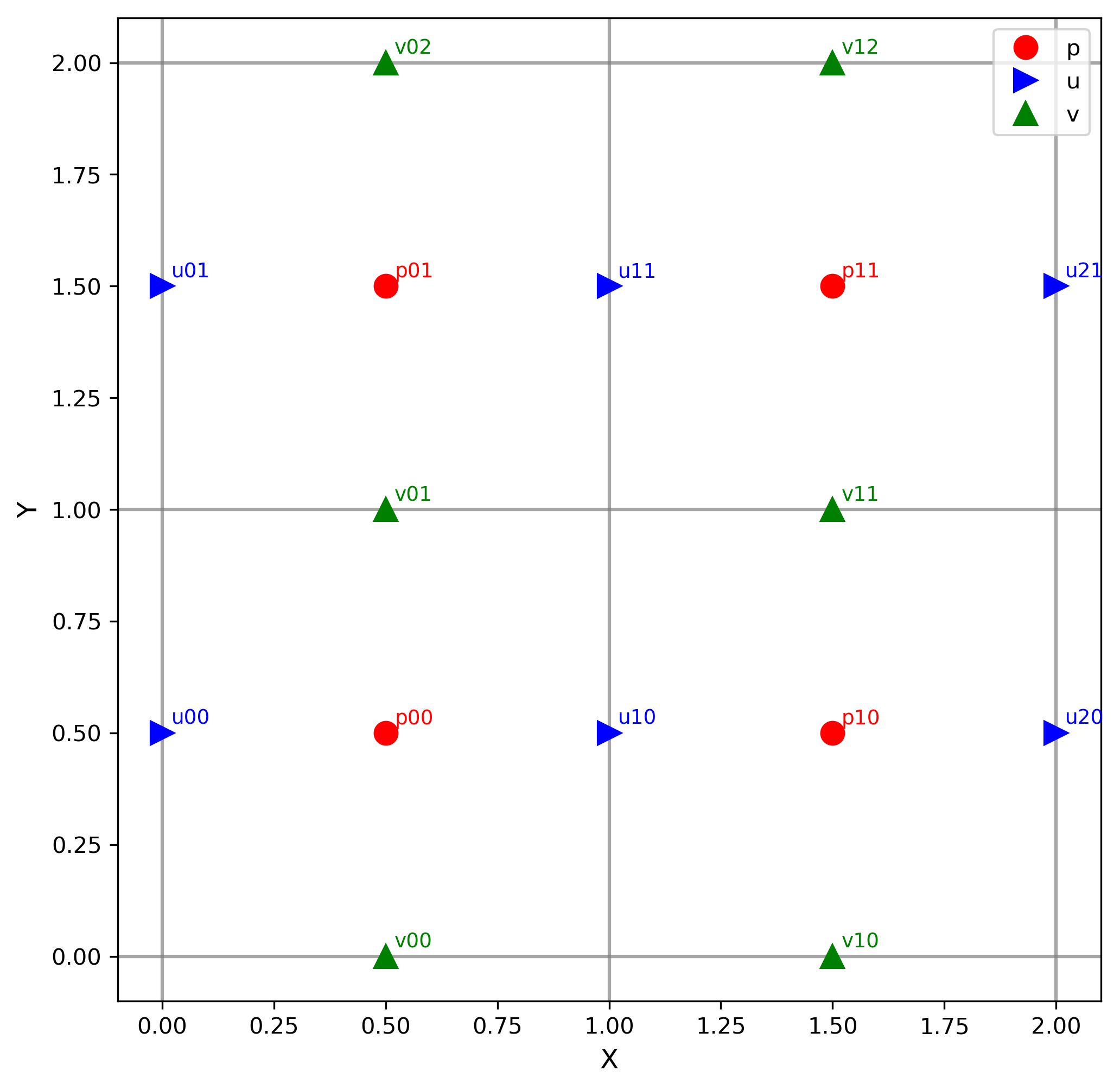
The method employs the artificial compressibility ansatz ∇⋅u=εp (ε≪1), yielding an evolution equation for pressure and regularized momentum conservation: a coupled velocity-pressure system suitable for explicit time stepping and quantum circuit construction. A staggered grid finite-volume discretization is used, storing velocity components at half-integer nodes and the pressure at cell centers to enhance numerical stability and ensure compatible velocity-pressure coupling consistent with incompressibility.
The error analysis (presented in full in the appendices) establishes that the artificial compressibility formulation converges to the incompressible solution at a linear rate O(ε) in the steady regime, and O(ε) in pressure for the time-dependent case. The staggered grid layout is crucial for suppressing spurious pressure modes and minimizing checkerboarding effects.
Figure 1: Schematic diagram illustrating the staggered grid configuration for velocity and pressure variables in the finite-volume discretization.
Schrödingerisation of the Artificially Compressible Stokes System
The dissipative parabolic-hyperbolic system derived from artificial compressibility is mapped to a unitary quantum system using Schrödingerisation. This involves the introduction of an ancillary coordinate q (the Fourier conjugate variable to the warped phase transformation), resulting in a higher-dimensional wave function whose evolution encodes the original (non-unitary) Stokes flow. The transformation utilizes an extended state mapping:
wi(t,x,q)=e−qui(t,x),o(t,x,q)=e−qp(t,x)
Fourier transforming in q yields a set of Schrödinger-type equations in the momentum variable η. The solution and all relevant operators are then discretized for circuit implementation. Central to the method is engineering the Hamiltonian such that it precisely represents the discretized Stokes operator and couplings.
Quantum Circuit Representation
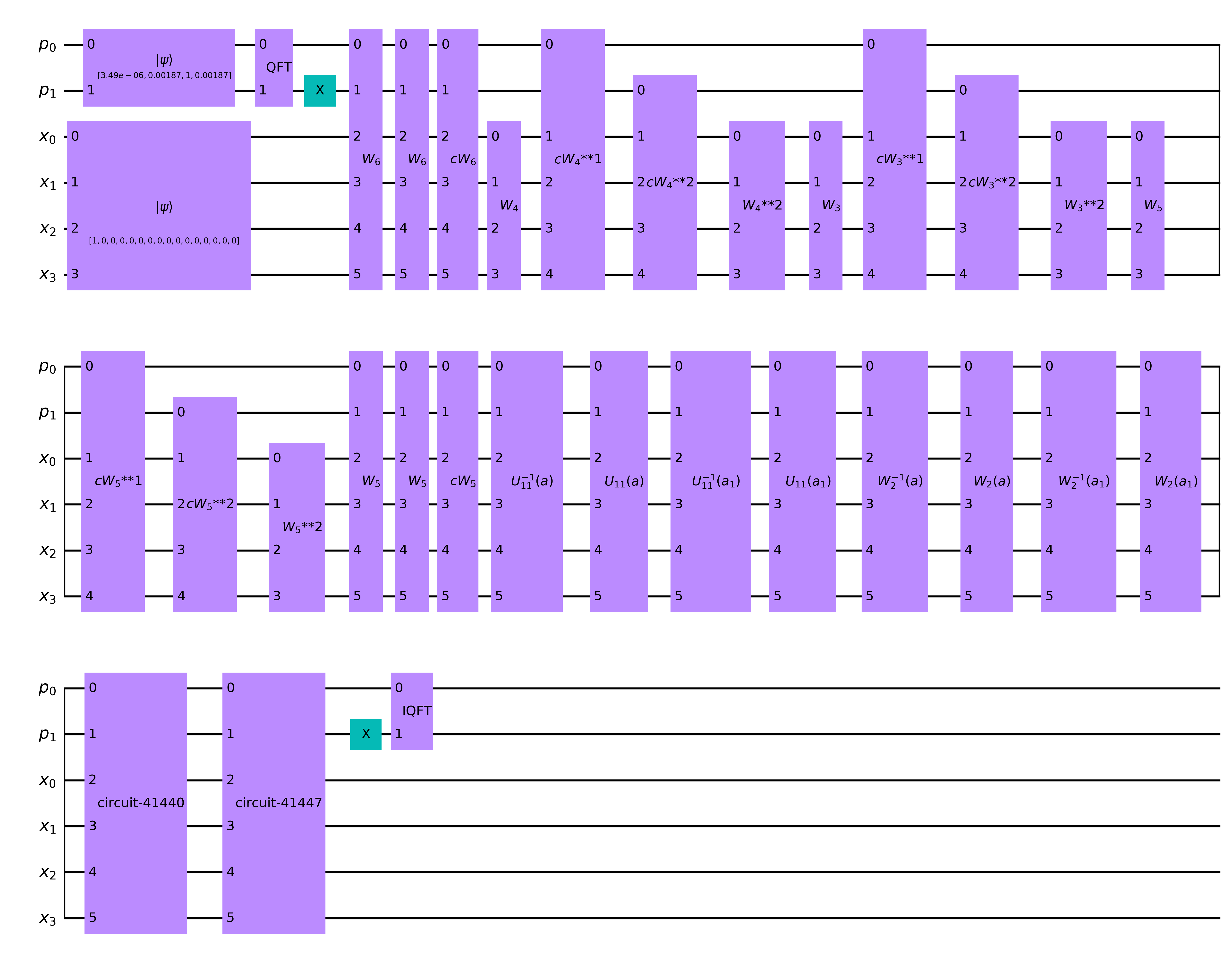
The construction of explicit quantum circuits to simulate the Schrödingerized Stokes system is described via a sequence of controlled-unitary gates, implementing finite-difference Laplacians and first-order spatial shifts as tensor products of multi-controlled single-qubit rotations. The circuits are built using Trotter-Suzuki decompositions for time evolution, allowing systematic control of operator splitting errors.
Figure 2: Schematic quantum circuit representing the Hamiltonian evolution and Trotterized building blocks employed for the discretized Stokes system.
Detailed binary encodings for staggered-grid difference operators, shift matrices d0, and controlled phase rotations (using multi-controlled d1 gates) are provided. The result is a fully explicit, gate-efficient mapping, with gate counts scaling as d2, where d3 is spatial dimension, d4 is the binary representation width for spatial indices, and d5 is the number of grid points in the ancillary dimension.
Complexity Analysis and Quantum Advantage
The paper provides a comprehensive complexity analysis incorporating Lie-Trotter-Suzuki decomposition error, discretization error in both space and ancillary dimension, and success probability after quantum measurement. For a precision d6, the total quantum gate complexity to prepare the state corresponding to the flow field at time d7 is
d8
in single-qubit and CNOT gates, accounting for grid resolution (d9), time of simulation (∇⋅u=εp0), and error tolerance (∇⋅u=εp1). In contrast, the classical solver for the same discretized system incurs exponential cost in ∇⋅u=εp2 due to the curse of dimensionality:
∇⋅u=εp3
Exponential quantum speedup is thus achieved for sufficiently large ∇⋅u=εp4 (e.g., ∇⋅u=εp5 under typical mesh scaling), especially notable for simulations far beyond the reach of classical hardware.
Numerical Validation
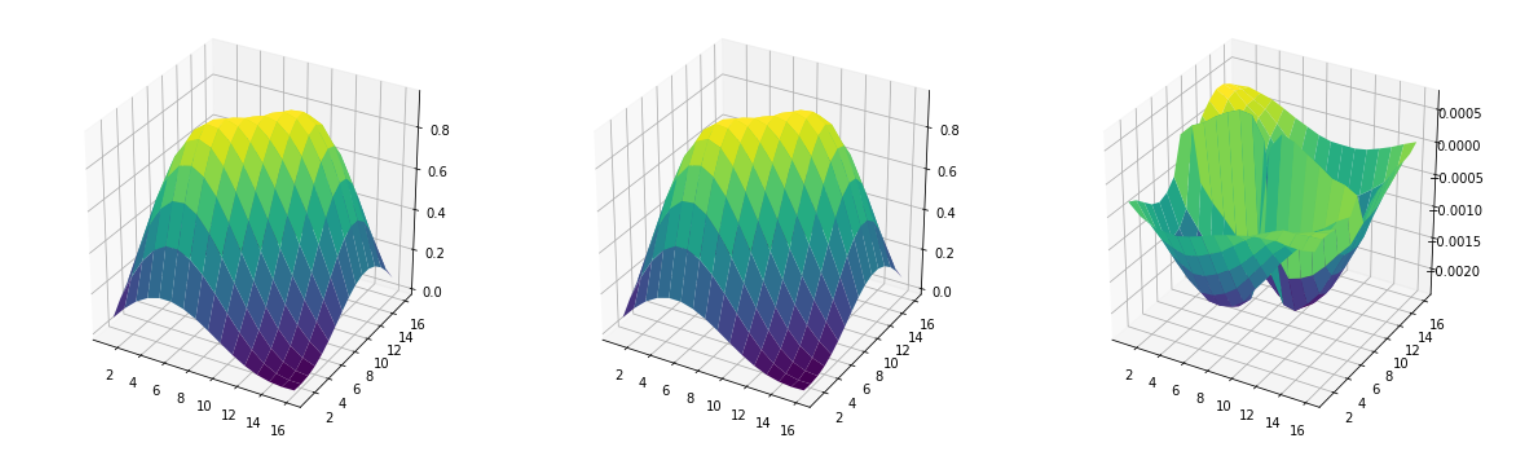
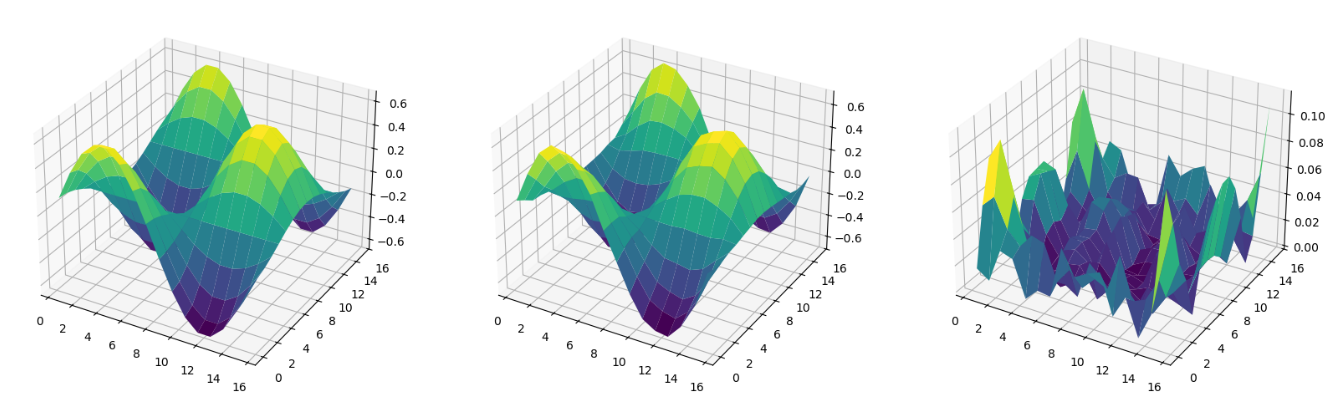
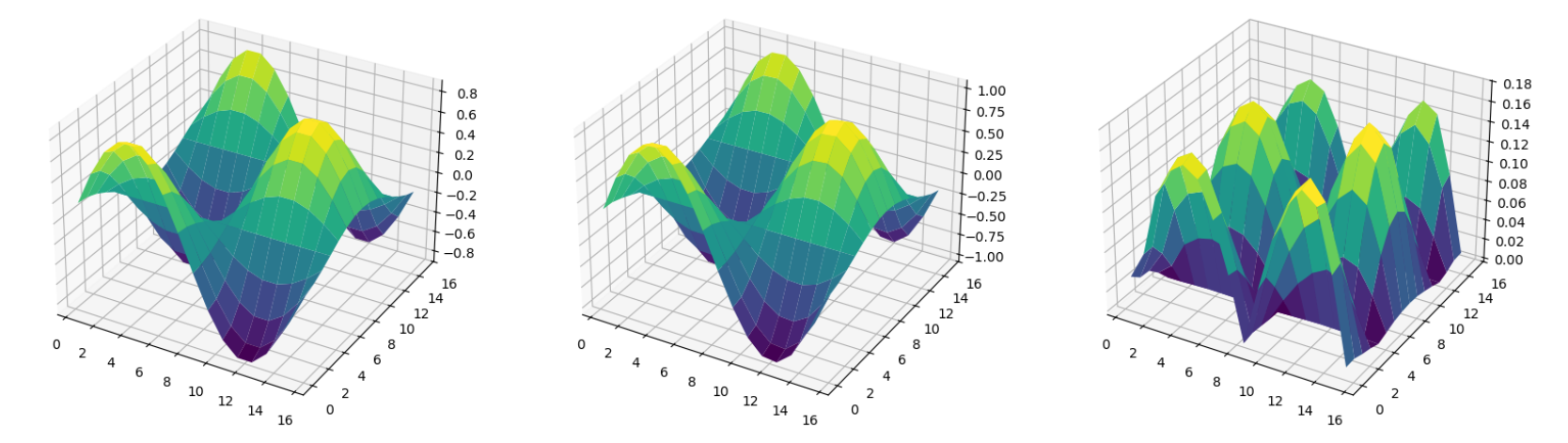
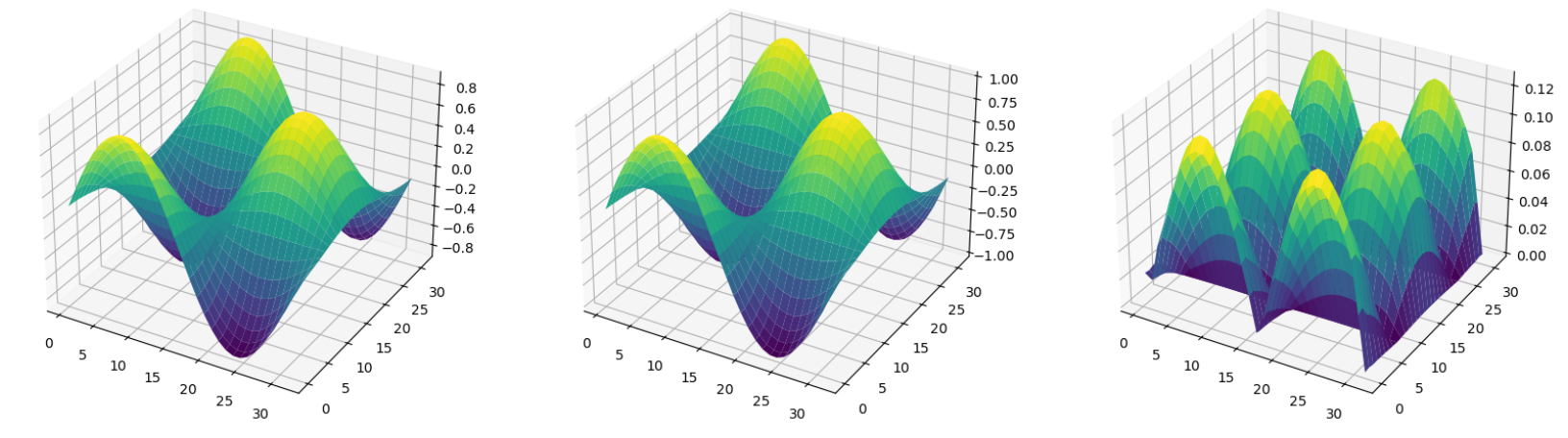
The algorithm was validated by Qiskit-based simulation. Quantum circuits were benchmarked on canonical test problems: first, operator discretization accuracy was assessed via comparison to analytic solutions on collocated grids. Then, the full solver was applied to analytic solutions of the regularized Stokes system on staggered grids. The visualizations show excellent agreement with analytic results, with small, localized errors commensurate with grid resolution.
Figure 3: Numerical solution and pointwise error for a benchmark problem using the implemented quantum circuit on a collocated grid.
Figure 4: Results for the full quantum-simulated Stokes flow on staggered grids confirming high solution fidelity.
In addition, systematic parameter studies were undertaken, varying number of grid points in ∇⋅u=εp6 (∇⋅u=εp7), ancillary dimension ∇⋅u=εp8 (∇⋅u=εp9), time-step size (ε≪10), and artificial compressibility parameter (ε≪11). Error decreases monotonically with increased resolution (ε≪12, ε≪13), and also as ε≪14, ε≪15 are reduced, in accordance with both theory and numerical analysis, revealing standard convergence rates and stability characteristics.
Figure 5: Quantum simulation with ε≪16, ε≪17, ε≪18, ε≪19, O(ε)0—baseline solution for convergence studies.
Figure 6: Improved resolution with O(ε)1, indicating reduced error and enhanced fidelity at larger ancillary dimension.
Theoretical and Practical Implications
The explicit Schrödingerisation-based quantum algorithm rigorously circumvents the limitations of classical incompressible solvers in high dimensions. It enables, for the first time, direct quantum simulation of non-Hermitian, dissipative PDEs—attributable to the saddle-point and incompressibility structures—via embedding into unitary evolution. The explicit quantum circuit construction is directly applicable to near-term quantum hardware, and the dependence on grid encoding, ancillary variable discretization, and overall operator design is systematically quantified.
The approach directly generalizes to related non-Hermitian PDEs and more complex coupled flow problems, offering a pathway to scalable quantum simulation of both linear and (via further development) nonlinear PDE systems such as the Navier–Stokes equations.
Future Directions
The immediate research trajectory involves deployment of the constructed circuits on NISQ hardware to characterize resilience with respect to realistic gate and decoherence noise, and investigating error mitigation and fault-tolerance. The generalization of the framework to nonlinear systems (full Navier–Stokes, multiphysics flows) presents nontrivial challenges due to nonlinear couplings and the need for iterative unitarization. It further invites extension to other regularization methods and the consideration of more general geometries and boundary conditions.
Conclusion
This work establishes a rigorous, explicit pipeline for quantum simulation of the Stokes flow, combining the Schrödingerisation of non-Hermitian PDEs with artificial compressibility regularization and staggered-grid discretizations. The explicit quantum circuits, supported by complexity analysis and empirical validation, demonstrate viable exponential quantum advantage in high-dimensional hydrodynamics. The approach opens new directions for quantum scientific computing in computational fluid dynamics and beyond.
Reference: "Quantum Simulation of Stokes Flow via Schrödingerisation and Artificial Compressibility" (2607.00281)