GEAR: Guided End-to-End AutoRegression for Image Synthesis
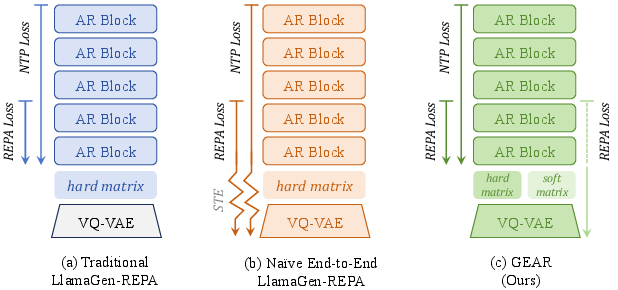
Abstract: Visual generative models are typically trained in two stages. A tokenizer is first trained for reconstruction and then frozen, after which a generator is trained on its discrete indices or continuous latents. This decoupling leaves the tokenizer unaware of what the generator finds easy to model. We present GEAR (Guided End-to-end AutoRegression), which trains a vector-quantized (VQ) tokenizer and an autoregressive (AR) generator jointly and end-to-end, guided by representation alignment. The key obstacle is that the VQ index fed to the AR model is non-differentiable, so gradients cannot reach the tokenizer, and a straight-through estimator collapses. GEAR resolves this with a dual read-out of the codebook assignment. A hard, one-hot branch trains the AR with next-token prediction, while a differentiable soft branch carries a representation-alignment loss that flows back to guide only the tokenizer. The AR model thereby steers its tokenizer toward an index distribution it can predict more easily. This shifts the alignment burden from the tokenizer to the AR: the tokenizer's own features become less DINOv2-like while the AR's become more so, the opposite of diffusion-side recipes that make the latent itself semantic. GEAR speeds up ImageNet gFID convergence by up to 10x relative to the strong LlamaGen-REPA baseline, learns markedly better patch-level and spatially-coherent features, and generalizes across quantizers (VQVAE, LFQ, IBQ) and to text-to-image generation.
Paper Prompts
Sign up for free to create and run prompts on this paper using GPT-5.
Top Community Prompts
Explain it Like I'm 14
What is this paper about?
This paper introduces GEAR, a new way to train image-generating AI models. Instead of training the “image compressor” (called a tokenizer) and the “image generator” (a predictor that builds images piece by piece) in two separate steps, GEAR trains them together so they can help each other. The goal is to make the generator learn faster and produce better images.
Think of it like this:
- The tokenizer turns an image into a grid of symbols (like a tiny alphabet for pictures).
- The generator learns to write that grid of symbols one by one, then a decoder turns the symbols back into a picture.
Most current systems train the tokenizer first and lock it in place, then train the generator. GEAR instead trains both together and uses a clever trick so the generator can “guide” the tokenizer toward symbols that are easier to predict—without breaking image quality.
What questions are the authors asking?
The paper focuses on a few simple questions:
- Can we train the image tokenizer and the image generator together so they cooperate?
- How can the generator send useful hints back to the tokenizer when the tokenizer uses hard, discrete choices (which normally block learning signals)?
- Will this joint training make the generator learn faster and produce higher-quality images?
- Where should “semantic understanding” (like recognizing objects or parts of a scene) live—in the tokenizer or in the generator?
How do they do it? (Explained simply)
The two parts of the system
- Tokenizer (like a translator): It compresses an image into a grid of tokens (discrete symbols), using a codebook (a set of learned “codewords”).
- Autoregressive (AR) generator (like a storyteller): It predicts the next token step by step, based on what it has already written.
The big challenge
- The tokenizer chooses the best codeword with a hard choice (like picking the top option with an argmax). That hard choice is not “differentiable,” which means the generator can’t easily send useful feedback back to the tokenizer during training.
- A common workaround (called a straight-through estimator) often makes the tokenizer collapse: it uses only a few symbols and stops reconstructing images well.
GEAR’s key idea: two “read-outs”
To get around this, GEAR reads the tokenizer’s choices in two ways:
- Hard branch: Uses the exact discrete tokens (the real choices) to train the generator with its normal next-token prediction. This branch behaves just like at test time.
- Soft branch: Uses a smooth, weighted mix of possible tokens (like saying “60% token A, 30% token B, 10% token C”). This soft path is differentiable, so feedback can flow back to the tokenizer.
But what feedback do they send back?
- They don’t let the generator’s “predict the next token” loss change the tokenizer—that would push the tokenizer to use only a few easy-to-predict symbols (bad for image quality).
- Instead, they use “representation alignment”: they encourage internal features to be similar to those from a strong, frozen vision model (like DINOv2), which acts as a teacher.
- Hard branch: Aligns the generator’s internal features to DINOv2 (this trains the generator).
- Soft branch: Aligns the generator’s internal features back through the soft path to the tokenizer (this gently guides the tokenizer to produce tokens the generator can work with).
In short: the hard path trains the generator; the soft path guides the tokenizer. Both use a shared “alignment to a vision teacher” objective, but next-token prediction never updates the tokenizer (avoiding collapse).
A helpful analogy
- Imagine the tokenizer writes notes in a shorthand alphabet, and the generator reads them out loud.
- The generator can’t change the alphabet directly, but it can “whisper” suggestions via the soft path: “It’d be easier for me if you used these kinds of symbols here.”
- The whisper comes from aligning to a teacher’s understanding (DINOv2), which gives both sides a common sense of what good representations look like.
What did they find?
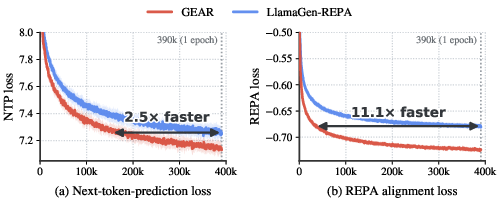
- Much faster training: On ImageNet, GEAR reaches good image quality up to 10× faster than a strong baseline (LlamaGen-REPA), based on the gFID metric (a common image-quality score).
- Better image quality at the end: Across different model sizes, GEAR improves generation metrics (like lower gFID and higher Inception Score) compared to the baseline.
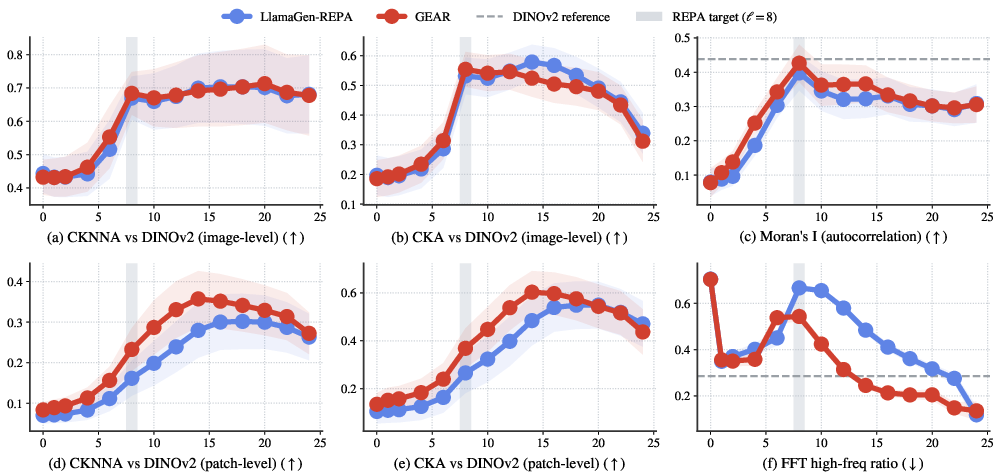
- More coherent local structure: The generator’s internal features become more “patch-aware”—they line up better with the teacher’s understanding at the patch level (small regions of the image). This helps it predict the next token more reliably.
- A surprising twist: The tokenizer itself becomes less “DINO-like” (less similar to the teacher) while the generator becomes more DINO-like. In other words, the tokenizer focuses on delivering tokens that are predictable, and the generator learns the semantics.
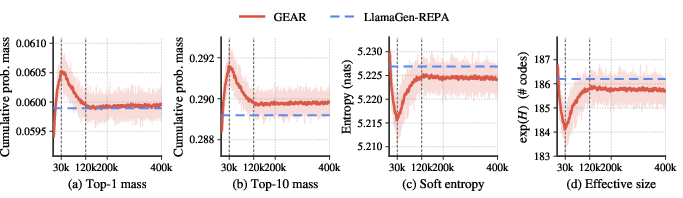
- No collapse: The tokenizer’s codebook remains well-used—it becomes more focused (tokens are used more predictably) without collapsing to just a few tokens. Reconstruction quality stays good.
- Works in many setups: The method works with different tokenizers (VQ-VAE, LFQ, IBQ) and also speeds up text-to-image models (where the generator reads text and then writes image tokens).
Why this matters:
- Faster convergence means less training time and compute.
- Better patch-level understanding makes images more consistent and detailed.
- GEAR’s tokenizer can be trained end-to-end once and then reused (“drop-in”) for future models to speed them up too.
Why is this important?
- It changes where “semantic understanding” lives: Instead of forcing the tokenizer to be super semantic, GEAR lets the generator learn semantics while the tokenizer produces tokens that are easier to predict. This division of labor trains faster and avoids breaking reconstruction.
- It’s practical: You can end-to-end train a tokenizer with GEAR and then freeze it; future generators trained on top of it learn faster—even for text-to-image tasks.
- It’s general: The approach works with different tokenization methods and in different tasks, so it’s a broadly useful training recipe.
Simple takeaway
GEAR is a smart training strategy that lets the image generator and tokenizer help each other. It uses a “hard path” for realistic training and a “soft path” for safe guidance back to the tokenizer—guided by a vision teacher. The result is quicker learning, better images, and a more reliable training pipeline that avoids common failures. This could make future image and text-to-image models faster and cheaper to train while improving their visual quality.
Knowledge Gaps
Knowledge gaps, limitations, and open questions
Below is a concise list of unresolved issues that the paper leaves open, focusing on what remains missing, uncertain, or unexplored.
- Sensitivity to guidance hyperparameters: The paper does not systematically study how the alignment coefficient , temperature , alignment depth , or the truncation point of the soft branch affect stability, convergence speed, codebook utilization, and final image quality.
- Temperature scheduling: The choice of a fixed (e.g., in some analyses) is not justified or explored; it remains unknown whether annealing or adaptive schedules improve stability or performance.
- Alignment layer selection: The representation is aligned at a fixed layer (e.g., the 8th), but sensitivity to layer choice, multi-layer alignment, or hierarchical alignment strategies is not analyzed.
- Alternative gradient estimators: Only the straight-through estimator (STE) is tested and shown to collapse; the efficacy of other discrete-gradient surrogates (e.g., Gumbel-Softmax, REINFORCE/RELAX, straight-through Gumbel-Softmax) is not explored.
- Choice of alignment targets: Alignment uses DINOv2; the effect of swapping or combining targets (e.g., SigLIP, V-JEPA, CLIP, task-specific encoders, or multi-target ensembles) on both training speed and fidelity is untested.
- Circularity of DINO-based metrics: Many evaluations (e.g., FDD, gFID improvement via stronger DINOv2 alignment) might reward optimizing toward the alignment target; the paper lacks human evaluations or metrics independent of the chosen target to rule out overfitting to DINO-space.
- Generalization of learned tokenizers: The extent to which an end-to-end-tuned tokenizer transfers across datasets and domains (beyond ImageNet and GPIC) is only partially tested; large-scale, cross-domain transfer and robustness (e.g., to medical, satellite, or artwork images) remains open.
- Resolution scaling: Results are limited to 256×256 (with some 384-to-256 evaluation for a baseline); behavior, stability, and gains at higher resolutions (512, 1024, 2048) are not reported.
- Long-horizon stability: The stability of joint training under very long schedules (beyond the 400k-step fine-tuning used to “harvest” the tokenizer) is unknown; potential slow drifts (e.g., toward entropy reduction or subtle codebook collapse) are not characterized.
- Diversity trade-offs: The paper reports sharper, lower-entropy token distributions; the impact on sample diversity and recall (especially in the long tail) is unclear, as some recall numbers are flat or slightly lower. A diversity–predictability trade-off curve is missing.
- Reconstruction–generation trade-off: While reconstruction is said to be preserved, the dependence on codebook size, entropy regularization strength, and adversarial/LPIPS weights is not explored; conditions under which reconstruction degrades are not characterized.
- Computational overhead breakdown: Although the soft branch is truncated at depth , the actual training-time overhead and memory footprint of dual-branch forward passes, and their scaling with model size and codebook size, are not quantified.
- Top‑k soft mixing vs full softmax: The soft read-out is described as a temperature-weighted interpolation over nearest codewords but is formulated as a full softmax over ; the effect of restricting to top‑k nearest codes for efficiency and stability is not studied.
- Sharing vs decoupling embeddings: The AR input embedding table is decoupled from the VQ codebook . Whether sharing, partially sharing, or learning an explicit mapping between and improves training or stability remains unexplored.
- Alignment targeting only the AR: The method shows tokenizer features become less DINO-like while AR features become more so. It is unclear if hybrid objectives that keep some semantic structure in the tokenizer (for broader reuse in perception tasks) can balance reconstruction/predictability with semantic utility.
- Soft-branch gradient routing: The soft branch’s gradients are said to bypass upper AR blocks and update only the tokenizer; implementation details and potential gradient leakage into the AR (and its impact) are not fully examined.
- Scaling to different quantizers: Although claims of generality across VQVAE, LFQ, and IBQ are made, detailed results, failure modes, and quantizer-specific design choices (e.g., how is computed for each) are not comprehensively presented.
- Extension to other generative regimes: Whether the dual hard/soft guidance mechanism benefits masked autoregression (e.g., MaskGIT), non-causal decoders, or two-pass/nucleus sampling variants remains untested.
- Text-conditioned guidance choices: For T2I, alignment uses a vision-only target (DINOv2); whether text-conditioned targets (e.g., CLIP image or joint embeddings) improve instruction following and compositionality is not investigated.
- Instruction-following at convergence: T2I benchmarks show modest adherence under a constrained, one-epoch training setup; it remains unknown how GEAR affects instruction-following and compositionality at full convergence, higher resolution, and with comprehensive CFG sweeps.
- Robustness to dataset scale and noise: The behavior under noisy captions, low-quality images, or smaller datasets is not studied; robustness to label or caption noise and domain shift for both tokenizer and AR remains open.
- Downstream reusability of tokenizers: Since tokenizer features become less DINO-like, the utility of the learned tokenizer for downstream perception tasks (classification, detection, retrieval) is unclear and untested.
- Impact on precision/recall balance: While gFID/IS improve, the precision–recall trade-off (especially with CFG) is not analyzed in detail; conditions under which precision increases at the expense of recall (or vice versa) are not clarified.
- Codebook design and size: The effects of codebook size, hierarchical codebooks, multi-level quantization, and codebook refresh strategies on stability and performance are not assessed.
- Curriculum and scheduling: Joint schedules for , , codebook entropy regularization, and GAN/LPIPS weights are fixed or lightly tuned; a principled curriculum (e.g., warming alignment late or annealing ) is not explored.
- Theoretical grounding: The paper offers an empirical rationale for why STE collapses and why alignment-driven guidance works, but lacks a formal analysis of optimization dynamics, convergence conditions, or guarantees (e.g., conditions under which codebook usage avoids collapse).
- Impact on sample realism vs semantics: The paper argues that AR features become more DINO-like while tokenizer features do not, but does not disentangle how much of the quality gain stems from semantic alignment versus improved local spatial structure; causal ablations are limited.
- Human studies and perceptual quality: No human preference or MOS evaluations are reported to validate that gFID/sFID/IS improvements translate into perceived quality gains.
- Safety and bias: Effects on biases, content safety, and fairness are not discussed; whether aligning to foundation models amplifies their biases is not evaluated.
- Applicability to video or multimodal generation: Extensions to video (temporal tokens), audio, or multi-modal conditioning are not investigated, despite the likely utility of token predictability in those domains.
- Inference-time strategies: The paper does not study whether the more predictable token grid allows for faster decoding strategies (e.g., speculative decoding, parallelized chunking, or beam search designs) without quality loss.
- Failure cases and diagnostics: The types of scenes or prompts where GEAR underperforms LlamaGen-REPA are not analyzed; targeted diagnostics for artifacts (e.g., texture repetition, spatial inconsistencies) are missing.
- Open-source reproducibility: While links are provided, the paper does not specify precise seeds, full hyperparameter grids, or training-time compute, impeding rigorous replication and sensitivity analyses.
Practical Applications
Immediate Applications
Below are actionable, near-term opportunities that can be deployed with today’s tooling and compute. Each item includes likely sectors, potential tools/workflows, and key assumptions.
- Bold drop-in tokenizer swap to accelerate AR model training
- What: Replace frozen VQ tokenizers in existing autoregressive (AR) image pipelines (e.g., LlamaGen-like) with a GEAR-tuned tokenizer to cut training time (up to ~10× faster gFID convergence reported) and improve quality at fixed budgets.
- Sectors: Software/AI platforms, model labs, creative tech, startups.
- Tools/workflows: Use the released GitHub repo and HuggingFace models; adopt the paper’s joint-then-freeze schedule (brief end-to-end fine-tune to produce a better tokenizer, then train AR as usual).
- Assumptions/dependencies: Access to a pretrained vision encoder (e.g., DINOv2) for alignment; adherence to the paper’s dual-branch (hard/soft) guidance and “no NTP gradient into tokenizer” rule; modest code changes to add the soft alignment path.
- Faster text-to-image (T2I) model iteration cycles
- What: Train T2I AR models that converge to higher quality faster (better FD-DINOv2, FID/CLIP, GenEval/DPG gains under the same encoder and data).
- Sectors: Advertising, media, design tools, game asset generation, e-commerce.
- Tools/workflows: Keep the same text encoder stack (e.g., Qwen3) and training corpus; swap in the GEAR tokenizer; maintain identical AR architecture to isolate and realize tokenizer-induced gains.
- Assumptions/dependencies: Training data quality remains the limiting factor for instruction following; inference speed is AR-bound (GEAR improves training efficiency and quality, not decoding speed).
- Cost and energy savings in foundation-model training
- What: Reduce GPU-hours and carbon footprint for AR image/T2I training via faster convergence and better token predictability.
- Sectors: Energy-conscious AI labs, cloud providers, sustainability programs.
- Tools/workflows: Track energy-per-FID or energy-per-FDD as internal KPIs; adopt the dual-branch alignment schedule; report savings in ML ops dashboards.
- Assumptions/dependencies: Ability to attribute and measure compute/energy vs. quality; buy-in to update training runbooks.
- Domain-adapted tokenizers for verticals
- What: Brief end-to-end guidance on in-domain data to produce tokenizers that make AR training easier in specialized settings (e.g., product catalogs, fashion, satellite, histopathology, documents).
- Sectors: Retail/e-commerce, remote sensing, healthcare imaging (research), enterprise document AI.
- Tools/workflows: Short, controlled joint fine-tunes to yield domain tokenizers; then freeze and train AR on top; compare convergence and quality vs. baseline tokenizer.
- Assumptions/dependencies: In regulated domains (e.g., healthcare), synthetic outputs must pass domain-specific validation; foundation-feature alignment (DINOv2) may need substitution with a domain encoder.
- Synthetic data generation at lower cost
- What: Use GEAR-trained AR models to produce higher-fidelity synthetic images sooner in training for bootstrapping perception models (classification, detection, segmentation).
- Sectors: Autonomous driving, robotics simulation, retail search, AR/VR content.
- Tools/workflows: Plug synthetic generation into existing data engines; schedule earlier evaluations as models reach usable quality earlier.
- Assumptions/dependencies: Downstream gains depend on synthetic-to-real transfer; maintain filtering/curation to avoid cascading biases from the alignment target.
- Cross-quantizer tokenization experiments without pipeline rewrites
- What: Evaluate VQVAE, LFQ, IBQ under the same GEAR guidance to pick the best tokenizer for a given AR backbone.
- Sectors: Research labs, model platform teams.
- Tools/workflows: Standardize tokenizers behind the dual hard/soft read-out; run bake-offs with equal budgets; adopt the most predictable-token variant for production.
- Assumptions/dependencies: Quantizer swaps preserve decoder fidelity; keep the “soft branch only updates tokenizer” invariant.
- Training diagnostics with patch-level alignment probes
- What: Use patch-level REPA alignment metrics (CKNNA/CKA) on AR hidden states to debug training, assess local coherence, and detect early tokenization pathologies.
- Sectors: AI R&D teams, MLOps.
- Tools/workflows: Integrate per-layer alignment monitors; set alerts for codebook usage entropy/effective size; track convergence of NTP vs. alignment loss.
- Assumptions/dependencies: Access to DINOv2 (or domain encoder) features; metrics do not replace human inspection or downstream task validation.
- Token-stream storage and dataset versioning
- What: Store images as tokenizer indices and reconstruct with the decoder; GEAR reduces index entropy, which can make entropy coding more effective.
- Sectors: Data infrastructure, mobile apps (offline assets), content delivery.
- Tools/workflows: Add arithmetic coding over token grids; ship codebook+decoder with assets; version datasets by tokenizer to control reproduceability.
- Assumptions/dependencies: Reconstruction quality requirements; stable retention of codebook/decoder with the data; legal/licensing for codecs.
- Curriculum for graduate courses and internal trainings
- What: Teach stable end-to-end optimization with discrete bottlenecks using GEAR’s dual-branch design as a canonical example.
- Sectors: Academia, corporate L&D.
- Tools/workflows: Labs comparing STE vs. soft-assignment guidance; ablations on temperature τ and alignment depth; assignments on tokenizer collapse prevention.
- Assumptions/dependencies: Compute for small-scale replications; availability of public checkpoints.
- Recommended production workflow: short E2E, then freeze
- What: Adopt the paper’s pragmatic schedule: run a 100–400k-step joint fine-tune to shape the tokenizer, then freeze and train a fresh AR to completion.
- Sectors: Any AR image/T2I stack.
- Tools/workflows: Add a “tokenizer bake” stage to CI/CD; codify checkpoints and rollbacks.
- Assumptions/dependencies: Hyperparameters (alignment weight λ, τ, alignment layer ℓ) need light tuning per scale/domain.
Long-Term Applications
These opportunities likely require additional research, scaling, or engineering maturation before broad deployment.
- Video generation with spatiotemporal tokens
- What: Extend guided end-to-end tokenization to video quantizers and AR video models; exploit patch-level alignment to improve temporal coherence.
- Sectors: Film/VFX, simulation, robotics, education.
- Tools/workflows: 3D codebooks over space-time; dual-branch alignment with video encoders (e.g., VideoMAE, V-JEPA variants).
- Assumptions/dependencies: Scalable video tokenizers; appropriate foundation encoders for alignment; substantial compute.
- Discrete audio/speech/music generation
- What: Apply the dual hard/soft guidance to codebook-based audio AR models (e.g., EnCodec-like tokens) for faster training and better local structure.
- Sectors: TTS, voice cloning, music tools, podcasting.
- Tools/workflows: Replace DINOv2 with audio encoders (e.g., wav2vec2, HuBERT) as alignment targets; adapt temperatures and alignment depths.
- Assumptions/dependencies: High-quality audio quantizers; latency constraints for real-time applications.
- Learned image/video compression codecs guided by predictability
- What: Use GEAR’s principle (reorganize token usage toward predictability without hurting reconstruction) to boost compression efficiency with AR entropy models.
- Sectors: Video streaming, mobile imaging, telecom.
- Tools/workflows: Jointly train tokenizer/decoder with AR entropy model; evaluate bitrate–distortion–compute trade-offs.
- Assumptions/dependencies: Standardization hurdles; decoder availability on edge devices; rigorous subjective evaluations.
- Fine-grained controllability and editing
- What: Leverage strongly aligned patch-level AR features for layout conditioning, localized edits, segmentation-aware inpainting, and multi-object composition.
- Sectors: Creative suites, product photography, design systems.
- Tools/workflows: Expose per-patch controls; integrate with segmentation/layout models; design UI/UX for region prompts.
- Assumptions/dependencies: Training with auxiliary controls; robust alignment across resolutions and aspect ratios.
- Safer and more steerable generative systems
- What: Use aligned intermediate features for integrated safety filters (NSFW, watermarking, bias checks) during generation.
- Sectors: Platforms, policy-compliant content pipelines.
- Tools/workflows: Train detectors on AR hidden states; apply token-level veto/redirect during sampling.
- Assumptions/dependencies: Reliable safety labels; governance to handle failure modes and bias amplification introduced by alignment targets.
- On-device and low-latency generative experiences
- What: Distill GEAR-trained AR models into smaller or non-AR decoders (e.g., masked generators) while retaining the improved token structure.
- Sectors: Mobile apps, AR/VR devices, edge cameras.
- Tools/workflows: Knowledge distillation from AR to faster decoders; mixed token–pixel decoders.
- Assumptions/dependencies: Effective distillation schemes; hardware acceleration for token decoders.
- Robotics and simulation world models
- What: Train token-based AR world models with better local coherence for planning/simulation and synthetic sensory data.
- Sectors: Robotics, autonomous systems, digital twins.
- Tools/workflows: Multi-sensor tokenizers (RGB, depth, proprioception); alignment to task encoders; closed-loop evaluation.
- Assumptions/dependencies: Robustness and real-to-sim validity; integration with control stacks.
- Healthcare and scientific imaging (research-to-practice)
- What: Domain-specific guided tokenizers that preserve fine details while improving AR training, for data augmentation and hypothesis generation.
- Sectors: Medical imaging R&D, microscopy, remote sensing science.
- Tools/workflows: Replace DINOv2 with domain encoders; strict clinical validation; privacy-preserving training.
- Assumptions/dependencies: Regulatory clearance; demonstrable lack of hallucinations harmful to diagnostics.
- Multi-modal foundation models with unified discrete bottlenecks
- What: Extend guided end-to-end training across image, text, audio, and video tokenizers for tightly coupled AR models.
- Sectors: Generalist agents, content generation platforms.
- Tools/workflows: Shared alignment curricula; cross-modal token routing; curriculum across modalities.
- Assumptions/dependencies: Stable training across heterogeneous codebooks; scalable infrastructure.
- Policy and benchmarking standards for energy-efficient training
- What: Establish procurement and reporting standards that incentivize methods with lower energy-per-quality (e.g., energy per FID/FDD point) in public research and grants.
- Sectors: Government, funding agencies, industry consortia.
- Tools/workflows: Standardized logging APIs; third-party audits; leaderboards including compute/energy metrics.
- Assumptions/dependencies: Community consensus on metrics; accurate and comparable telemetry across stacks.
Cross-cutting assumptions and risks
- Alignment target availability and bias: Most results use DINOv2; swapping targets (e.g., SigLIP, V-JEPA) may change behavior and transfer biases.
- Stability constraints: Do not back-propagate next-token prediction into the tokenizer; use the soft branch for tokenizer guidance with tuned τ and λ.
- Inference cost: AR decoding remains sequential; GEAR primarily accelerates training and improves quality rather than inference latency.
- Generalization: Demonstrated at 256×256; scaling to higher resolutions, video, and new domains requires additional validation.
- Licensing and governance: Ensure licenses for pretrained encoders and datasets; institute safety reviews for deployment in sensitive domains.
Glossary
- adversarial term: A GAN-based component added to the tokenizer loss to encourage photorealistic reconstructions. "an adversarial term~\cite{vqgan}"
- alignment loss: A feature-matching objective (via cosine similarity) used to align generator features to a pretrained vision encoder. "carrying an alignment loss that flows back to guide only the tokenizer."
- argmax (non-differentiable): The discrete index selection operator that blocks gradient flow, making end-to-end training challenging. "The map from a VQ index to the AR input is a non-differentiable "
- autoregressive (AR) generator: A model that predicts each token conditioned on previously generated tokens in a causal order. "an autoregressive (AR) generator jointly and end-to-end"
- causal transformer: A transformer with causal masking that enforces left-to-right (past-to-future) token generation. "a stack of causal transformer blocks"
- CKA (Centered Kernel Alignment): A representation-similarity metric used to compare learned features to a reference encoder. "Similarities are measured with CKNNA~\citep{cknna} and CKA~\citep{cka}."
- CKNNA: A nearest-neighbor accuracy-based metric used to assess alignment between learned and reference features. "Similarities are measured with CKNNA~\citep{cknna} and CKA~\citep{cka}."
- classifier-free guidance (CFG): A sampling technique that trades off fidelity and adherence by blending conditional and unconditional predictions. "(without CFG)"
- codebook: The set of discrete embedding vectors used by a VQ tokenizer to quantize continuous latents. "collapses the codebook"
- codebook entropy term: A regularizer encouraging diverse code usage by maximizing the entropy of code assignments. "a codebook entropy term that encourages full codebook usage"
- commitment term: A VQ-VAE regularizer that encourages encoder outputs to stay close to their assigned code vectors. "and a commitment term:"
- cosine similarity: The similarity measure used in representation alignment to match generator features to target features. "aligned token-wise by maximizing cosine similarity:"
- DINOv2: A pretrained self-supervised vision encoder used as the alignment target for generator features. "a pretrained encoder such as DINOv2~\citep{dinov2}"
- diffusion model: A generative model trained to denoise latents over iterative steps, often paired with a VAE. "diffusion models over continuous latents~\citep{dit,sit}"
- diffusion transformer (DiT): A transformer architecture tailored for diffusion-based generation in latent space. "a diffusion transformer~\citep{dit,sit}"
- effective codebook size: The exponential of assignment entropy, indicating how many codes are effectively used. "the effective codebook size "
- gFID (generation FID): Fréchet Inception Distance computed on generated samples to assess distributional quality. "gFID versus training steps on ImageNet (without CFG):"
- guidance temperature: A temperature parameter controlling the softness of the token assignment distribution used for differentiable guidance. "where is a guidance temperature"
- hard assignment: One-hot code selection for each position, producing discrete tokens used for inference and AR training. "Soft and hard assignments."
- IBQ: A discrete image tokenizer/quantizer variant used as an alternative to VQ-VAE and LFQ. "IBQ~\citep{ibq}"
- Inception Score (IS): A metric that evaluates generated image quality and diversity via a pretrained classifier’s predictions. "Inception Score (IS)"
- latent: A lower-dimensional representation of an image produced by an encoder (e.g., a VAE), used for generation or reconstruction. "align the VAE #1{latent} itself with such features."
- LFQ: A learned discrete quantizer alternative to VQ-VAE for tokenizing images. "LFQ~\citep{magvitv2,openmagvitv2}"
- LPIPS: A perceptual similarity metric often used as a reconstruction loss term for tokenizers. "perceptual (LPIPS~\cite{lpips}) term"
- masked generator: A generator that predicts masked tokens rather than strictly next tokens (e.g., MaskGIT). "a masked generator~\citep{maskgit}"
- nats: The natural-logarithm unit for information measures (entropy), used to quantify code assignment uncertainty. "usage entropy in nats"
- next-token-prediction (NTP) loss: The cross-entropy objective that trains AR models to predict the next discrete token. "trained by the next-token-prediction (NTP) loss"
- projection head: A small network mapping generator hidden states into the target feature space for alignment. "a lightweight projection head maps the hidden state"
- PSNR: Peak Signal-to-Noise Ratio, a reconstruction metric measuring fidelity between reconstructed and original images. "reconstruction FID (rFID), PSNR and SSIM."
- raster order: A flattening order that scans tokens across the image grid row by row for AR modeling. "flattened in raster order"
- representation alignment: Training strategy aligning internal generator features to a fixed, pretrained vision encoder’s features. "A line of #1{representation alignment} methods accelerates training by injecting external semantics."
- rFID (reconstruction FID): FID computed between reconstructed and real images to evaluate tokenizer reconstruction quality. "reconstruction FID (rFID)"
- sFID (spatial FID): A variant of FID focusing on spatial consistency and structure in generated images. "spatial FID (sFID)"
- soft assignment: A differentiable distribution over codebook entries (via softmax) enabling gradients to flow to the tokenizer. "a differentiable guidance channel built from a soft assignment."
- softmax: The normalization applied to assignment scores to produce a probability distribution over code indices. ""
- SSIM: Structural Similarity Index, a reconstruction metric capturing perceived structural similarity. "reconstruction FID (rFID), PSNR and SSIM."
- straight-through estimator (STE): A gradient approximation technique for discrete operations; unstable here and prone to codebook collapse. "the straight-through estimator collapses"
- variational autoencoder (VAE): A continuous latent-variable model used for image tokenization and reconstruction. "a continuous VAE"
- vector-quantized (VQ) tokenizer: An encoder–decoder with a discrete codebook that maps images to token grids via quantization. "A vector-quantized (VQ) tokenizer maps an image to a grid of discrete tokens."
- VQGAN: A VQ-based generative model that adds adversarial training to improve reconstruction realism. "VQGAN~\citep{vqgan}"
- VQ-VAE: A vector-quantized autoencoder for learning discrete representations of images. "VQ-VAE~\citep{vqvae}"
Collections
Sign up for free to add this paper to one or more collections.