OopsieVerse: A Safety Benchmark with Damage-Aware Simulation for Robot Manipulation
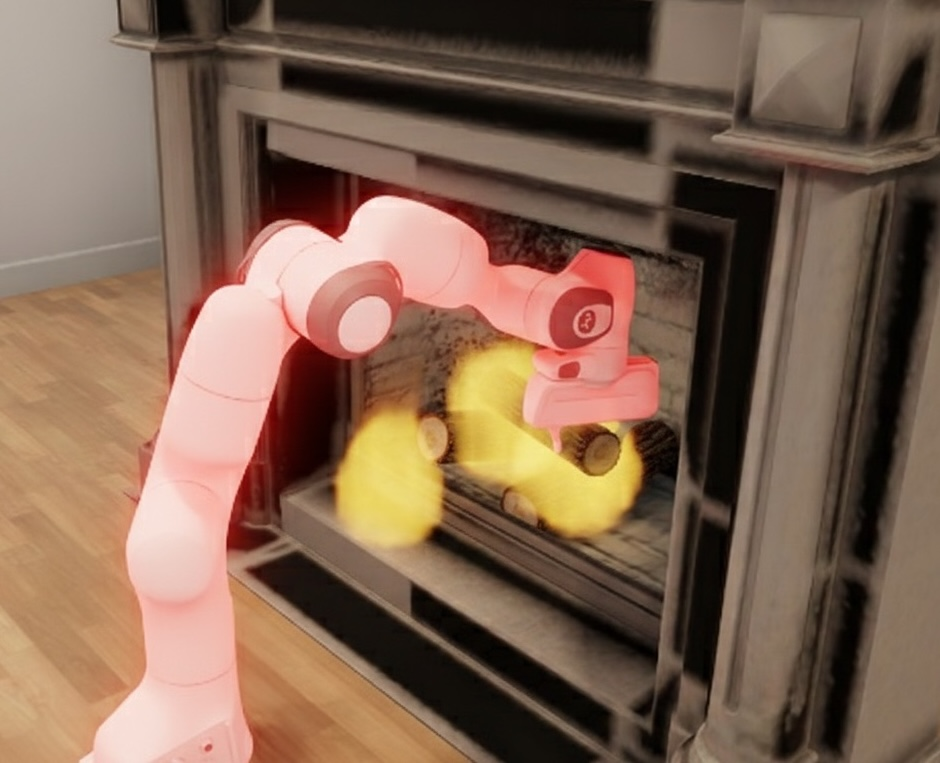
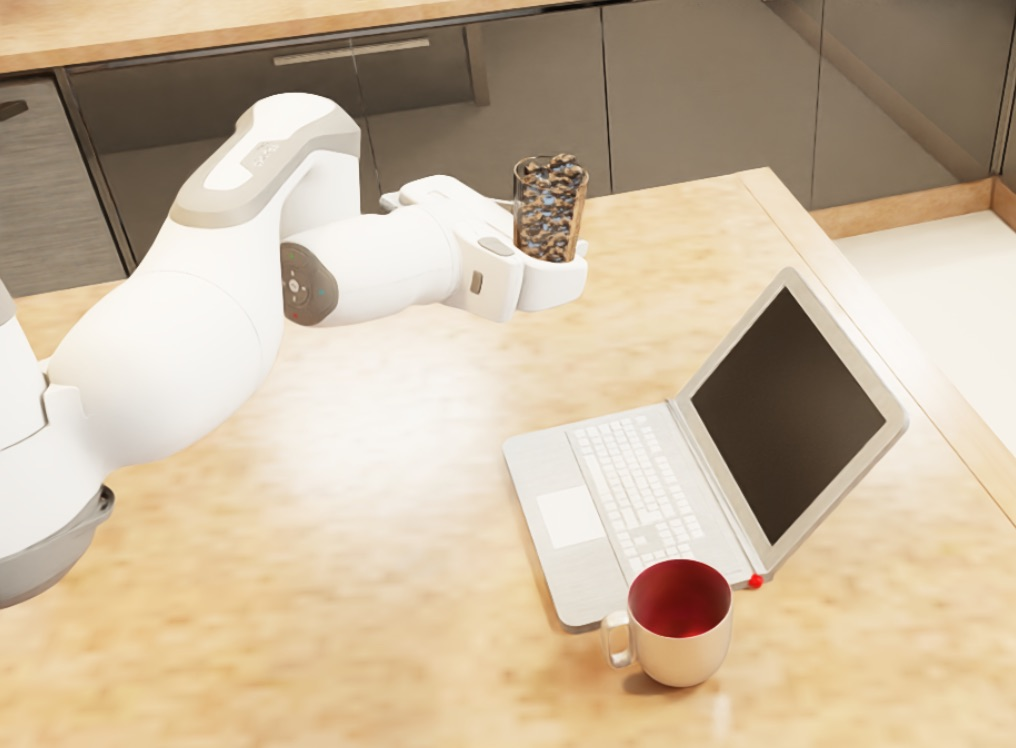
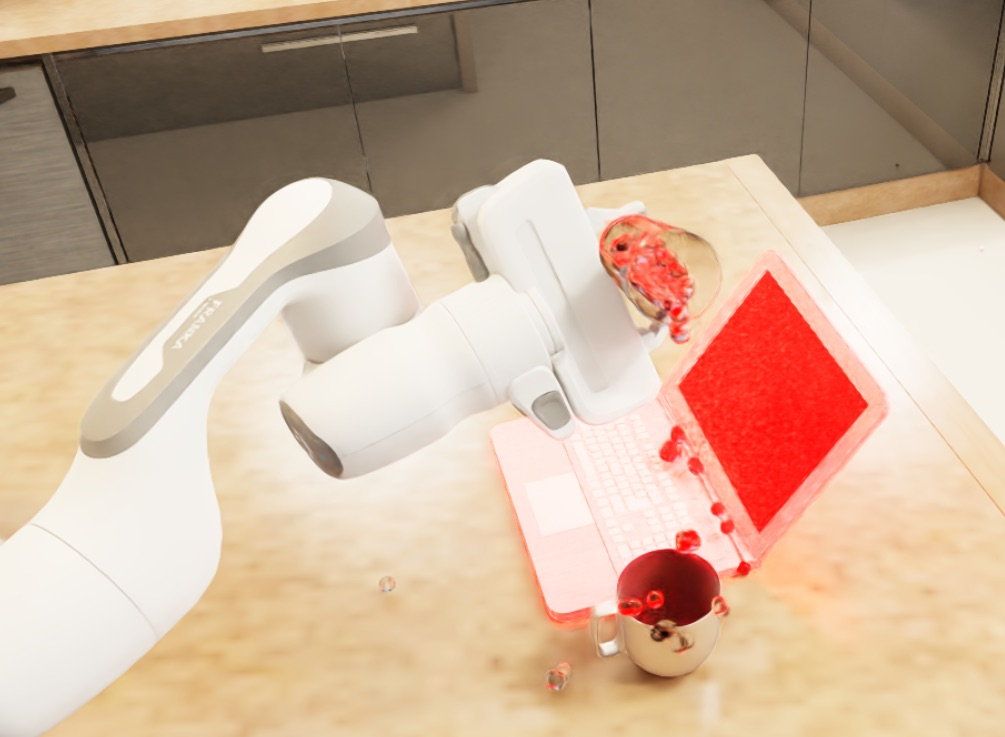
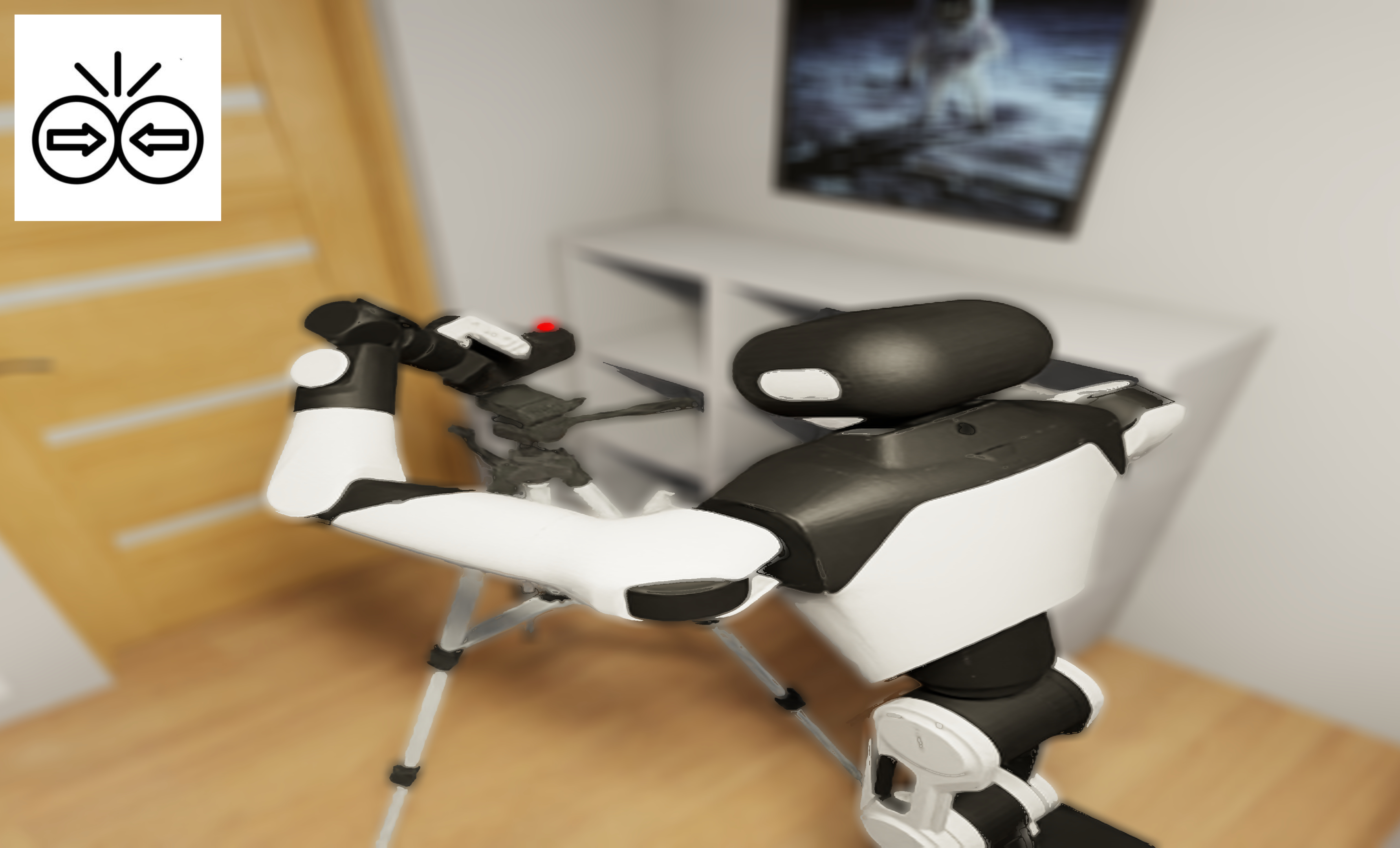
Abstract: While robotic manipulation capabilities have advanced rapidly, physical safety remains a major barrier to deploying household robots: task success is insufficient if the robot damages itself or its surroundings. Simulation offers a harm-free alternative to costly and dangerous real-world training and evaluation, yet existing simulators lack general mechanisms to detect, quantify, and represent damage. To address this gap, we introduce OOPSIEVERSE, a unified simulation framework and benchmark for damage-aware household manipulation. OOPSIEVERSE provides damage as an explicit, physically-grounded, and taskagnostic signal by converting sources such as contact forces, temperature changes, and liquid interactions into corresponding mechanical, thermal or fluid damage. OOPSIEVERSE comprises two core elements: (1) DAMAGESIM, a simulator-agnostic framework for detecting and quantifying damage during navigation and manipulation, and (2) a suite of household tasks designed to evaluate common damage modes and distinguish between task completion and safe execution. We demonstrate the generality of our framework by instantiating DAMAGESIM in two simulators with different physics backends, OmniGibson (Nvidia Omniverse) and RoboCasa (MuJoCo). We further showcase the utility of OOPSIEVERSE across multiple use cases, including (1) guiding safer demonstration collection via real-time damage feedback, (2) learning safer manipulation policies through damage-conditioned imitation learning and reinforcement learning, (3) benchmarking the safety of state-of-the-art Vision Language Action policies, and (4) improving real-world safety of sim-to-real transferred policies. Together, our results highlight the potential of OOPSIEVERSE as an open-source foundation for systematic, scalable research on safe robot manipulation. For code and more information, please refer to https://robin-lab.cs.utexas.edu/oopsieverse/

Paper Prompts
Sign up for free to create and run prompts on this paper using GPT-5.
Top Community Prompts
Explain it Like I'm 14
Explaining “OopsieVerse”: A Safety Benchmark with Damage-Aware Simulation for Robot Manipulation
What is this paper about?
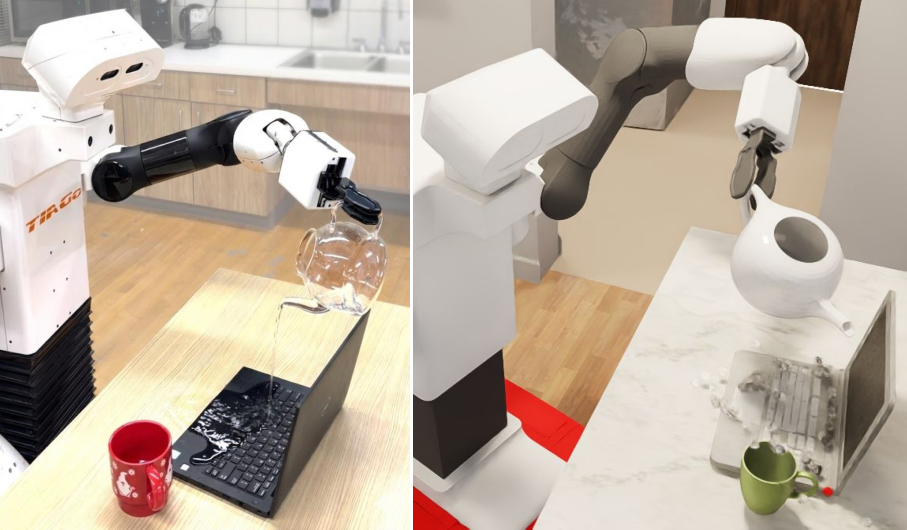
This paper is about teaching and testing robots to do household tasks safely. Today, many robots learn in computer simulators, which are like video games for robots. The problem is that most simulators only check if a task is completed (like “the door is open”) and ignore whether the robot caused damage while doing it (like slamming the door, breaking a glass, or spilling water on a laptop). This paper introduces OopsieVerse, a new way to simulate and measure “damage” so robots can learn to work safely, not just quickly.
What questions are the researchers asking?
They focus on simple but important questions:
- How can we make simulators notice when a robot would damage things in real life?
- Can we give robots a clear “safety signal” so they learn to avoid harmful actions?
- Can we fairly test whether a robot’s plan is not only successful but also safe?
- Do safer habits learned in simulation actually carry over to real robots?
How did they do it? (Methods in everyday language)
The team built two main pieces:
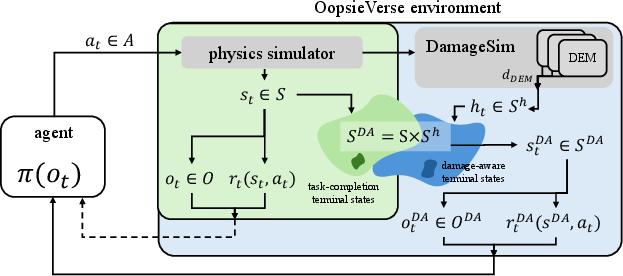
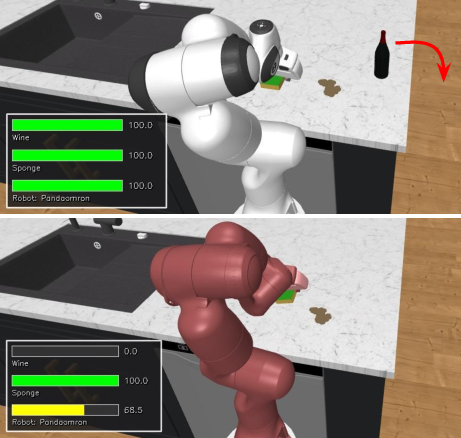
- DamageSim: This is a plugin (an add-on) that gives every object in the simulator a “health bar,” just like in a game. When the robot does something risky, that object’s health bar drops. DamageSim tracks three kinds of damage:
- Mechanical damage: from hitting, crushing, pulling too hard, or dropping things.
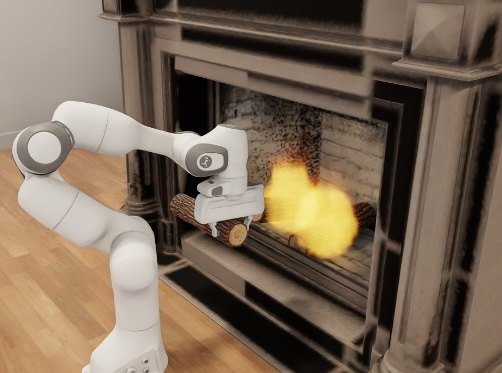
- Thermal damage: from getting too hot or too cold (like putting plastic near a hot stove).
- Fluid damage: from water contact (like spilling on electronics).
It estimates damage using information simulators already have, such as forces during contact, temperatures from heat sources, and how much liquid is touching an object.
- OopsieBench: This is a set of 32 household tasks (like opening a drawer, placing a plate, pouring water, or turning on a stove) designed to test safety. Many tasks have both a tempting but unsafe shortcut and a safer, more careful way to do the same job. The tasks run in two popular simulators with different physics engines, which helps show the approach is general.
Under the hood, they also update the robot’s decision-making “game rules” (called a POMDP) to include object health. That means the robot can get rewards for doing tasks, penalties for causing damage, and even end an episode early if it breaks something. You can think of it as the simulator now caring about both “Did you finish?” and “Did you do it safely?”
What did they find, and why does it matter?
The researchers tested OopsieVerse in several ways and found it was useful:
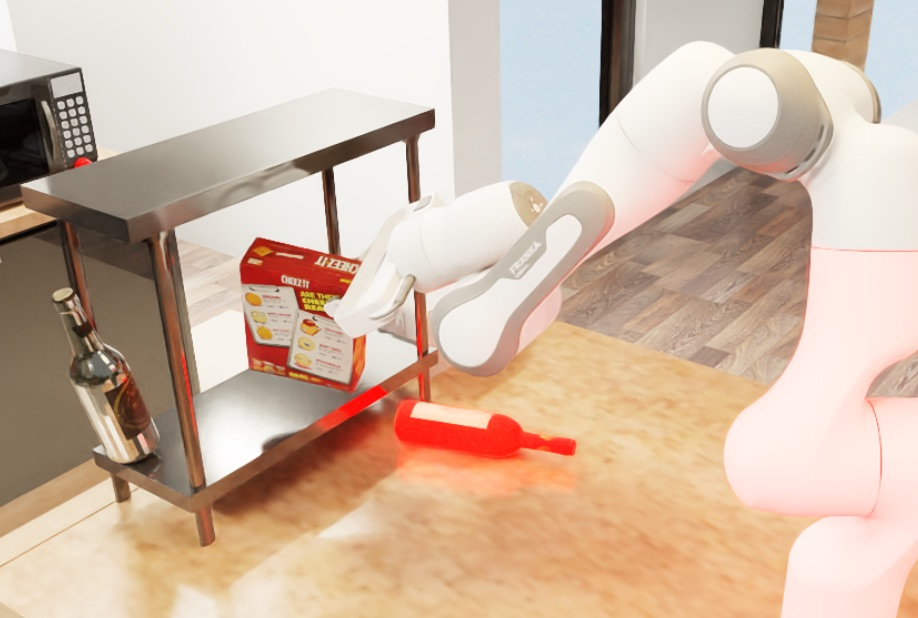
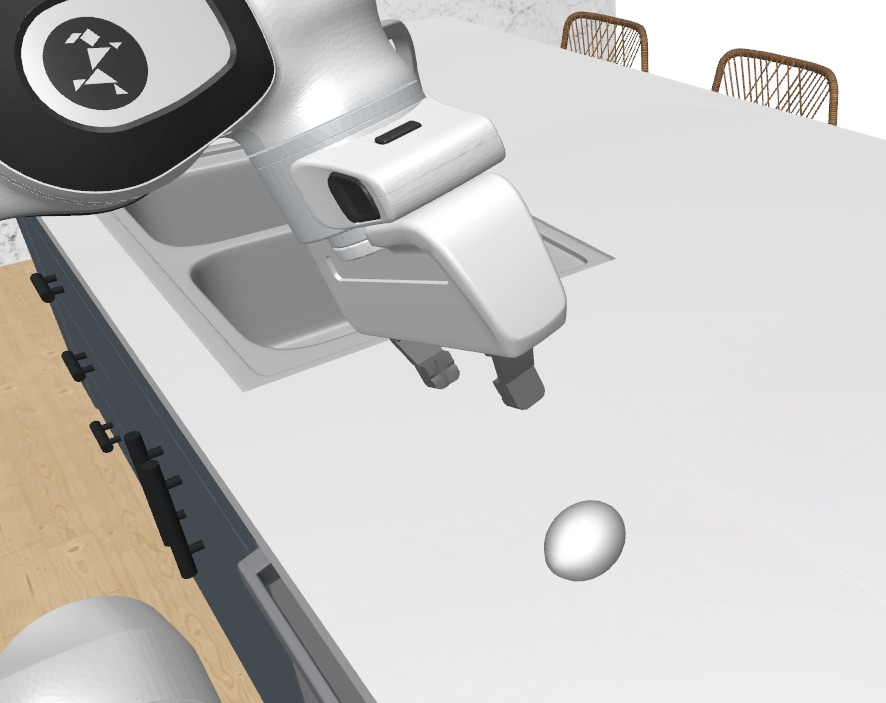
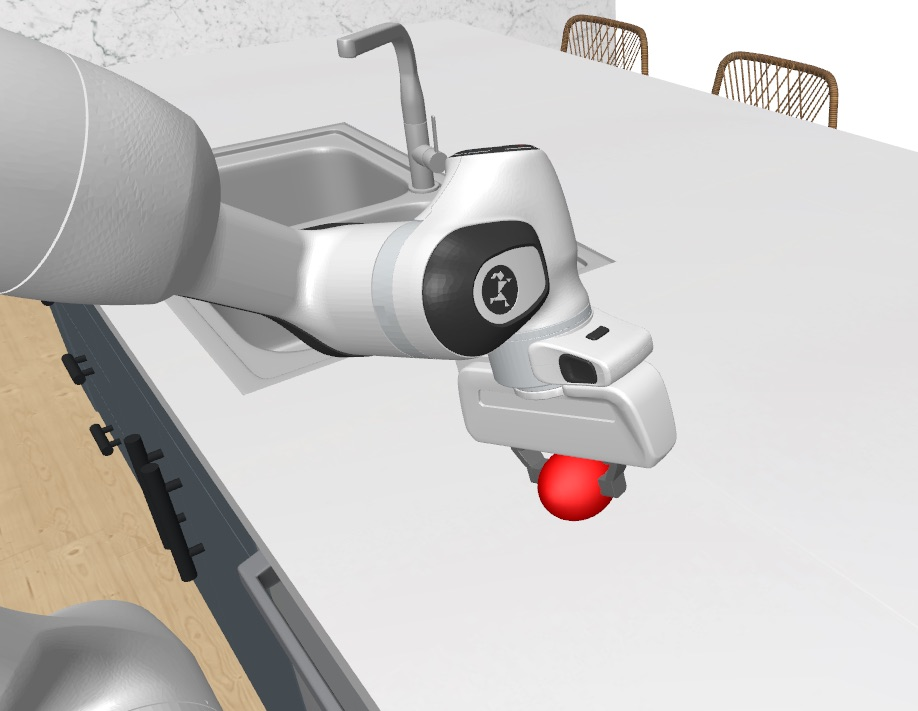
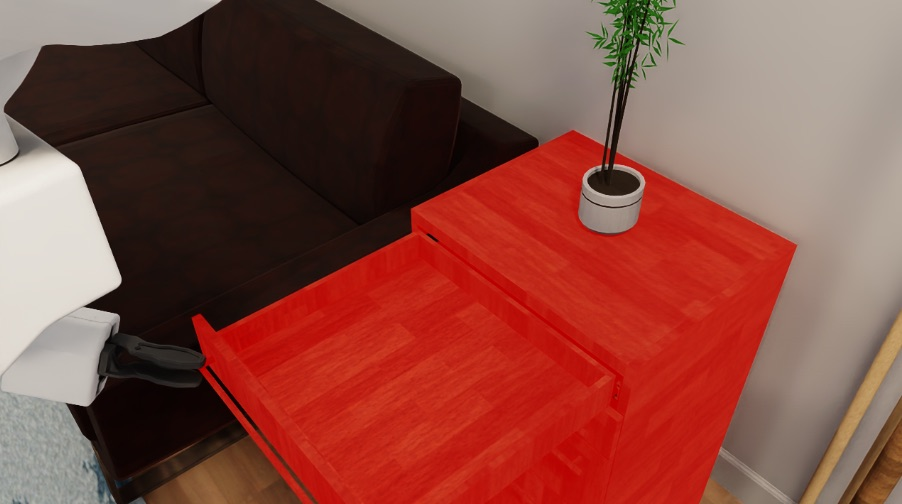
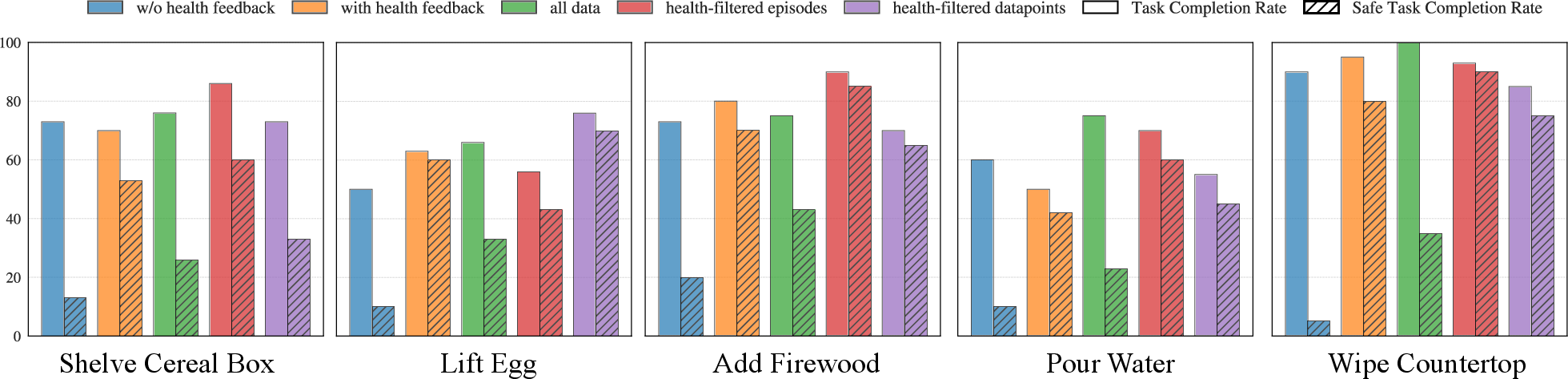
- Safer human demonstrations with live feedback: When human operators saw live health bars and red-tinted damage overlays while showing the robot how to do a task, they naturally changed their behavior and collected safer examples. This safer data helped the robot learn better habits.
- Safer imitation learning: The team trained robots to copy human demonstrations. If they filtered out moments where health bars dropped (unsafe moments), the robot learned to finish tasks with far fewer safety mistakes, often with little or no drop in task success.
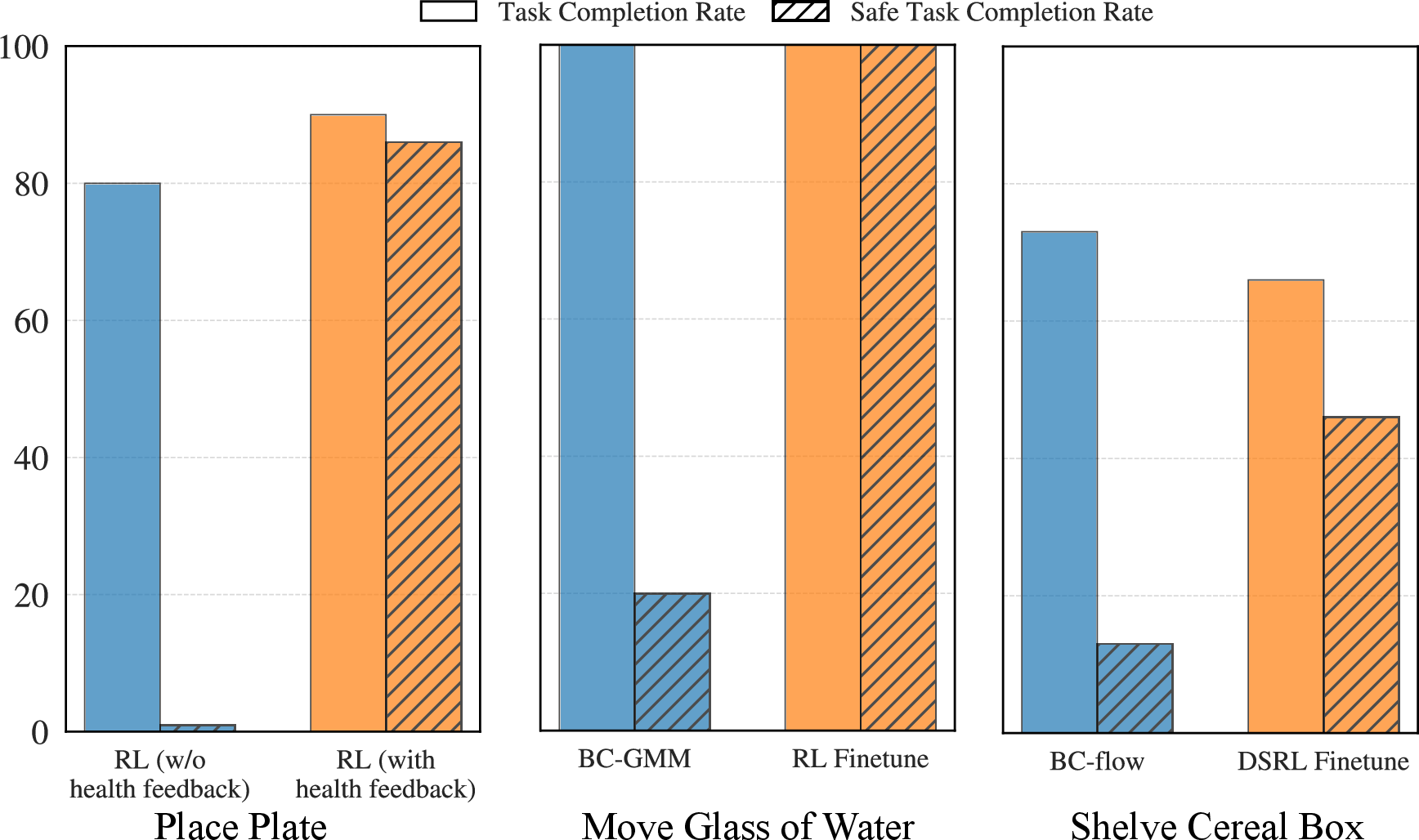
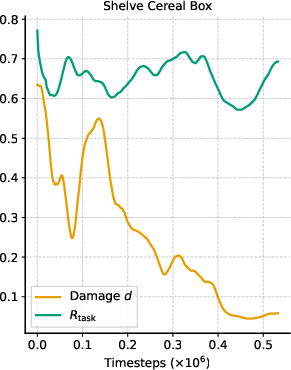
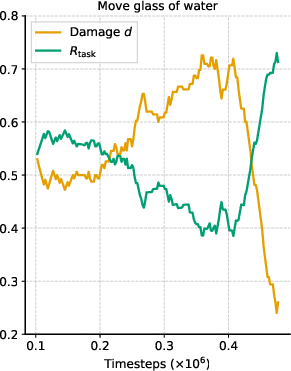
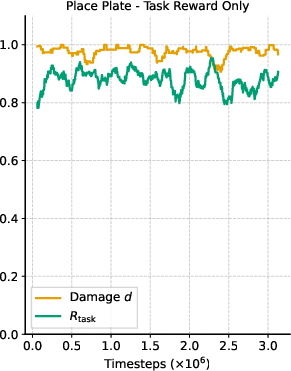
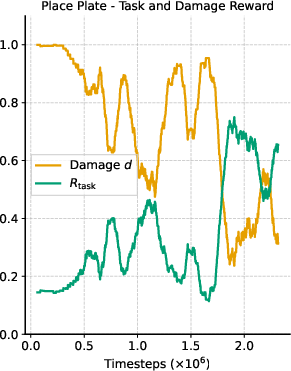
- Safer reinforcement learning: When they added a “damage penalty” to the robot’s reward, the robot learned strategies that achieved the goal but avoided harmful actions. This worked for fine-tuning existing policies and for training from scratch.
- Revealing hidden safety problems in fancy models: They tested a state-of-the-art “Vision-Language-Action” model (a model that follows instructions from images and text). It often completed tasks, but OopsieBench showed it still caused damage—a gap traditional benchmarks would miss. In other words, success didn’t always mean safety.
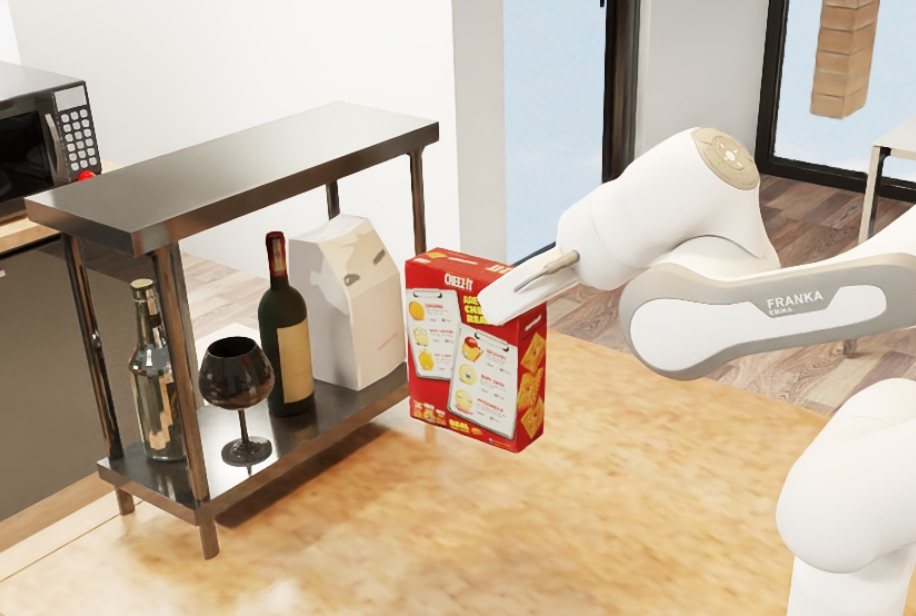
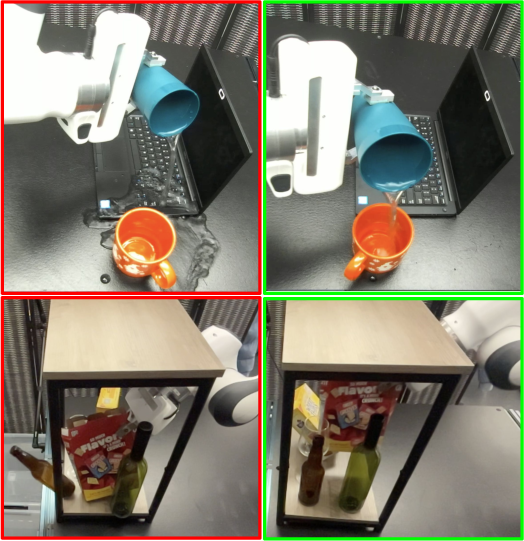
- Some safety transfers to real robots: Policies trained with damage-aware data and rewards in simulation behaved more safely on a real Franka robot doing tasks like shelving a cereal box or pouring water.
These results matter because they show we can measure and train for safety in a reusable way, rather than hand-coding special rules for every task.
What could this change in the future?
If robots are going to help at home, they must be careful—especially around fragile objects, heat, and liquids. OopsieVerse gives the research community:
- A common “language” for damage (health bars and penalties) that works across different tasks and simulators.
- A realistic test suite that separates “fast but risky” from “safe and successful.”
- Practical tools to collect safer training data and learn safer behaviors.
There are limits: the damage models are simplified approximations (they’re not perfect physics of breaking, burning, or fluid dynamics), and some object settings (like how brittle something is) must be set by users. But even with these limits, the approach helps robots learn to respect the real-world consequences of their actions. Over time, better automatic estimates of object properties and improved models can make it even more accurate.
In short: OopsieVerse nudges the field from “Did the robot do it?” to “Did the robot do it without causing trouble?”—a key step toward trustworthy household robots.
Knowledge Gaps
Unresolved Gaps, Limitations, and Open Questions
Below is a concise, actionable list of what remains missing, uncertain, or unexplored in the paper.
- Cross-simulator consistency: How to calibrate and validate that identical interactions yield comparable damage signals across Omniverse (OmniGibson) and MuJoCo (RoboCasa) physics backends.
- Thermal and fluid coverage gaps: Thermal and fluid damage are only implemented in OmniGibson; there is no counterpart in MuJoCo, limiting cross-platform evaluation of these modalities.
- Object-level vs link-level thermal modeling: Thermal is computed at object-level (not per-link) in OmniGibson; implications for articulated objects with heterogeneous materials are unaddressed.
- Fluid modeling fidelity: Fluid damage depends on particle contact counts; no validation that this proxy tracks real exposure risks (e.g., wetting depth, seepage, conductivity, viscosity).
- Mechanical damage proxy validity: The F∥/F⊥ approximation (based on acceleration alignment) lacks empirical calibration against real impact/strain/fracture outcomes.
- Parameter specification burden: Damage thresholds and scaling parameters (α, β, Λ, thresholds) are manually set per object/link; there is no automated pipeline to infer them from material metadata or asset libraries.
- Parameter sensitivity and robustness: No analysis of how damage metrics and policy behavior change with different threshold/weight configurations or physics time steps.
- Additivity assumption: Damage is summed across modalities; interactions (e.g., heat weakening materials before impact) and nonlinear coupling remain unmodeled.
- Fatigue and wear: Repeated sub-threshold loading, abrasion, or cyclic stresses are not modeled (no Miner's rule–style accumulation), limiting realism for long-horizon tasks.
- Damage recovery/repair: Health is strictly decreasing; no modeling of reversible/partial recovery (e.g., cooling down) or repair actions that may affect planning.
- Missing damage modalities: Electrical (without fluid), chemical/solvent corrosion, radiation, abrasion, and environmental hazards (e.g., smoke, fire spread) are not considered.
- Robot self-damage: While the framework tracks robot health, experiments largely focus on object damage; systematic evaluation of robot wear, joint torque overages, or thermal overload is missing.
- Human/animal safety: The benchmark excludes human-in-the-loop hazards (contacts, proximity) and does not model safety with moving bystanders or pets.
- Health-to-observation pathway: The augmented health state is not used as a policy input in reported experiments; whether exposing health improves learning or control remains untested.
- Reward design choices: The RL penalty weight w and success threshold (e.g., health > 95) are ad hoc; no ablation on thresholds, multi-object aggregation, or alternative risk metrics (e.g., CVaR, expected damage).
- Termination conditions: The paper proposes that health can define terminations, but experiments do not study when/if to terminate upon damage and its effect on learning and safety.
- Benchmark scoring and aggregation: There is no standardized aggregate score combining task success and safety across tasks/modalities, hindering fair comparisons of methods.
- Dataset scale and coverage: Only 90 demonstrations across 5 tasks (and elsewhere 450 mentioned) are provided; the size inconsistency and limited breadth constrain imitation learning evaluations.
- Teleoperation UX effects: Live damage overlays may change human strategies (e.g., risk-averse but inefficient); no user-study on workload, bias, and data quality vs efficiency.
- VLA safety conditioning: VLAs (e.g., GR00T) are only evaluated off-the-shelf; it remains open whether safety-aware prompts, finetuning, or reward models reduce damage without degrading task success.
- Real-to-sim calibration: No procedure to map real material properties and failure thresholds to simulation parameters; how to tune DEMs to match physical tests remains open.
- Real-world observability: Health is unobservable on hardware; there is no concrete sensing stack (force/torque, thermal, moisture) or estimator to approximate health during deployment.
- Sim-to-real validation depth: Real-world evaluation is qualitative and small-scale, with low-dim inputs; generalization to vision-based policies and diverse objects/hazards is untested.
- Physics stochasticity and domain randomization: No experiments on robustness to changes in contact models, friction, compliance, or simulation noise for safety outcomes.
- Computational overhead: The runtime cost of DamageSim (per-step DEM evaluation, many objects) is not measured; scalability to complex scenes and long horizons is uncertain.
- Adversarial or missing instrumentation: Potential for reward hacking (e.g., interacting with untracked objects, camera framing) and robustness to incomplete/mis-specified health tracking is unaddressed.
- Task and asset diversity: 32 tasks do not cover many household edge cases (e.g., slippery/soft deformables, transparent liquids, compositional multi-hazard scenarios).
- Multi-object, multi-hazard trade-offs: How to plan under competing risks (e.g., avoiding heat increases fluid risk) is not modeled with principled risk-sensitive objectives.
- Safety guarantees: The framework provides evaluation signals but no control-theoretic guarantees (e.g., barrier functions or shields) combined with DEMs for certified safety.
- Cross-physics alignment: There is no method to align contact force magnitudes, temperature dynamics, or fluid quantities across engines to ensure comparable safety metrics.
- Open-source reproducibility: Precise per-object/link parameters, material assignments, and task-specific DEM settings needed to reproduce results are not systematically documented.
- Long-term safety metrics: Metrics center on per-episode safe completion; cumulative environmental health over prolonged operation and maintenance costs are unexplored.
- Multi-agent and social contexts: Collaboration with humans or robots, and safety in shared workspaces with dynamic agents, is outside the current benchmark scope.
Practical Applications
Immediate Applications
The paper introduces OopsieVerse, consisting of DamageSim (a simulator-agnostic, damage-aware plugin) and OopsieBench (32 household tasks), instantiated in OmniGibson/Omniverse and RoboCasa/MuJoCo. The following applications can be deployed now with the released code and mainstream simulators.
- Safer demonstration collection with live damage feedback
- Sectors: robotics (service/home robots, logistics), education
- What: Use DamageSim’s health bars and damage-based coloration in teleoperation/VR interfaces to guide operators away from damaging interactions during data collection.
- Tools/workflows: Teleop UI overlay integrated with OmniGibson or RoboCasa; create “safe demo” datasets for imitation learning (IL).
- Evidence: The paper shows teleop feedback leads to significantly safer demonstrations across 5 tasks.
- Assumptions/dependencies: Requires material/damage parameters per object; live sensor/physics access; thermal/fluid feedback currently available only in OmniGibson.
- Damage-aware curation of IL datasets
- Sectors: robotics (R&D, product QA), software/AI research
- What: Automatically filter episodes or timesteps with health loss > threshold to produce safer training sets without manual labeling.
- Tools/workflows: Data pipeline step that computes per-timestep health and filters by thresholds; plug into BC/flow-matching IL training.
- Evidence: “Health-filtered episodes/datapoints” yielded higher safe task completion with minimal task success drop.
- Assumptions/dependencies: Thresholds must be chosen per task/object; potential data-efficiency trade-offs if over-filtering.
- Reward shaping for safer reinforcement learning
- Sectors: robotics (home service, warehousing), software/AI research
- What: Add damage penalties (mechanical, thermal, fluid) to task reward for PPO or similar RL algorithms to reduce unsafe behaviors.
- Tools/workflows: DamageSim reward adapters; PPO training scripts; Diffusion Steering (DSRL) to steer existing policies.
- Evidence: Improved safe success in three settings (steering a flow-matching policy, fine-tuning Gaussian policy, training from scratch).
- Assumptions/dependencies: Requires careful weighting of damage penalties vs task reward; simulator access to contact/temperature/liquid states.
- Benchmarking safety of VLA and foundation robot policies
- Sectors: robotics (platform providers, model labs), academic benchmarking
- What: Evaluate models (e.g., GR00T) with Safe Completion, Average Environment Health, exposing gaps masked by goal-only metrics.
- Tools/workflows: OopsieBench test suite; continuous integration (CI) safety regression tests for policy releases.
- Evidence: High task success coincided with low safe success and degraded health in several tasks.
- Assumptions/dependencies: VLA policies must be callable in the target simulators; task mappings provided.
- Sim-to-real transfer of safer policies
- Sectors: consumer/home robotics, professional service robotics
- What: Train in DamageSim, then deploy on real robots to reduce harmful behaviors (e.g., spills, breakage).
- Tools/workflows: Low-dimensional sim policies; OSC pose controllers; sim2real pipelines augmented with damage-aware objectives.
- Evidence: On a Franka Panda, “filtered_episodes” policies cut unsafe behavior by ~60% while maintaining comparable task success.
- Assumptions/dependencies: Sim-to-real gap remains; success depends on accurate material/threshold calibration and controller quality.
- QA and regression testing for robot software releases
- Sectors: robotics (productization, QA), enterprise devops
- What: Add damage-aware CI tests to detect regressions that increase damage risk while not affecting goal metrics.
- Tools/workflows: Automated nightly runs on OopsieBench; fail gates based on Safe Completion or Avg. Health.
- Assumptions/dependencies: Compute resources for batch simulation; stable simulator versions across releases.
- Curriculum and courseware for safe robot learning
- Sectors: academia (courses, labs), workforce training
- What: Use the tasks and plugin to teach damage-aware POMDPs, safe IL/RL, and evaluation methodology.
- Tools/workflows: Ready-to-use environments and demonstrations; lecture assignments centered on safety-performance trade-offs.
- Assumptions/dependencies: Access to MuJoCo or Omniverse; student hardware capacity to run simulations.
- Design feedback for grippers and controllers
- Sectors: hardware design (grippers, compliant actuators)
- What: Rapidly A/B test controller gains or gripper compliance by tracking damage metrics across tasks.
- Tools/workflows: Parameter sweeps; damage KPIs; DOE (design of experiments) in simulation.
- Assumptions/dependencies: Proxy models approximate real damage; further real-world validation needed.
- Procurement and internal governance KPIs
- Sectors: industry policy/compliance within firms
- What: Define internal safety gates (e.g., minimum Safe Completion rates) before pilots with customers or in-home trials.
- Tools/workflows: OopsieBench-derived KPIs integrated into program management dashboards.
- Assumptions/dependencies: Not a formal regulatory certification; serves as internal evidence.
- Open-source safety benchmark leaderboards
- Sectors: research community, startups
- What: Host public leaderboards tracking Safe Completion and Avg. Health to spur progress beyond goal-only metrics.
- Tools/workflows: Reproducible task configs; submission pipelines; baseline policies.
- Assumptions/dependencies: Community adoption; consistent simulator versions and seeds.
- Training and evaluating teleoperators
- Sectors: telepresence robotics, remote operations
- What: Use live health feedback to coach operators, measure safety adherence, and certify competency in simulation.
- Tools/workflows: Operator dashboards; scorecards tied to health/damage events.
- Assumptions/dependencies: Transfer of sim skill to real ops; need for scenario variability.
- Safety-driven data generation for multi-modal models
- Sectors: software/AI (LLMs/VLAs), dataset providers
- What: Generate aligned, safety-annotated episodes for instruction-tuning: prompt + video + action + health/damage labels.
- Tools/workflows: Synthetic data pipelines; health-conditioned demonstration generation.
- Assumptions/dependencies: Requires careful domain randomization to avoid overfitting simulation idiosyncrasies.
Long-Term Applications
The following applications require further research, standardization, broader simulator support, or integration with real-time systems.
- Standardized “damage-aware” certification and pre-certification
- Sectors: policy/regulation (ISO 13482/IEC 61508/UL 3300), consumer robotics
- What: Evolve simulation-based safety metrics (Safe Completion, Avg. Health) into recognized pre-cert tests or normative annexes.
- Potential products: “Sim-safe” certification suites; scenario catalogs tied to standards.
- Dependencies: Regulatory acceptance; cross-simulator validation; third-party auditors; mappings from sim thresholds to real risk.
- On-robot runtime damage monitors and safety guards
- Sectors: robotics (consumer/professional), healthcare robotics
- What: Train onboard estimators (learned from sim) to predict damage risk from tactile/force/vision; trigger guard policies or policy steering.
- Potential products: Embedded risk modules; controller plug-ins with damage-aware constraints.
- Dependencies: Reliable sensors, low-latency inference, calibrated thresholds; generalization beyond sim.
- Automatic material parameter inference and object health modeling
- Sectors: software/AI research, digital twins
- What: Use LLM/VLM pipelines plus small real tests to auto-populate mechanical/thermal/fluid thresholds per object.
- Potential products: “Material-to-sim” parameter service; object library with inferred damage profiles.
- Dependencies: Vision-LLMs’ reliability; datasets linking materials to properties; in-situ calibration.
- Richer physics for wear, fatigue, fracture, and fluid-electric interactions
- Sectors: simulation tool vendors, robotics research
- What: Integrate more accurate models (fracture mechanics, thermal diffusion, corrosion) without prohibitive compute.
- Potential products: DamageSim Pro modules for Isaac/Gazebo/Unity; hybrid surrogate models.
- Dependencies: Performance/accuracy trade-offs; standardized APIs for extended physics.
- Household digital twins for safe cohabitation planning
- Sectors: smart home, consumer robotics, insurance
- What: Build home-specific twins where robots plan tasks minimizing expected damage to user-valued items.
- Potential products: “Do-no-harm” planners; pre-deployment risk scans; insurance “telematics” for robots.
- Dependencies: Accurate mapping of household assets and materials; privacy; dynamic updates.
- Damage-aware foundation robot model training
- Sectors: AI model labs, platform vendors
- What: Pretrain VLAs with loss terms that penalize simulated damage; multi-task objectives combining success and safety.
- Potential products: “Safety-tuned” foundation robot models; adapters for safety-sensitive domains (elder care, labs).
- Dependencies: Large-scale, diverse, damage-annotated corpora; optimization stability.
- Cross-platform compatibility and ecosystem integration
- Sectors: simulation platforms (Isaac Sim, Gazebo, Webots, Unity), robotics
- What: Port DamageSim to more engines; unify APIs for damage signals; support graph of household objects/materials.
- Potential products: SDKs and ROS2 packages; standardized “health topic” interfaces.
- Dependencies: Simulator physics access; alignment on object schemas; maintenance across versions.
- Product design verification for appliances and consumer devices
- Sectors: appliance/consumer electronics OEMs
- What: Test how robots interact with their products, quantify damage risks (e.g., knobs, drawers, surfaces).
- Potential products: Robot-compatibility badges; co-design guidelines (tolerances, compliant features).
- Dependencies: Shared CAD/material libraries; agreement on test batteries and KPIs.
- Insurance and risk-based pricing for robot operation
- Sectors: finance/insurance
- What: Use expected simulated damage and on-robot telemetry to price policies or incentivize safer behaviors.
- Potential products: Usage-based premiums linked to “health events”; safety score discounts.
- Dependencies: Actuarial validation; data sharing frameworks; regulatory approvals.
- Assistive and healthcare robotics safety curricula and validation
- Sectors: healthcare, eldercare, rehabilitation
- What: Tailor tasks/metrics to delicate-care scenarios (fragile items, thermal/liquid hazards around patients).
- Potential products: Domain-specific benchmark suites; hospital pre-deployment tests.
- Dependencies: Clinical constraints; expansion of scenarios and materials; stakeholder buy-in.
- Multi-agent and human-robot safety interaction studies
- Sectors: academia, HRI research
- What: Extend to human avatars and multiple robots to study near-miss events and compounding hazards.
- Potential products: Benchmarks for cooperative safe manipulation; HRI safety tools.
- Dependencies: Human modeling fidelity; ethical guidelines; real-time performance.
- Marketplaces for safety-annotated simulation content
- Sectors: tooling, content platforms
- What: Distribute reusable scenes and tasks with material/damage metadata for rapid testing and training.
- Potential products: Scene packs; plug-and-play safety tests for verticals (kitchens, labs, retail).
- Dependencies: Licensing of assets; standard metadata; curation.
- Consumer-facing “safety preferences” for home robots
- Sectors: consumer robotics, daily life
- What: Expose user-adjustable damage tolerance profiles (e.g., prioritize protecting electronics vs speed).
- Potential products: App sliders for “gentleness,” room/item-level protection policies.
- Dependencies: Clear UX; mapping preferences to damage thresholds and policies; household data privacy.
- Robotic workforce training and certification
- Sectors: professional services, facilities management
- What: Sim-based training modules that certify operators/technicians on safety-aware manipulation.
- Potential products: Micro-credentials; employer dashboards tracking safety proficiency.
- Dependencies: Industry adoption; alignment with job roles and standards.
Key Cross-Cutting Assumptions and Dependencies
- Parameterization: Per-object/link thresholds and scaling factors must reflect real materials and tolerances; current paper notes manual setup, with future automation via LLM/VLM-assisted inference.
- Simulator capabilities: Thermal and fluid damage currently implemented in OmniGibson; broader fluid/thermal support and other engines require extensions.
- Fidelity vs. practicality: Damage models are approximations; good enough for policy learning and relative comparisons but not replacements for detailed physical testing.
- Sim-to-real gap: Gains in simulated safety translate to hardware with careful calibration, sensing, and controller quality; validation needed per deployment.
- Compute and integration: Batch simulation for QA/benchmarking needs compute and stable APIs; production workflows must manage simulator versioning and reproducibility.
Glossary
- Action chunking: Grouping consecutive low-level actions into fixed-length segments for learning or inference efficiency. "with action chunking under five data regimes:"
- AI Safety Gridworlds: A suite of simple environments designed to study safety-related failure modes such as reward hacking. "AI Safety Gridworlds study abstract safety failures such as reward hacking in discrete environments~\cite{leike2017aisafetygridworlds}."
- BEHAVIOR-1K: A large-scale household simulation benchmark offering diverse, realistic tasks for embodied agents. "In the context of household manipulation, large-scale simulation benchmarks such as BEHAVIOR-1K~\cite{li2024behavior1khumancenteredembodiedai} and RoboCasa~\cite{nasiriany2024robocasa} provide diverse, realistic tasks built on simulators like OmniGibson and MuJoCo~\cite{todorov2012mujoco}."
- BC-GMM: Behavior Cloning with a Gaussian Mixture Model policy class for imitation learning. "fine-tuning a BC-GMM policy"
- Control barrier functions: Control-theoretic constructs that enforce safety by restricting system trajectories to safe sets. "including control barrier functions, Hamiltonian methods, and related formulations~\cite{mitchell2005time,tomlin2002conflict,ames2016control,ames2019control}."
- Damage Evaluation Models (DEM): Module(s) that compute per-timestep damage from different modalities (mechanical, thermal, fluid) to update object health. "The link health values are updated using a set of Damage Evaluation Models (DEM)."
- damage-aware POMDP: A POMDP augmented with a health state to model and reason about damage during task execution. "we propose a damage-aware POMDP , an augmentation of the original simulation POMDP that explicitly includes a health state"
- DamageSim: A simulator-agnostic plugin/framework for detecting and quantifying damage during manipulation and navigation. "DamageSim, a general damage-aware simulation framework"
- Diffusion Steering (DSRL): A method that steers a pretrained diffusion/flow policy by optimizing its noise initialization to bias trajectories (e.g., toward safety) without changing weights. "We apply Diffusion Steering (DSRL)~\cite{wagenmaker2025steeringdiffusionpolicylatent} to the IL policy"
- DSRL: A platform for offline safe reinforcement learning tasks and datasets. "DSRL introduces a platform tailored for offline safe reinforcement learning~\cite{liu2023datasetsbenchmarksofflinesafe}"
- Flow matching: A generative modeling technique that learns continuous-time flows, used here for action policy learning. "pre-trained flow-matching policy"
- Fracture mechanics: The study of crack initiation and propagation in materials under stress; used as a reference for realistic damage modeling. "fracture mechanics~\cite{Anderson2017FractureMechanics}"
- GR00T: NVIDIA’s Vision-Language-Action foundation model for robotics manipulation. "NVIDIA GR00T \cite{gr00tn1_2025}"
- GUARD: A benchmark suite that standardizes constrained RL problems for safe control. "GUARD standardize constrained RL problems across classic control domains~\cite{yuan2022safe,zhao2023guard}"
- Hamiltonian methods: Control and reachability techniques grounded in Hamilton–Jacobi formulations for safety analysis. "including control barrier functions, Hamiltonian methods, and related formulations~\cite{mitchell2005time,tomlin2002conflict,ames2016control,ames2019control}."
- Health state: An explicit, object-centric variable representing remaining “health” (inverse accumulated damage) tracked during simulation. "includes a health state, "
- Imitation learning: Learning policies from expert demonstrations rather than from explicit reward signals. "imitation learning policies"
- MuJoCo: A physics engine for detailed, efficient simulation of articulated bodies and contacts. "MuJoCo~\cite{todorov2012mujoco}"
- Nvidia Omniverse: A real-time 3D simulation and collaboration platform used as a physics backend. "OmniGibson (Nvidia Omniverse)"
- OmniGibson: A robotics simulation environment built on NVIDIA Omniverse for household tasks. "OmniGibson (Nvidia Omniverse)"
- Operational Space Control (OSC) Pose controller: A control scheme that regulates end-effector pose directly in task/operational space. "We use a OSC Pose controller to control the Emika Franka Panda robot."
- Partially Observable Markov Decision Processes (POMDP): A framework for decision-making under uncertainty where the agent observes partial state information. "Robotic tasks can be formulated as Partially Observable Markov Decision Processes (POMDP)~\cite{Kaelbling1998PlanningAA} defined by the tuple"
- pi0: A Vision-Language-Action model evaluated as an additional baseline (reported in the appendix). "We additionally report results for pi0~\cite{black2026pi0visionlanguageactionflowmodel} in Appendix \ref{sec:add_vla}."
- Proximal Policy Optimization (PPO): A policy-gradient RL algorithm that stabilizes training via clipped objectives. "All settings use PPO~\cite{schulman2017proximal} for optimization;"
- Reachability analysis: Methods that compute sets of states that can be reached while ensuring safety constraints. "grounded in control theory and reachability analysis, including control barrier functions"
- RoboCasa: A kitchen-centric simulation benchmark/environment for household manipulation. "RoboCasa~\cite{nasiriany2024robocasa}"
- Robosuite: A modular simulation framework for robot manipulation tasks, used with RoboCasa. "RoboCasa/Robosuite~\cite{nasiriany2024robocasa,zhu2025robosuitemodularsimulationframework}"
- Safety Gym: A benchmark for safe reinforcement learning with constraint costs in navigation/control tasks. "Safety Gym and its successor Safety-Gymnasium encode safety through constraint costs"
- Safety-Gymnasium: The successor to Safety Gym, providing unified safe RL environments. "Safety Gym and its successor Safety-Gymnasium encode safety through constraint costs"
- safe-control-gym: A benchmark that standardizes constrained RL problems for classic control tasks. "safe-control-gym and GUARD standardize constrained RL problems across classic control domains~\cite{yuan2022safe,zhao2023guard}"
- sim-to-real: The transfer of policies trained in simulation to real robots. "improving real-world safety of sim-to-real transferred policies."
- teleoperation: Human remote control of a robot to collect demonstrations or operate in simulation. "teleoperation interface"
- Vision Language Action (VLA): Models that integrate vision and language inputs to produce action outputs for robotics tasks. "a state-of-the-art Vision Language Action (VLA) model"
- yield or fracture limit: A material threshold beyond which permanent deformation or breakage occurs. "analogous to a material's yield or fracture limit~\cite{Anderson2017FractureMechanics}"
Collections
Sign up for free to add this paper to one or more collections.

