- The paper identifies a universal absence of governance primitives such as membership, deliberation, voting, dissent, human escalation, and audit across major agent protocols.
- Using a rigorous six-dimensional governance taxonomy and gap matrix analysis, the study benchmarks protocols like MCP, A2A, and ACP, exposing fundamental design omissions.
- The paper underlines practical risks in enterprise compliance and regulatory oversight, urging the development of protocol-native governance layers.
Systematic Analysis of Governance Lapses in Agent Interoperability Protocols
Introduction
The paper entitled "Governance Gaps in Agent Interoperability Protocols: What MCP, A2A, and ACP Cannot Express" (2606.31498) presents a comprehensive analysis of current agent interoperability protocols—most notably MCP, A2A, ACP, ANP, and ERC-8004. The core claim is that while these protocols are now mature enough to operationalize identity, discovery, tool access, message exchange, and even trust/reputation, they systematically fail to express and enforce governance mechanisms such as membership control, collective deliberation, voting, dissent preservation, escalation to human authority, and auditable governance event logging.
The authors approach this shortfall through the construction of a six-dimensional governance taxonomy, perform a detailed gap matrix analysis across leading protocols, and conclude that a governance layer is universally absent—a lacuna with profound implications for multi-agent system design and real-world deployment.
Governance Taxonomy: Theoretical and Practical Primitives
Drawing from organizational theory (Habermas, Robert), multi-agent systems research (Ostrom, Sierra et al.), and enterprise governance standards (e.g., ISO/IEC 42001), the authors articulate six governance primitives essential for legitimate, auditable, and human-aligned collective agency:
- G1 Membership: Admission, invitation, removal, and role assignment.
- G2 Deliberation: Structured argument and challenge-response exchange.
- G3 Voting: Preference aggregation, quorum, and round management.
- G4 Dissent: Recording and surfacing minority positions.
- G5 Human Escalation: Criteria and mechanisms for human intervention.
- G6 Audit/Replay: Tamper-evident logs for reconstructable governance processes.
These dimensions are precise: the sufficiency argument preempts conflations with reputation, resource allocation, or incentive mechanisms, providing a focused and application-agnostic lens for protocol evaluation.
Gap Matrix Analysis: Empirical Coverage Across Protocols
Applying the taxonomy, the analysis reviews MCP, A2A, ACP, ANP, and ERC-8004 (as of mid-2026) and finds critical and systemic deficits:
- MCP: Tool-centric, lacks all governance dimensions except partial audit through session state.
- A2A: Delegation-centric; partial membership through registries, no governance-native deliberation, voting, or dissent.
- ACP: Offers partial roles (member as communication role), partial deliberation (limited to bilateral negotiation).
- ANP: Pure routing protocol; governance primitives entirely absent.
- ERC-8004: On-chain trust/reputation focused; partial audit and membership via registries, no governance semantics.
Notably, voting, dissent preservation, and human escalation are entirely unaddressed across all protocols.
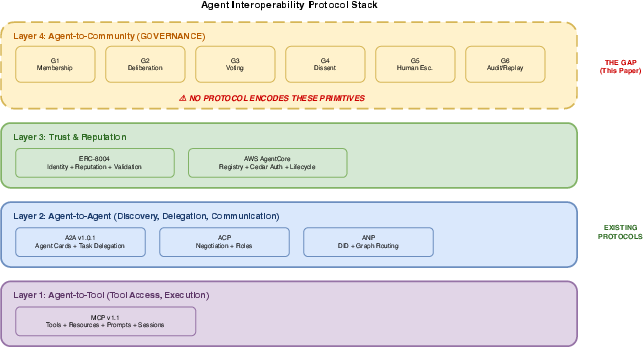
Figure 1: Agent interoperability protocol stack. Layers 1–3 (tool access, agent coordination, trust) are addressed by existing protocols. Layer 4 (governance: membership, deliberation, voting, dissent, escalation, audit) is universally absent.
Extensibility Versus Structural Deficiency
The authors disaggregate superficial extensibility (theoretical possibility to extend via protocol hooks) from structural and architectural adequacy. Although A2A permits arbitrary extension through new state machines and data types, no governance-centric extensions have emerged despite high adoption and active extension activity. MCP’s architecture is fundamentally client-server and tool-focused, making governance extensibility awkward. ERC-8004’s on-chain cost and latency constraints make it impractical for real-time governance.
This analysis highlights that the governance gap is not an incidental oversight but an architectural omission rooted in the original division of protocol concerns: task routing, tool access, and trust do not subsume the requirements of collective agent governance.
Empirical and Implementation Implications
The absence of governance primitives is not merely academic but impacts major deployments. For example, AWS Bedrock AgentCore offers production agent registries and audit via CloudTrail but does not encode trust scoring, behavioral reputation, or any protocol-level governance. The practical upshot is that enterprise and regulatory compliance tasks—such as collective compliance adjudication, risk management, and safety-critical escalation—remain outside the reach of protocol-native agent interaction.
Illustrative Absence: Inexpressibility of Governance Workflows
The concrete illustration of an enterprise compliance scenario shows that current protocols cannot natively express critical governance events such as “admit agent”, “challenge claim”, “vote”, “record dissent”, “escalate to human”, or “produce tamper-evident audit”. These must be implemented opaquely at the application layer, precluding composability and standardization.
Implications and Prospective Developments
The paper’s matrix and layered architecture model make the bold, empirically grounded claim that current agent interoperability protocols have universally omitted governance. This omission is not easily reparable without protocol-native extension and, in some architectures, may require a new, dedicated governance protocol layer.
Practical implications include the risk of incompatible, redundant, or non-composable governance solutions implemented ad hoc at the application layer, and the potential for regulatory non-compliance or agent collusion in the absence of standardized protocols for deliberation, voting, and auditability.
Theoretical implications suggest future research must prioritize the design, standardization, and empirical validation of governance-native agent interoperability protocols. Protocol designers should treat the governance taxonomy (G1-G6) as a mandatory specification checklist to ensure that future agent communities can self-govern, deliberate, escalate, and audit at the protocol level.
Given increasing velocity of protocol evolution and enterprise adoption, the window for setting interoperable protocol standards in the governance layer is narrowing. Failure to address these issues promptly may result in fragmentation and divergence across agent infrastructure deployments.
Conclusion
The analysis identifies a clear and urgent architectural deficiency: agent community governance—encompassing membership, deliberation, preference aggregation, dissent handling, human escalation, and auditability—is absent in all major agent interoperability protocols to date. The governance gap is not merely a missing feature but a universally missing protocol layer. The study invites the community to prioritize protocol-native governance primitives to support robust, auditable, and human-aligned multi-agent systems, preventing the pitfalls of fragmented, application-specific governance workarounds as agent fleets continue to scale and diversify.