- The paper introduces LOPA, a lightweight SLA method combining a prototype-based geometric prior with SALR to align language proficiency scales.
- It employs a frozen Whisper encoder with semantic-anchored layer routing and attention-based pooling to effectively capture temporal speech features.
- Quantitative results show LOPA significantly improves RMSE and ordinality metrics while enhancing interpretability compared to baseline methods.
Latent Ordinal Prototype Alignment for Lightweight and Interpretable Spoken Language Assessment
Overview and Motivation
The presented paper addresses core limitations in current SLA paradigms, particularly the computational and interpretability bottlenecks posed by large multimodal LLMs. Rather than scaling model parameters, the authors advocate structural inductive bias and task-aware regularization. The proposed Latent Ordinal Prototype Alignment (LOPA) combines a prototype-based geometric prior in the embedding space with Semantic-Anchored Layer Routing (SALR) over a frozen Whisper encoder, explicitly targeting the ordinal structure inherent in language proficiency scales. This end-to-end framework achieves performance comparable to multimodal foundation models while maintaining operational simplicity, interpretability, and resource efficiency.
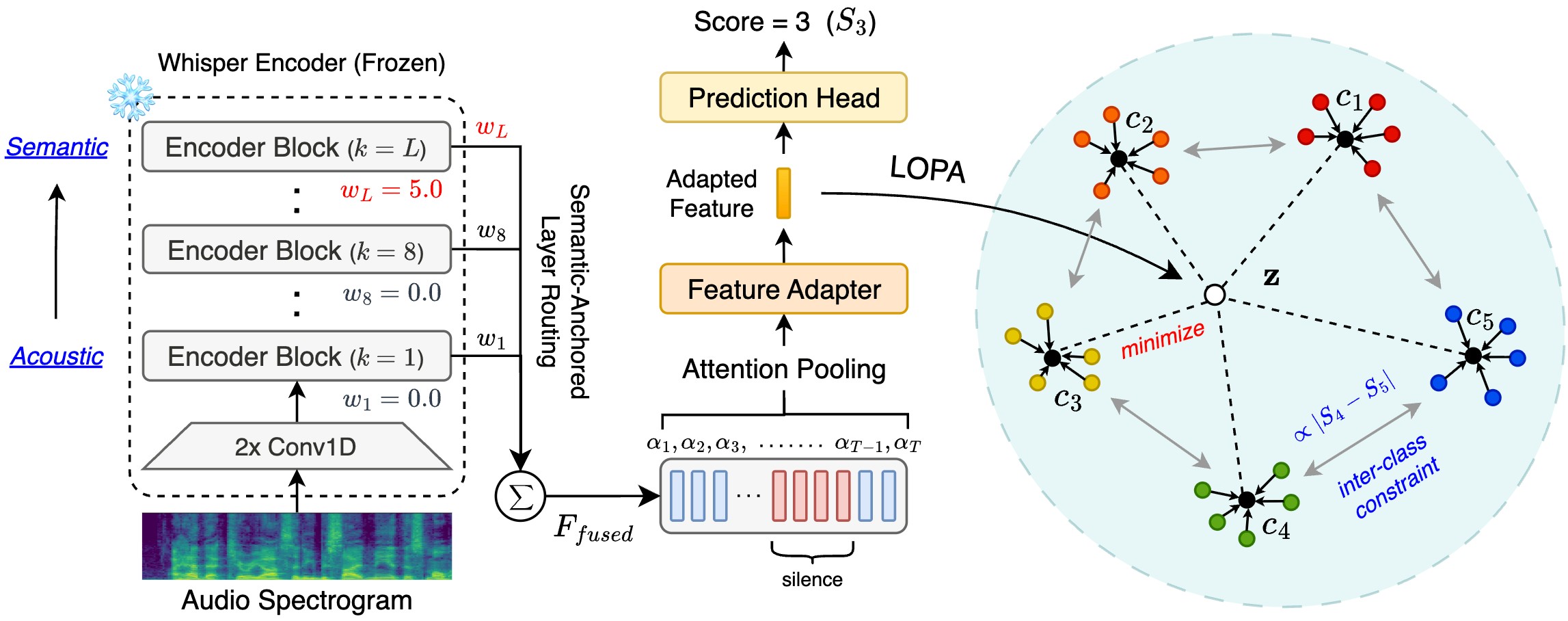
Figure 1: Schematic architecture of the proposed lightweight SLA method integrating Whisper encoder, SALR, temporal attention, and LOPA loss.
Methodology
The architecture is organized as a sequential pipeline:
Quantitative Results
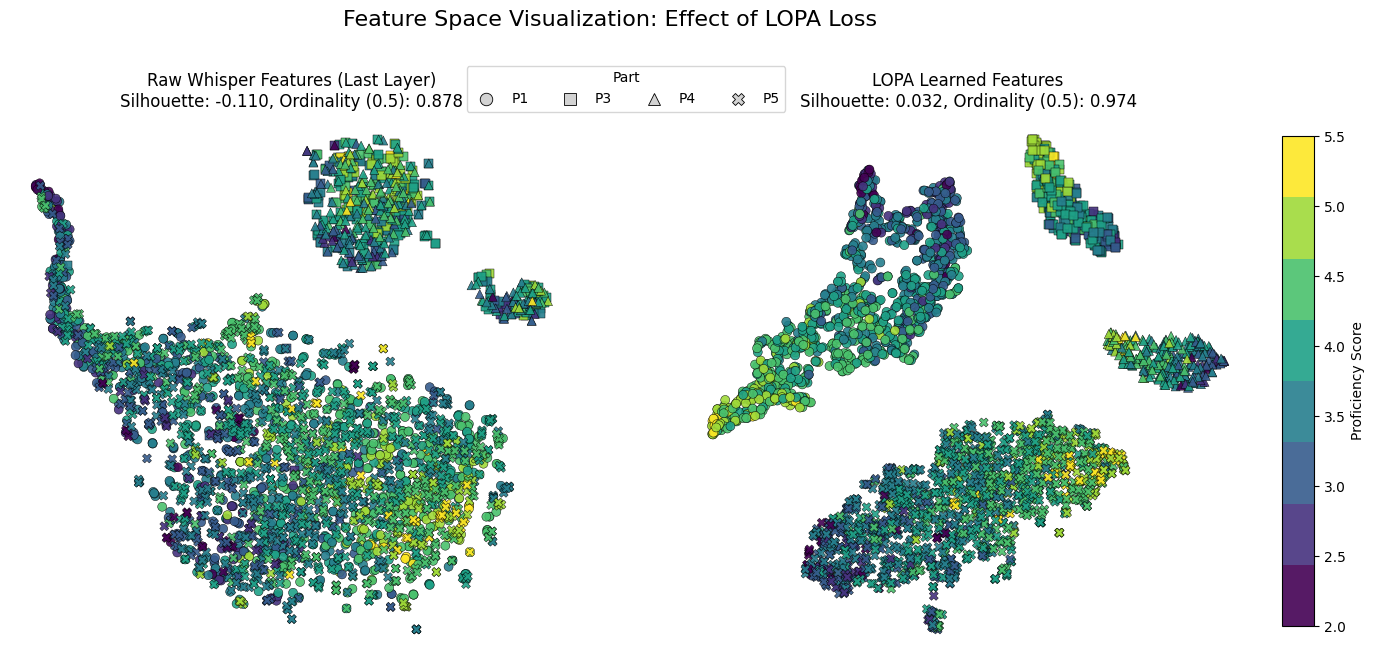
On the S{content}I Corpus 2025 evaluation set, the framework attains RMSE = 0.361 and PCC = 0.828, matching the accuracy of much larger LLM-powered graders (e.g., multimodal Phi-4 variants). Compared to Whisper-only baselines, the addition of SALR and LOPA yields measurable improvements in both error metrics and latent space ordinality (Silhouette score from −0.110 to 0.032, Ordinality Correlation from 0.878 to 0.974). LOPA drives consistent reductions in examinee-level squared error by paired t-test (p<0.02, Cohen's dz=0.14).
Ablation studies confirm each module's contribution: removing LOPA degrades RMSE to 0.383, omitting SALR increases it to 0.374, and naive layer aggregation is markedly inferior (RMSE = 0.495).
Interpretability and Criterion-Alignment
SALR's learned preferences expose part-dependent feature usage: semantic anchors dominate most tasks, but auxiliary layers vary systematically by test component (e.g., shallow layers for P1, mid-depth for P3/P4, deep for P5). This aligns with linguistic theory regarding the distribution of phonetic and semantic information in encoder layers [klimova2024uncovering], [gandelsman2024beyond]. The latent space, visualized via t-SNE, demonstrates compact clusters and clear ordinal trajectories across proficiency bands, mitigating level overlap and fostering criterion-aligned interpretability.
Implications and Future Directions
This work challenges the scaling-centric orthodoxy in SLA, presenting evidence for the sufficiency of architectural and loss-level inductive biases when the ordinal structure is prioritized. The explicit mapping from CEFR gradations to prototype-aligned latent geometry augments both reliability and explainability, critical in educational and assessment domains constrained by computational resources. The synergy between SALR and LOPA suggests further opportunities:
- Extending structured manifold regularization to additional speech tasks (pronunciation, fluency, paralinguistics).
- Adapting prototype-aligned losses to multilingual/transfer learning, where proficiency scales differ.
- Integrating task-aware routing with dynamic token-level aggregation for richer inter-part feedback.
- Investigating zero/few-shot generalization, leveraging explicit geometric priors.
This architecture enables practical deployment of SLA systems without GPU-intensive fine-tuning, broadening access to automated assessment in low-resource or edge-device settings, and enhancing trust through interpretable, criterion-consistent scoring.
Conclusion
The LOPA framework introduces principled, lightweight SLA modeling by explicitly structuring latent ordinal geometry and leveraging dynamic feature aggregation. SALR and LOPA jointly outperform conventional Whisper-based and multimodal LLM approaches in both accuracy and interpretability, with robust statistical significance. This highlights the potential for inductive architecture design in spoken language assessment tasks, paving the way for efficient, criterion-aligned, and explainable auto-grading systems.