- The paper's main contribution is introducing the claim calibration operator to systematically align AI-generated claims with supporting evidence.
- It outlines a five-step process—from hypothesis generation to calibrated claim validation—to mitigate overclaiming and manage epistemic drift.
- By comparing diverse AI science routes, the study reveals risks of unvalidated claims and offers actionable guidelines for integrating calibration in research.
The Calibration Turn in AI-Assisted Research: Summary and Analysis
Overview and Motivation
The paper “The Calibration Turn in AI-Assisted Research: A Conceptual and Methodological Framework for Evidence-Licensed Claims” (2606.31273) advances a critical theoretical framework for scientific claim calibration in the context of AI-driven research. Rather than focusing solely on hypothesis generation or experimental automation, the work’s central thrust is epistemic: how can scientific claims made by AI-assisted systems be licensed according to the evidence, and what mechanisms are required to prevent overclaiming and epistemic drift as automation accelerates?
The motivation reflects recent trends in AI for science, where the gap between system capabilities (e.g., LLMs generating plausible hypotheses, foundation models outputting candidate structures, self-driving labs running closed-loop experiments) and robust scientific assertion has widened. The author asserts that automation amplifies the need for rigorous calibration—scientific assertions must be systematically aligned with the actual warrant provided by gathered evidence.
Conceptual Foundation: Scientific Claim Calibration
At the heart of the paper is an operator-based decomposition of the scientific process, applicable to both human- and AI-driven workflows. The proposed pipeline consists of five operators:
- Hypothesis Generation (G): Mapping knowledge, data, and research questions to candidate hypotheses.
- Consequence Derivation (MD): Producing domain-appropriate, testable consequences for each hypothesis.
- External Validation (V): Independent evaluation through experiments, simulations, proof checking, or benchmarking.
- Belief Update (U): Integration of new evidence into system state.
- Claim Calibration (CalD): Mapping raw claims, evidence, evaluator, and domain context into the maximal set of evidence-licensed claims.
The paper formalizes the assertion right through the license relation:
E⊩D,VC
which denotes that, in domain D, with evaluator V, the evidence E licenses claim C. Further, it introduces two scalar diagnostics:
- The claim–evidence gap: MD0, quantifying the degree to which a claim exceeds permissible assertion.
- Epistemic debt: MD1, which must be resolved via more evidence or suitable claim downgrading.
This claim-centric semantics is not a stylistic device; it formalizes scientific meaning as boundary-constrained assertion rights, not mere language selection.
(Figure 1)
Figure 1: The calibrated AI science loop, showing the flow from hypothesis generation and consequence derivation to validation, belief update, and, critically, claim calibration via MD2.
From Automation to Evidence-Licensed Claims: Comparative Analysis
The framework is stress-tested against six paradigmatic AI science routes, each with different epistemic structures:
- Specialized Scientific Foundation Models (e.g. AlphaFold 3, GNoME): Optimize predictive accuracy but risk conflating prediction with explanation or discovery without further validation.
- Human-Led LLM Assistants: Amplify hypothesis generation but provide limited guarantee of external or independent adjudication.
- Multi-Agent Co-Scientist Systems: Leverage critique and hypothesis selection but require explicit mapping from actionability to scientifically licensed discovery.
- End-to-End AI Scientist Pipelines: Automate artifact generation, but risk Goodharting—optimizing proxies (e.g., paper completeness) instead of epistemic value.
- Algorithmic/Proof Agents (e.g. AlphaEvolve, AlphaProof): Can provide strong warrant through verifiable artifacts; limited by applicability to evaluator-rich domains.
- Self-Driving Laboratories: Offer experimental contact but still require explicit calibration for claim boundaries, especially for assertions of novelty and generalizability.
The author demonstrates, via synthetic diagnostics, how systems with strong generation and modeling capacity but weak calibration and evaluation accumulate overclaiming pressure and epistemic debt.
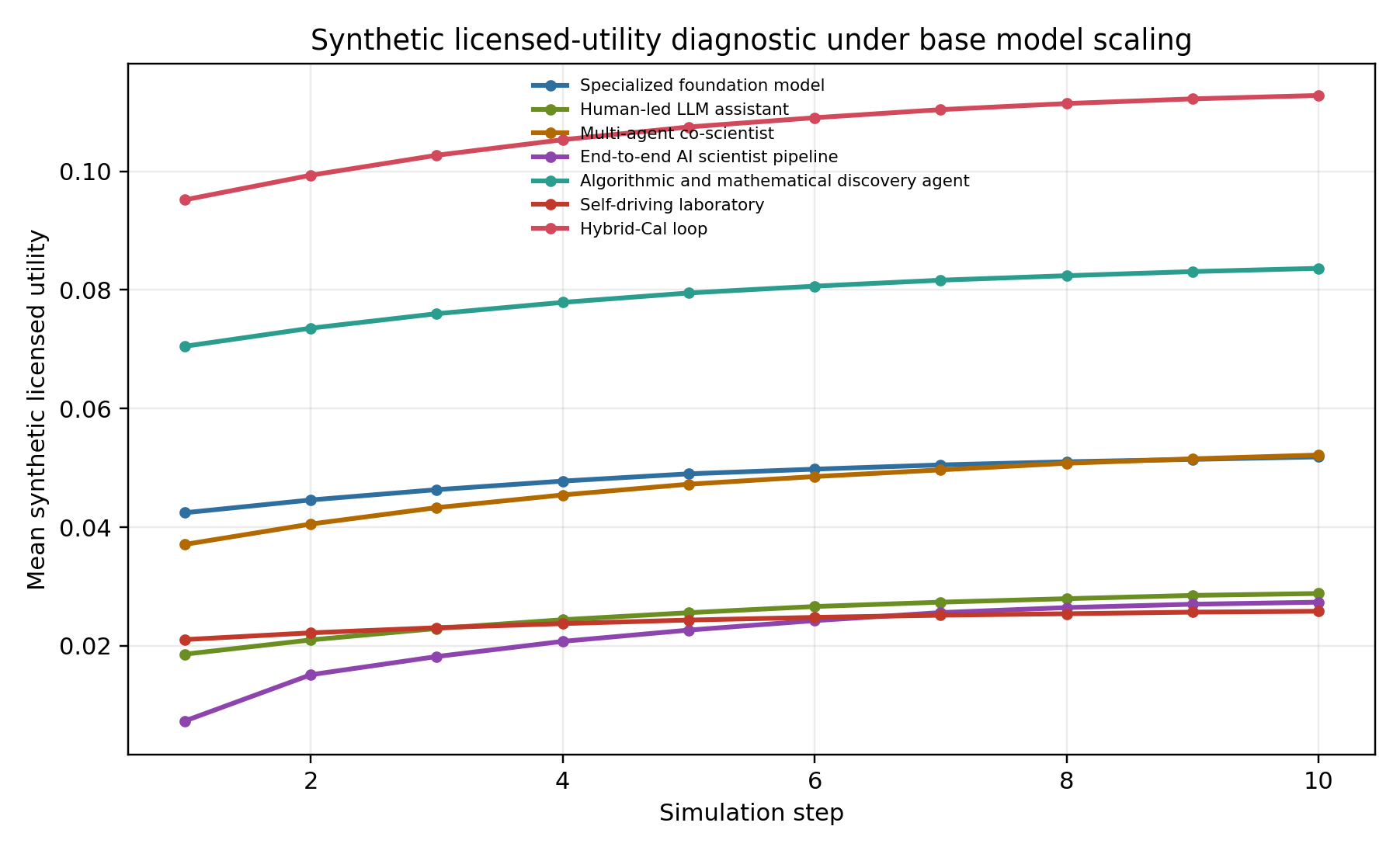
Figure 2: Synthetic licensed-utility diagnostic for AI science routes under modelled calibration regimes; dimensionless outputs reflect calibration efficacy not empirical productivity.
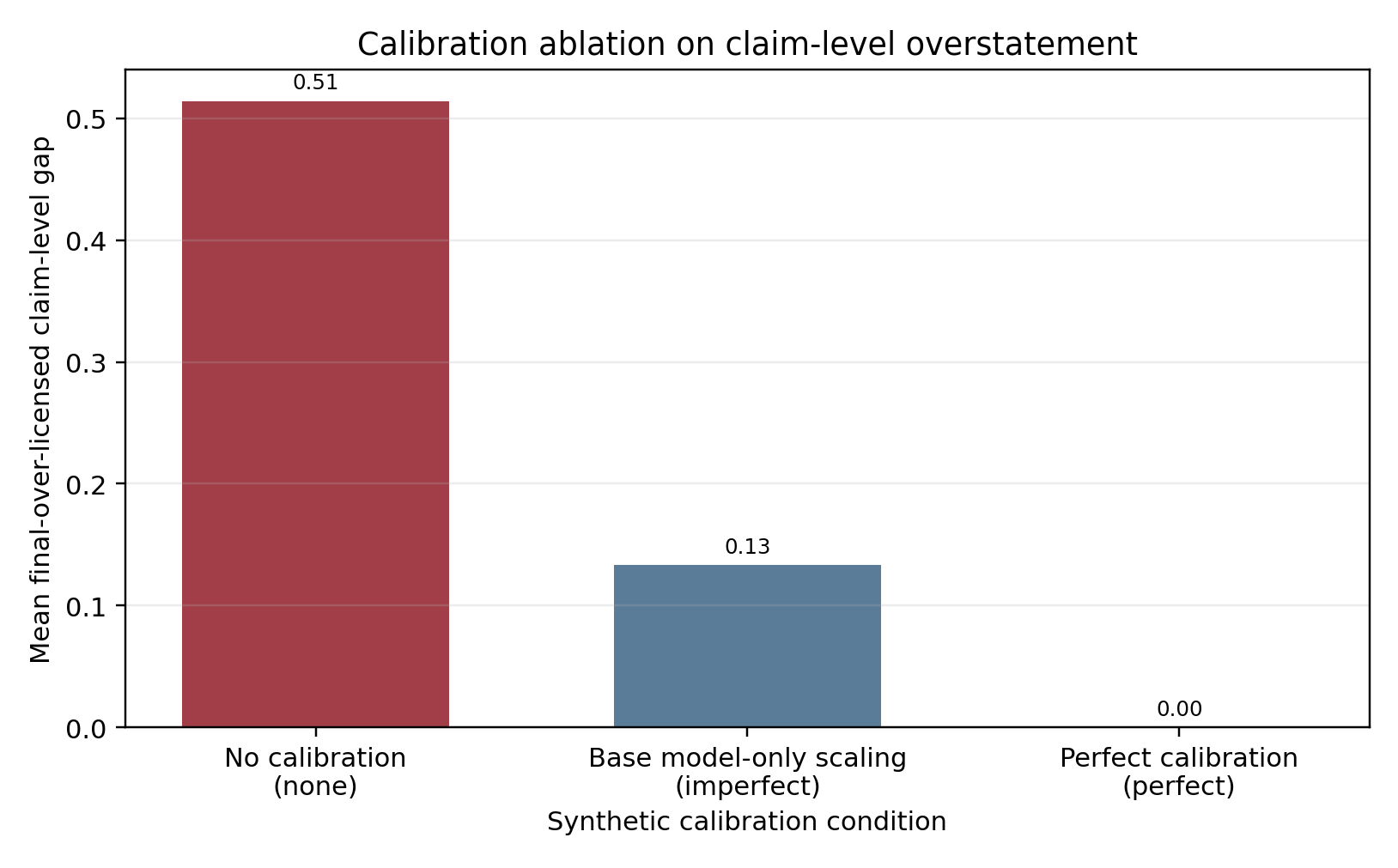
Figure 3: Calibration ablation in AISim-Cal; the overclaim gap decreases with stronger calibration, illustrating that external validation alone does not suffice to license strong scientific claims.
Core Theoretical Contributions
Evidential Calibration Semantics
The manuscript formalizes a multi-step mapping from hypotheses to consequence profiles, adjudication, and calibrated claims. Notably:
- A claim MD3 is defined structurally as MD4, combining hypothesis, strength, boundary, and modal status.
- The paper operationalizes a downward-closed licensed claim set MD5 and shows that calibration can require not just weakening, but boundary or type change.
- Structural calibration is highlighted: sometimes, minimal structural reconstruction across heterogeneous outputs provides the strongest justifiable claim, not simply intersection of validated instances.
Route-Level Failure Modes and Implications
The work maps failure modes across routes. For instance:
- Artifact-to-knowledge drift in automated paper-generation systems.
- Plausibility-to-truth drift in LLM assistants.
- Prediction-to-discovery drift in foundation models.
- Intervention-to-generalization drift in self-driving labs.
A central assertion is that validation does not determine claim level: positive results permit only claims exactly at the boundary of what was tested under the given evaluator. The risk of automation is that claim inflation may scale with generation capacity unless calibration operators are explicitly implemented and audited.
Checklist and Practical Recommendations
The framework culminates in an actionable checklist for AI research system design and reporting, prescribing specification of hypothesis objects, consequence profiles, evidence, evaluators, independence, explicit claims, calibration procedures, residual epistemic debt, and scoping boundaries. This harmonizes with domain-specific norms—what licenses a claim in mathematics (e.g., formal proof) may be insufficient in biology (e.g., only an in vitro screen).
Theoretical and Practical Implications
The theoretical implication is a shift in AI for science evaluation: from “did the system discover something?” to “which claims are licensed, and what epistemic debt remains?”. This applies to benchmarking new AI science systems, cross-domain comparison, as well as future AI design.
Practically, the author advocates for hybrid systems: integrate broad generative models (LLMs, agents), strong evaluators (experiments, proof checkers, independent replication), and enforce claim calibration at the reporting boundary. This would maximize scientific utility while minimizing overclaim risk, preserving the integrity of AI-assisted science.
The framework is directly applicable to the design, audit, and governance of AI science pipelines. As automation increases, the calibration operator, not just hypothesis novelty or experimental validation, becomes the epistemic bottleneck; calibration failure leads to epistemic inflation and undermines scientific trust.
Conclusion
This manuscript advances the claim calibration operator (MD6) as the critical stage in the AI-assisted science loop, enforcing evidence-licensed claims and managing residual epistemic debt. The proposed framework enables precise comparative epistemology across diverse AI science systems and clarifies the necessary reporting, evaluation, and auditing standards as automation increases. As a result, the productive future of AI for science hinges not only on the brilliance of its models and autonomy of its systems, but fundamentally on the principled calibration of the claims it makes.
The practical unit of AI-assisted scientific reporting is thus not the uncalibrated claim, but the licensed claim paired with explicit non-claims that remain unsupported.
References
- Li, H., "The Calibration Turn in AI-Assisted Research: A Conceptual and Methodological Framework for Evidence-Licensed Claims" (2606.31273).