- The paper demonstrates a novel fiber-based Fabry–Perot optomechanical platform with hBN that achieves high single-photon coupling (g0/2π ~180 kHz) and low effective mass.
- It establishes nonlinear optomechanically induced transparency (OMIT) in the unresolved-sideband regime, revealing transparency, gain, and strong dynamical backaction at low optical powers.
- The study further explores optomechanical frequency comb generation via both mechanical and all-optical excitation, highlighting the platform's efficiency and scalability.
Unresolved-Sideband Optomechanics with Hexagonal Boron Nitride: Induced Transparency, Gain, and Frequency Combs
The work establishes a fiber-based Fabry–Perot microcavity platform, designed in a membrane-in-the-middle geometry, integrated with exfoliated hexagonal boron nitride (hBN) nanomechanical drums. The cavity, composed of concave, dielectric Bragg-mirror-coated fiber ends, achieves tunable lengths down to 24 µm, with single-mode input and multimode output coupling to minimize losses. Alignment protocols are supplemented by white-light spectroscopy and auxiliary 780 nm imaging for precise sample positioning and cavity-length calibration.
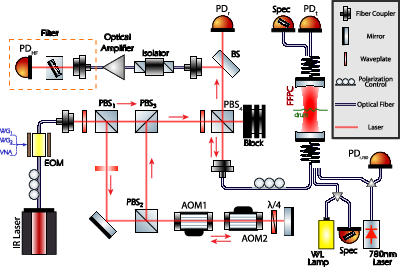
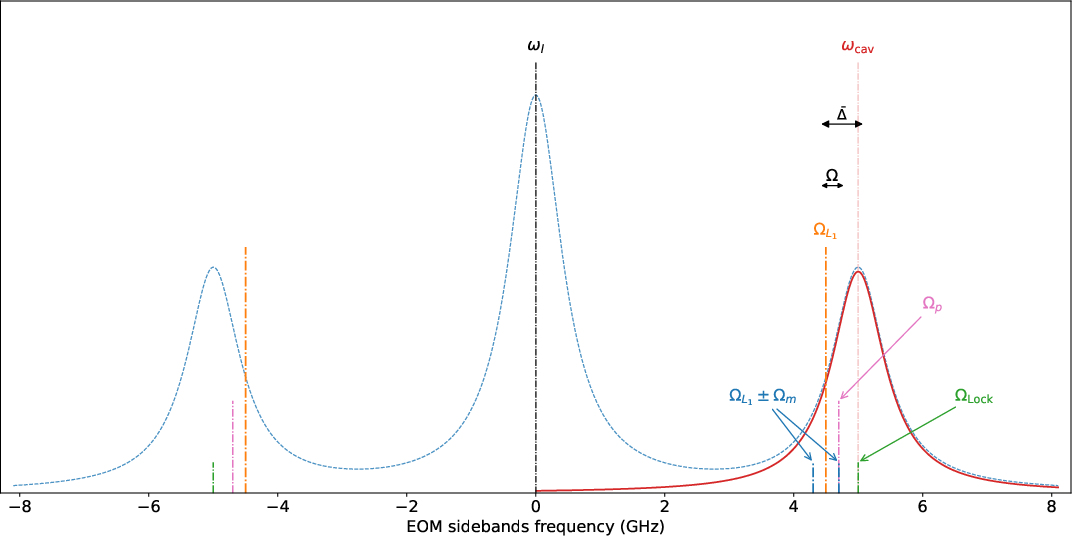
Figure 1: Optical setup and RF-tone layout, including schematic of the fiber-based Fabry–Perot cavity and detailing phase-modulated laser injection, sideband generation, and detection architecture.
Key cavity parameters—mode waists, coupling efficiencies, and off-centering tolerances—are characterized, highlighting a trade-off between enhanced optomechanical coupling at small cavity lengths and increased sensitivity to misalignment or clipping. The multimode-fiber output ensures that divergence at practical cavity lengths does not constrain the transmission.
The optomechanical element is a hybrid hBN/Si3N4 platform, with hBN flakes transferred onto prepatterned high-stress Si3N4 membranes, fabricated using established wet transfer and cleaning techniques. The platform supports both isolated hBN drum modes and hybridized modes, but this study focuses on the fundamental hBN mode for its small effective mass and strong frequency pull, critical for maximizing g0.
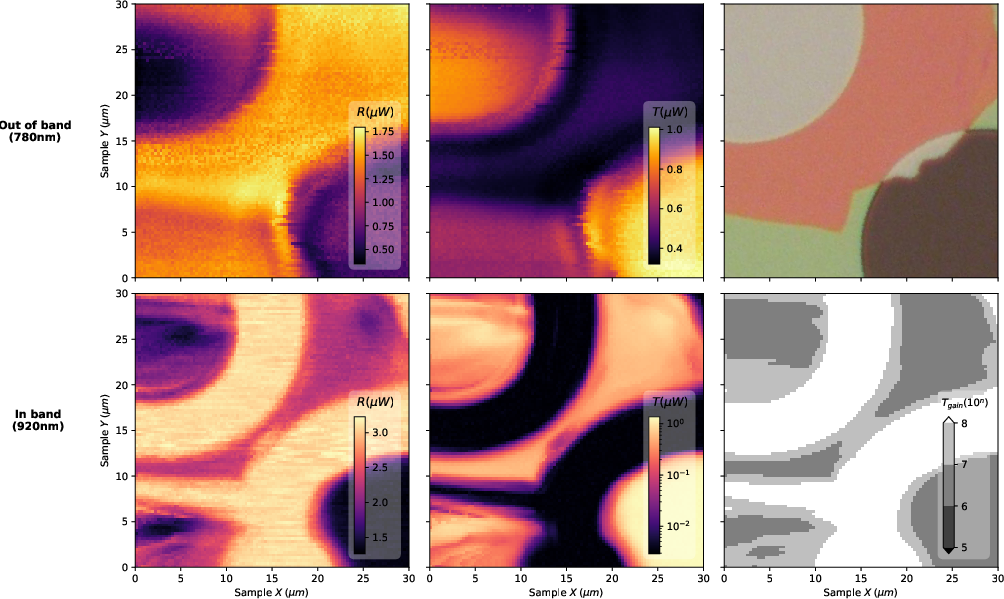
Figure 3: Sample imaging and navigation; optical and cavity-laser scans identify low-loss regions and highlight vignetting and scattering consistent with fabrication boundaries and membrane apertures.
Static and Dynamical Optomechanical Characterization
Static optomechanical coupling is first established via reference scans of the bare cavity (through empty Si3N4 holes), enabling baseline mapping of reflection/transmission properties and cavity drift corrections. Dispersive and dissipative coupling parameters (G, Gκ) are then extracted in both bare Si3N40 and suspended hBN drum regions.
Notably, the hBN device achieves 41 kHz with a minimal effective mass 42 pg and 43 MHz, providing order-of-magnitude improvement over Si44N45 benchmarks, driven not only by increased reflectivity but, crucially, by reduced mass and enhanced mode overlap.
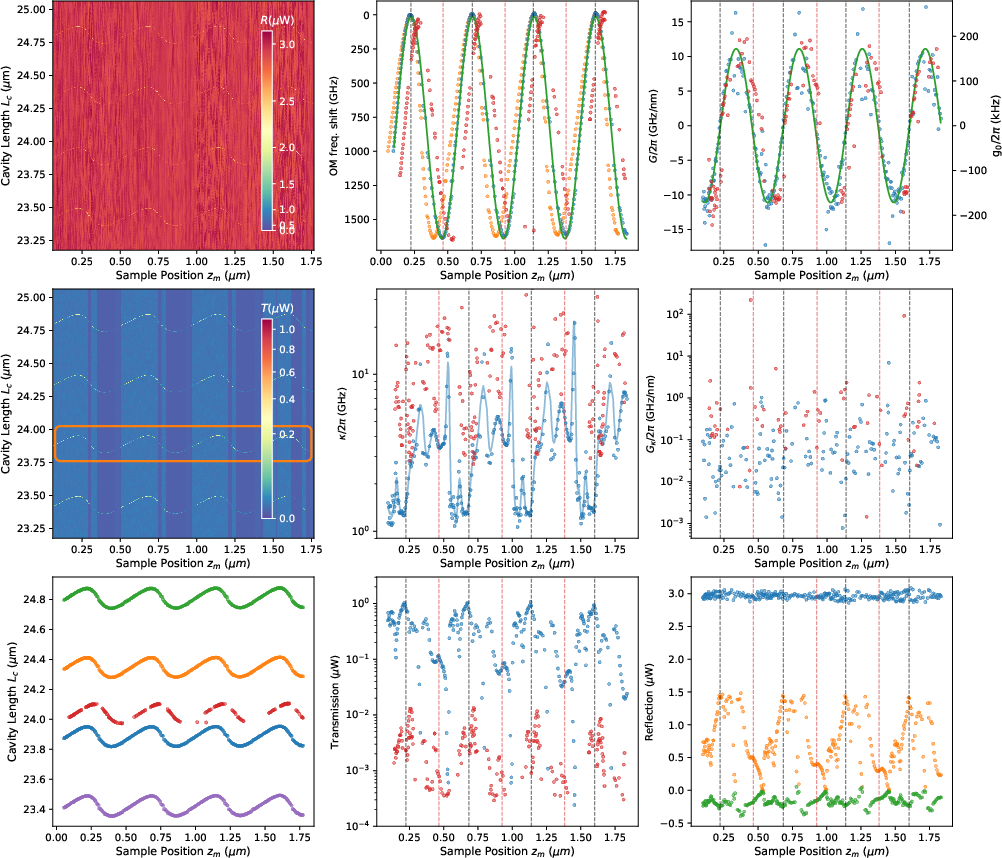
Figure 5: Static optomechanical coupling for suspended hBN drum: reflection/transmission maps, resonance shifts, linewidth variation, and resulting 46, 47 across cavity positions. Dispersive coupling peaks, and dissipative coupling becomes significant off-resonance.
Experimental dispersive pull parameters closely approach theoretical limits set by cavity geometry and membrane thickness (analyzed via full transfer-matrix and elasticity models), confirming that the fiber-cavity/hBN device is at or near the optimal operating point for maximizing single-photon coupling in the present architectural context.
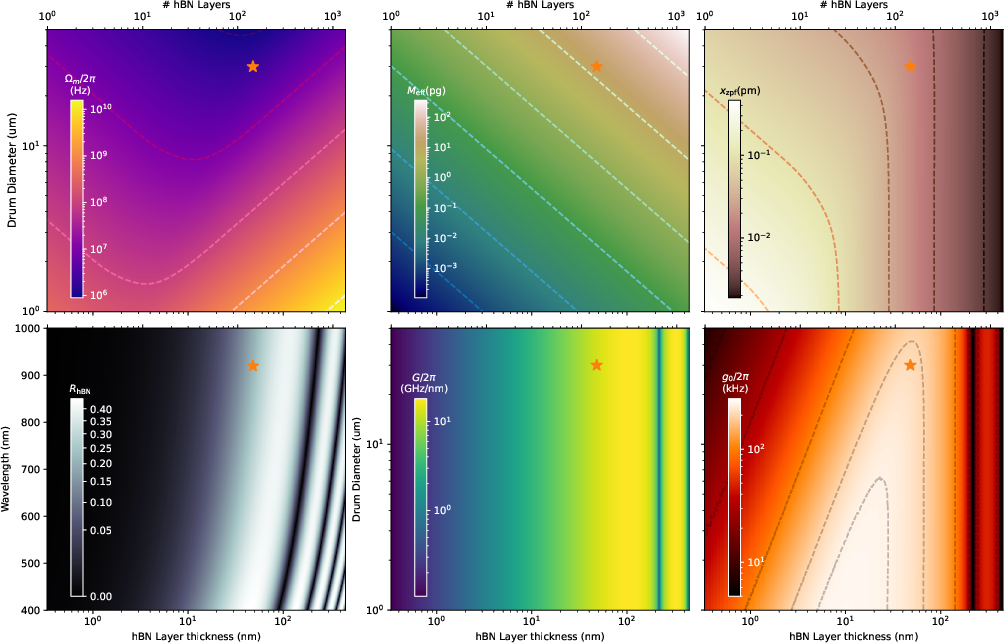
Figure 2: Theoretical estimate for hBN drum: frequency, effective mass, zero-point motion, reflectivity, frequency-pull 48, and 49 versus geometry, highlighting the experimental device location near optimal coupling.
Dynamical backaction (optical spring and radiation pressure anti-damping) is calibrated against static 30 estimates. Extracted frequency shifts and linewidth changes under varying detuning and optical power corroborate the static dispersive coupling, with nontrivial behavior and spectral splitting observed at high coupling/power, indicative of entering strong backaction regimes even in the deep unresolved-sideband limit.
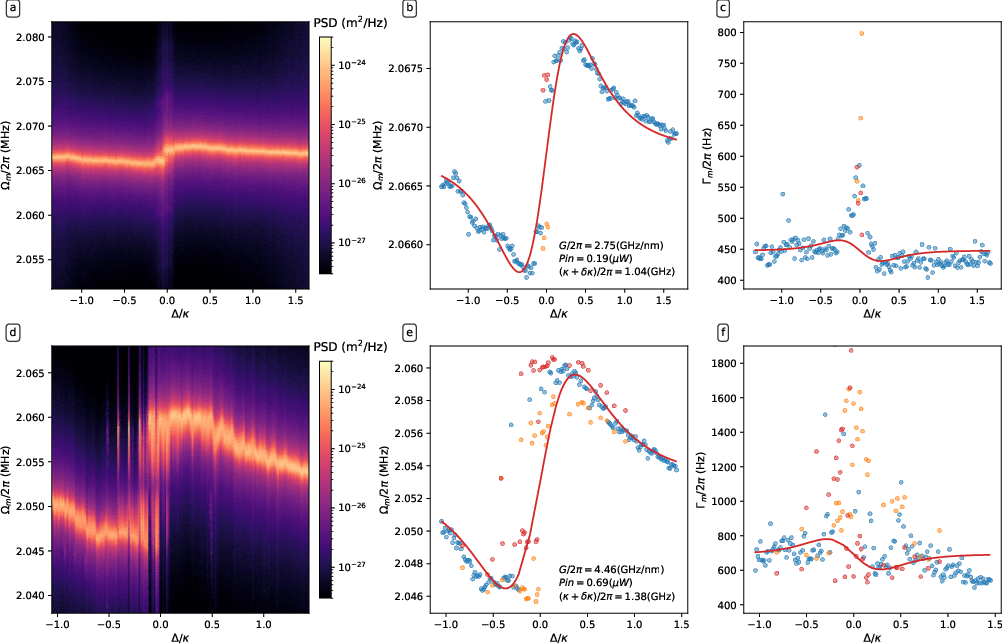
Figure 8: Radiation-pressure dynamical backaction: mechanical resonance shift and linewidth versus detuning; upper/lower branch splitting and optical-spring fit reflect strong coupling and nonlinear behavior.
OMIT in the Unresolved Sideband Regime: Theoretical and Experimental Framework
A central achievement is the extension and experimental verification of Optomechanically Induced Transparency (OMIT) in the deep unresolved-sideband regime (USR, 31), with the system exhibiting strong coherent interaction and highly non-RWA probe response. The theoretical model departs from the resolved-sideband rotating-wave theory, retaining both upper and lower sidebands to account for the non-negligible Stokes channel and yielding a generalized probe response 32 that features critical points (true zero-transparency conditions), gain, and strong backaction effects.
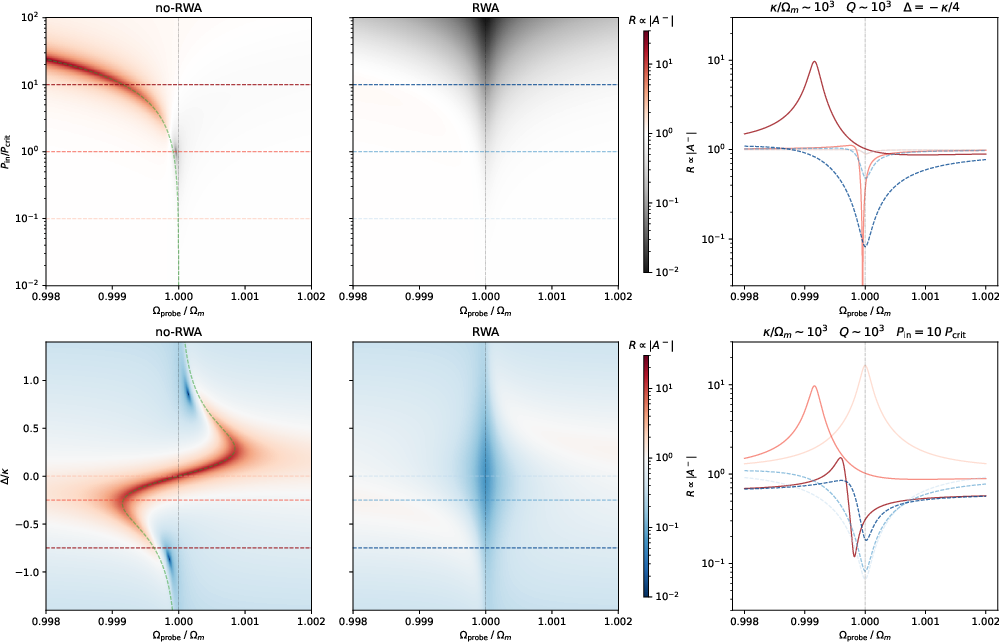
Figure 10: Comparison of full (no-RWA, upper panels) and sideband-resolved (RWA, center panels) probe response in the USR. Strong differences in critical power, dip-to-peak crossover, and frequency shift evolution are visible.
Thermally induced frequency noise is incorporated as an effective linewidth broadening that renormalizes the critical power for perfect transparency, reduces the intracavity photon population at fixed drive, and degrades contrast at elevated temperature, consistent with the large 33 regime.
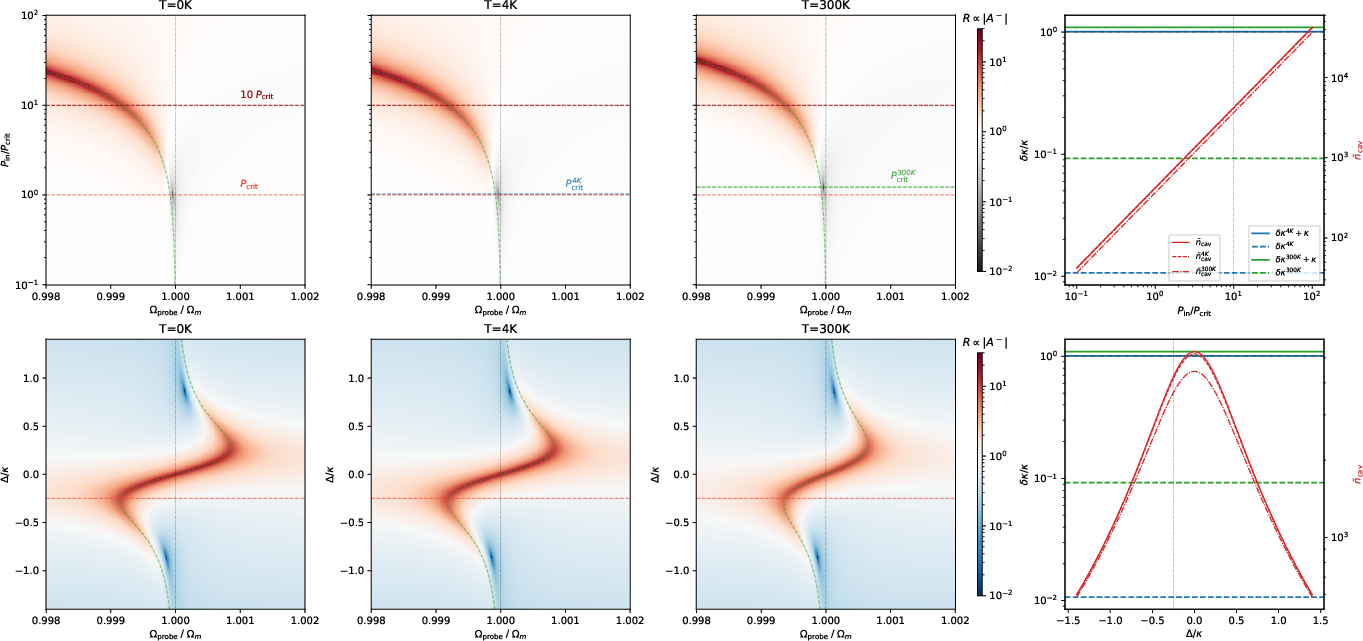
Figure 4: USR response with thermal broadening; increased temperature broadens the response, shifts critical power, and decreases contrast, especially relevant for large 34 systems.
By mapping the critical input power for perfect OMIT as a function of 35, detuning, sideband resolution, and 36, the analysis underscores that USR operation in this architecture enables access to nonlinear OMIT features at nanowatt to microwatt powers, an order of magnitude more efficient than traditional RSR configurations (which typically require mW powers at much higher 37).
(Figure 12, 13)
Figure 6: Critical-power maps in the USR (left) and at 38 K (right) emphasize strong dependence on 39 and power penalty from thermal broadening.
Frequency Combs: Scaling and Limits in hBN Fiber Cavities
The platform demonstrates robust optomechanical frequency comb (OM-comb) generation, both by mechanical piezo drive and by all-optical two-tone excitation. The underlying mechanism is efficient transfer of radiation-pressure force (amplified by large 40) to coherent mechanical motion, achieving large modulation indices 41 for sub-nanometer displacement amplitudes.
Detection is ultimately constrained by a cavity-filtered sideband envelope: even though the phase-modulation mechanism allows very broad ideal comb spans, the observable sideband order is limited by cavity linewidth-to-pull ratio and the experimental SNR, with the adiabatic limit yielding a geometric roll-off per sideband order. For devices at measured parameters, 42 sidebands are detectable per µm amplitude, while reduction of 43 by an order of magnitude would enable 44 at comparable drive.
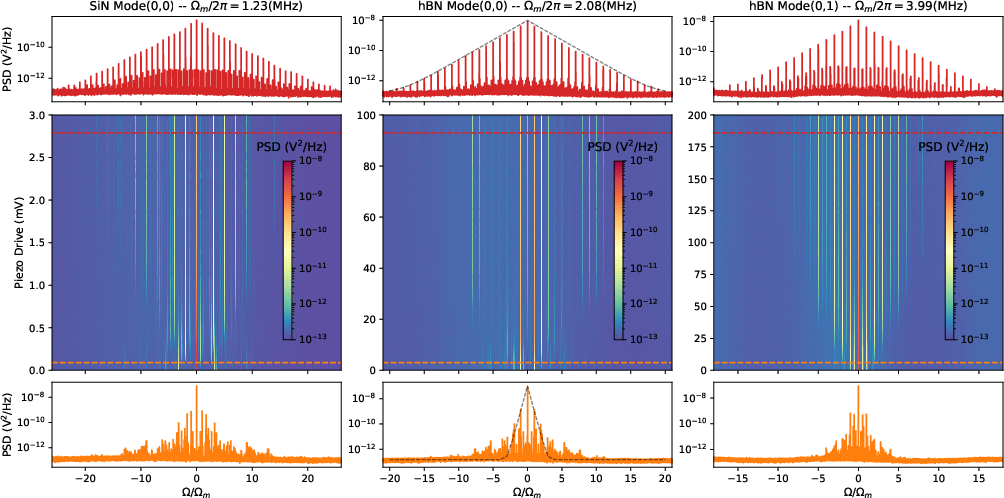
Figure 7: Mechanically driven frequency-comb generation for several modes; at strong drive, comb extends to high orders with an envelope quantitatively described by the cavity-filtered geometric model.
A cross-platform comparison (see Table) establishes that the hBN fiber cavity, even at moderate Q, achieves higher 45 and lower OM-comb drive powers than most resolved-sideband and nanophotonic architectures, provided that cavity losses can be stabilized at required operating points.
Implications and Outlook
This work demonstrates that hBN-based fiber-cavity optomechanical systems operating in the unresolved-sideband regime can attain single-photon coupling rates close to the theoretical maximum for chip-scale devices, and access nonlinear OMIT and OM-comb phenomena at strikingly low optical power. The results challenge the necessity of the resolved-sideband condition for accentuated quantum-coherent control, provided 46 is sufficiently large and technical instabilities—especially thermal frequency noise—are managed.
For theory, the results motivate the development of full non-RWA response models in OMIT/OMIT-gain/metamaterial and related phenomena, as analytic RWA approximations become quantitatively inadequate. For practical quantum and classical applications, the demonstrated architecture can enable low-power quantum-limited measurement, sensitive force/mass transduction, and scalable, tunable OM-comb sources with the potential for integrated and hybrid configurations via straightforward changes in cavity design or membrane geometry.
Conclusion
This study defines new performance benchmarks for optomechanical platforms in the USR, enabled by the confluence of large 47, reconfigurable cavity design, and hybrid nanomechanics using hBN. The approach fundamentally expands the accessible regime for coherent optomechanical phenomena at low repetition rates and modest optical powers. Future work could focus on leveraging higher-48 drums, narrower 49, and dynamic mode control to further scale nonlinear photon–phonon interactions, pursue ground-state cooling, and realize robust quantum devices in the unresolved-sideband domain.

