- The paper demonstrates a novel integrated interface that achieves dissipative coupling between GHz HBARs and sub-MHz SiN membranes, enabling enhanced phononic information processing.
- It employs flip-chip bonding and a modified Butterworth-Van Dyke circuit model to quantify both dispersive and dissipative interactions, with the latter being 20-fold stronger.
- Experimental results reveal acousto-mechanical induced transparency, significant group delays, and nonlinear acoustic frequency comb generation, indicating potential for quantum metrology and advanced acoustic networks.
Dissipative Acousto-Mechanical Parametric Interface: Integrating HBARs and Flexural Phonons
Motivation and Background
High-overtone bulk acoustic wave resonators (HBARs) have become integral in phononics given their exceptionally high f×Q values at GHz frequencies, supporting advancements in quantum acoustodynamics, phononic quantum information processing, and transduction across domains such as microwaves and optics. HBARs harness strong piezoelectric coupling in the microwave regime and photoelastic effects in the optical domain, facilitating interactions with superconducting qubits and optical cavities. Low-frequency flexural silicon nitride (SiN) membrane resonators, operating in the sub-MHz regime, are pivotal in quantum phononics, offering low-loss integration, high Q, and superior optomechanical parametric coupling.
However, a critical challenge emerges from the substantial frequency mismatch between low-frequency flexural modes and high-frequency HBARs or superconducting qubits, constraining direct, efficient parametric interactions and hybrid platforms leveraging both domains. This work introduces a hybrid interface that bridges this gap by establishing dissipative acousto-mechanical coupling, advancing scalable, multimode phononic information processing architectures.
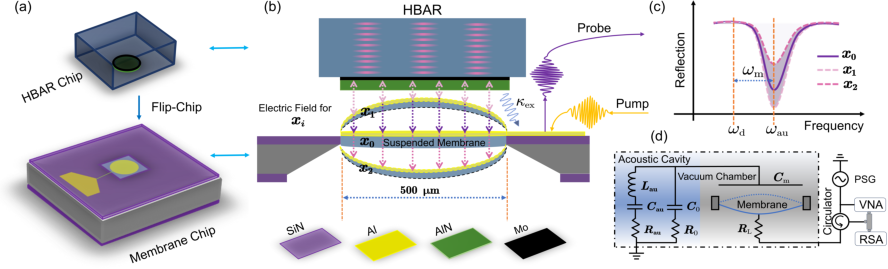
Figure 1: Schematic depiction of a hybrid interface: flip-chip integration of GHz HBAR with flexural SiN membrane, enabling displacement-modulated external dissipation rate κex.
Device Architecture and Coupling Mechanism
The interface comprises a flip-chip bonded system: a HBAR on sapphire (with Mo/AlN electrodes) and a suspended, metallized SiN membrane. The SiN membrane is positioned sub-micron above the HBAR, forming a parallel-plate structure where its flexural displacement directly modulates the HBAR's external dissipation rate κex, enabling dissipative optomechanical-like coupling.
The hybrid platform leverages the modified Butterworth-Van Dyke (MBVD) circuit model for quantitative analysis, where the displacement-dependent capacitance Cm(x) shunts the HBAR motional branches. The derived coupling strengths gdisp and gdiss reflect, respectively, dispersive and dissipative single-photon interactions. Crucially, the regime where β>1/4 (β=ωauRLCm) ensures dissipative coupling dominance, and design parameters prioritize boosting Cm for enhanced effect.
Experimental Characterization: Mode Structure and Coupling Ratios
Room-temperature, high-vacuum measurements reveal a dense manifold of longitudinal HBAR modes in the 2.5–4 GHz regime, operating with high Q0 governed by intrinsic Akhiezer scattering and surface boundary effects. A representative mode at 2.7454 GHz presents Q1, critical coupling, and commensurate external and internal dissipation rates. The fundamental flexural mode of the SiN membrane at 571.5 kHz is characterized by a relaxation time Q2 ms and an intrinsic damping rate Q3 Hz.
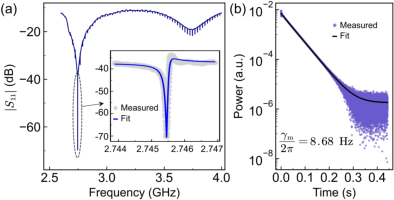
Figure 2: Reflection spectra of selected HBAR modes and ringdown of the fundamental SiN flexural mode establishing resonance and damping characterization.
Single-photon acousto-mechanical coupling Q4 Hz is directly measured, confirming quantitative predictions. Importantly, the analysis establishes the dissipative coupling strength to be 20 times larger than the dispersive coupling—a ratio unprecedented among hybrid dissipative–dispersive systems, reinforced by the system's room-temperature resolved-sideband operation.
Acousto-Mechanically Induced Transparency and Nonlinear Effects
The resolved-sideband regime is exploited for coherent control of the interface. Strong red-detuned driving produces acousto-mechanically induced transparency (AMIT): destructive interference between probe and anti-Stokes fields yields a narrow transparency window in the HBAR reflection spectrum. The transparency amplitude and linewidth broaden with pump power, while asymmetric features emerge above baseline, unambiguously indicating dominant dissipative coupling.
Under large drive powers, dynamic backaction fundamentally alters mechanical response; fitting yields Q5, marking dissipative interaction as 20-fold dominant. Associated steep phase dispersions across the AMIT window slow acoustic pulses, producing group delays up to Q6 ms—critical for precision sensing and metrology.
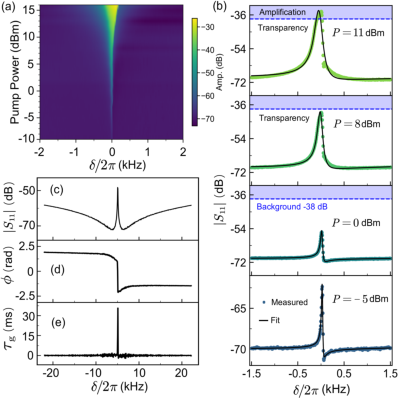
Figure 3: Evolution of AMIT window in HBAR reflection under varying pump powers, showcasing amplitude, phase, and group delay phenomena.
Kerr Nonlinearity and Acoustic Frequency Combs
Beyond the linear regime, the interface's nonlinear radiation-pressure-type interaction manifests as Kerr nonlinearity (Q7). Implementing a two-tone pumping protocol—resonant and red-sideband drives—enables deterministic generation of phase-coherent acoustic frequency combs (AFCs), with up to 14 uniform teeth matching the membrane's mechanical frequency. The nonlinear modulation depth Q8 characterizes comb structure, while time-domain and phase-space analyses confirm long-range phase coherence and direct linkage to the mechanical mode.
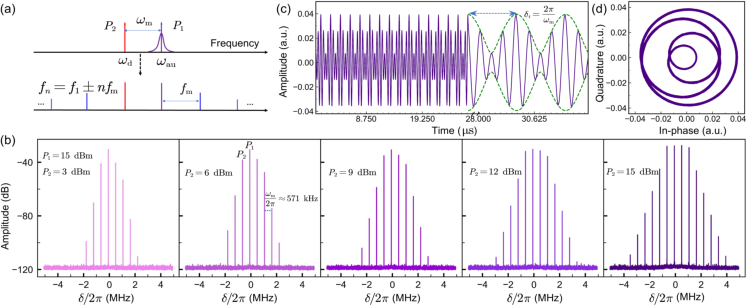
Figure 4: Two-tone pumping configuration yielding AFCs, periodic envelope and Lissajous orbits affirming phase coherence and mechanical origin.
Implications and Future Directions
This platform sets a robust foundation for scalable, multimode phononic information processing. Operation at room temperature eliminates cryogenic dependencies, advancing practical integration in precision metrology, sensing, and quantum-regime applications. The high dissipative-to-dispersive coupling ratio enables novel control regimes for many-body phononics, nonlinear phonon lasers, and topological phononic networks. Future developments may focus on cryo-compatible extensions for quantum-limited operation, leveraging the dense HBAR spectra coupled to common mechanical modes to explore complex dynamical phenomena and topological transport.
Conclusion
The presented dissipative acousto-mechanical interface integrates high-frequency HBARs with low-frequency SiN membrane resonators, achieving the strongest reported dissipative-to-dispersive coupling and enabling resolved-sideband operation at ambient conditions. It demonstrates AMIT, acoustic amplification, and nonlinear AFC generation, outlining a scalable on-chip route to high-capacity phononic information processing. The approach is anticipated to catalyze further progress in quantum phononics, topological transport, and advanced acoustic network dynamics.