- The paper identifies a first-order phase transition in the holographic Casimir effect as defect separation crosses a critical width.
- It constructs gravitational duals using AdS soliton geometry and EOW branes with varying tension parameters, highlighting methodological innovation.
- The study enforces cosmic and topological censorship principles, establishing universal bounds for the Casimir effect compared with free theories.
Phase Transition and Censorship Principle for the Holographic Casimir Effect
Introduction and Motivation
This paper presents a rigorous analysis of the Casimir effect for parallel spherical defects, focusing on systems governed by strongly coupled boundary conformal field theories (BCFTs) via AdS/BCFT duality. The study systematically investigates the gravitational duals within the AdS soliton framework, revealing a first-order phase transition in the holographic Casimir effect as the inter-defect width increases. The work emphasizes the contrast between the behavior of the Casimir effect in strongly coupled versus free theories, particularly the unique phase transition and vanishing of the effect in the disconnected holographic phase, a phenomenon absent in free field theory. Furthermore, the research explores the implications of cosmic and topological censorship principles, providing a physical basis for the universality and bounds of the Casimir effect in these systems.
Holographic Setup for Parallel Spherical Defects
The Casimir effect between two parallel spherical defects is investigated by constructing their gravity dual using a region of the AdS soliton geometry terminated by end-of-the-world (EOW) branes characterized by a brane tension parameter T. The geometry is described by the metric
z2ds2=h(z)dz2+h(z)dx2+R2dΩd−12
with the metric function:
h(z)=1+R2z2−c1zd.
Here, c1 is set by the defect separation and the EOW brane embedding, whose tension T=(d−1)tanhρ is a crucial parameter. For negative T, the gravity dual region is between the EOW brane and the AdS boundary; for positive T, it is the complement. This construction generalizes prior results for plane and hyperbolic defects.
The dual geometry admits two possible topologies for the EOW branes, leading to connected and disconnected brane phases.
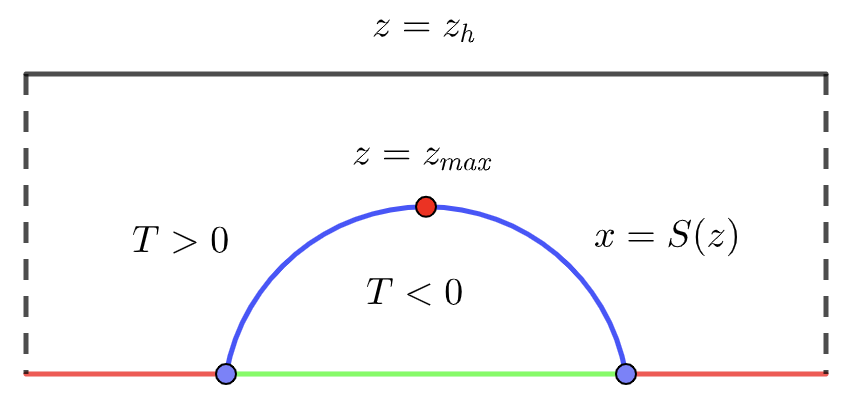
Figure 1: Gravity dual of parallel spherical defects with EOW brane and identification of regions for T<0 and T>0.
The width L between the defects decreases monotonically as the brane tension z2ds2=h(z)dz2+h(z)dx2+R2dΩd−120 increases, with the requirement z2ds2=h(z)dz2+h(z)dx2+R2dΩd−121 imposing an upper bound on z2ds2=h(z)dz2+h(z)dx2+R2dΩd−122.
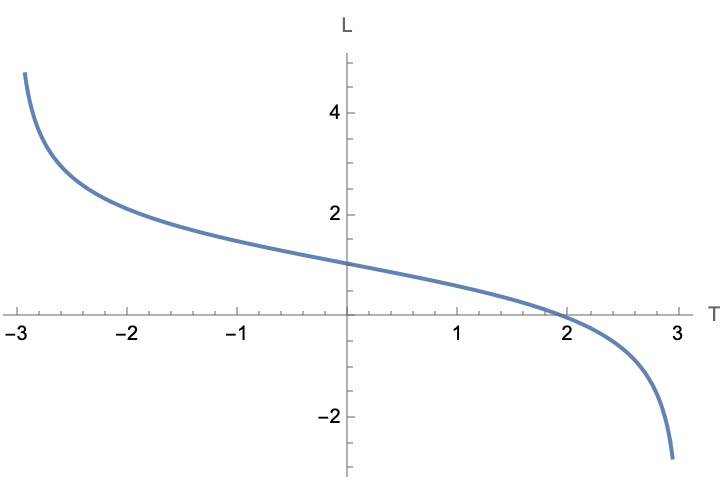
Figure 2: Relation of defect width z2ds2=h(z)dz2+h(z)dx2+R2dΩd−123 with brane tension z2ds2=h(z)dz2+h(z)dx2+R2dΩd−124; z2ds2=h(z)dz2+h(z)dx2+R2dΩd−125 as z2ds2=h(z)dz2+h(z)dx2+R2dΩd−126, z2ds2=h(z)dz2+h(z)dx2+R2dΩd−127 at a finite z2ds2=h(z)dz2+h(z)dx2+R2dΩd−128.
For fixed z2ds2=h(z)dz2+h(z)dx2+R2dΩd−129 and h(z)=1+R2z2−c1zd.0, h(z)=1+R2z2−c1zd.1 attains a maximal value, indicating a fundamental limit to the AdS soliton dual description.
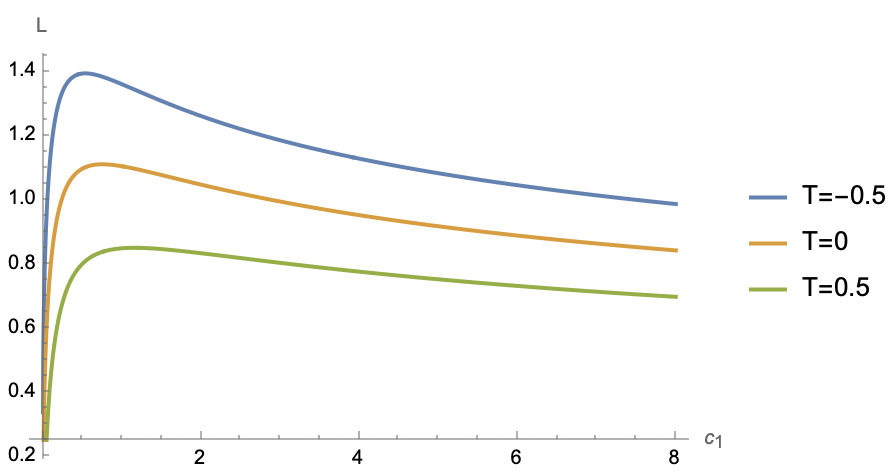
Figure 3: The defect width h(z)=1+R2z2−c1zd.2 has a maximum for fixed h(z)=1+R2z2−c1zd.3 and h(z)=1+R2z2−c1zd.4. Two distinct branches in h(z)=1+R2z2−c1zd.5 correspond to the same h(z)=1+R2z2−c1zd.6; physical branch chosen by free energy minimization.
Holographic Casimir Bound and Displacement Operator Ratio
A central result concerns the bound for the ratio h(z)=1+R2z2−c1zd.7, where h(z)=1+R2z2−c1zd.8 is the Casimir amplitude and h(z)=1+R2z2−c1zd.9 is the norm of the displacement operator. The ratio reflects the Casimir energy density per degree of freedom and is proposed to be bounded below by the AdS/BCFT with minimal brane tension c10. For the minimal tension limit, detailed scaling analyses yield an explicit parametric dependence of this ratio as a function of the defect width.
The ratio c11 monotonically decreases and asymptotes to zero as c12 increases; for short distances, it matches the value for parallel planarly symmetric defects. Notably, a nontrivial minimum is observed.
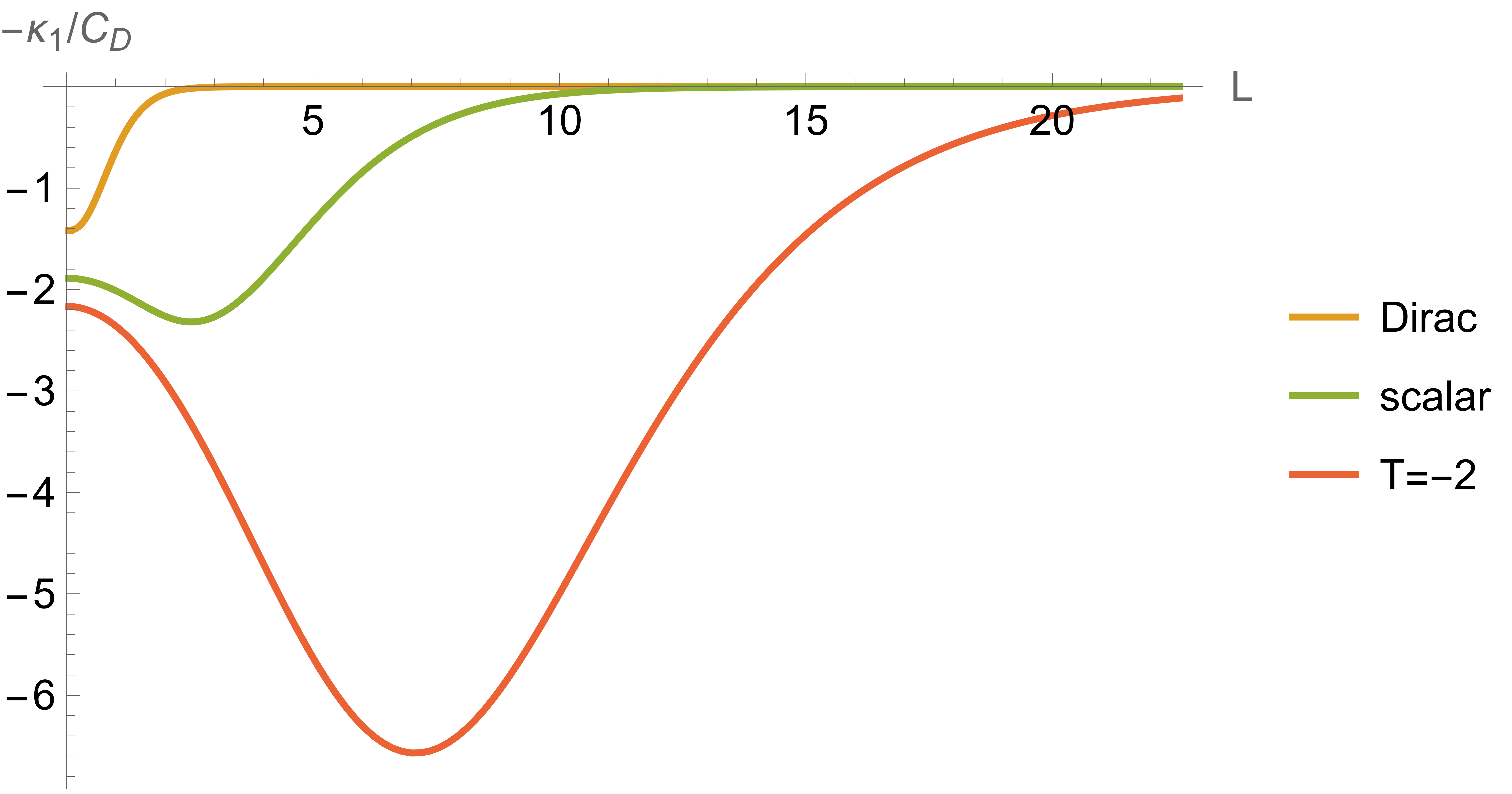
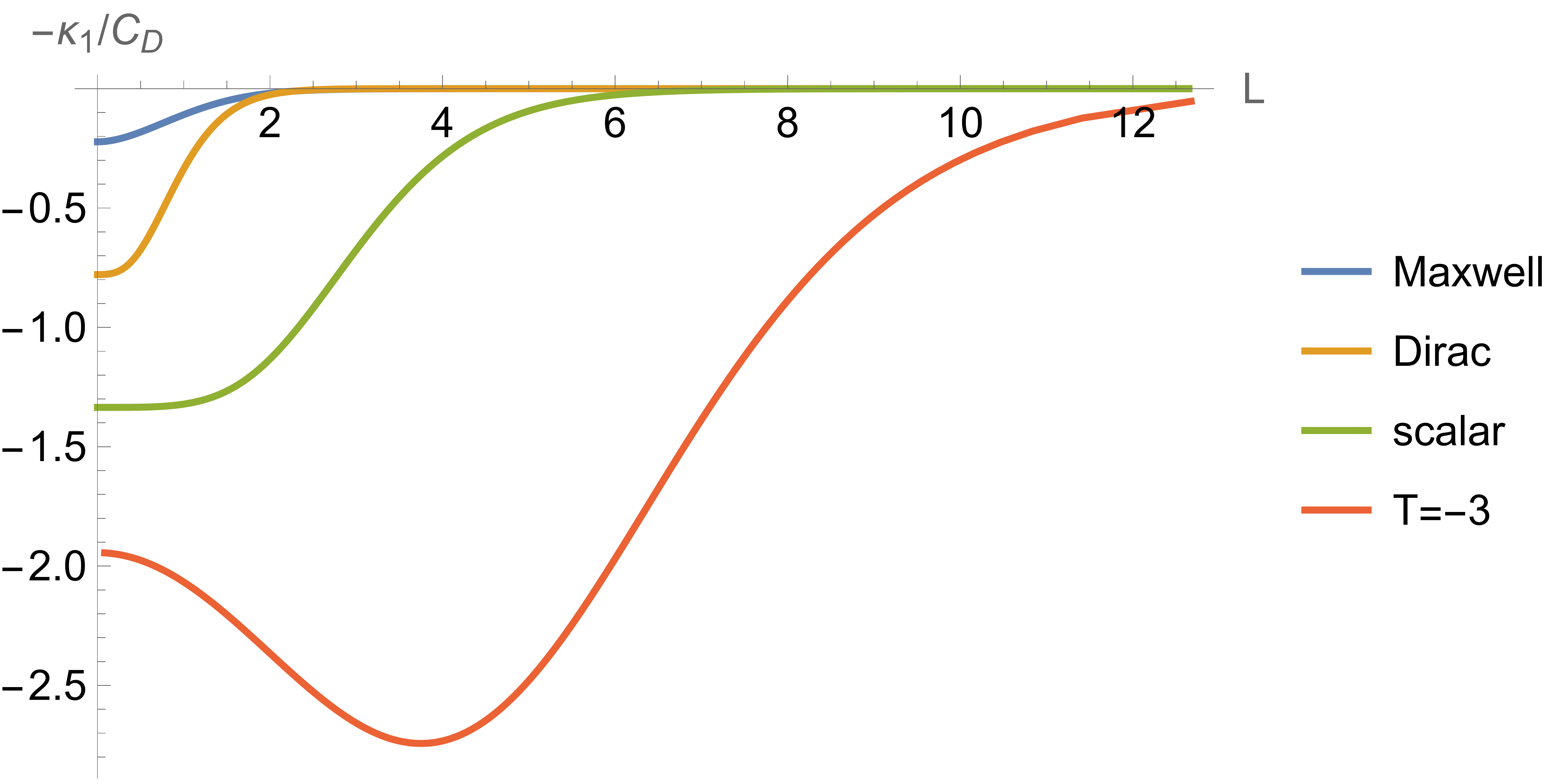
Figure 4: Ratio c13 for free theories and for the holographic model at minimal tension, confirming the holographic lower bound is not violated by free field realizations.
Holographic Phase Transition
A principal finding is the identification of a first-order phase transition in the Casimir effect for holographic spherical defects: as the defect separation c14 crosses a critical value c15, the gravitational dual transitions from the connected phase (AdS soliton with connected EOW brane) to a disconnected phase (AdS space with two disconnected EOW branes). In the latter, the Casimir effect vanishes identically.
The critical and maximum allowable widths as functions of brane tension parameter c16 are systematically quantified, and the free energy analysis confirms the first-order nature of the transition via non-analyticity in the Casimir energy.
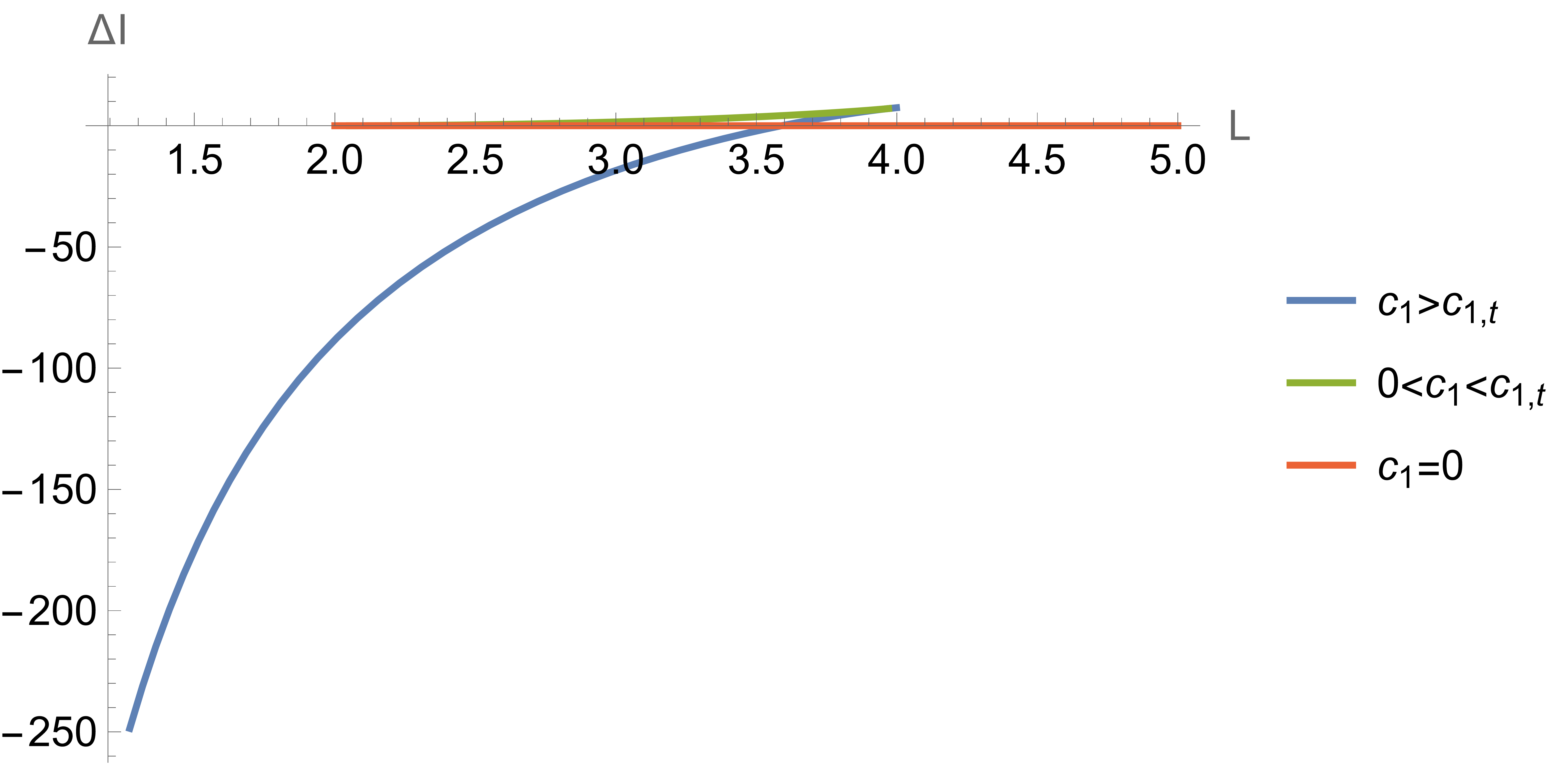
Figure 5: Action difference between connected and disconnected phases versus width c17—first-order phase transition at c18.
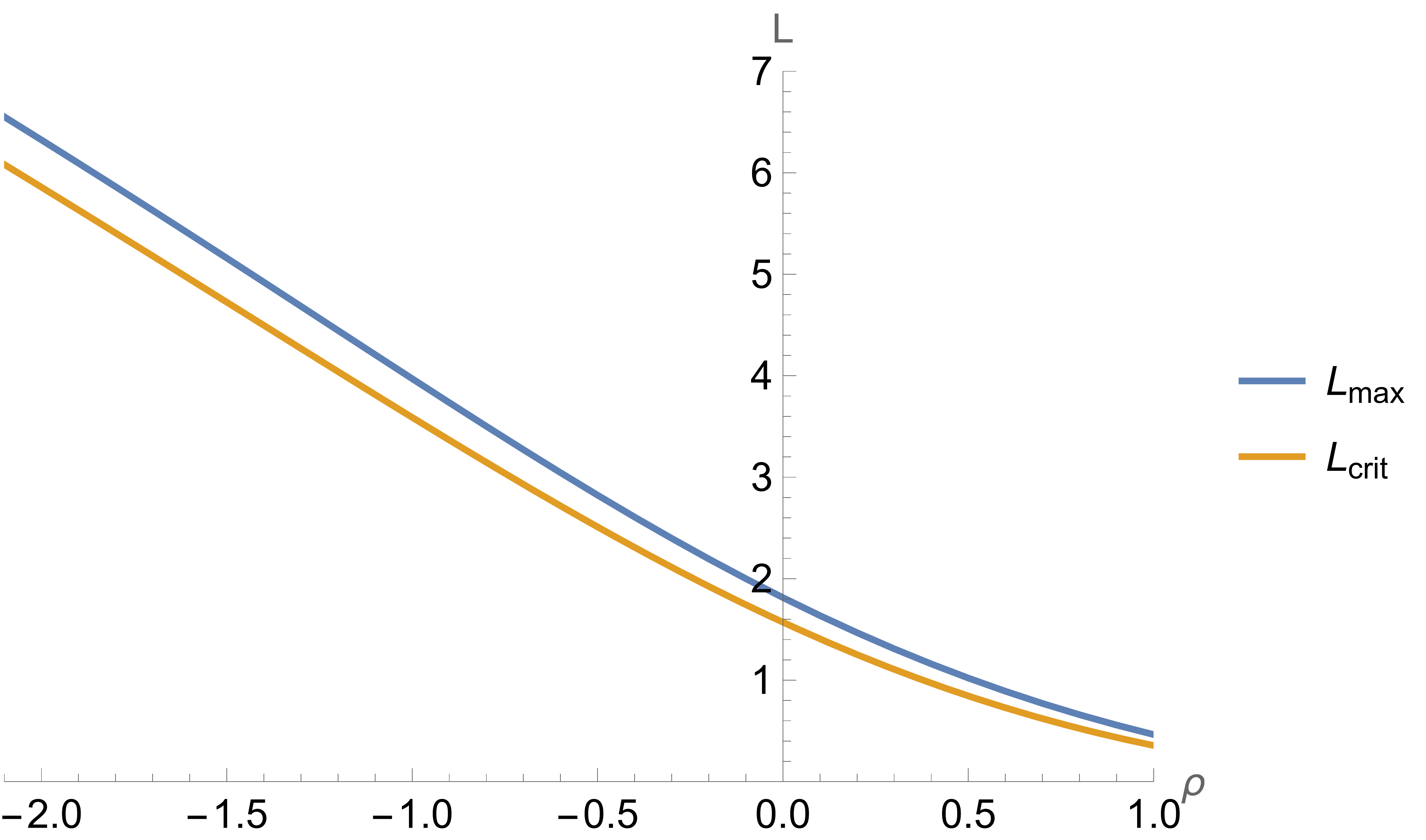
Figure 6: Maximum width for the connected phase decreases monotonically with increasing brane tension parameter c19.
This phase transition is absent for parallel plane and hyperbolic defects in the holographic setting, highlighting its geometric specificity.
Censorship Principles and Constraints on the Casimir Effect
The analysis demonstrates that cosmic censorship excludes any bulk solution with T=(d−1)tanhρ0, which would minimize the free energy but introduce naked singularities—prohibiting unboundedly negative Casimir energies and precluding repulsive Casimir forces under identical boundary conditions.
Topological censorship provides a holographic interpretation of boundary regularity and the identification subtleties of the AdS soliton. The necessary bulk periodicity resolves apparent discrepancies between boundary and bulk topology in these systems.
Comparison with Free Field Theories
By explicit calculation for free scalar, Maxwell, and free Dirac fields, the ratio T=(d−1)tanhρ1 is found to be smooth (no phase transition), always lying strictly above the holographic lower bound set by the minimal-tension AdS/BCFT dual. In free theories, the Casimir effect vanishes only as T=(d−1)tanhρ2, in contrast to the abrupt disappearance after the phase transition for strongly coupled holographic BCFTs. These results reinforce the universality of the holographic bound for the Casimir effect.
Implications and Future Directions
The established first-order phase transition in the holographic Casimir effect and the rigorous bound on normalized Casimir amplitudes illuminate qualitative distinctions between the behavior of free and strongly coupled quantum field theories in the presence of boundaries. The censorship principles enforce physical consistency in the dual gravity description and exclude otherwise problematic solutions.
Practical implications include new constraints for engineering systems where the Casimir effect is relevant and for the reliable application of holographic methods to BCFTs and interface systems in both condensed matter and high-energy contexts.
Theoretical extensions could address less symmetric geometries, finite temperature, or the entanglement entropy structure across the transition. Open questions include the determination of the holographic dual for the ball and precise criteria for the attraction-versus-repulsion Casimir force in nontrivial geometries, which may impact the ongoing debate in the field.
Conclusion
This work provides a comprehensive treatment of the holographic Casimir effect for parallel spherical defects, including the demonstration of a first-order phase transition, the establishment of a rigorous lower bound consistent with free field calculations, and a detailed elucidation of the role of censorship principles in the AdS/BCFT correspondence. The results deepen the understanding of boundary effects in strongly coupled field theories and open clear pathways for further investigation in holographic and non-holographic settings.

