- The paper demonstrates that Casimir energy induces quantum corrections that obstruct regular black-brane completions of non-supersymmetric 7-branes.
- It uses an axisymmetric dilaton-gravity ansatz with two massless scalars to numerically construct canonical solutions exhibiting non-flat asymptotics.
- The study highlights strict constraints on effective field theory IR completions in string theory, impacting traditional swampland and cobordism scenarios.
Casimir-Induced Obstructions in Non-Supersymmetric 7-Brane Black-Brane Completions
Introduction and Background
The study focuses on axisymmetric 7-brane configurations in ten-dimensional (10d) supergravity, specifically investigating the impact of the Casimir energy induced by nontrivial monodromies around the transverse circle. Codimension-two branes such as 7-branes exhibit non-localized backreaction, allowing monodromy effects—including duality transformations associated with symmetries like SL(2,Z) and various discrete group elements—to influence the geometry at infinity.
Theoretical motivation is provided by developments surrounding the cobordism conjecture, which asserts that gauge or duality holonomies around compactifications are detected by the existence of appropriate brane defects. Notably, for non-supersymmetric compactifications, the Casimir energy yields a quantum correction to the low-energy supergravity action, significantly modifying the geometry near and far from the brane.
Reduction and Ansatz for the 7-Brane System
Ignoring all nontrivial gauge-field backgrounds (the configurations relevant for non-supersymmetric 7-branes of interest), the system reduces, after dimensional reduction, to three-dimensional Einstein gravity coupled to two massless scalar fields—dilaton ϕ and an additional scalar σ, capturing the circle volume modulus and monodromy-dependent structure. The axisymmetric metric ansatz for the three-dimensional (transverse) space takes the form
ds2=−A(z)2dt2+dz2+R(z)2dφ2 ,
with all fields being z-dependent only. Casimir effects are introduced via a negative vacuum energy density VCasimir(L), where L(z) is the proper radius of the circle in the Einstein frame. The explicit form of the Casimir energy, extracted in ten dimensions for relevant field contents and monodromies, takes the characteristic structure VCasimir∼±L−10.
Analytical Solutions Without Casimir Energy
In the absence of Casimir energy, the coupled equations of motion are exactly solvable. The general solution for the relevant fields is:
- A(z)=a0(z−z0)γ
- R(z)=r0(z−z0)1−γ
- ϕ0, ϕ1 run logarithmically, with amplitudes set by integration constants and an angle ϕ2 parameterizing the direction in the ϕ3 scalar space.
The parameter ϕ4 governs the conical deficit at infinity; ϕ5 yields locally flat geometry (potentially with a deficit angle), while ϕ6 describes solutions with a naked singularity at finite distance.
Key result: Such solutions, supported only by classical sources, provide locally flat asymptotic regions but always contain a naked singularity at finite ϕ7. They are applicable to supersymmetric branes or branes whose monodromy does not induce nontrivial Casimir energy, such as type II ϕ8 reflection 7-branes and heterotic 7-branes with periodic spin structures.
Casimir Backreaction and the Search for Black-Brane Cores
For non-supersymmetric monodromies (e.g., antiperiodic spin structures), the Casimir energy cannot be neglected. The resulting system includes the Casimir-induced potential in the equations of motion, leading to non-analytic, nontrivial differential equations. The analysis focuses on whether the previously naked singularity can be cloaked by a regular, finite-horizon black-brane solution compatible with asymptotically locally flat behavior.
The scaling symmetries of the equations enable reduction to a canonical form, allowing the numerical construction of a universal "canonical" black-brane solution subject to regular horizon conditions.
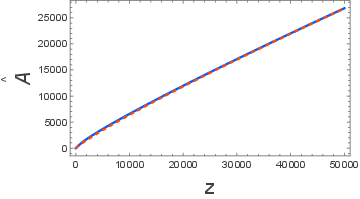
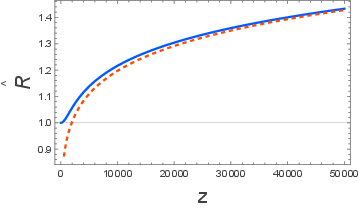
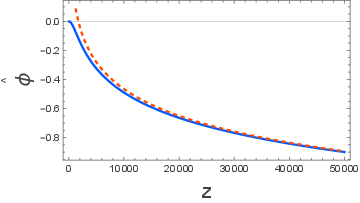
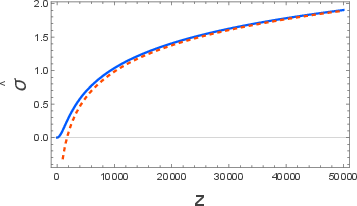
Figure 1: Canonical solutions for ϕ9, σ0, σ1, and σ2 (blue solid); red dashed denotes solutions without Casimir contribution, showing far-region matching.
The numerical solution demonstrates that regular black-brane geometries with Casimir backreaction asymptote not to σ3 solutions but to non-flat classical branches with fixed nonzero logarithmic running for the scalars. The far-region exponents σ4, determined by large σ5 behavior, are universal for all regular black-brane completions with finite horizons. For the heterotic 7-brane with antiperiodic spin structure:
σ6
Strong claim: Within the axisymmetric, two-scalar dilaton-gravity ansatz and with trivial gauge/axion backgrounds, Casimir backreaction obstructs the existence of asymptotically locally flat black-brane completions of the naked 7-brane solution.
String Theory Applications
Type II σ7 Reflection 7-Branes
Type IIB (and by T-duality, IIA) 7-branes with reflection (σ8) monodromy correspond to nontrivial elements in the duality group σ9. For periodic spin structures, the supergravity degrees of freedom are paired bosonically and fermionically, resulting in a cancellation of the Casimir energy:
ds2=−A(z)2dt2+dz2+R(z)2dφ2 ,0
Thus, the axisymmetric solutions are as in the Casimir-free case, with the only obstruction to regularity being the naked singularity in the core.
Non-Supersymmetric Heterotic 7-Branes
For exotic heterotic 7-branes related to outer-automorphism monodromies (as in ds2=−A(z)2dt2+dz2+R(z)2dφ2 ,1), the monodromy splits physical fields into sectors with periodic and antiperiodic boundary conditions, such that the gauge sector's Casimir contributions cancel, but the supergravity multiplet yields a nonvanishing Casimir energy for the antiperiodic spin structure:
ds2=−A(z)2dt2+dz2+R(z)2dφ2 ,2
with explicit positive ds2=−A(z)2dt2+dz2+R(z)2dφ2 ,3 determined by the field content.
For these non-supersymmetric branes, the analysis and numerics above apply directly. The universal exponents set by the canonical solution show that the black-brane completions always develop scalar logarithmic runnings incompatible with locally flat asymptotics.
Discussion and Implications
The principal implication is the rigidity of the Casimir-induced obstruction: the removal of a singular 7-brane core via a regular finite-horizon black-brane solution is inconsistent with approaching a locally flat asymptotic geometry when the Casimir energy is present. For non-supersymmetric 7-branes, this signals a strong constraint on the allowed infra-red completions in effective field theory and string theory.
Potential loopholes include:
- Relaxing the axisymmetric or trivial-gauge ansatz to more general field configurations
- Permitting horizons at infinite proper distance (e.g., scaling or running throat geometries), though the analysis suggests simple AdS-like throats are not allowed by the dynamics
The result is especially relevant for the landscape/swampland program, indicating that cobordism-induced branes associated with nontrivial monodromies may either be singular or must admit more exotic (possibly stringy or nonperturbative) resolutions not capturable in minimal supergravity.
Conclusion
The analysis establishes, in a controlled and technically precise fashion, that the Casimir backreaction due to non-supersymmetric monodromy presents an obstruction to constructing asymptotically locally flat, regular black-brane completions of axisymmetric 7-brane solutions in 10d supergravity. This result applies to a broad class of non-supersymmetric branes predicted by cobordism considerations, clarifying the role of quantum backreaction in the effective field theory of defects in string compactifications. Future developments may involve relaxing the symmetry or including nontrivial gauge and axion profiles, as well as classifying and exploring the physical significance of possible infinite-distance horizon completions.

