Thermal Casimir Effect in A Schwarzschild-like Wormhole Spacetime
Published 26 May 2026 in hep-th, gr-qc, and quant-ph | (2605.26743v1)
Abstract: We study the finite-temperature Casimir effect for a massless scalar field confined between two parallel plates in a Schwarzschild-like wormhole spacetime. Imposing Dirichlet boundary conditions, we compute the renormalized Casimir free energy in the comoving frame. We find that the thermal correction to the renormalized Casimir free energy decreases gradually with the temperature and becomes independent of the background geometry in this frame. Thermodynamic quantities derived from the Casimir free energy, namely, the renormalized Casimir entropy, internal energy, and heat capacity at constant volume, exhibit distinct temperature dependence. At low temperatures, all thermodynamic quantities recover the expected behavior, consistent with the fundamental laws of thermodynamics. These results provide a compact framework for analyzing quantum vacuum forces in gravitational backgrounds.
The paper's main finding is that thermal corrections to the Casimir free energy are independent of the wormhole geometry when computed in the comoving frame.
It employs Matsubara formalism and zeta function regularization to quantify temperature effects, distinguishing boundary from bulk contributions.
Numerical results reveal clear thermodynamic behavior such as increasing entropy and internal energy with temperature, consistent with the Nernst theorem.
Thermal Casimir Effect for Scalar Fields in Schwarzschild-like Wormhole Spacetimes
Introduction and Motivation
The paper "Thermal Casimir Effect in A Schwarzschild-like Wormhole Spacetime" (2605.26743) analyzes the finite-temperature Casimir effect for a massless scalar field confined between two parallel plates orbiting a static, zero-tidal Schwarzschild-like wormhole. The Casimir effect, traditionally manifested as a vacuum-induced force between conducting plates, is extended to curved spacetime backgrounds and scalar fields under Dirichlet boundary conditions. Here, the interest lies in understanding how gravitational backgrounds—specifically traversable wormholes—impact quantum vacuum fluctuation phenomena, and how thermal effects modify these results.
Of particular theoretical relevance are scenarios where Casimir-induced negative energy helps support traversable wormhole geometries by violating local energy conditions, thus providing exotic matter. The finite-temperature regime is crucial, as thermal fluctuations often rival or even dominate zero-temperature Casimir contributions, potentially yielding significant differences in strong-field contexts.
Model Formulation and Reference Frames
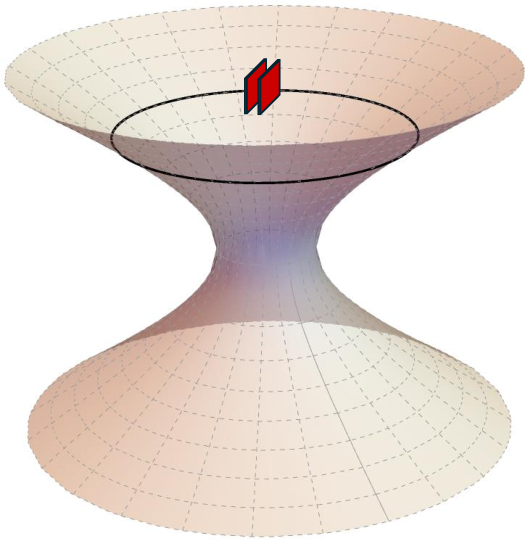
The system involves massless scalar fields confined in a cavity between two plates (separation L, plate area S) in orbit around the wormhole throat, with the Schwarzschild-like wormhole described by a metric of the form:
ds2=dt2−(1−γ)(1−rr0)dr2−r2dθ2−r2sin2θdϕ2
where r0 denotes the throat radius, and 0<γ<1 characterizes the wormhole's shape function. A transformation to isotropic coordinates permits defining the comoving frame (locally Minkowskian), enabling calculation of vacuum energies with boundary conditions enforced on the parallel plates’ surfaces.
Figure 1: Casimir cavity orbiting around a Schwarzschild-like wormhole.
Scalar Field Quantization and Casimir Energy Density
The field dynamics are governed by the massless Klein-Gordon equation in the locally comoving (tetrad) frame, subject to Dirichlet boundary conditions on both plates. Solutions are expanded in discrete eigenmodes with quantized kz=nπ/L and continuous planar momenta, yielding eigen-frequencies:
ωn2=k⊥2+(Lnπ)2
The vacuum energy density, derived from the time-time component of the energy-momentum tensor and normalized in the comoving frame, results (post renormalization) in:
εˉCas(0)=1−r2Ω2F(r)2⋅εCas(0)
where εCas(0)=−1440L4π2 is the flat-space Casimir density, F(r) is the conformal factor from the metric, S0 the orbital angular velocity, and S1 the orbital radius. The reduction relative to Minkowski space signals gravitational suppression.
Thermal Corrections: Formalism and Numerical Behavior
Analysis of finite-temperature corrections employs Matsubara formalism. The free energy at temperature S2 receives a correction:
S3
with S4. Series expansion and integration techniques (summation over Matsubara modes, hyperbolic functions, zeta function regularization) ensure proper renormalization, leading to a thermodynamic framework where divergent terms—especially high-temperature bulk contributions—are systematically subtracted.
A crucial result emerges: after such renormalization, thermal corrections to the Casimir free energy depend on temperature and plate separation only, not on the background spacetime geometry, provided calculations are made in the locally comoving (flat-equivalent) frame. This claim stands in contrast to the raw (unrenormalized) expressions, which include geometric factors.
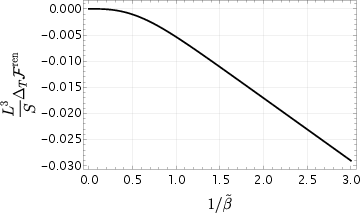
Figure 2: Plot of S5 versus the dimensionless parameter S6 quantifying finite-temperature corrections.
The numerical plots show that thermal corrections decrease as temperature increases (S7 grows), and exhibit distinct regimes depending on the dominance of terms proportional to S8 or S9, tracking boundary and bulk (blackbody) thermal effects.
Thermodynamic Quantities and Low-Temperature Regime
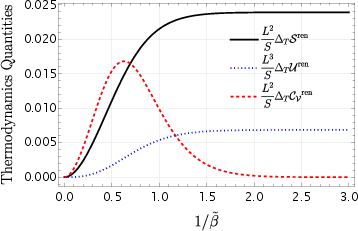
Derived quantities—Casimir entropy, internal energy, and heat capacity at constant volume—inherit their temperature dependencies from the thermal correction term. The entropy and internal energy show monotonic increases with temperature, saturating at high values, while heat capacity displays a peak before decaying to zero as temperature rises, consistent with thermodynamic laws.
Figure 3: Behavior of thermal correction to entropy (black-solid), internal energy (blue-dotted), and heat capacity (red-dashed) as functions of ds2=dt2−(1−γ)(1−rr0)dr2−r2dθ2−r2sin2θdϕ20.
In the low-temperature limit (ds2=dt2−(1−γ)(1−rr0)dr2−r2dθ2−r2sin2θdϕ21), exponentially suppressed terms emerge alongside leading power-law contributions (ds2=dt2−(1−γ)(1−rr0)dr2−r2dθ2−r2sin2θdϕ22, ds2=dt2−(1−γ)(1−rr0)dr2−r2dθ2−r2sin2θdϕ23), corresponding to boundary and bulk modifications, respectively. The entropy vanishes as ds2=dt2−(1−γ)(1−rr0)dr2−r2dθ2−r2sin2θdϕ24, with internal energy approaching the zero-temperature Casimir value—consistent with the Nernst theorem.
Implications and Future Directions
The results show that, after consistent regularization and renormalization, the background spacetime (wormhole) geometry does not explicitly affect thermal Casimir corrections in the comoving frame. This has both practical and theoretical implications: it simplifies the analysis of Casimir effects for moving apparatuses in curved backgrounds, provided local frames are used, and clarifies the role of quantum vacuum energy in exotic spacetimes.
Potential extensions include exploring boundary conditions beyond Dirichlet, massive fields, non-circular motion, and effects of background electromagnetic fields on Casimir apparatus properties. The findings could be relevant for evaluating energy conditions in traversable wormhole support, stability under thermal perturbations, and regimes where global geometric effects or strong curvature modify quantum vacuum thermodynamics.
Conclusion
This paper provides an analytic and numerical analysis for the thermal Casimir effect in a Schwarzschild-like wormhole spacetime, employing rigorous regularization and renormalization in the comoving frame. Key results include the geometric independence of thermal corrections for the renormalized Casimir free energy, and well-characterized thermodynamic behaviors across temperature regimes. These outcomes reinforce the utility of comoving local frames for Casimir analysis in strong-field and exotic geometries, and portend fruitful avenues for further study in quantum gravity and astrophysical contexts.
“Emergent Mind helps me see which AI papers have caught fire online.”
Philip
Creator, AI Explained on YouTube
Sign up for free to explore the frontiers of research
Discover trending papers, chat with arXiv, and track the latest research shaping the future of science and technology.Discover trending papers, chat with arXiv, and more.