- The paper introduces the SPRINT framework, optimizing Trotter product formulas for simulating electronic structure Hamiltonians.
- It leverages GRADE factorization, near-integrable formulas, and symmetry protection to significantly reduce Toffoli counts and qubit overhead.
- Empirical results demonstrate up to 4.5x fewer Toffoli gates and 5.5x fewer qubits, making Trotter-based simulation competitive with qubitization.
Introduction and Motivation
The simulation of quantum dynamics is a central application for quantum computing, particularly in quantum chemistry and materials science where electronic structure Hamiltonians pose significant challenges for classical methods. Historically, two paradigms dominate quantum simulation algorithms: Trotter product formulas and qubitization-based LCU (Linear Combination of Unitaries) techniques. While the former is noted for minimal qubit overhead and algorithmic simplicity, it is often dismissed for fault-tolerant computation due to pessimistic gate complexity assessments and a lack of effective, tight error estimation methods. The paper "Theory and practice of Trotter product formulas for quantum chemistry" (2606.30741) systematically challenges this narrative by introducing an advanced framework—SPRINT (Symmetry-Protected Randomized near-Integrable Trotter)—which integrates sophisticated product formula design, error analysis, Hamiltonian factorization, and compilation strategies to make Trotter-based simulation competitive with, and in some regimes preferable to, qubitization.
SPRINT Framework: Algorithmic Innovations
At the core of the method is the SPRINT framework, an integrated methodology that optimizes Trotter product formula simulation for electronic structure Hamiltonians. SPRINT entails several algorithmic innovations:
- Generalized Rank Decomposition (GRADE): This unifies and extends prior rank-reduction schemes such as Compressed Double Factorization (CDF) and isometric Tensor Hypercontraction (THC), producing a hierarchy of Hamiltonian fragments with rapidly decaying norms.
- Near-Integrable Product Formulas: By leveraging the strong norm hierarchy revealed by GRADE, SPRINT applies high-order product formulas selectively to large-norm fragments and low-order formulas to small-norm, abundant fragments. This targeted approach dramatically reduces the leading-order Trotter error at negligible additional cost.
- Randomization and Processing: Random permutation of fragment orderings averages out certain error terms, while processing (conjugation by a carefully chosen unitary) suppresses leading error contributions in the Baker-Campbell-Hausdorff (BCH) expansion.
- Symmetry Protection: For Hamiltonian factorizations involving auxiliary orbitals (Mℓ>N), symmetry-protected steps suppress leakage errors—terms that couple the physical and auxiliary subspaces—to the same order as the intrinsic Trotter error.
- QROM-Based Compilation: Quantum Read-Only Memory (QROM) compilation batches costly diagonal rotations, yielding significant reductions in Toffoli counts for implementing fast-forwardable Hamiltonian fragments.
A schematic of the SPRINT product formula, which shows the combination and ordering of these elements, is presented below.
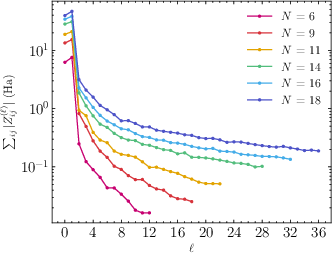
Figure 2: Frobenius norm of the Hamiltonian fragments in the CDF decomposition for Li4Mn2O, illustrating hierarchical decay essential for near-integrable product formulas.
Hamiltonian Factorization: GRADE and Error Structure
A major technical advance in the work is the design and application of the GRADE factorization procedure. GRADE interpolates between CDF and isometric THC, resulting in a decomposition that exposes a norm hierarchy across fragments, which is crucial for error-efficient simulation strategies.
Empirical findings demonstrate that while GRADE reduces per-step gate cost (by reducing the number of orbitals per fragment), it can introduce significant "leakage error"—the tendency for the wavefunction to escape into auxiliary orbital subspaces introduced by factorization. This error is addressed by symmetry protection, implemented as conjugation by projectors onto the physical subspace, which converts the leakage into an error term that scales with the square of the Trotter step, aligning control of leakage with control of standard Trotter error.
The effectiveness of this hierarchical partitioning and the associated error scaling are visualized below.
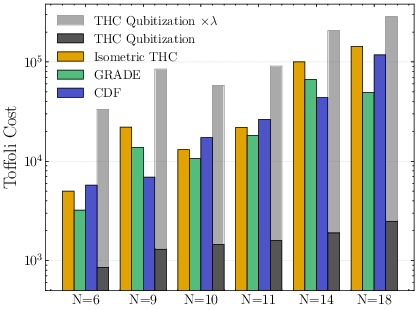
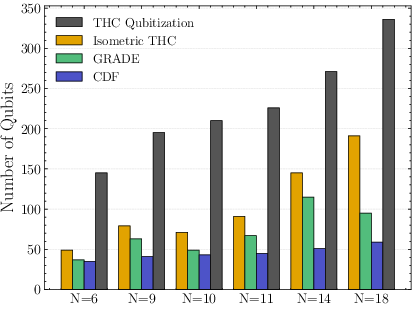
Figure 4: Toffoli gate and qubit cost per first-order Trotter step for various Hamiltonian factorizations of Li4Mn2O at 1 eV target peak shift, showing the tradeoff curves between GRADE, CDF, and THC.
Trotter Error Estimation and Optimization
The paper establishes a best-practices methodology for selecting product formula parameters via explicit estimation (rather than conservative bounds) of Trotter error. It utilizes perturbative estimates based on the action of leading-order BCH commutator terms on low-energy eigenstates, with all computations of effective Trotter error performed numerically for the actual problem Hamiltonian, using DMRG and MPS/MPO machinery.
A key claim, substantiated by numerical evidence and tight error modeling, is that with SPRINT, Trotter formulas can be made competitive with qubitization-based methods in Toffoli count, while maintaining a drastic reduction in logical qubit requirements.
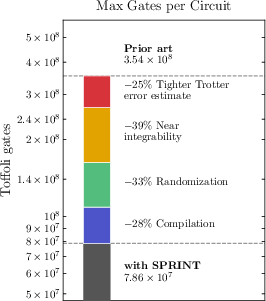
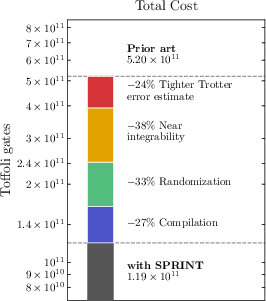
Figure 5: Reduction in total Toffoli gate count for X-ray absorption spectroscopy on Li4Mn2O using SPRINT versus previous state of the art, showing contributing sources of improvement (near-integrability, randomization, QROM).
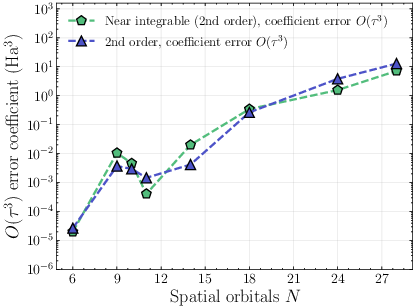
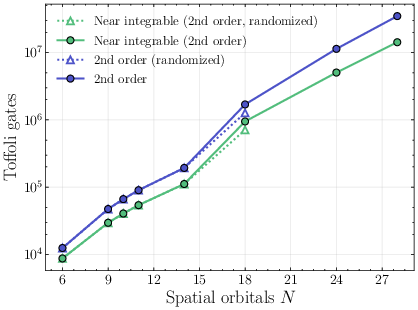
Figure 1: Magnitude of leading-order Trotter error coefficients for the second-order (Strang) and second-order near-integrable formula V2,1, demonstrating effective error suppression for tailored product formula design.
Numerical Results: Resource Savings for Spectroscopy
The practical impact of the SPRINT framework is best demonstrated on the paradigmatic problem of simulating X-ray absorption spectra for a Li-excess cluster, Li4Mn2O:
- Toffoli Gate Reductions: On the cluster with 40 active orbitals, SPRINT achieves a 41 reduction in total Toffoli count compared to prior leading Trotter-based approaches, and the final product is only 42 higher than qubitization while using 5.5-fold fewer qubits.
- QuBit Requirements: The qubit overheads of Trotter-based simulation scale much more gently than in qubitization frameworks; for the demonstrated problem, SPRINT needs 43 times fewer qubits, which is pivotal for near-term fault-tolerant hardware.
- Dominant Cost Contributors: Near-integrability yields up to a 1.6x reduction, randomization a 1.5x reduction, and QROM-based compilation a 1.4x reduction in gate cost.
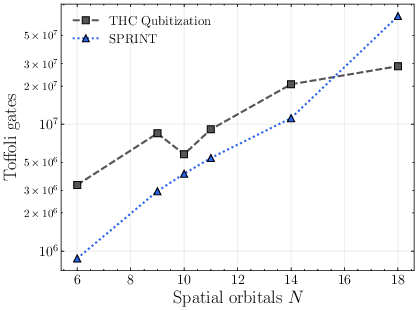
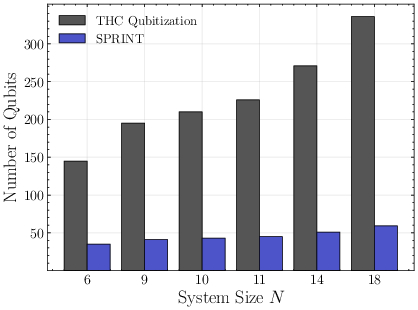
Figure 8: Toffoli gate and qubit cost comparison for SPRINT (randomized near-integrable formula plus CDF) vs. qubitization for the X-ray absorption simulation of Li44Mn45O; SPRINT achieves similar Toffoli complexity with far fewer qubits.
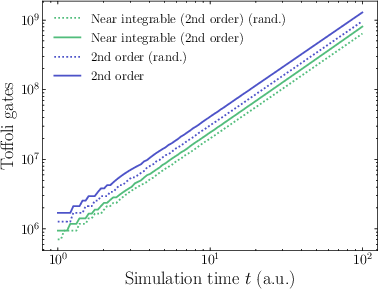
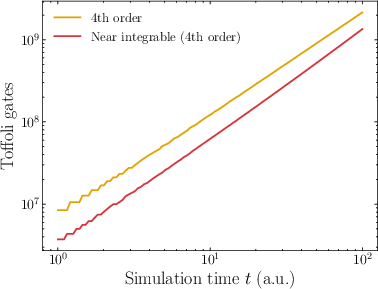
Figure 10: Toffoli gate cost comparison for second- and fourth-order near-integrable formulas versus standard Suzuki formulas as a function of evolution time, illustrating where various approaches become more cost-effective due to commutator error scaling dynamics.
Theoretical Implications and Potential Extensions
The results decisively demonstrate that with proper Hamiltonian partitioning, adaptive product formula selection, randomization, and symmetry-based mitigation of leakage, Trotterization can be transformed from a baseline algorithm to a highly competitive strategy for simulating correlated electronic Hamiltonians on fault-tolerant quantum architectures.
Theoretical implications include:
- Algorithmic Cross-Over: While LCU-based qubitization remains asymptotically optimal for large 46 due to 47 step cost, non-asymptotic scaling and practical hardware constraints mean Trotter-based SPRINT can outperform for smaller 48 or tight qubit budgets.
- Generalizability: The framework extends to a broader class of Hamiltonians provided a norm-hierarchical factorization can be achieved.
- Methodological Impact: The approach unifies advances from geometric integration, quantum compilation, randomization, and symmetry protection, and demonstrates the importance of tight numerical error estimation for Hamiltonian simulation resource analysis.
Conclusion
The work presents a comprehensive theoretical and practical reassessment of Trotter product formulas, revealing, via SPRINT, that sophisticated product formula design can yield quantum simulations of complex chemistry with resource requirements rivaling those of qubitization, but with much lower qubit overhead. The unified treatment of effective Hamiltonian construction, error estimation, leakage suppression, and Toffoli-efficient compilation sets new best practices for product-formula-based quantum simulation. Future research should further optimize these methodologies for other classes of Hamiltonians, explore the tradeoff surface between precision, circuit depth, and qubit overhead, and extend SPRINT to time-dependent and open-system scenarios in quantum simulation.

