- The paper presents a quantum simulation framework using PPP models for nanographenes, highlighting Trotter error cancellation to improve energy gap estimation.
- It employs second-order split-operator and tile Trotterization schemes with symmetry shifts to reduce circuit resource counts by 10–25%.
- Optimized error metrics enable significant reductions in quantum phase estimation resources, facilitating practical energy difference calculations.
Quantum Simulation of Nanographenes and Trotter Error Cancellation
Problem Motivation and Model Selection
Quantum simulation, particularly for molecular electronic structure, remains a computationally intensive task. The gap between existing classical approximations and quantum hardware requirements demands strategically chosen, scalable models for early fault-tolerant quantum algorithms. This paper identifies nanographene π-systems as chemically relevant, scalable benchmarks, focusing on Pariser–Parr–Pople (PPP) models that interpolate between the tractable Hubbard model and the classically prohibitive ab initio quantum chemistry.
The PPP model, featuring nearest-neighbor hopping and all-to-all Coulomb interaction, accurately captures optoelectronic and magnetic properties of nanographenes. Three structural classes—acenes, rhombenes, and triangulenes—span quasi-1D to 2D topologies and provide progressively more difficult DMRG targets.

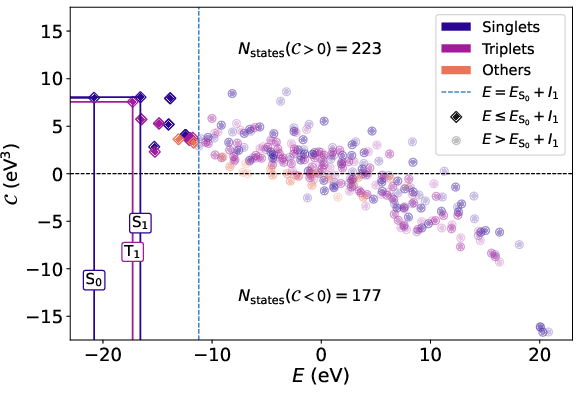
Figure 1: Illustration of low-lying electronic states (singlet, triplet) and structural classes of nanographenes (acenes, rhombenes, triangulenes), each scalable via hexagon count.
Hamiltonian Simulation and Trotterized Methods
Simulation protocols are centered on Trotterized unitary evolution, mainly second-order split-operator (SO) and tile Trotterization schemes. SO separation evolves kinetic and potential energy terms independently, while tile Trotterization partitions the kinetic energy operator for cost-effective diagonalization.
Resource overhead per Trotter step is dominated by potential energy term count, minimized via symmetry shifts that commute with the Hamiltonian and reduce the number of terms in the Pauli representation (10–25% reduction for typical systems).
Error Analysis: Worst-case, Average-case, Energy, and Gap
Four error metrics are evaluated:
- Worst-case error: Operator norm between exact and approximate unitary, computed using tight Monte Carlo spectral norm bounds on nested commutators ([blunt2025montecarloapproachbound]).
- Average-case error: Ensemble-averaged state vector deviations, estimated using normalized Frobenius norm sampling ([Zhao2022]).
- Energy error: Deviation in eigenvalues between true and effective Hamiltonians, quantified via tensor-network (TD-DMRG) based time-series analysis.
- Gap error: Deviation of energy differences between pairs of eigenstates, particularly between low-lying states.
Error constants for Trotterization were found to differ by several orders of magnitude (especially gap errors relative to worst-case), warranting application-specific error models rather than worst-case generalities.
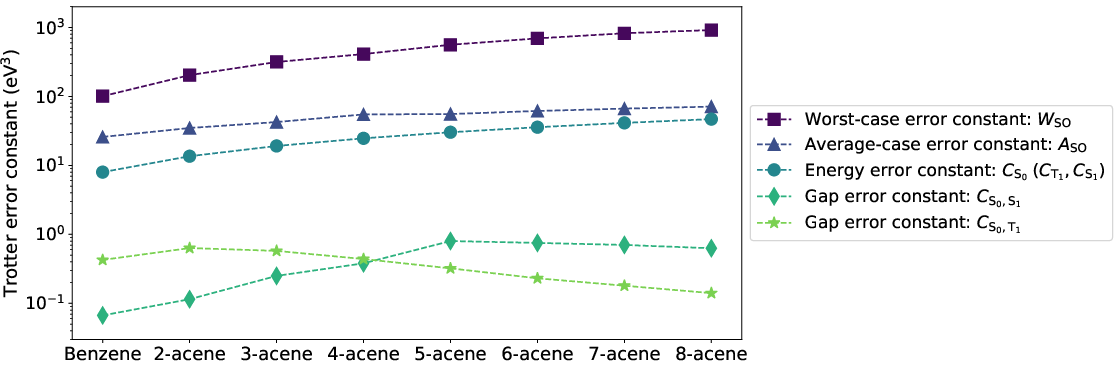
Figure 2: Comparative scaling of worst-case, average-case, energy, and gap error constants for acenes; gap error is significantly suppressed.
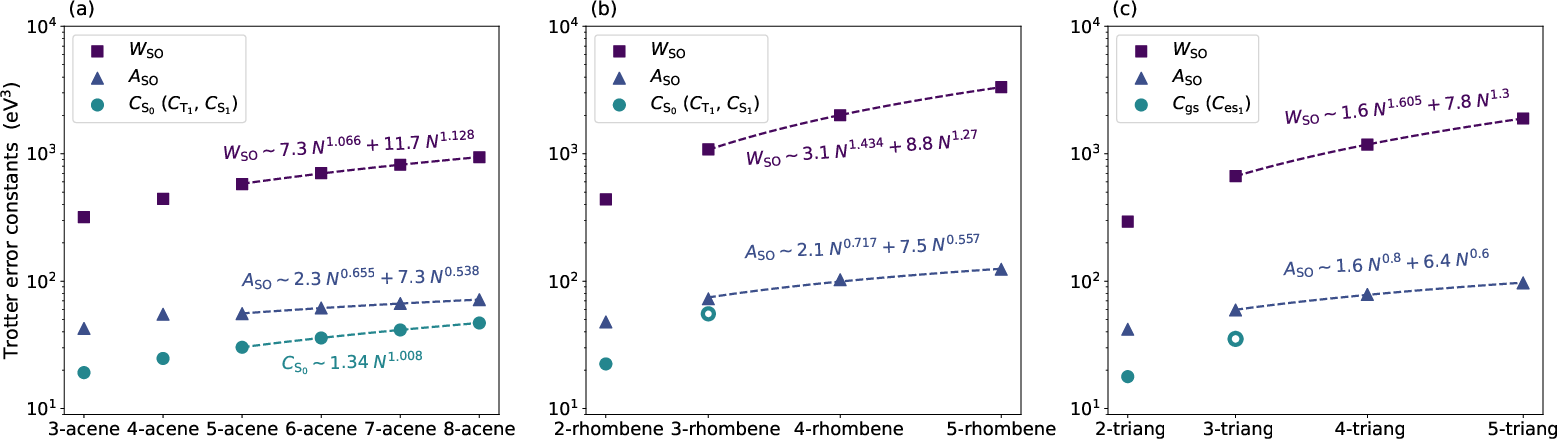
Figure 3: System size scaling of worst-case and average-case spectral and Frobenius norm error constants for commutators in nanographene PPP models.
Trotter Error Cancellation and Practical Simulation Implications
A principal finding is the Trotter error cancellation phenomenon: gap errors for energy differences (vertical excitation, singlet-triplet splitting, ground-excited state gaps) are much smaller than absolute energy errors. This enables circuit depths for quantum phase estimation (QPE) of energy differences to be reduced by an order of magnitude compared to absolute energy calculations.
Tensor-network spectral analysis confirms that for low-lying states (e.g., S0, T1, S1), cancellations arise from correlated error directions and magnitudes. This is not a universal feature for arbitrary states but prevalent for chemically relevant pairs. The phenomenon is robust across quasi-1D and small 2D nanographenes.
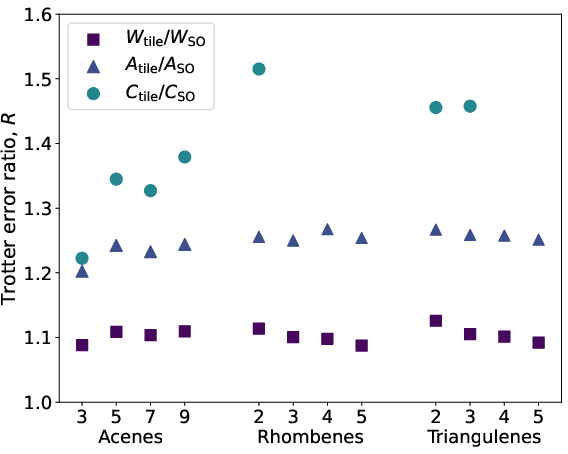
Figure 4: Error constant ratios for tile vs. SO Trotterization schemes; tile Trotterization incurs negligible additional error relative to cost benefits.
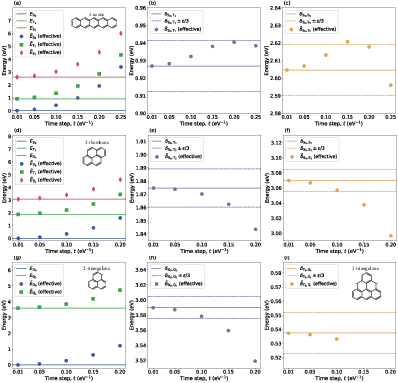
Figure 5: Exact vs. effective energies and energy gaps for multiple nanographene classes across Trotter step sizes; gap errors remain within chemical accuracy over a wide range of t.
Quantum Phase Estimation Resource Requirements
Resource estimates are presented using worst-case, average-case, energy, and gap error constants, as well as fixed Trotter step sizes justified by gap cancellation. Calculating energy gaps for large nanographenes (e.g., up to 140 spin orbitals) in PPP models can be achieved with fewer than 3.2×10⁷ Toffoli gates, aligning with estimates for the Fermi-Hubbard model and confirming suitability as early fault-tolerant quantum applications.
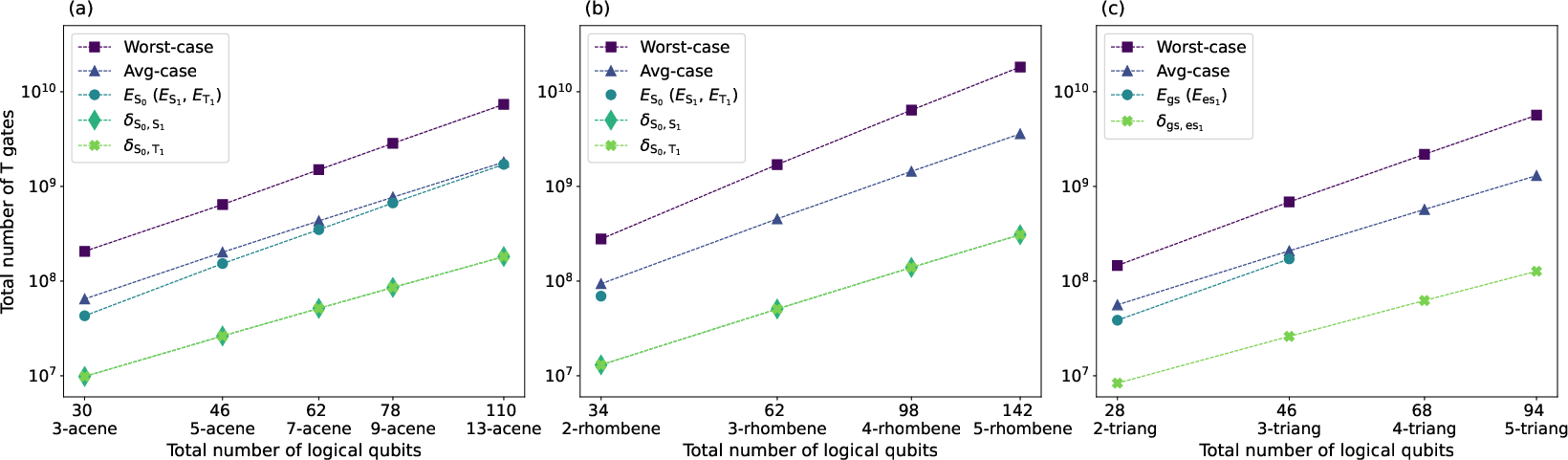
Figure 6: T gate and logical qubit estimates for nanographene QPE using differing Trotter error metrics; gap errors enable substantial resource reduction.
Hamming-weight phasing (HWP) further reduces Clifford+T gate counts at the expense of ancilla qubits, though circuit depth and parallelizability must be evaluated in hardware cost models.
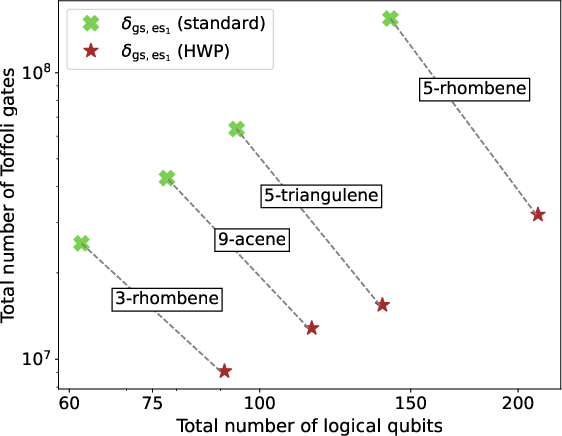
Figure 7: Toffoli gate and logical qubit counts for QPE with and without Hamming-weight phasing; non-Clifford counts decrease while ancillas increase.
Theoretical and Practical Implications
The analysis demonstrates that for realistic chemical targets, algorithmic resource costing should leverage application-focused error metrics. Trotter error cancellation offers a quantitative reduction pathway analogous to favorable error cancellation in classical approximations. QPE for energy differences—vertical excitations, spin gaps—offers a path to relevant, verifiable early-stage quantum simulation benchmarks.
Further reductions in circuit depth are conceivable via more efficient Clifford+T rotation synthesis ([Campbell2016]), statistical phase estimation ([Blunt2023, Wan2022, Lin2022]), and improved initial state preparation techniques ([Berry2025]).
Caveats include:
Conclusion
Quantum simulation of nanographene π-systems via Trotterized PPP Hamiltonians exemplifies a strategically chosen benchmark set, bridging early and large-scale fault-tolerant quantum computation. Application-specific Trotter error analysis, especially for energy gaps, unlocks substantial reductions in quantum resources relative to absolute energies, supporting robust practical and theoretical progress. Critical next directions include generalizing cancellation phenomena, extending error analysis to more chemically relevant differences (e.g., across geometries), and optimizing QPE circuits leveraging statistical estimation.