- The paper introduces a fault-tolerant quantum blueprint that combines photonic mobility and atomic coherence via cavity QED to achieve deterministic entanglement.
- The methodology employs high-fidelity SPAM and a symmetrized CZ gate with photon-loss as low as 1.6% per gate, ensuring rapid, reliable qubit operations.
- The approach supports scalable MBQC through RHG lattice-based error correction, enabling transversal Clifford gates and efficient magic state distillation for universal computation.
Compound Photon–Atom Quantum Architecture for Fault-Tolerant Quantum Computing
Introduction and Motivation
The synthesis of scalable hardware, unrestricted qubit connectivity, and practical error correction remains the critical challenge for realizing fault-tolerant quantum computing. This work introduces a blueprint for a compound quantum architecture leveraging both photonic and atomic degrees of freedom, using cavity QED for high-fidelity and near-deterministic photon–atom entangling operations. This approach targets the limitations of superconducting and ion-trap architectures—in particular, connectivity and scaling—by utilizing the mobility and long-range nature of photons, while atoms serve as reusable, high-coherence resources for photonic state generation and entanglement.
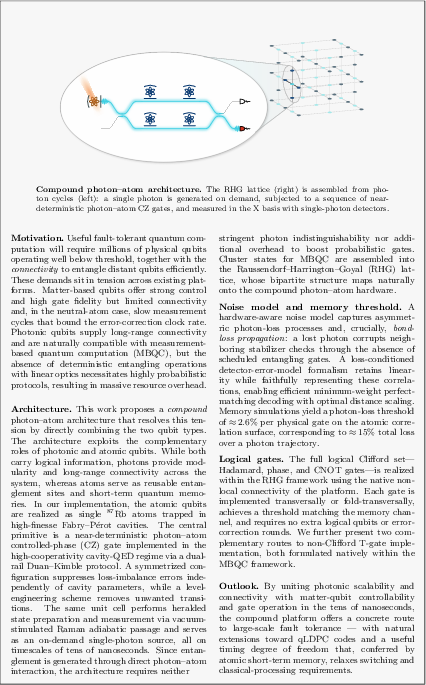
Figure 1: Overview of the compound photon--atom architecture with integrated unit cells, routing, and control for large-scale MBQC.
Physical Layer: Building Blocks and Protocols
Unit Cell Design
The foundational hardware primitive is a single 87Rb atom trapped in a high-finesse micro-cavity, establishing strong atom–photon coupling (g/2π∼360MHz) in the regime of high cooperativity (C∼100). Efficient atomic state preparation and measurement (SPAM), single-photon generation (via vSTIRAP), and photon–atom CZ gates are implemented on timescales of O(10ns), compatible with photon clock cycles and critical for throughput and error correction round times.
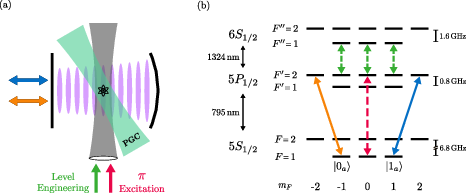
Figure 2: Detailed structure of the atom–cavity unit cell and the optical configuration for coherent protocols.
Atom–Photon CZ Gate
The architecture realizes the core two-qubit operation as a symmetrized Duan–Kimble CZ gate. The symmetric protocol equalizes reflection amplitudes and suppresses infidelity from loss imbalance and imperfect mode-matching. The measured photon-loss per gate is as low as 1.6%, translating to an efficiency η≈98.4% under realistic parameters. Notably, both photonic and atomic qubits are accessible to direct high-fidelity gates without the interference requirements or probabilistic overhead of linear-optics fusion schemes.
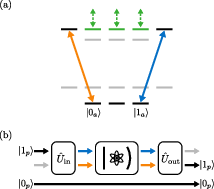
Figure 3: Photon–atom CZ gate using controlled coupling to polarized cavity modes and engineered level structure.
State Preparation, Measurement, and Single-Photon Generation
SPAM protocols leverage vSTIRAP for heralded qubit initialization and measurement with cavity-limited efficiencies exceeding 97%. Single-photon sources using the same physical platform deliver indistinguishability and mode purity unavailable in parametric-pair-based photon sources, sidestepping fundamental scaling limits of all-photonic approaches.
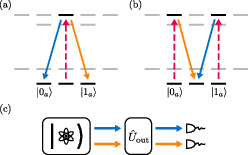
Figure 4: vSTIRAP-based atomic state preparation and atom-to-photon state transfer enabling SPAM.
Large-Scale Architecture and Cluster-State Generation
At the architectural level, the platform supports efficient generation of large-scale cluster states, which constitute the resource for MBQC. Routing networks, delay lines, and a classical control subsystem coordinate photonic paths and temporal scheduling. Two main cluster-state generation schemes are analyzed:
- Bipartite Scheme: Bulk photons undergo up to four CZ interactions; atoms are measured and recycled. This requires O(d2) active atoms for a code of distance d, but minimizes optical memory depth.
- Interleaved Scheme: The atomic resource overhead is reduced to O(d) at the cost of requiring delay lines of length g/2π∼360MHz0. This introduces increased photonic loss due to longer path lengths.
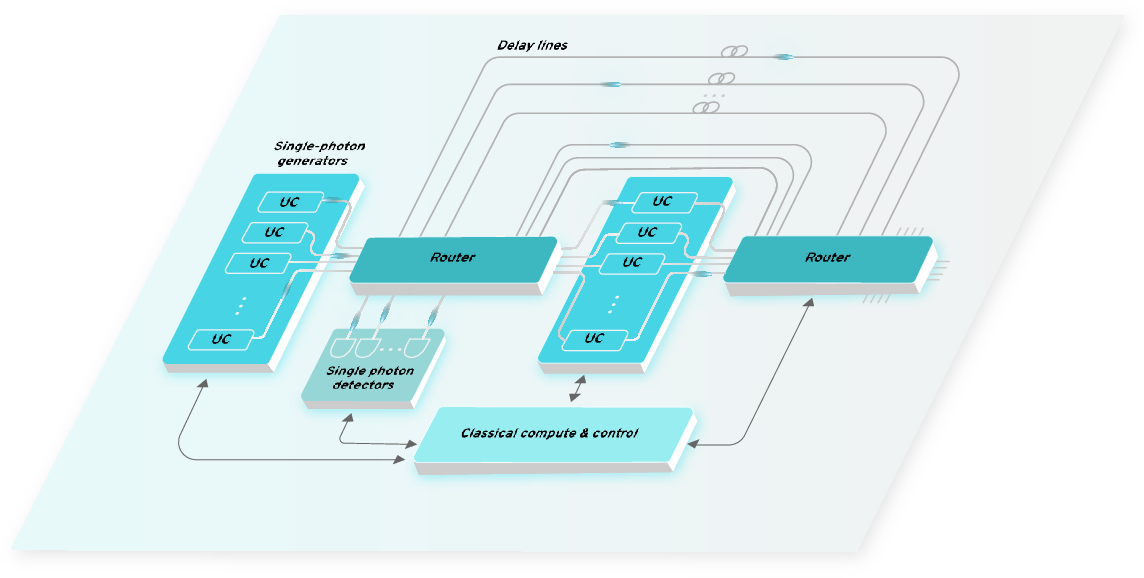
Figure 5: Overall hardware architecture for MBQC with unit cells, photonic and atomic resources, routing, and error correction.
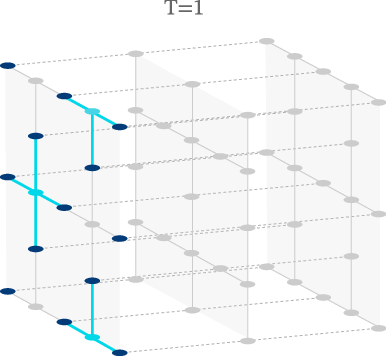
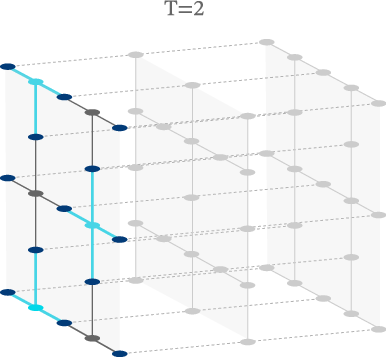
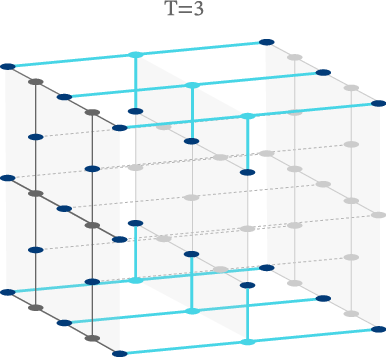
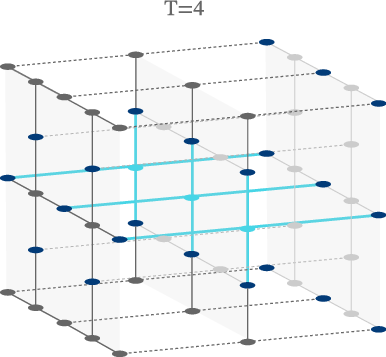
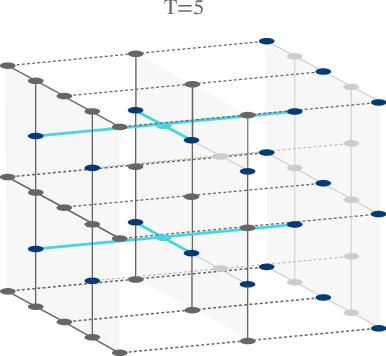
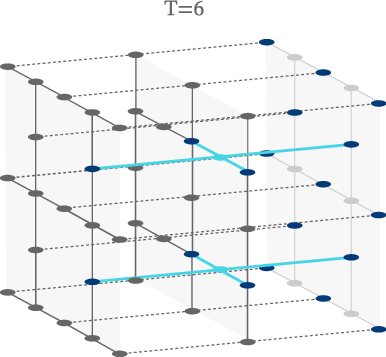
Figure 6: Sequential layer-by-layer generation of a topological cluster state in the bipartite scheme.
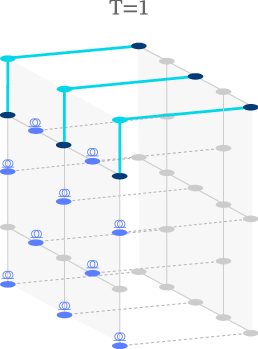
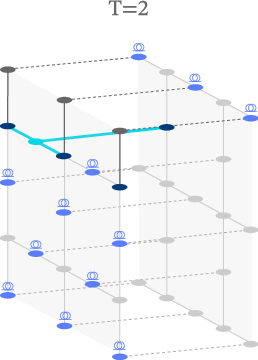
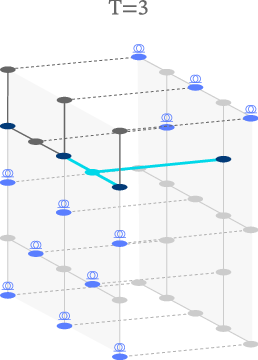
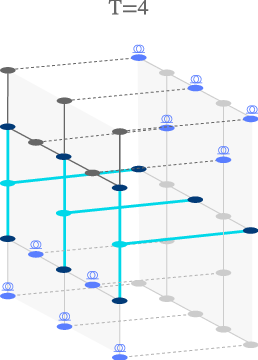
Figure 7: Interleaved scheme with dynamic memory/photon delay-management for low atomic overhead.
Fault Tolerance, Noise Model, and Logical Operations
RHG Lattice Implementation and Error Correction
The compound platform targets the RHG (Raussendorf–Harrington–Goyal) lattice for topological error correction, which combines high loss thresholds and low local connectivity. A key contribution of this work is a hardware-aware noise and loss model distinguishing atomic and photonic error mechanisms, and explicitly modeling bond-loss propagation, where lost photons induce correlated errors on neighboring atoms after failed interactions.
The circuit-level photon-loss threshold for logical memory in the architecture is found to be approximately g/2π∼360MHz1 per physical gate, corresponding to a total path loss tolerance of g/2π∼360MHz2—a figure set by the limiting surface of correlation surfaces supported on atomic qubits.
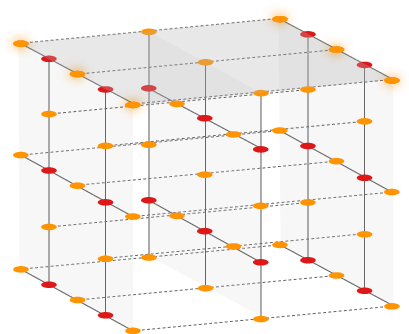
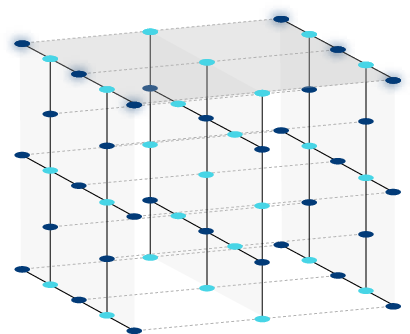
Figure 8: Schematic of RHG lattice with bipartitioned atomic and photonic qubits supporting logical encoding.
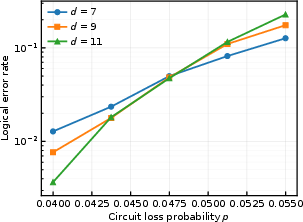
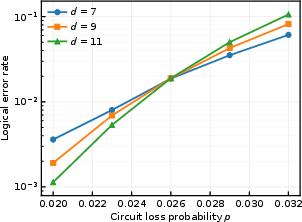
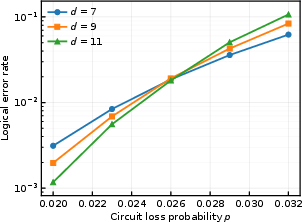
Figure 9: Simulated logical error rates (LER) for memory under circuit-level bond-loss-aware noise model on the RHG lattice.
Clifford Gates and Universal Computation
Logical Clifford gates (g/2π∼360MHz3, g/2π∼360MHz4, CNOT) are implemented transversally or fold-transversally in MBQC, leveraging the all-to-all connectivity of photonic routing. These gates do not degrade the loss threshold beyond the value for the identity channel as demonstrated by threshold simulations. The only cost is additional (but confined) CZ gates per gate layer.
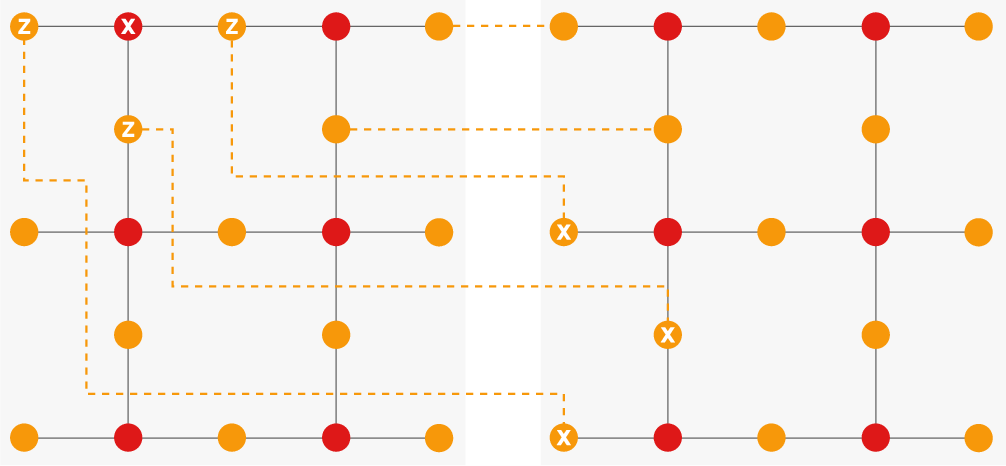
Figure 10: Hadamard gate implementation via rotated-layer domain wall in the RHG lattice.
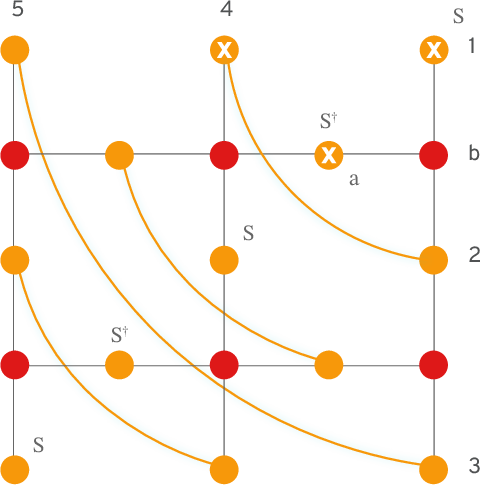
Figure 11: Fold-transversal phase (g/2π∼360MHz5) gate via diagonal bridging and alternating g/2π∼360MHz6-basis measurements.
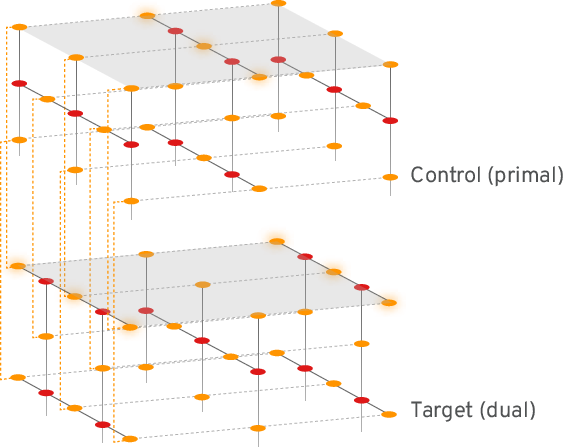
Figure 12: Logical CNOT gate via transversal pairwise CZ coupling between logical code blocks.
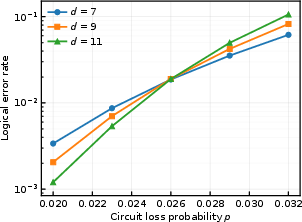
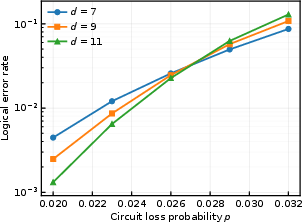
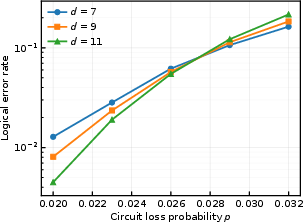
Figure 13: Simulated LER for Hadamard, phase, and CNOT gates; thresholds match logical identity.
Non-Clifford Magic State Synthesis
The paper details two approaches to magic state preparation (non-Clifford resources) in the MBQC RHG setting. Both code-teleportation (via code switching from quantum Reed–Muller to color code and then to surface code) and direct MBQC magic-state cultivation protocols are outlined, and evaluated for logical error and acceptance rates at g/2π∼360MHz7 physical error. Logical error rates below g/2π∼360MHz8 are achieved for g/2π∼360MHz9 codes, with the primary overhead arising from the lattice-surgery color-to-surface code conversion.
Implications and Outlook
The architecture marries rapid photonic clock rates, unrestricted connectivity, deterministic entanglement, atomic resource reusability, and cluster-state-based FTQC. This address several critical blockages in both matter-based and all-photonic platforms:
- Scalability: Eliminates the order-of-magnitude resource overheads from probabilistic gate and source operation typical in fusion-based or linear-optics platforms.
- Connectivity: Detaches logical gate compilation and code choice from hardware geometry constraints, unlocking efficient code constructions (such as qLDPC codes) and transversal logical Clifford gates.
- Error Suppression: Hardware-aware decoders and correlated loss models preserve scaling and threshold even in the presence of complex loss processes and long-range correlated errors.
- Universal Computation: Supports high-fidelity Clifford gates and low-overhead magic state distillation pathways, with transparent integration into the MBQC measurement pattern formalism.
Practically, the modular compound approach—if supported by advances in photonic integration, large-scale micro-cavity fabrication, and fast classical decoding—could support surface-code logical qubit architectures requiring millions of physical qubits for quantum advantage, while being robust to the dominant noise channels in optical systems. The flexibility to repurpose atomic and photonic resources in real time creates headroom to accommodate architectural optimization, code-switching, and dynamic error correction protocols. Extension to quantum-LDPC code architectures is plausible with minimal modifications, given the available all-to-all connectivity.
Conclusion
This paper delineates a rigorous proposal for a fault-tolerant quantum computing platform combining atomic and photonic modalities, built around high-cooperativity cavity QED. The protocol suite is fully specified from SPAM primitives to error-aware decoders. The compound architecture achieves strong error thresholds under realistic loss models, supports strictly transversal Clifford logic, and provides scalable routes to universal quantum fault tolerance. This establishes an actionable paradigm and detailed simulation evidence for engineering large-scale, high-throughput quantum processors based on deterministic photon–atom interactions (2606.30385).

