High-fidelity entangling gates and nonlocal circuits with neutral atoms
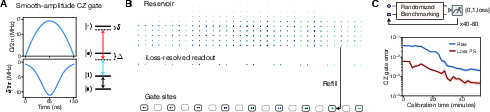
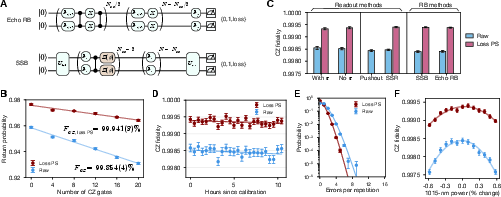
Abstract: Creation and manipulation of entanglement with low error is essential in quantum information systems. In practice, two-qubit entangling gates constitute a dominant error source, limiting circuit depths and performance in fault-tolerant architectures. Using a neutral-atom quantum processor, we realize entangling CZ gates with a high Rabi frequency smooth-amplitude pulse, employing state-selective readout and qubit reuse for fast calibration, and achieve state-of-the-art fidelities of 99.854(4)% which improve to 99.941(3)% upon loss postselection, with stable performance for 10 hours. We then use these low-error gates in quantum circuits with coherent atom rearrangement. We first benchmark performance by creating and disentangling cluster states, and subsequently implement scrambling circuits featuring longer-range connectivity to study non-locally entangled states generated through chaotic dynamics. These results pave the way towards deep-circuit, efficient fault-tolerant quantum computation.
Paper Prompts
Sign up for free to create and run prompts on this paper using GPT-5.
Top Community Prompts
Explain it Like I'm 14
What is this paper about?
This paper shows how to make two atoms share quantum information (become “entangled”) very reliably, using a kind of quantum computer that traps and moves individual neutral atoms with laser light. The team builds a high-accuracy two-qubit gate (a basic operation on a pair of quantum bits) and then uses it to run small but powerful quantum circuits, including ones where atoms are moved to interact with faraway partners. The big idea: if you can make entanglement with very few mistakes, you can run much longer and smarter quantum programs.
What questions were the researchers asking?
- Can we build a two-qubit entangling gate for neutral atoms that works with extremely high accuracy (very few errors)?
- Will that high accuracy stay stable for many hours without constant retuning?
- Can we still keep that accuracy when we actually run circuits that move atoms around and connect far-apart qubits?
- Can we use these low-error gates to create strongly entangled, hard-to-simulate quantum states?
How did they do it? (In everyday language)
Think of each atom as a tiny, controllable coin that can be heads, tails, or both at once (a qubit). To make two atoms “talk” and become entangled, the researchers use a special excited state called a Rydberg state—like making an atom puff up so much that nearby atoms feel it strongly. This “Rydberg blockade” stops two nearby atoms from both being excited at the same time, and with the right laser pulse, that creates a controlled-Z (CZ) gate, the standard two-qubit entangling operation.
Key parts of their approach:
- Smooth, fast laser pulses: They shaped the laser strength and frequency smoothly over time (like turning a volume knob up and down in a precise pattern) to reduce unwanted effects, and they did it quickly to beat natural atom decay.
- Two-laser “ladder”: They used two colors of light (420 nm and 1015 nm) to reach the Rydberg state without lingering too long in a short-lived middle step.
- Careful tuning and reuse: They used a clever readout that tells them if an atom was lost, then quickly refilled and reused atoms from a large “reservoir.” This let them calibrate quickly, over and over, to keep things sharp.
- Moving atoms like tractor beams: For circuits, they combined fixed traps (like parking spots) and moving traps (like conveyor belts) to bring atoms together for gates—even if they started far apart.
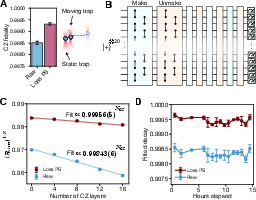
To check how good their gate is, they used “randomized benchmarking,” which is like giving the system a long sequence of random instructions and seeing how well it returns to the starting point. They also ran real circuits, like building and then “unbuilding” special entangled states called cluster states, and more complex “scrambling” circuits that spread information quickly across many atoms.
What did they find, and why is it important?
Headline results:
- Extremely accurate two-qubit gates: About 99.854% success on average. If they ignore runs where an atom was lost (called “postselection”), it rises to about 99.941%.
- Long-term stability: The high accuracy stayed steady for over 10 hours without retuning.
- Works in real circuits: Even when moving atoms around and running multi-step circuits, the gates stayed just as accurate.
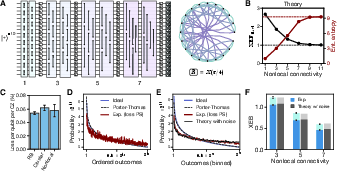
- Strong entanglement and “scrambling”: They built circuits that quickly spread quantum information across the system (faster than if only neighbors talked). The output patterns matched what’s expected from very “random-like” quantum states, confirmed using a test called cross-entropy benchmarking.
Why this matters:
- Quantum error correction (QEC), which lets quantum computers survive noise, needs very low error rates. This work pushes neutral-atom gates into the low-error zone many people believe is needed to run useful, fault-tolerant quantum computers.
- Stable performance and fast calibration mean you can run deep circuits (many steps) and bigger experiments without constant manual tweaking.
What are the main sources of error, and how can they improve further?
The team analyzed where the remaining mistakes come from:
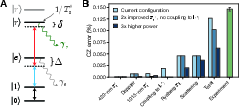
- Natural decay of the excited (Rydberg) state: excited atoms don’t live forever.
- Small amounts of unwanted scattering from the middle energy level in the two-laser step.
- Tiny drifts in laser power/position that slightly shift the atom frequencies.
- Rare atom losses and a very small amount of leakage into other internal states.
They showed that with stronger stabilization, better coherence, and more laser power, they could plausibly reach 99.9–99.95% raw gate accuracy—pushing errors even lower.
What could this lead to?
This work is a strong step toward practical, fault-tolerant quantum computing with neutral atoms. With such high-fidelity gates:
- Quantum error-correcting codes can run more efficiently, potentially supporting many reliable logical qubits.
- Nonlocal circuits (where faraway qubits interact) can be executed cleanly, opening doors to faster algorithms, simulations of exotic physics (including gravity-inspired models), and more efficient ways to map problems onto qubits.
- The approach scales: with improved optics, lasers, and control, similar methods could be applied to thousands to tens of thousands of qubits.
In short, these results show that neutral-atom quantum computers can make very reliable building blocks and use them in complex circuits—exactly what’s needed for powerful quantum machines in the future.
Knowledge Gaps
Below is a single, concrete list of knowledge gaps, limitations, and open questions left unresolved by the paper. These highlight what is missing, uncertain, or unexplored, to guide future work:
- Mechanism of atom loss during CZ gates: While loss per atom per CZ is quantified (0.054%/atom/gate) and partially correlated, the dominant physical channels (e.g., off-resonant scattering to untrapped states, photoionization, Rydberg anti-trapping, blackbody-induced transitions, or light-assisted collisions) are not identified or experimentally disentangled.
- Correlated-loss characterization: The correlation structure and distance dependence of two-atom loss events are not mapped; it is unclear whether losses correlate within a gate pair only, across nearby sites, or system-wide under certain conditions.
- Leakage dynamics and impact: Leakage to other ground hyperfine levels (F=1 leakage at 0.008%/atom/CZ) is measured but not dynamically characterized (e.g., persistence, accumulation, effect on subsequent gates) nor mitigated (no mid-circuit repumping or leakage reduction demonstrated).
- Coherent vs. stochastic error decomposition: RB-based metrics do not separate coherent phase/over-rotation errors from stochastic errors; no gate set tomography, cycle benchmarking, or interleaved RB is reported to quantify coherent error contributions and crosstalk.
- Validation of numerical error model: The model assumes specific noise pathways (e.g., T2* dominated by beam pointing–induced light-shift fluctuations) yet lacks independent in-situ noise spectroscopy (frequency noise spectra, spatial noise maps) to validate model parameters and assumptions.
- Rydberg-state lifetime limits and environment: The reported T1≈80 μs is close to theory but environmental contributions (e.g., blackbody radiation at room temperature, vacuum pressure, stray fields) are not isolated or improved; feasibility of cryogenic operation or BBR shielding is not explored experimentally.
- Off-resonant coupling to |r′> and magnetic-field stability: While stronger magnetic fields suppress |r′> excitation, sensitivity to B-field drifts, spatial gradients, and optimal field values vs. Rabi rates is not quantified.
- Sensitivity to laser drifts: Gate fidelity is sensitive to ~0.1% power variations, but no closed-loop, real-time stabilization scheme is implemented or benchmarked; stability limits over >10 hours are not assessed under automated feedback.
- Beam uniformity and scaling: The uniformity of Rydberg beam intensity and phase over larger entangling zones (beyond 17 sites) is not demonstrated; spatial maps of CZ fidelity across hundreds–thousands of qubits remain unmeasured.
- Crosstalk in dense parallel operation: Benchmarking uses sparser gate sites to reduce Rydberg decay–induced interference; performance during simultaneous, densely parallel gates across larger arrays (as required for QEC) is not evaluated.
- Trap configuration generality: High-fidelity operation is shown for SLM-SLM and AOD-SLM pairs, but not for AOD-AOD gates or across varied spacings and focus mismatches; tolerances and calibration protocols for these configurations are not provided.
- Motion-induced errors: Impact of coherent atom transport (AOD motion) on heating, dephasing, and motional-state changes over many cycles is not quantified; limits to repeated motion in deep circuits are unknown.
- Trap-off timing and heating: Traps are pulsed off during CZ gates for “hundreds of ns,” but induced heating, parametric excitation, and their cumulative effect across many gates are not characterized.
- Rydberg detuning and light-shift management: The large light-shifts at high intensities drive detuning sensitivity but the optimal operating point (trade-off between scattering, lifetime, and light-shifts) is not systematically mapped.
- Intermediate-state scattering channels: Although scattering is a dominant error source, the relative contributions from different intermediate hyperfine sublevels and polarization impurity are not experimentally isolated.
- Alternative excitation schemes: The paper cites possible alternatives (e.g., different intermediate states, single-photon UV schemes, pulsed lasers), but provides no comparative experimental data on achievable error budgets or technical hurdles.
- Achieving 99.9–99.95% raw fidelity: Projections require higher power and improved T2* and |r′> suppression; concrete design targets (e.g., intensity, beam pointing stability, B-field stability, noise PSDs) and associated engineering solutions are not specified.
- Scalability to thousands of qubits: While up to 442 qubits are loaded, high-fidelity gates and circuits are demonstrated on ≤20 qubits; performance, calibration overhead, and uniformity for ≥103 active qubits remain untested.
- Automated calibration: Calibration is manual and serial; no demonstration of closed-loop or ML-based auto-calibration (e.g., Nelder–Mead, Bayesian optimization) for rapid, large-scale parameter tuning is provided.
- Mid-circuit loss detection and erasure handling: Loss is postselected at end-of-circuit; feasibility and benefits of mid-circuit loss detection, rerouting, or immediate erasure decoding in long circuits are not explored.
- Single-qubit gate fidelity in context: SSB suggests negligible single-qubit error impact, but there is no independent, device-wide benchmark of single-qubit errors under the same optical background and timing as used for CZ gates and circuits.
- Time-to-solution and throughput: Cycle rates (20–30 Hz) and total sequence times are not broken down; limits imposed by atom loading, transport, and calibration on algorithmic throughput are not quantified.
- Scrambling circuit hardness: Nonlocal circuits up to 20 qubits match noisy simulations, but the regime of classical hardness is not reached; scaling behavior of XEB and entanglement growth beyond 20 qubits is untested.
- Entanglement diagnostics: Circuit scrambling is inferred via XEB and theory; no direct entanglement measurements (e.g., randomized measurements of purity/entropies or OTOCs) are performed to validate super-ballistic growth experimentally.
- Readout error characterization: State-selective readout detects loss, but misclassification rates, crosstalk, and state-dependent detection errors are not quantified or incorporated into circuit-level performance metrics.
- Effect of leakage on algorithms/QEC: While leakage is measured, its impact on sampling distributions, stabilizer measurements, and QEC decoding (with erasure and leakage flags) is not evaluated experimentally.
- Parallel nonlocal gate implementation: The circuits interleave single-qubit and two-qubit operations with nonlocal transport; constraints, scheduling, and synchronization for parallel nonlocal gates at scale are not assessed.
- Long-term stability beyond 10–15 hours: Although stable for ~10–15 hours without recalibration, longer-term drifts, seasonal variations, and duty-cycle effects are not monitored or mitigated with feedback.
- Environmental sensitivity: Sensitivity to ambient temperature, acoustic/vibration noise (affecting beam pointing), and air currents (affecting path length) is not measured; environmental controls needed for 0.1%-level stability are unspecified.
- Magnetic-field gradients and tensor shifts: Potential spatially varying Zeeman shifts and tensor AC Stark shifts (e.g., from polarization inhomogeneity) are not mapped across the array or incorporated into the uniformity analysis.
- Impact of simultaneous laser systems: The interaction of Raman beams, lattice beams for readout, and Rydberg beams (e.g., induced light-shifts, scattering) during interleaved operations is not quantified.
- Benchmarking bias from echo sequences: Echo RB cancels certain single-qubit phases; although SSB cross-checks were done, potential biases from echo-like cancellations in more complex circuit contexts are not fully ruled out.
- Reservoir refilling effects: Reuse and refilling are used for fast calibration, but any bias on measured fidelities (e.g., selection effects from atom quality/temperature after many cycles) is not assessed.
- Uniformity of CZ phase across array: The single-qubit phase accumulated during the CZ gate is calibrated for SSB, but spatial variation and drift of this phase (relevant for circuit compilation) are not mapped at scale.
- Heating and lifetime under increased laser power: Projections to higher power to reach 99.9–99.95% raw fidelity do not assess possible side effects (e.g., optical damage, thermal lensing, photodarkening, or increased technical noise).
- QEC-level validation: Although improvements imply >10× below-threshold performance, no direct demonstration of a code cycle with these improved gates (e.g., surface or high-rate LDPC codes) is provided; decoder performance using loss/erasure information is not tested with this hardware generation.
- Generality across Rydberg states and isotopes: Gates are shown for 87Rb at 53S; robustness across different principal quantum numbers, isotopes, or S/P states (and corresponding lifetimes and polarizabilities) is not examined.
- Effects of background gas and vacuum quality: No measurements isolate the role of background collisions in loss/decoherence rates over multi-hour runs, nor do they present vacuum improvements as a pathway to lower loss.
These unresolved points outline concrete avenues for deeper error diagnosis, robust calibration and control, scaling to larger systems, and validating algorithmic/QEC performance with the demonstrated high-fidelity entangling gates.
Practical Applications
Immediate Applications
The following applications can be deployed now by leveraging the paper’s demonstrated gate fidelities, calibration methods, circuit techniques, and benchmarking workflows.
- High-fidelity neutral-atom CZ gate implementation
- Sector: Quantum hardware, manufacturing
- What: Adopt smooth-amplitude, high-Rabi-frequency CZ gates with optimal-control pulse shapes and magnetic-field tuning to suppress unwanted Rydberg coupling; operate at ~1.7 μm spacing and peak two-photon Rabi frequencies ~2π×17 MHz.
- Tools/workflows: Optimal-control pulse library; amplitude correction (Chebyshev) routines; bias-field optimization; camera-based beam-pointing/power stabilization.
- Assumptions/dependencies: Sufficient laser power and beam quality; stable beam pointing; adequate Zeeman splitting; trap-off windows; thermal management; supply of SLM/AOD optics.
- Fast, loss-resolved calibration with qubit reuse
- Sector: Hardware operations, control software
- What: Use state-selective readout (spin-to-position), loss detection, and qubit reuse to calibrate CZ gates from scratch in <40 minutes and sustain 20–30 Hz cycle rates with 40–80 repetitions per load.
- Tools/workflows: Automated parameter scans; echo-RB-based hill-climbing; loss-postselected metrics to disentangle phase vs population errors.
- Assumptions/dependencies: Robust state-selective readout optics; reservoir-based refill; reliable atom transport and imaging.
- Stable long-duration operation (10+ hours) with drift monitoring
- Sector: Hardware operations, reliability engineering
- What: Maintain ~99.85% raw CZ fidelity without recalibration; monitor and correct sub-0.1% Rydberg beam power/position drifts.
- Tools/workflows: Beam-position/power feedback loops; dashboards tracking return probabilities, Poissonian loss statistics; minimal-parameter touch-ups (beam alignment/power) without pulse re-optimization.
- Assumptions/dependencies: Passive mechanical/thermal stability; camera-based feedback; laser frequency/pointing noise within measured T2* budget.
- In-situ, circuit-level fidelity checks via cluster-state make/unmake
- Sector: Hardware QA, academia
- What: Use “make-and-unmake” 1D cluster-state circuits to extract CZ fidelity in circuit context (raw ~99.84%, postselected ~99.96% on 20 qubits).
- Tools/workflows: Standardized circuit templates for routine health checks; regression tests across zones and trap configurations (SLM–SLM vs AOD–SLM).
- Assumptions/dependencies: Uniform trap spacing and matched focal planes; validated single-qubit gate performance.
- Robust benchmarking standards for neutral-atom platforms
- Sector: Standards, policy, academia
- What: Adopt echo-RB and symmetric stabilizer benchmarking (SSB) as complementary methods; report raw and loss-postselected fidelities, leakage, and stability over time; include XEB on nonlocal circuits.
- Tools/workflows: Benchmark suites and data-reporting schemas; leakage tracking across F manifolds; Poissonian loss modeling; cross-entropy benchmarking.
- Assumptions/dependencies: Availability of calibration for single-qubit phases (SSB); consistent readout protocols (SSR vs blowout).
- Erasure-aware QEC prototypes and decoders
- Sector: Quantum software, academia
- What: Use detected atom loss as erasures to improve QEC thresholds; prototype below-threshold surface-code experiments with higher margins (>10× gains projected).
- Tools/workflows: Decoders that incorporate erasure and correlated-loss models; syndrome-data pipelines; erasure flagging interfaces from hardware to decoder.
- Assumptions/dependencies: Stable and accurate loss detection; low leakage; integration between control stack and decoding software.
- Device validation via nonlocal scrambling circuits and XEB
- Sector: Cloud providers, certification, academia
- What: Deploy nonlocal kicked-Ising-like circuits with super-ballistic scrambling; evaluate distributions against Porter–Thomas and XEB; use as certification for deep-circuit capability.
- Tools/workflows: Circuit libraries with increasing nonlocal connectivity; noise-informed simulators for comparison; binned-XEB evaluation for larger n.
- Assumptions/dependencies: Classical simulation capability for reference; consistent single-qubit phase control; low loss per gate consistent with RB.
- Compiler/mapping that exploits coherent atom motion
- Sector: Quantum software (compilers, scheduling)
- What: Incorporate constraints for uniform inter-trap spacing, focal-plane alignment, and movement timing; schedule AOD–SLM gates without fidelity degradation.
- Tools/workflows: Movement-aware mappers; transport calibration profiles; cost models penalizing spacing/focus errors.
- Assumptions/dependencies: Accurate motion control; real-time calibration hooks; trap-shape uniformity.
- Education and workforce training modules
- Sector: Education, daily life (STEM outreach)
- What: Teaching kits demonstrating scrambling, cluster-state creation, and erasure-informed decoding on small neutral-atom arrays.
- Tools/workflows: Pre-built circuit notebooks; visualization of Page entanglement and XEB; safe-operation protocols.
- Assumptions/dependencies: Access to small neutral-atom setups or cloud-based simulators; safety/training for high-power optics (if on-prem).
- Hardware sub-systems as products
- Sector: Photonics and controls vendors
- What: Packaged SSR modules, beam-stabilization cameras/feedback, tophat beam shapers, magnetic-field subsystems optimized for Rydberg suppression of |r’⟩.
- Tools/workflows: Drop-in control APIs; self-test routines; vendor-provided error budgets tied to FRT-style models.
- Assumptions/dependencies: Component availability (SLMs, AODs, ULE cavities); integration with existing control stacks.
Long-Term Applications
These applications need further research, scaling, and engineering (e.g., to achieve 99.9–99.95% raw CZ fidelity, larger systems, automated control).
- Fault-tolerant quantum computing with high-rate codes and nonlocal architectures
- Sector: Finance, pharma, energy, materials, logistics, cybersecurity
- What: Deploy deep-circuit, high-rate QEC with erasure-aware decoding, potentially leveraging transversal gates enabled by nonlocal connectivity; scale to many logical qubits.
- Tools/products: Full-stack FTQC systems; high-rate QEC libraries; logical-qubit cloud services.
- Assumptions/dependencies: Raw CZ ≥ 99.9–99.95%; high-fidelity single-qubit ops; scalable decoders; efficient cryo/thermal/optical stability at scale; robust supply chains.
- 10,000+ physical-qubit neutral-atom processors
- Sector: Cloud quantum infrastructure, hardware manufacturing
- What: Large-scale, continuously operating systems using advanced beam shaping, fast scanning, higher-power/pulsed lasers, and automated calibration/self-healing.
- Tools/products: Turnkey neutral-atom racks; autonomous calibration agents; real-time performance steering via QEC metrics.
- Assumptions/dependencies: Advanced laser power and stability; mechanical/thermal isolation; automated fault detection and recovery.
- Algorithmic speedups from nonlocal connectivity
- Sector: Industry computing (optimization, chemistry, ML)
- What: Exploit nonlocal layouts to reduce circuit depth (e.g., √N-depth scrambling, transversal subroutines) for variational and Hamiltonian-simulation workloads.
- Tools/products: Connectivity-aware compilers; template circuits exploiting long-range gates; circuit knitting with coherent motion.
- Assumptions/dependencies: Verified robustness of nonlocal gates at scale; co-design of algorithms/compilers/hardware.
- Quantum simulators for nonlocal many-body physics and gravity analogs
- Sector: Academia (high-energy, condensed matter), national labs
- What: Simulate chaotic dynamics, scrambling, Page curves, and gravity-inspired models; study information propagation beyond Lieb–Robinson bounds.
- Tools/products: Domain-specific circuit libraries; diagnostics for OTOCs, entanglement growth, and XEB variants.
- Assumptions/dependencies: Reliable mid-circuit measurements (future); higher qubit counts; noise-tailored circuit design.
- Large-scale entanglement for sensing and metrology
- Sector: Healthcare, navigation, energy (gradiometry, clocks)
- What: Use high-fidelity entangling operations and coherent transport to create large entangled probes (e.g., cluster/GHZ-like states) for enhanced sensitivity.
- Tools/products: Neutral-atom sensing platforms; calibration suites tuned for metrological robustness rather than computational depth.
- Assumptions/dependencies: Operation in sensing-optimized regimes (magnetic-field noise, light shifts); application-specific error mitigation.
- Native multi-qubit gates (e.g., CCZ) in nonlocal circuits
- Sector: Hardware, compilers, QEC
- What: Integrate CCZ and constant-velocity gates to reduce T-depth and improve logical gate sets; compile magic-state-lite or transversal routines.
- Tools/products: Gate libraries and compilers exploiting multi-qubit primitives.
- Assumptions/dependencies: Robust control at higher laser powers; refined optimal-control pulses; calibrated motion trajectories.
- Certification and regulatory standards for quantum performance
- Sector: Policy, standards bodies
- What: Establish norms for reporting raw vs postselected fidelities, loss/leakage rates, long-duration stability, and XEB results on nonlocal circuits.
- Tools/products: Standardized benchmarks and disclosure templates; third-party labs for certification.
- Assumptions/dependencies: Community consensus on metrics; access to reference circuits and datasets; reproducibility across vendors.
- Full-stack erasure-informed QEC toolchains
- Sector: Quantum software, cloud platforms
- What: Integrate erasure flags, correlated-loss models, and noise-informed routing into compilers and decoders for routine logical operation.
- Tools/products: Erasure-aware schedulers; real-time decoder integration; performance SLAs at the logical level.
- Assumptions/dependencies: Low-latency control–decoder interfaces; accurate, timely erasure data; stable leakage control.
- Quantum advantage and secure randomness services via deep nonlocal circuits
- Sector: Cloud services, security
- What: Offer certified sampling tasks with XEB validation; explore randomness generation using Porter–Thomas-like outputs with verification.
- Tools/products: Public challenge suites; verifiable randomness APIs.
- Assumptions/dependencies: Sufficient scale and fidelity to surpass classical simulators; verification protocols resistant to spoofing.
Glossary
Below is an alphabetical list of advanced domain-specific terms from the paper, each with a brief definition and a verbatim example of usage from the text.
- acousto-optic deflectors (AODs): Beam-steering devices that use sound waves in a crystal to deflect laser light, enabling fast movable optical tweezers. "acousto-optic deflectors (AODs, DTSX-400, AA Opto-Electronic)"
- acousto-optic modulator (AOM): A device that modulates a laser’s intensity, frequency, or phase via sound waves; used here for fast pulse shaping. "The measured rise time of the 420-nm AOMs is around $10$ns"
- Alkali Rydberg Calculator: A software/library used to compute atomic properties of alkali Rydberg states. "given by the Alkali Rydberg Calculator"
- BB1 composite pulses: Error-robust pulse sequences that suppress certain systematic errors in single-qubit gates. "fidelities for BB1 composite pulses of "
- blockade energy: The interaction-induced energy shift that prevents simultaneous Rydberg excitation of nearby atoms. "the blockade energy is around 950 MHz."
- CCZ: A three-qubit controlled-controlled-Z entangling gate. "multi-qubit gates such as CCZ"
- cluster states: Highly entangled graph states used as a resource for measurement-based quantum computation. "making and unmaking one-dimensional cluster states"
- coherent atom rearrangement: Moving atoms while preserving quantum coherence to implement flexible connectivity. "quantum circuits with coherent atom rearrangement."
- collision probability: The second moment of a probability distribution; for random states it equals the ideal XEB value. "often called the collision probability"
- controlled-phase gate: A two-qubit entangling gate that adds a phase to the |11⟩ state; implemented here via Rydberg interactions. "controlled-phase gates based on Rydberg blockade"
- cross-entropy benchmarking (XEB): A protocol comparing measured and ideal output probabilities to quantify circuit fidelity on random states. "cross-entropy benchmarking (XEB)"
- CZ gate: A controlled-Z two-qubit entangling gate central to many quantum algorithms. "entangling CZ gates"
- dark state: A coherently engineered superposition that avoids population of lossy intermediate levels. "maximizing population in the dark state not containing "
- detuning: The frequency offset between a laser and an atomic transition. "with a detuning profile "
- Doppler decoherence: Loss of coherence due to thermal motion causing Doppler shifts during coherent evolution. "from a Doppler decoherence model"
- echo randomized benchmarking (echo RB): An RB variant inserting a spin-echo-like pulse to isolate two-qubit gate errors. "global echo randomized benchmarking (``echo RB")"
- erasure conversion: Turning detected loss errors into erasures that can be handled more effectively by QEC decoders. "loss detection and erasure conversion"
- exact diagonalization: A numerical method that computes dynamics/fidelities by directly diagonalizing the Hamiltonian. "combination of exact diagonalization"
- fault-tolerant architectures: System designs that can operate reliably despite component errors by using QEC and fault-tolerant gates. "fault-tolerant architectures"
- Fidelity Response Theory (FRT): A framework to predict fidelity sensitivity to control noise/drifts. "Fidelity Response Theory (FRT)"
- ground–Rydberg coherence (T2*): The dephasing timescale of a superposition between a ground state and a Rydberg state. "ground-Rydberg coherence "
- hyperfine clock states: Magnetic-field-insensitive hyperfine states used as robust qubits. "long-lived hyperfine clock states"
- intermediate state detuning: The frequency offset from an intermediate excited level in a multi-photon transition. "intermediate state detuning GHz"
- intermediate state manifold: The set of intermediate excited atomic states coupled during two-photon excitation. "intermediate state manifold "
- intermediate-state scattering: Spontaneous emission or decoherence from transient population of the intermediate level. "intermediate-state scattering"
- kicked Ising models: Periodically driven Ising spin models used to study chaos and scrambling. "nonlocal kicked Ising models"
- lightshift: An AC Stark shift of atomic energy levels caused by off-resonant laser light. "substantial lightshifts on the Rydberg transition"
- loss postselection: Discarding runs where atom loss is detected to estimate intrinsic gate/circuit fidelity. "improve to 99.941(3)\% upon loss postselection"
- magneto-optic trap (MOT): A standard cold-atom trap combining laser cooling with magnetic fields. "magneto-optic trap (MOT)"
- nonlocal connectivity: Gate connectivity extending beyond nearest neighbors, often enabled by moving qubits. "nonlocal connectivity"
- optical tweezers: Tight, movable laser traps used to confine and rearrange individual atoms. "optical tweezers"
- Page entropy: The typical entanglement entropy of a random pure state (near-maximal). "the Page entropy"
- polarization gradient cooling (PGC): A sub-Doppler laser cooling method reducing atomic temperatures in tweezers. "3D polarization gradient cooling (PGC)"
- Porter-Thomas distribution: The exponential distribution of outcome probabilities for Haar-random quantum states. "Porter-Thomas distribution PT"
- qubit reuse: Recycling atoms as qubits across many shots by non-destructive readout and refilling when needed. "qubit reuse"
- Rabi frequency: The coherent oscillation rate between two levels under resonant drive; sets gate speed. "peak Rabi frequency"
- randomized benchmarking (RB): A protocol using random gate sequences to estimate average error rates. "Randomized benchmarking is performed"
- Ramsey T2*: The inhomogeneous dephasing time measured via Ramsey interferometry. "Ramsey measurements"
- resonant pushout: A destructive readout method ejecting one qubit state with resonant light. "resonant pushout of versus state-selective readout (SSR)"
- Rydberg blockade: The interaction mechanism that prevents simultaneous excitation of nearby atoms to Rydberg states. "Rydberg blockade"
- Rydberg lifetime T1: The spontaneous decay timescale of a Rydberg state. "Rydberg lifetime "
- spatial light modulator (SLM): A programmable optical device shaping beam phase/intensity to form static tweezer arrays. "spatial light modulator (SLM, Hamamatsu X13138-02)"
- spin-to-position conversion: A readout technique mapping spin states to distinct spatial locations for high-fidelity detection. "spin-to-position conversion"
- state-selective optical lattice potential: A lattice potential that differentially traps qubit states to separate them during readout. "one-dimensional state-selective optical lattice potential"
- state-selective readout (SSR): A non-destructive measurement that distinguishes qubit states while preserving atoms. "state-selective readout (SSR)"
- super-ballistic scrambling: Faster-than-ballistic growth of entanglement/information spread in a circuit. "super-ballistic scrambling of quantum information"
- surface code: A leading topological quantum error-correcting code with a 2D layout. "surface code logical qubit"
- symmetric stabilizer benchmarking (SSB): A two-qubit benchmarking protocol insensitive to single-qubit errors. "symmetric stabilizer benchmarking (``SSB")"
- transversal gate architectures: Schemes where logical gates act bitwise across code blocks, aiding fault tolerance. "transversal gate architectures"
- two-photon excitation scheme: Driving a transition via an intermediate state using two lasers to reach a Rydberg state. "two-photon excitation scheme"
- ULE cavity: An ultra-low-expansion optical cavity used to stabilize laser frequency. "filtered by a ULE cavity"
- von Neumann entanglement entropy: A standard measure of bipartite entanglement for quantum states. "von Neumann entanglement entropy"
- Zeeman splitting: Energy level splitting due to an external magnetic field. "Zeeman splitting"
Collections
Sign up for free to add this paper to one or more collections.