- The paper introduces a failure taxonomy that maps recurring AVLM issues to specific interventions for effective moderation.
- It presents a multi-stage training pipeline integrating audio, visual, and non-lexical cues to balance perception and reasoning.
- Empirical results show that direct audio modeling outperforms transcript-based pipelines in scalable, policy-aligned moderation.
Diagnostic Methodology for Industry-Scale Audio-Visual-Language Moderation
Introduction
The proliferation of video and live-streaming platforms necessitates robust, scalable, and policy-aligned moderation systems. Traditional moderation pipelines, predominantly relying on Vision-LLMs (VLMs) supplemented by Automatic Speech Recognition (ASR) outputs, exhibit critical limitations. These include loss of vital acoustic and paralinguistic information, vulnerability to context misinterpretation, and lack of adaptability to platform-specific policies and content diversity. This paper proposes a comprehensive diagnostic methodology for developing Audio-Visual-LLMs (AVLMs) at industrial scale, explicitly linking observable failure modes to targeted model development interventions. The presented methodology is instantiated within a major video/live-streaming platform, supporting hundreds of regions and complex, noisy, multilingual content.
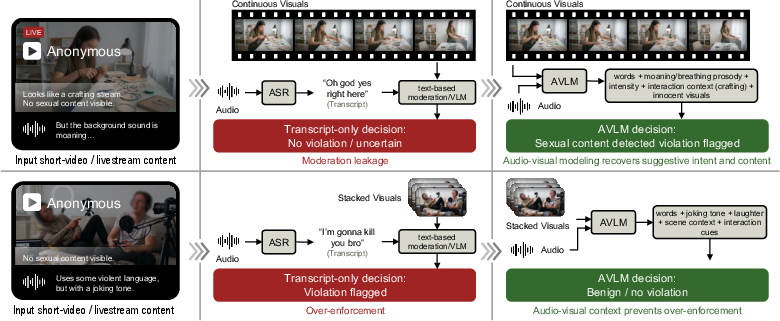
Figure 1: Audio evidence beyond transcription in video and live-streaming moderation. The upper example illustrates moderation leakage when policy-relevant acoustic evidence is lost during transcription. The lower example illustrates overkill when risky words are preserved in transcript form but the original audio-visual context indicates benign intent.
AVLM Development Pipeline and Diagnostic Framework
The AVLM construction pipeline is organized into progressively supervised data regimes: massive-scale weak audio-text pairings for initial alignment, dense supervised audio corpora emphasizing non-lexical semantics, and audio-visual instruction data for integrating multimodal reasoning. Architecturally, the system aligns a proprietary audio encoder with a pretrained language or VLM backbone using a projection layer, enabling joint modeling of speech, non-speech sounds, visual context, and cross-modal interactions.
The diagnostic lifecycle couples staged training with iterative evaluation and failure taxonomy abstraction, forming a feedback loop where persistent failure modes are mapped to concrete interventions in data selection, supervision design, and training objectives.
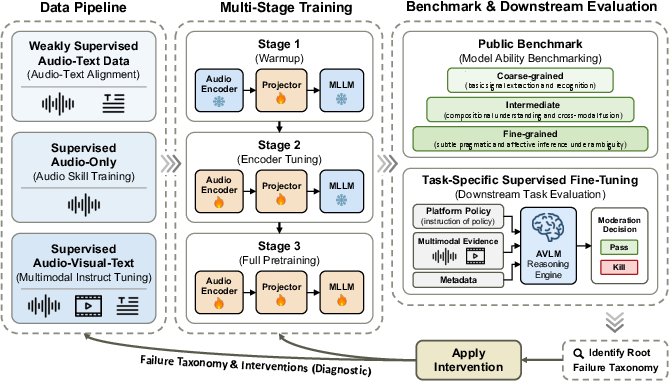
Figure 2: Overview of the proposed AVLM development and diagnostic framework, including a staged data pipeline, multi-stage training, downstream evaluation, and an explicit diagnostic feedback loop targeting failure taxonomies and interventions.
Failure Taxonomy and Targeted Interventions
The core contribution is the systematic mapping of recurring AVLM failures to actionable developmental interventions. This taxonomy is critical for escaping heuristic trial-and-error cycles and attributing improvements to explicit causes.
Selection-Induced Support Erosion
Data curation pipelines often impose non-neutral selection biases, favoring clean, high-resource, and easily aligned samples while inadvertently filtering out rare, noisy, and critical edge cases. This selective erosion distorts the effective training distribution, undermining model robustness for real-world moderation. Interventions include region-aware rebalancing, content-driven upweighting of rare violation cases, and calibrated filter thresholds to retain policy-relevant, ambiguous samples.
Regime-Limited Audio-Language Alignment
Weak pretraining with large-scale pseudo-labeled data is necessary for broad audio-language alignment. Unconverged pretraining manifests as unstable downstream reasoning and instruction-following performance. Scaling analyses inform the transition point: after diminishing returns on error reduction, supervision should shift from quantity to informativeness, emphasizing higher-quality multimodal and reasoning targets.
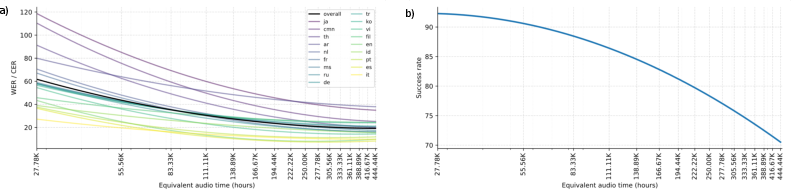
Figure 3: Effect of scaling equivalent audio training time. a) FLEURS WER/CER across common languages and overall. b) MMSU question-answering success rate.
Proxy-Sufficient Representation Collapse
ASR-centric pretraining often yields audio representations highly optimized for lexical recovery, but deficient for downstream reasoning reliant on semantics, non-speech events, and audio-visual grounding. The paper demonstrates that cross-modal continuation (CMC)—requiring generation in one modality conditioned on another (e.g., text from audio)—mitigates representational collapse and yields concurrent gains in transcription and Audio Question Answering (AQA) performance.
Instruction Tuning and Perception-Reasoning Tradeoff
Instruction tuning for multimodal tasks improves higher-level reasoning at the expense of detailed audio perception, as the optimization process favors response-level cues accessible from semantics or priors over speech-fidelity. Preceding instruction tuning with CMC enables the model to maintain high-quality perception and lexicon retention during reasoning-focused training.
Perception-Moderation Discrepancy
A central empirical result refutes the assumption that perceptual improvements (e.g., lower ASR error) linearly transfer to enhanced moderation: models over-optimized for lexical recovery exhibit degraded policy-relevant reasoning and grounding, leading to poor downstream moderation performance. Optimal design instead frames model selection as multi-objective optimization, explicitly balancing perception and reasoning metrics to avoid representational monopolization.
Empirical Results
The proposed AVLMs, under matched scaling with open-source baselines (Qwen2.5-Omni-3B, Gemma-4-E2B-it), achieve either best or highly competitive results on speech recognition (FLEURS), audio understanding (MMAU, MMSU), and a diverse set of public multimodal reasoning benchmarks. Ablation on real-world moderation datasets confirms that direct audio modeling consistently outperforms transcript-based pipelines—capturing both incremental and non-lexical evidence essential for nuanced violation detection.
The results demonstrate AVLMs’ superior capacity to generalize across diverse content, maintain robust performance in minority languages, and adapt to the intricacies of platform-specific policy enforcement. These gains stem not only from data and architectural innovations, but from a methodical, taxonomy-driven diagnostic framework guiding each developmental stage.
Implications and Future Directions
The failure taxonomy/intervention methodology enables greater transparency, traceability, and optimization in complex AVLM development for moderation, facilitating scaling to new languages, regions, and policy regimes. Practically, the approach strengthens content safety by minimizing moderation leakage and overkill, supporting more legitimate and defensible policy decisions.
Theoretically, these findings challenge the sufficiency of proxy task optimization and advocate for explicit multi-objective balancing in multimodal model development. Future directions include integrating more sophisticated multi-objective optimization algorithms, extending root-cause diagnostics to additional edge-case failure modes (e.g., adversarial, multimodal hallucinations), and automating intervention selection based on observed failure patterns.
Conclusion
This study establishes a principled, scalable diagnostic methodology for industrial AVLM development in video and live-streaming moderation. By linking fine-grained failure signatures to targeted interventions, the method facilitates construction of robust, adaptable, and policy-aligned AVLMs. The approach disrupts heuristic iteration paradigms and provides a replicable template for other domains requiring high-stakes multimodal content understanding.

