- The paper introduces a nonperturbative LEO method embedding Floquet–Magnus expansion to enable quantum control beyond high-frequency limits.
- It applies systematic Magnus corrections to optimize pulse designs, achieving nearly perfect state transfer and adiabatic speedup in simulated spin chains and two-level systems.
- The work presents analytic pulse conditions for hardware-constrained quantum devices, improving fidelity in superconducting systems and other platforms.
Nonperturbative LEO-Based Quantum Control Pulse Design Beyond the High Frequency Driving Regime
Introduction
The elimination of leakage from target subspaces to external Hilbert spaces remains a stringent hurdle to achieving high-fidelity quantum operations in realistic devices, where the control field strength is fundamentally limited by hardware constraints. The Leakage Elimination Operator (LEO) framework, which can restrict quantum dynamics to a specific subspace via time-dependent control Hamiltonians, was initially developed under high-frequency driving assumptions based on the Feshbach PQ partitioning technique. However, this regime is physically unrealistic for many experimental setups, such as superconducting qubits, where strong fields induce detrimental effects. This article presents a nonperturbative extension of the LEO protocol, embedding it in the Floquet-Magnus theoretical framework, which naturally incorporates arbitrary driving frequencies and provides systematically improvable analytical control conditions for pulse design.
The LEO approach augments a system Hamiltonian H0(t) with a time-dependent control term HLEO(t)=c(t)A(t) engineered to suppress transitions outside a designated computational subspace. Traditional approaches, based on partitioning the Hilbert space (Feshbach PQ technique), derive control pulse conditions using a strong-driving or high-frequency expansion, resulting in constraints such as zero area for the control function over a period. For example, rectangular and sinusoidal pulses satisfy Iτ=2πm and J0(Iτ/π)=0, respectively.
However, strong driving in realistic quantum hardware is limited by environmental coupling, non-Markovianity, and pulse distortion. The current formalism transcends these limitations by utilizing Floquet theory and applying the Magnus expansion to the effective Hamiltonian in a rotating frame defined by the integrated pulse area. This process yields a block-diagonal Floquet Hamiltonian, and the control conditions correspond to the vanishing of off-diagonal blocks order by order in the Magnus expansion. The zeroth-order recovery of the PQ result and the explicit role of higher Magnus orders enable rigorous nonperturbative pulse design.
Analytical Pulse Conditions: Equivalence and Beyond Zeroth Order
The equivalence between the Feshbach PQ-derived pulse conditions and the Magnus-expansion zeroth-order result is formally demonstrated. The off-diagonal Floquet blocks vanish when
I0=∫0Teiϕ(t)dt=0,
as in the PQ approach. Systematic inclusion of higher Magnus orders yields corrections parameterized by control pulse parameters, e.g., intensity I and time-slice τ, allowing nonperturbative optimal control in the experimentally relevant low-frequency regime.
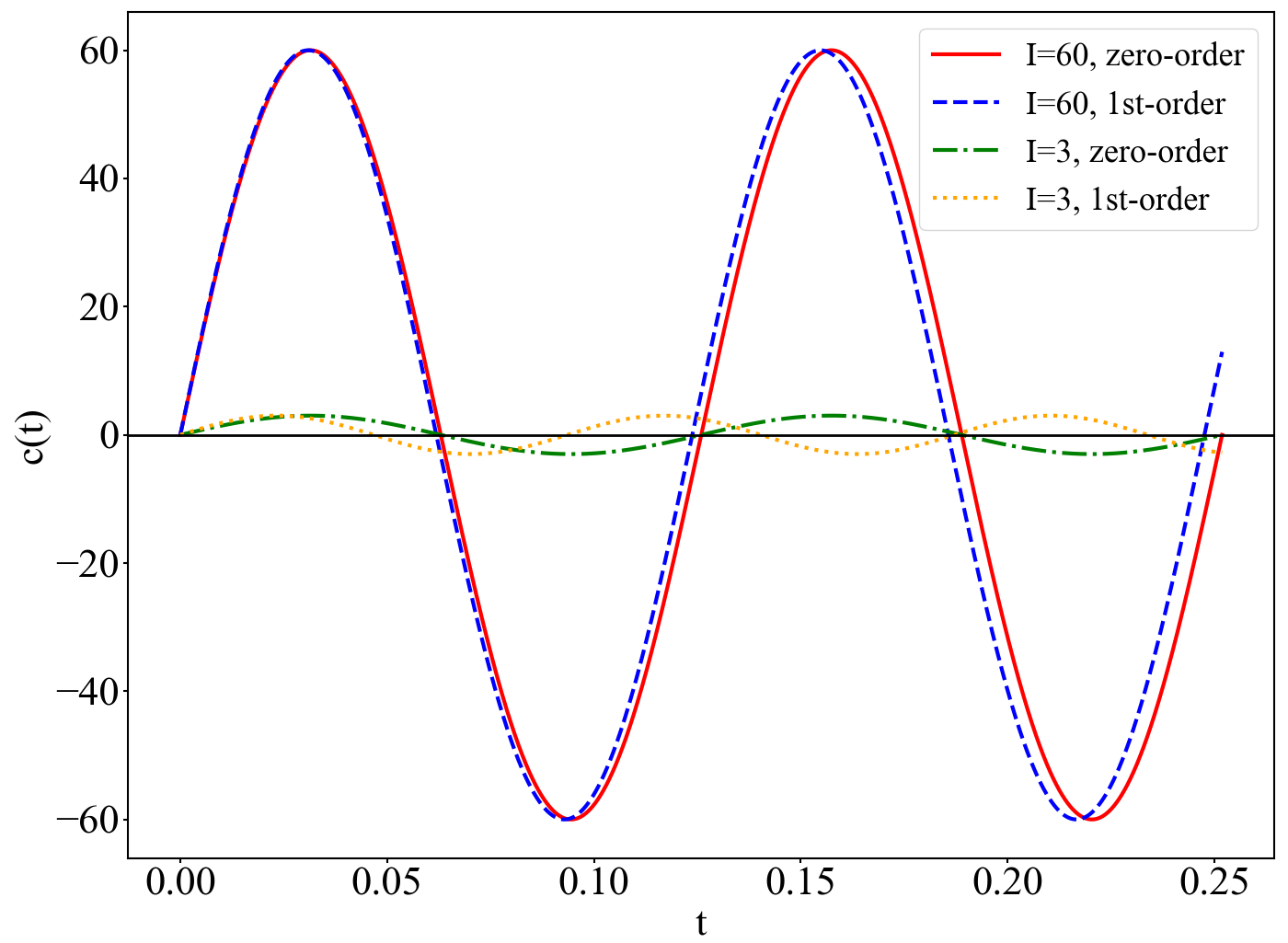
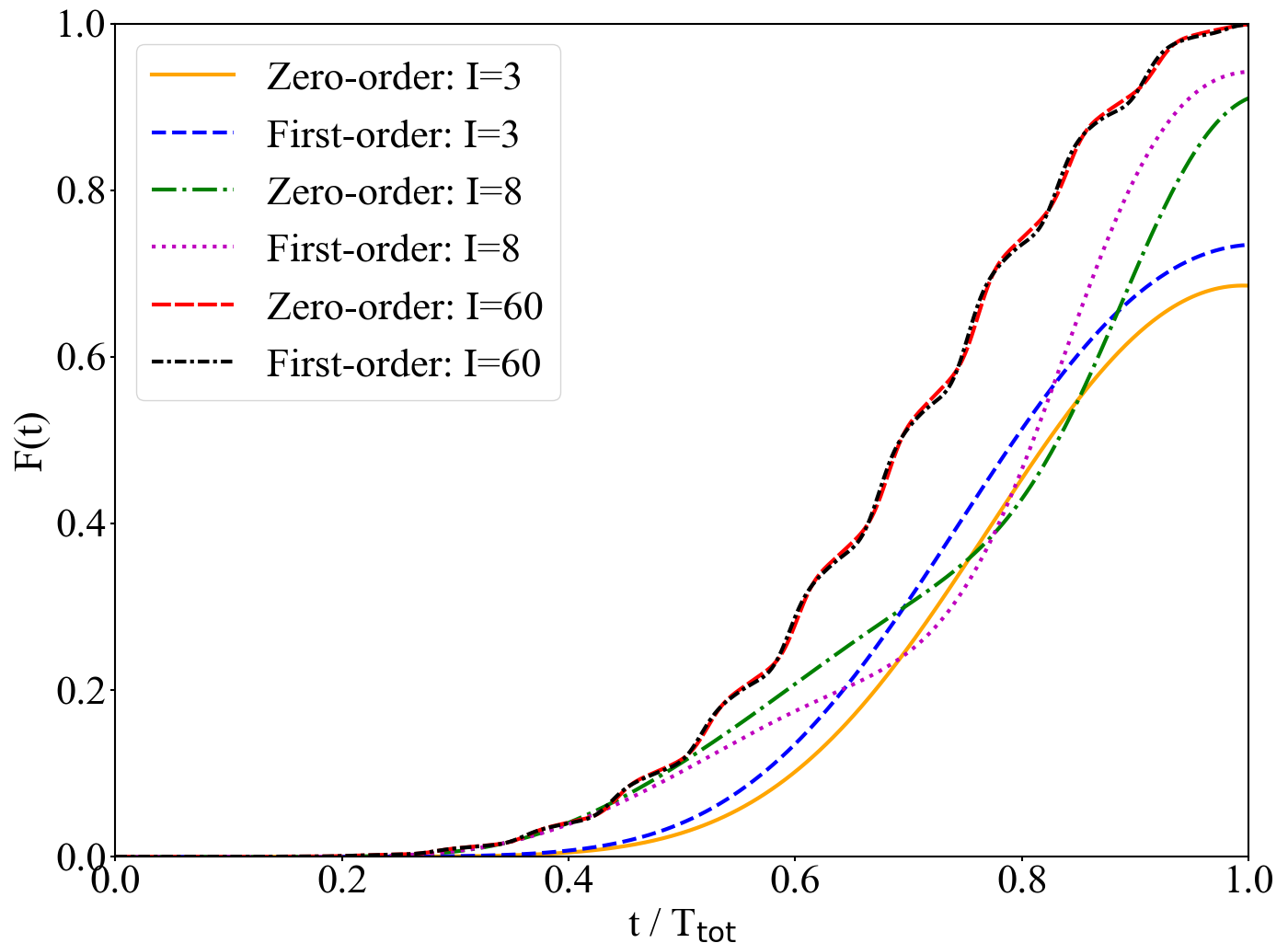
Figure 1: (a) Sinusoidal pulse shapes under zeroth and first Magnus order approximations for various I; (b) Corresponding transmission fidelity F as a function of normalized time t/Ttot for HLEO(t)=c(t)A(t)0 chain sites.
Application I: State Transfer in a Spin Chain
The efficacy of the generalized LEO protocol is rigorously tested for state transfer in an HLEO(t)=c(t)A(t)1-site XY spin chain. The system Hamiltonian HLEO(t)=c(t)A(t)2 is mapped to a tight-binding form. The system is initialized in HLEO(t)=c(t)A(t)3 (first site), targeting transfer to HLEO(t)=c(t)A(t)4 (last site). As the control intensity HLEO(t)=c(t)A(t)5 is reduced from the high-frequency regime (HLEO(t)=c(t)A(t)6) to experimentally relevant values (HLEO(t)=c(t)A(t)7), the transmission fidelity HLEO(t)=c(t)A(t)8 starts deviating from the zeroth-order PQ prediction. Inclusion of first- and second-order Magnus corrections systematically restores agreement with optimal numerical results, as seen in the narrowing gap between theory and simulation.
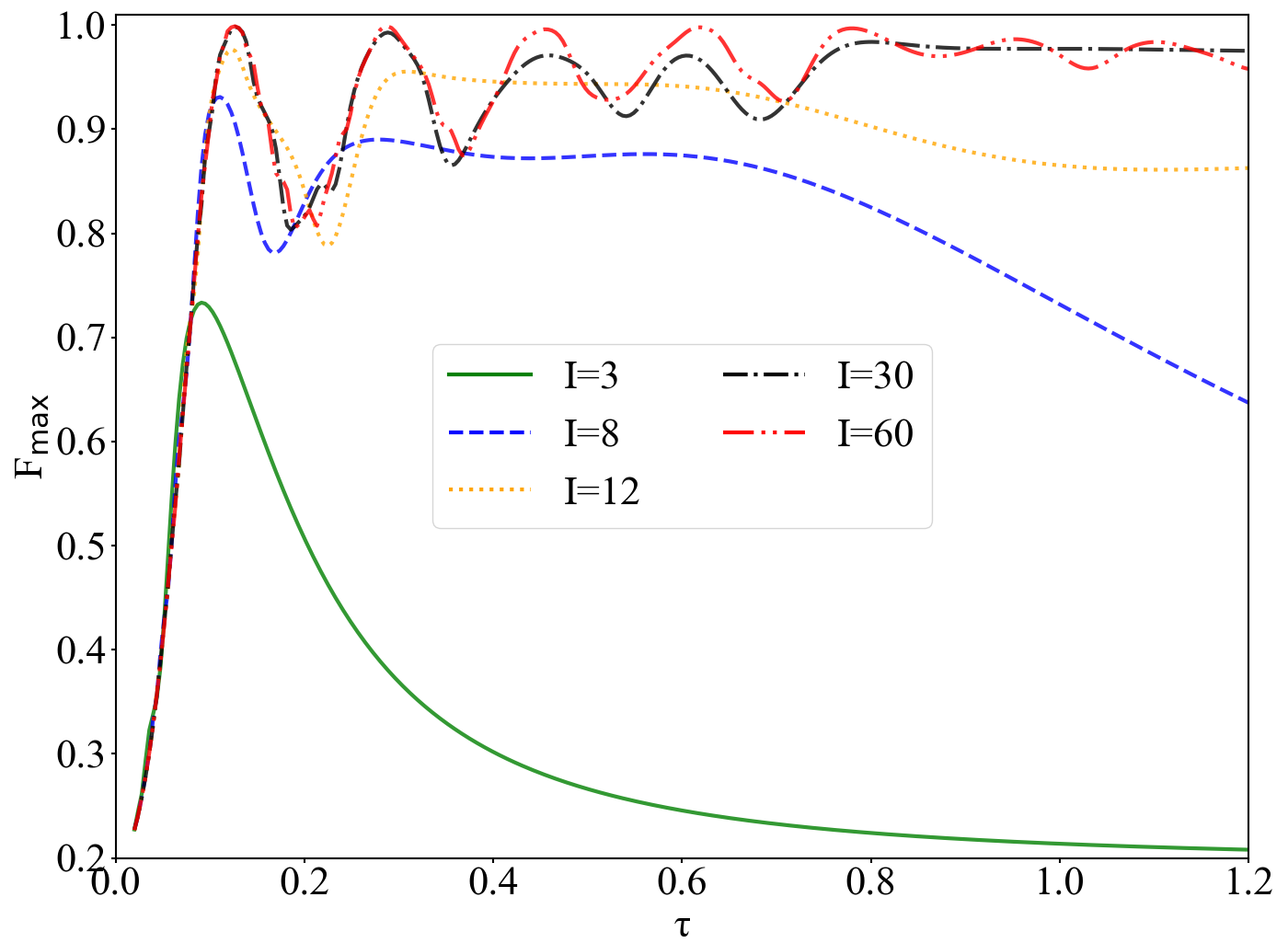
Figure 2: Maximum fidelity HLEO(t)=c(t)A(t)9 as a function of pulse half-period Iτ=2πm0 for different control intensities Iτ=2πm1 in a Iτ=2πm2 chain.
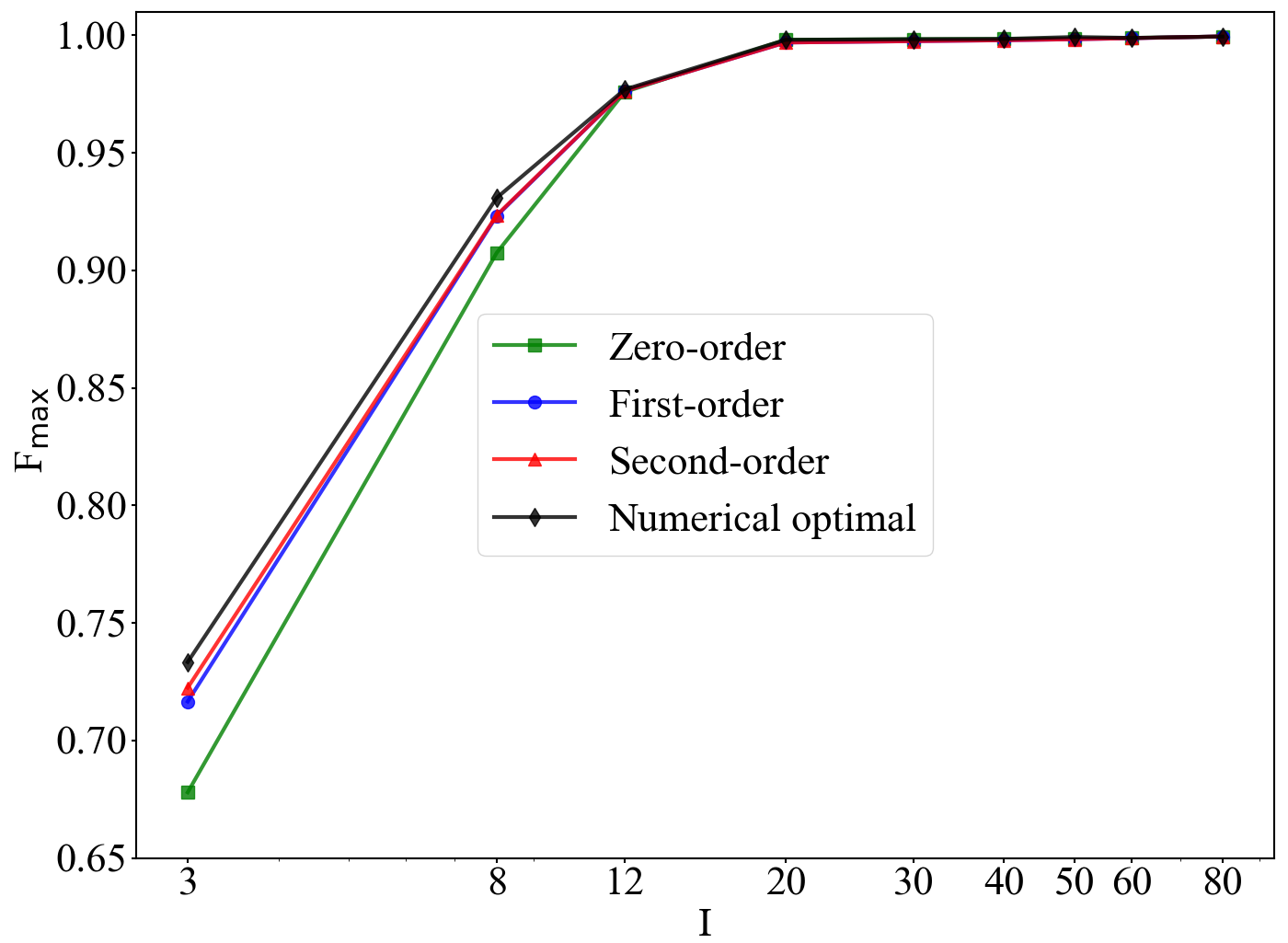
Figure 3: First peak fidelity at varying pulse intensities: comparison among zeroth, first, second Magnus orders, and exact numerics.
Peak splitting, shifting, and amplitude reduction in low-frequency/fewer-pulse regimes are quantitatively reproduced by higher-order Magnus expansion. Analytical corrections for pulse design (as roots of transcendental equations involving Bessel functions and Magnus series parameters) enable nearly perfect transfer in low-frequency environments.
Application II: Adiabatic Speedup in a Two-Level System
A second test case focuses on expediting adiabatic passage in a two-level system with a time-periodic Hamiltonian. The addition of an LEO term proportional to the instantaneous ground state projector, controlled by pulses Iτ=2πm3 (rectangular, sinusoidal), dynamically engineers adiabatic eigenstate tracking at arbitrarily large driving rates. The rotating-frame Floquet Hamiltonian reveals that nontrivial Magnus corrections (beyond zeroth order) are particularly relevant when the control strength is not asymptotically large relative to system scales.
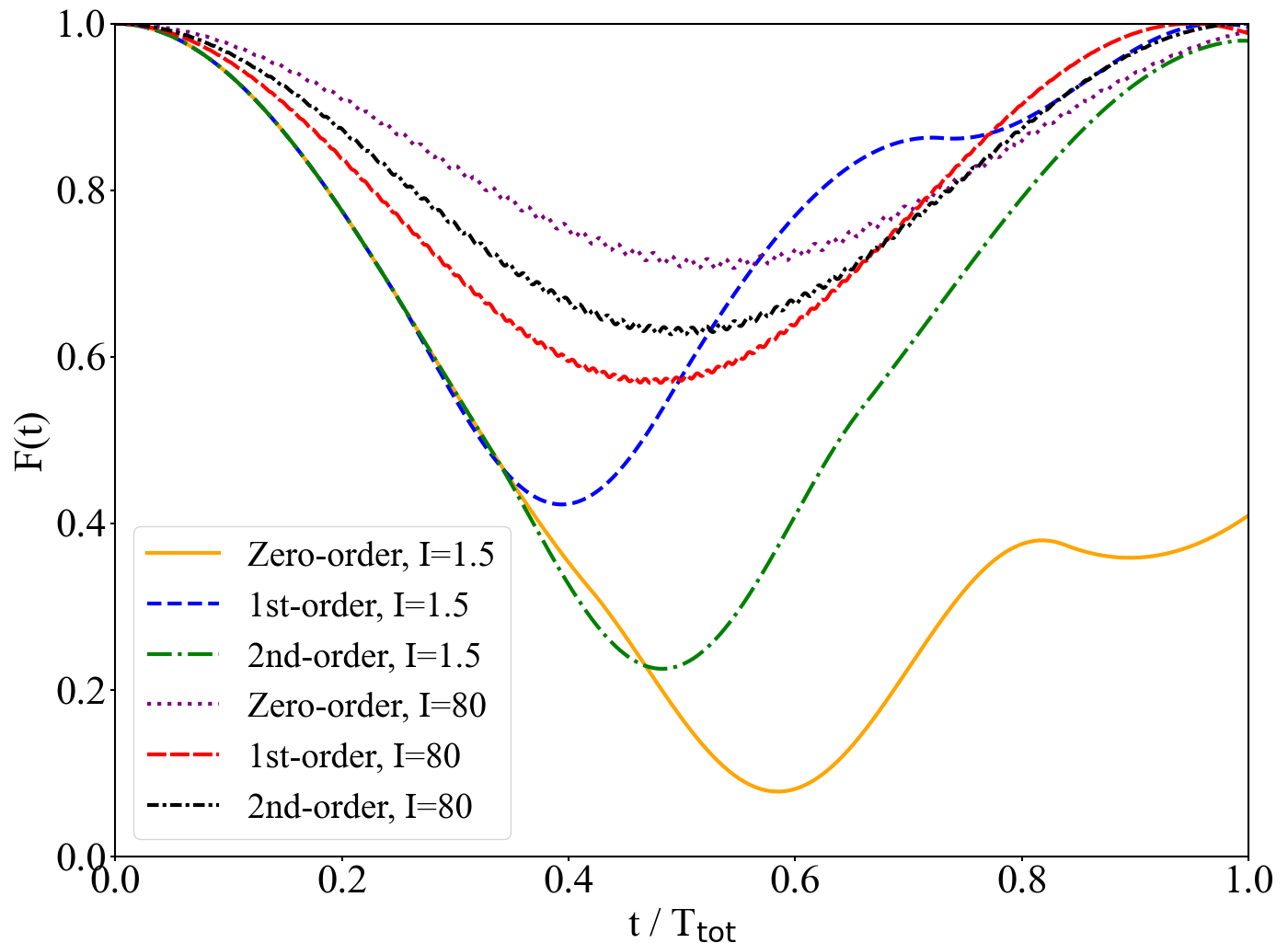
Figure 4: Adiabatic speedup under rectangular pulses; fidelity Iτ=2πm4 vs. rescaled time for various intensities and Magnus expansion orders.
In the low-frequency regime, first and second Magnus corrections dramatically enhance adherence to the adiabatic trajectory, effectively removing leakage and preserving ground state population even when the standard LEO/PQ approach severely underperforms.
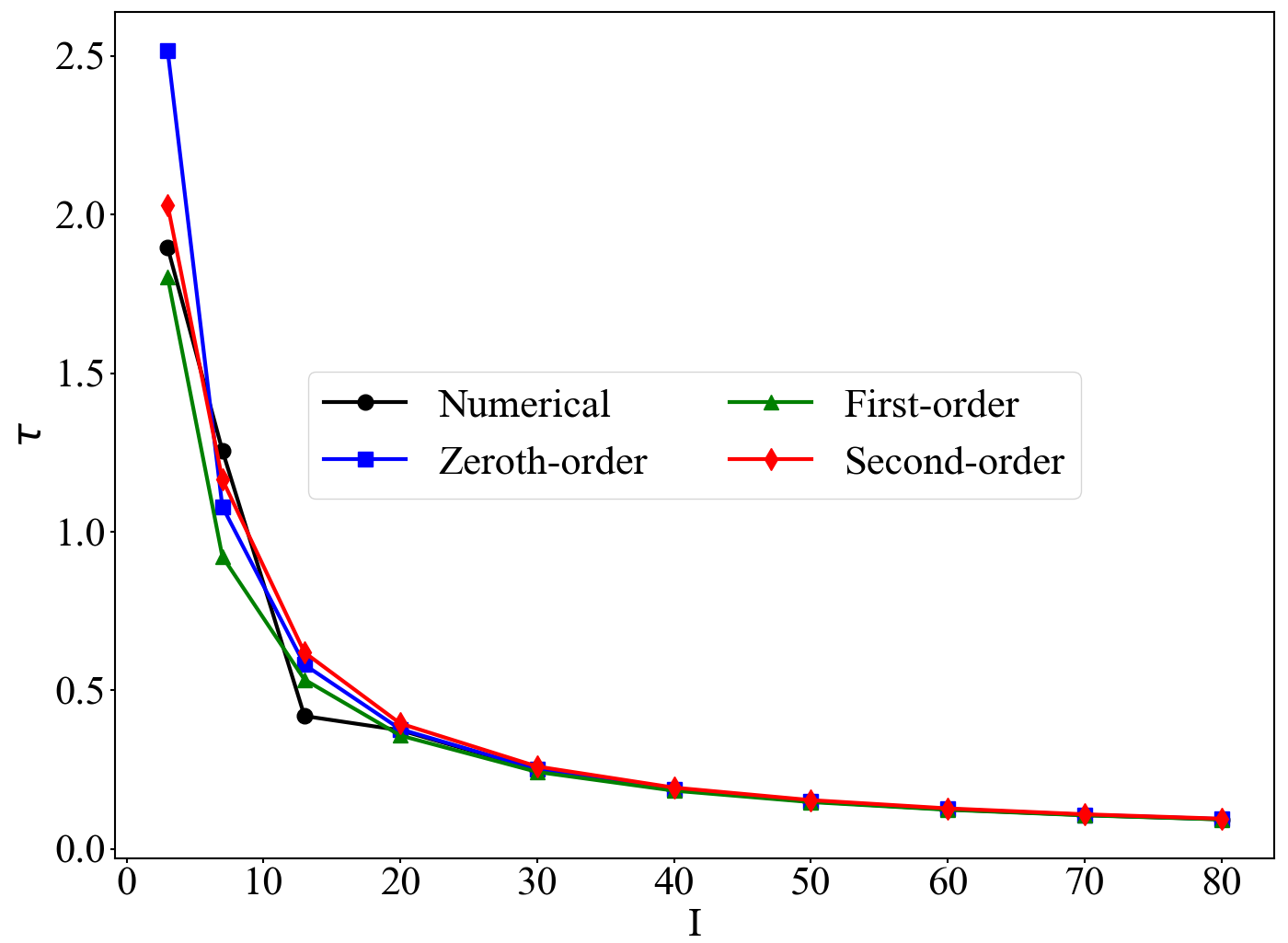
Figure 5: Relationship between pulse intensity Iτ=2πm5 and half-period Iτ=2πm6 for numerical, zeroth, first, and second order analytical conditions.
As Iτ=2πm7 increases, all theoretical constructions coalesce, confirming that high-frequency results are encompassed as a special limit. The utility of the Magnus hierarchy is evident in the fidelity optimization for practical, hardware-constrained environments.
Implications and Future Directions
The nonperturbative, Magnus-enhanced LEO Floquet control protocol provides a robust foundation for subspace-preserving quantum operations under realistic driving constraints. Beyond closed systems, this formalism is readily generalizable to open-system dynamics, allowing for systematic treatment of environment-induced non-Markovian effects. The analytic corrections derived here have immediate applicability in superconducting qubits, trapped ions, and other engineered quantum information platforms, where they enable enhanced state transfer, dynamical decoupling, and robust adiabatic passage in regimes previously inaccessible by standard methods.
The theoretical backbone also opens possibilities for automated pulse design via integration with quantum optimal control toolkits, providing direct analytic gradients for variational or machine learning approaches in quantum control. Future developments may include the exploration of nontrivial gauge structures in many-body Floquet systems, generalizations to higher-dimensional leakage spaces, and the synthesis of composite pulses using the full Magnus–Floquet toolbox for universal quantum computation under realistic constraints.
Conclusion
This work establishes a unified, nonperturbative pulse design framework based on embedding the LEO protocol in the Floquet–Magnus expansion, overcoming limitations inherent to high-frequency control assumptions. Accurate analytical pulse conditions at arbitrary frequencies are derived, enabling robust and high-fidelity quantum control in experimentally relevant regimes. The versatility of this approach points toward broad implications in quantum information, quantum simulation, and the development of error-resilient quantum technologies.
Reference: "Nonperturbative Leakage Elimination Operator-Based Quantum Control Pulse Design Beyond the High Frequency Driving Regime" (2606.29854)