- The paper introduces a DRAG protocol that cancels first-order leakage errors in superconducting qubits, reducing leakage by an order of magnitude over standard pulses.
- It employs analytical models and numerical simulations to compare pulse shapes, revealing that sharper pulses enhance speed but increase spectral leakage.
- The review integrates hardware considerations with multi-qubit pulse engineering, using echoed CR sequences and active cancellation to achieve fidelities above 0.99.
Pulse Shaping Strategies for High-Fidelity Superconducting Qubit Control
Introduction
This paper presents a comprehensive review of pulse shaping techniques optimized for superconducting qubit systems, particularly transmon-based architectures. The authors provide not only the analytical and physical underpinnings for the pulse design but also directly address the impact of hardware non-idealities and discuss practical multi-qubit gate engineering. The review integrates theoretical insights from the Magnus expansion, explicit Hamiltonian modeling, and systematic strategies for both single- and two-qubit high-fidelity gate construction.
Physics of Pulse Shaping
The analysis begins with a rigorous treatment of pulse-driven gate operations in two-level and multi-level (three-level) systems. Using a driven qubit Hamiltonian, the authors leverage the Magnus expansion to systematically construct the effective evolution operator order by order, preserving unitarity and transparently exposing error channels.
In the resonant, two-level system limit, it is shown that pulse shape details are irrelevant to first order at exact resonance. Nevertheless, in practical scenarios with small but finite detuning, pulse shaping effects manifest at higher-order terms, directly influencing the fidelity of gate operations. Square, triangular, and Gaussian pulses are compared analytically and numerically, with the square pulse achieving sharper (higher amplitude) Rabi oscillations at the cost of severe spectral leakage relative to smoother alternative envelopes.
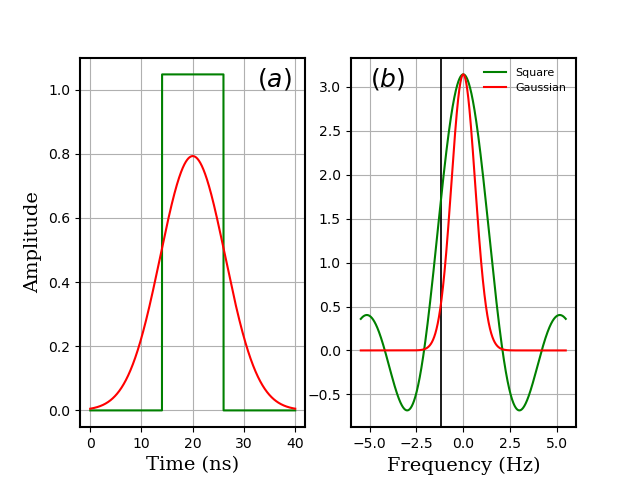
Figure 2: The time-domain comparison of square and Gaussian pulses with their respective frequency spectra, highlighting the larger spectral sidelobes (leakage potential) in square pulses.
A pivotal observation is that the non-ideal nature of transmon qubits as weakly-anharmonic, multi-level systems necessitates three-level (or beyond) modeling to capture dominant error mechanisms. The inclusion of a leakage state in the minimal model exposes the critical role of pulse spectral content—short, sharp-edged pulses exacerbate leakage due to broad frequency components overlapping with the non-computational transition frequency.
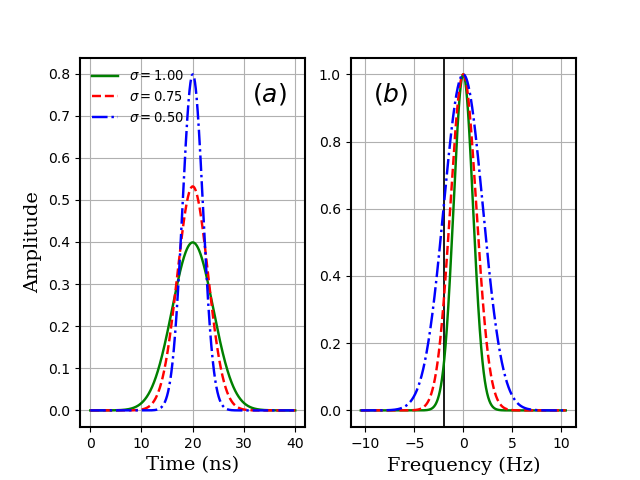
Figure 4: Gaussian pulses of varying durations show that narrower pulses (shorter in time) produce a wider frequency spread, hence more leakage potential.
DRAG Protocol: Analytical and Numerical Validation
The central analytical contribution is the systematic derivation and justification for the DRAG protocol (Derivative Removal by Adiabatic Gate). By augmenting the primary in-phase control pulse I(t) with a quadrature component Q(t) proportional to the time derivative of I(t) (i.e., Q(t)=−I˙(t)/Δ with Δ as the qubit anharmonicity), the leading-order leakage terms in the Magnus expansion are exactly cancelled. This approach suppresses both out-of-subspace excitation and minimizes undesired rotation-axis errors in the computational manifold.
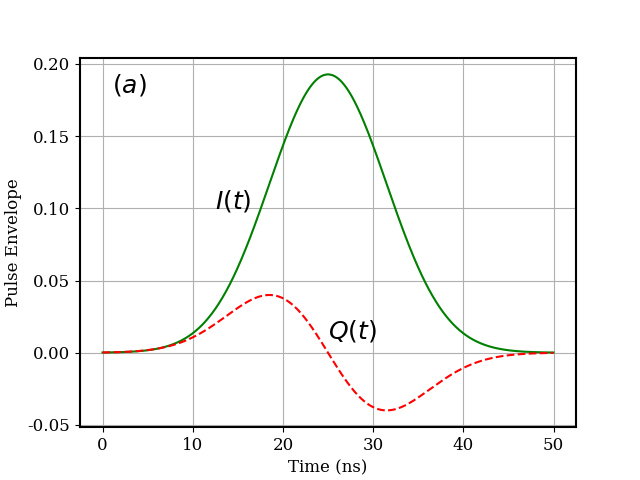
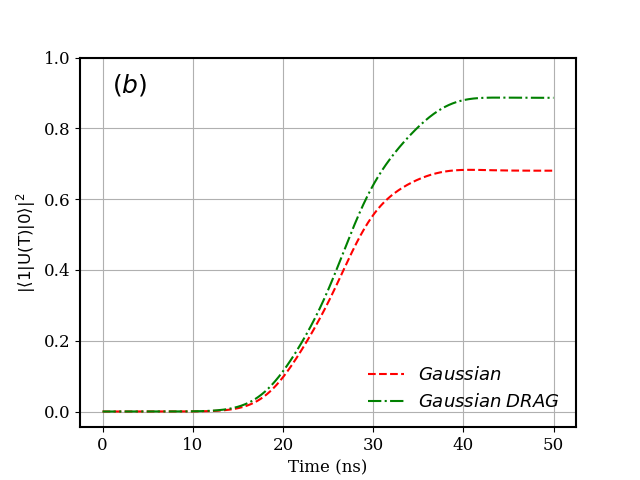
Figure 1: Left: Schematic of DRAG pulse I/Q components; Right: Numerical simulation showing DRAG (red) suppresses leakage much better than a pure Gaussian (blue) in a three-level transmon model.
While the DRAG correction completely refocuses first-order leakage, residual second-order errors remain—notably AC Stark shifts (phase errors) and higher-order leakage via ∣0⟩↔∣2⟩ coupling. These cannot all be analytically eliminated given hardware constraints and non-zero bandwidth requirements, and motivate advanced multi-derivative DRAG procedures for further error suppression.
Hardware Realities in Pulse Generation
A detailed engineering treatment of pulse synthesis illuminates the translation from analytic shapes to physical signals. The review covers AWG (Arbitrary Waveform Generator) sampling limits, Nyquist zones, digital-to-analog conversion artifacts (e.g., sinc roll-off, aliasing), and the complete analog IQ-mixing signal chain.
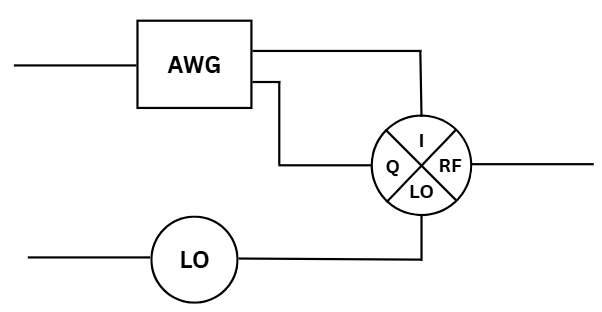
Figure 3: Schematic for pulse synthesis using AWG, LO, and IQ mixer; I/Q bases enable universal qubit rotations but suffer from calibration-dependent imperfections.
Hardware non-idealities—mixer skew, amplitude mismatches, finite phase stability from the local oscillator—are shown to produce errors equivalent in magnitude to environmental decoherence and crosstalk. The digitization and digital up-conversion approaches are emphasized as superior for maintaining quadrature orthogonality and combating these errors.
Pulse Engineering for Two-Qubit Cross-Resonance Gates
For multiqubit superconducting architectures, the cross-resonance (CR) gate is analyzed as a scalable native two-qubit entangling operation. Beginning with an effective Hamiltonian containing desired and spurious interaction terms (Z⊗X, I⊗X, Z⊗Z, etc.), the authors detail composite pulse and echo protocols to refocus and suppress dominant error channels. Echo sequences, active cancellation (AC) pulses, and rotary-tone extensions are conceptually and practically explored.
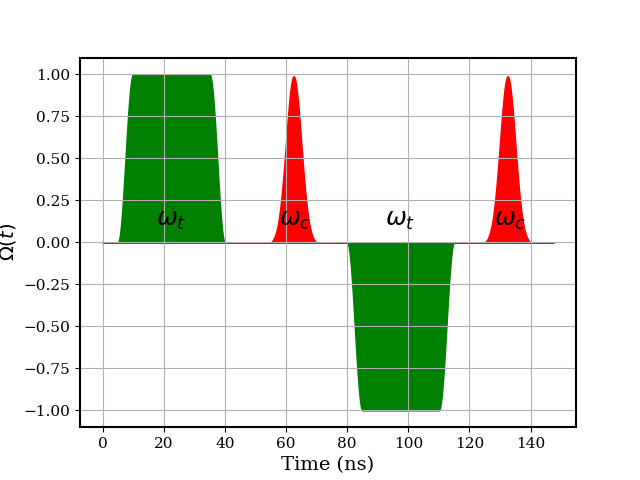
Figure 8: Echoed CR gate sequence with CR (green, flat-top Gaussian) and control π-pulses (red) for error refocusing.
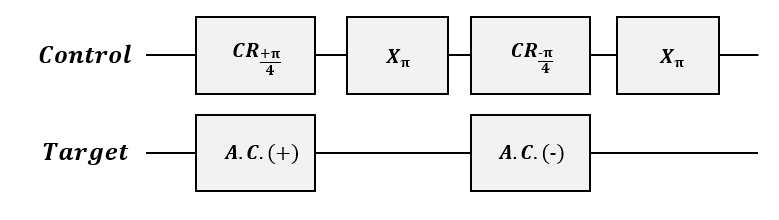
Figure 5: Simultaneous active cancellation pulse (blue) targeting the Q(t)0 error channels during the CR echo sequence.
Systematic AC calibration is shown to achieve high fidelity (Q(t)1) and reduced gate times (from 400 ns to 160 ns). The multi-derivative DRAG extends this protocol, recursively canceling multiple leakage channels and supporting faster, more robust CR gates with even higher fidelity (reported up to 0.997).
Mitigating Spectator-Qubit and Crosstalk Effects
Always-on Q(t)2 coupling induces idle-time crosstalk on non-participant qubits (“spectators”), impacting the global fidelity of deep circuits. The review proposes the application of dynamical identity gates (Q(t)3) on spectator qubits, effectively acting as a Hahn echo to refocus accumulated phases and restore computational coherence before active use.
Conclusion
This paper provides a rigorous, technically detailed, and pedagogically structured integration of pulse shaping theory and engineered implementations for superconducting quantum processors. Pulse envelope optimization, combined with systematic hardware-aware protocols such as DRAG, echoed CR sequences, and active cancellation, are articulated as essential components for achieving high-fidelity operations across both single- and multi-qubit gates.
Key numerical results include:
- Analytical DRAG reduces leakage error by an order of magnitude over standard Gaussian gating.
- Echoed CR sequences with active cancellation achieve fidelities Q(t)4 with pulse durations as low as 160 ns.
- Multi-derivative DRAG approaches push fidelity to Q(t)5 and reduce gate ramp times by over 60%.
The theoretical implications underscore that error mitigation in quantum control is fundamentally an integrated analytical, hardware, and calibration problem; practical optimization will lie at this intersection. Future developments are likely to focus on:
- Systematic synthesis of higher-order, platform-specific composite pulses
- Hardware-software co-design for signal chain error cancellation
- Calibration protocols for robust entangling gate benchmarking in large-scale chips
By unifying Hamiltonian-model-based insight, spectral-engineered pulse protocols, and hardware error analysis, this work establishes a mature foundation for ongoing advancements in quantum gate fidelity for superconducting quantum devices.

