- The paper demonstrates that static parameter offsets effectively suppress leakage errors by compensating control-induced couplings in quantum systems.
- It reveals significant fidelity improvements for single- and two-qubit gates in superconducting transmon circuits, achieving near fault-tolerance.
- The method is compatible with pulse shaping and crosstalk mitigation techniques, offering a scalable solution for robust quantum control.
Leakage Suppression in Quantum Control via Static Parameter Offsets
Introduction
The fidelity of logical quantum operations in noisy intermediate-scale quantum (NISQ) architectures is fundamentally limited by leakage errors: undesired evolution from the computational subspace into higher, non-computational energy levels. Such leakage manifests as a major bottleneck for quantum error correction, especially in large-scale superconducting quantum processors due to the weak anharmonicity inherent in the transmon platform. This paper introduces a strategy to actively suppress leakage by applying static offsets to tunable control parameters, thereby compensating for the deleterious effects of inevitable control-induced couplings. Crucially, this method neither modifies the original control pulse sequence nor incurs time or complexity penalties, and it proves compatible with subsequent pulse-shaping or optimal control enhancements.
General Methodology and Theoretical Framework
The proposed leakage suppression protocol is platform-agnostic, relying on static adjustment of experimentally available parameters (amplitude, detuning, phase) in the system Hamiltonian. The central observation is that leakage couplings are functions of these tunable parameters; thus, judicious selection of small, static offsets can systematically minimize gate infidelity contributed by the leakage Hamiltonian. Technically, the evolution operator is partitioned into desired dynamics and leakage-induced errors, and the protocol employs a sequence of frame transformations (implemented by unitary rotations parameterized by the offsets) to neutralize leakage effects segment-wise. Practical determination involves deriving the system Hamiltonian and leakage terms, constructing the relevant frame, mapping theoretical offsets to physical parameters, and then numerically optimizing gate fidelity.
The protocol is general: it requires only that leakage is parameter-dependent, not relying on specifics of the level structure or coupling. The static offset strategy can be layered atop any control method, and especially complements pulse-optimal schemes or composite gates. Experimental feasibility derives from the modest magnitude of the necessary offsets, all lying within contemporary calibration tolerances.
Application to Superconducting Qubits: Single-Qubit and Two-Qubit Gates
This framework is instantiated in detail for superconducting transmon circuits, covering both single- and two-qubit gates. The computational subspace is formed by the two lowest transmon levels; higher states form the leakage subspace, with unwanted ∣1⟩↔∣2⟩ transitions induced by standard microwave control.
For single-qubit gates (NOT, Hadamard), the protocol identifies optimal combinations of detuning, phase, and amplitude offsets, yielding fidelity improvements from 99.6%–99.5% to nearly 99.99% for NOT and Hadamard, respectively, even in the presence of typical decoherence (2π×2 kHz). The method's operation and results are illustrated in the energy spectrum and state space trajectory:
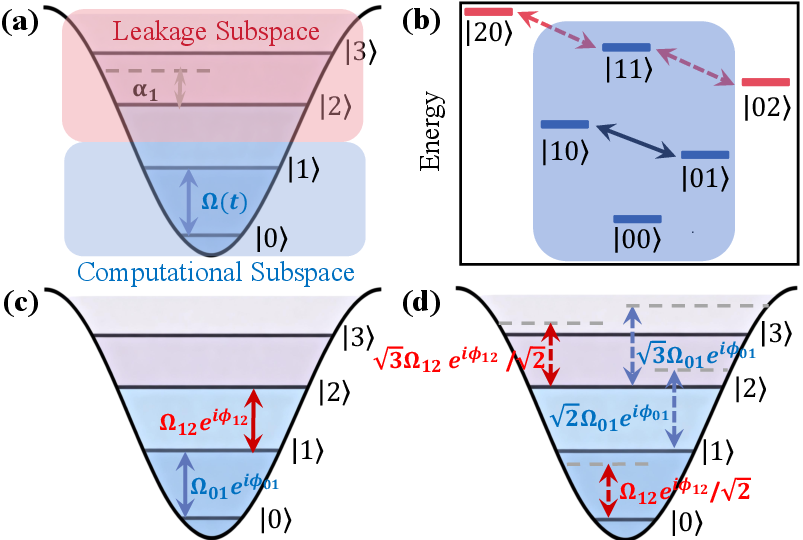
Figure 1: The non-equidistant energy spectrum for a transmon, indicating computational and leakage subspaces.
The theoretical predictions for fidelity improvement closely match exact numerics:
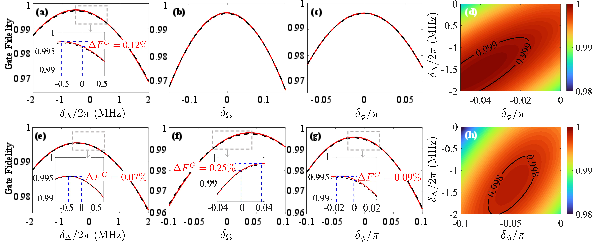
Figure 2: Gate fidelity as a function of offsets, for NOT and Hadamard gates, showing substantial enhancements.
With decoherence included, the population transfer for initial ∣0⟩ states under NOT/Hadamard is shown:
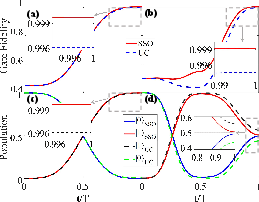
Figure 3: Fidelity and state population for NOT and Hadamard gates with and without optimized static offsets under decoherence.
For two-qubit operations (parametric iSWAP gates), the paper derives parameter corrections to suppress crosstalk-induced population loss into ∣02⟩/∣20⟩. The optimized offsets (magnitude <0.5 MHz and phase 99.6%0) deliver fidelity improvement from 99.6%1 to 99.6%2.
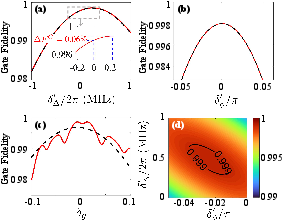
Figure 4: Fidelity for 99.6%3SWAP gates as a function of static offsets in coupling, phase, and detuning.
Decoherence-robustness is also demonstrated:
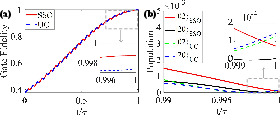
Figure 5: Fidelity and population for 99.6%4SWAP gate with and without static parameter offsets under decoherence.
Suppression of Leakage in Multi-Level State Transfer
The framework is extended to multi-level systems, enabling perfect stimulated Raman adiabatic passage (STIRAP) between distant computational states using static parameter offsets. In a ladder-type transmon, tailored offsets applied to simultaneous pulses enable error-tolerant population transfer:
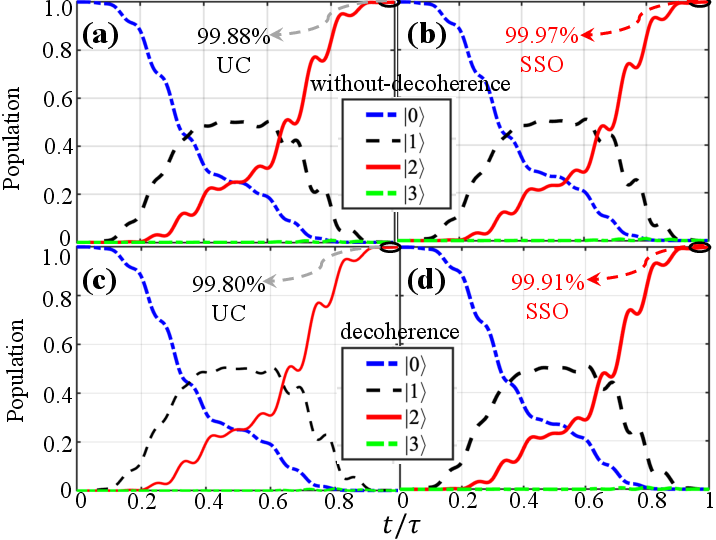
Figure 6: State fidelity and populations during multi-level state transfer, with and without static offsets, under both unitary and decohering conditions.
Here, fidelity improvements from 99.6%5 to 99.6%6 (no decoherence) and 99.6%7 to 99.6%8 (with decoherence) are reported.
Compatibility With Optimal Control and Crosstalk Mitigation
A critical theoretical result is the demonstrated compatibility of static offset corrections with advanced optimal control strategies, notably geometric trajectory correction (GTC) methods that target suppression of residual ZZ crosstalk. In a two-dimensional lattice with significant static crosstalk, direct application of static offsets on top of GTC enables cooperative suppression of both leakage and crosstalk errors without performance loss.
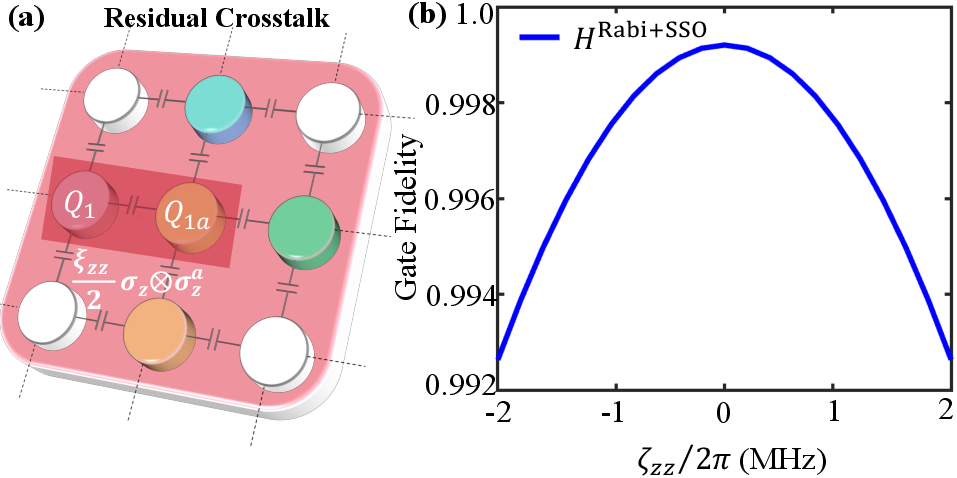
Figure 7: Schematic of a 2D superconducting qubit lattice with residual ZZ crosstalk among nearest neighbors.
Gate fidelity and leakage sensitivity under GTC and combined SSO schemes are contrasted:
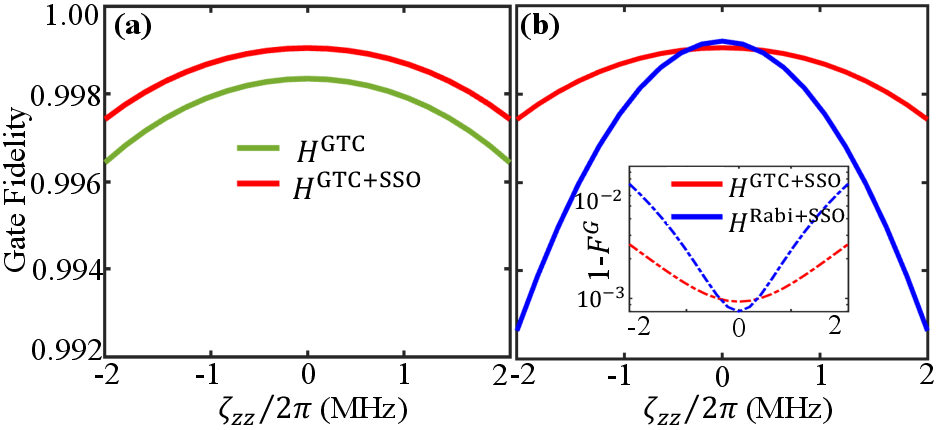
Figure 8: (a) Gate fidelity under ZZ crosstalk with and without static offsets. (b) Comparison of multi-scheme compatibility versus simple static offset for ZZ error suppression.
Quantitative analysis shows a fidelity gain from 99.6%9 to 99.5%0 for geometric Hadamard gates, and substantially enhanced robustness to residual errors, relative to single-technique implementations.
Robustness to Calibration Errors and Comparison With DRAG
Parametric studies of calibration precision demonstrate that the approach confers strong robustness: even with order-of-magnitude relaxed offset precision (99.5%1 MHz), single- and two-qubit fidelities remain above 99.5%2 and 99.5%3, respectively.
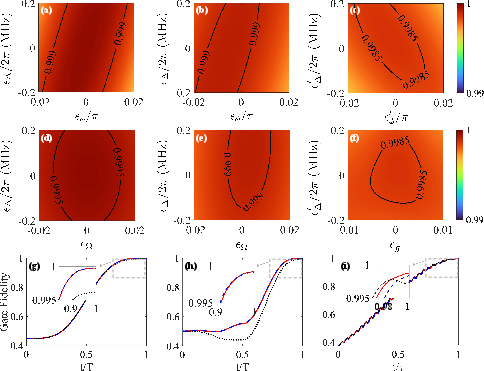
Figure 9: Gate fidelity versus calibration errors and offset precision for NOT, Hadamard, and 99.5%4SWAP gates.
Contra DRAG pulse shaping, static offset correction requires no additional control pulses or pulse shaping and is computationally cheaper. Direct comparison evidences almost equivalent error suppression at lower implementation overhead.
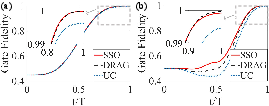
Figure 10: Fidelity comparison for NOT and Hadamard gates with static offset scheme, DRAG, and no correction under decoherence.
Implications and Future Directions
This work establishes that static parameter offsets provide a general, scalable, and platform-independent route to leakage minimization. Importantly, it does not preclude the use of advanced pulse engineering and is inherently extensible to optimal control, composite pulses, and hybrid circuits. The effectiveness over a wide calibration range and for both single- and multi-qubit interactions ensures its suitability for current and next-generation devices.
The synergy of static offsets with techniques mitigating correlated errors (e.g., crosstalk, non-Markovian noise) suggests that systematic, layered error suppression—where leakage is one ingredient—will become standard. High-fidelity gates (99.5%5) naturally approaching thresholds for fault-tolerance can be targeted without hardware modification or increased pulse complexity, accelerating progress toward scalable quantum computation. Further extensions should address optimization under realistic, correlated noise models, automated calibration in large devices, and generalization to other hardware platforms such as semiconductor dots and neutral atoms.
Conclusion
The application of static parameter offsets offers an efficient, universal strategy to suppress leakage errors in quantum control. The method's operational simplicity, experimental accessibility, and demonstrated compatibility with optimal control and crosstalk minimization enables high-fidelity, robust quantum operations required for scalable and fault-tolerant quantum information processing. This protocol provides immediate practical value for existing quantum processors and theoretical foundations for error management in future quantum architectures.