LLM Semantic Signaling Game and Mechanism Design: Systematic Blindness, Awareness Shaping, and Mindset Dynamics
Published 27 Jun 2026 in cs.GT, cs.AI, and cs.MA | (2606.29113v1)
Abstract: LLMs increasingly mediate strategic interactions through natural language, making semantic control a critical element of communication and deception. This paper develops a semantic signaling game in which a sender selects a semantic control, an LLM generates a stochastic message, and a receiver evaluates the message using an awareness-dependent scoring mechanism. Receiver awareness is modeled as a type that determines which linguistic features are perceived and used for inference, providing a formal model of systematic blindness. The framework connects prompt-based control, statistical detection, and game-theoretic equilibrium analysis. Gaussian approximations of aggregate message scores enable likelihood-ratio decision rules, while Perfect Bayesian Nash equilibria characterize strategic behavior. The paper further develops mechanism-design approaches that reshape receiver awareness, penalize deceptive semantic controls, and modify receiver populations to induce benign pooling equilibria. Numerical experiments validate the Gaussian approximation, quantify awareness-ordering effects, analyze mindset dynamics under adaptive adversaries, and demonstrate how awareness shaping and guardrail costs reduce successful phishing attacks. The proposed framework provides a principled foundation for analyzing strategic language-mediated interactions in agentic AI systems and offers new tools for the design of robust and secure human-AI communication.
The paper develops a formal model of LLM-mediated semantic signaling by linking sender semantic control, stochastic message generation, and receiver awareness.
It demonstrates that systematic blindness arises when receiver feature scoring omits critical cues, with Gaussian approximations used to compute detection thresholds.
The study proposes mechanism design strategies, including guardrails and population shaping, to mitigate adversarial adaptations in LLM communications.
LLM Semantic Signaling Games: Awareness, Systematic Blindness, and Mechanism Design
Introduction and Modeling Framework
The paper "LLM Semantic Signaling Game and Mechanism Design: Systematic Blindness, Awareness Shaping, and Mindset Dynamics" (2606.29113) develops a formal framework for understanding strategic language-mediated interactions where LLMs serve as the generative mechanism between a sender and a receiver. The sender exerts high-level semantic control (e.g., through prompts or instructions), the LLM realizes stochastic messages, and the receiver evaluates messages through an awareness-dependent feature map. Central to the analysis is the notion that receiver awareness is not a mere scalar for detection accuracy, but a type-dependent selection of features and scoring rules, directly shaping which linguistic signals are processed for inference and action.
The model closes the gap between traditional signaling games—which abstract away from linguistic content—and real LLM-mediated systems, where message generation is neither fixed nor directly selected token-by-token by the sender. Instead, a strategic sender picks a semantic-level control, which the LLM turns into a distribution over messages, introducing operational stochasticity. Receivers, parameterized by their awareness type, process only a subset of message features, embedding systematic blindness and heterogeneity across a population.
Semantic Control, Message Generation, and Receiver Awareness
The interaction pipeline is formally specified as: θμyLLMmΨαSαδαa
where θ is the sender’s private type, y the semantic control, m the LLM-generated message, Ψα a feature-based scoring map depending on receiver awareness α, Sα the resulting score, and δα the receiver’s decision rule. The key elements include:
Sender Strategies: With a finite type space, the sender's action is to select a semantic control, not the specific message. Each control y parameterizes the LLM's autoregressive kernels and induces a distribution over token sequences, modeled as a non-homogeneous Markov process.
Receiver Awareness: Awareness types α correspond to different subsets of token features or cue categories scored by the receiver. For instance, in phishing detection, naive receivers may only track explicit terms ("password", "login"), while aware receivers expand to action words, authority cues, or contextual mismatches.
Score Construction: The receiver’s score is an additive function over tokens, θ0, where θ1 maps tokens to (possibly weighted) feature scores. This provides analytic tractability and encompasses keyword-based as well as more graded scoring functions.
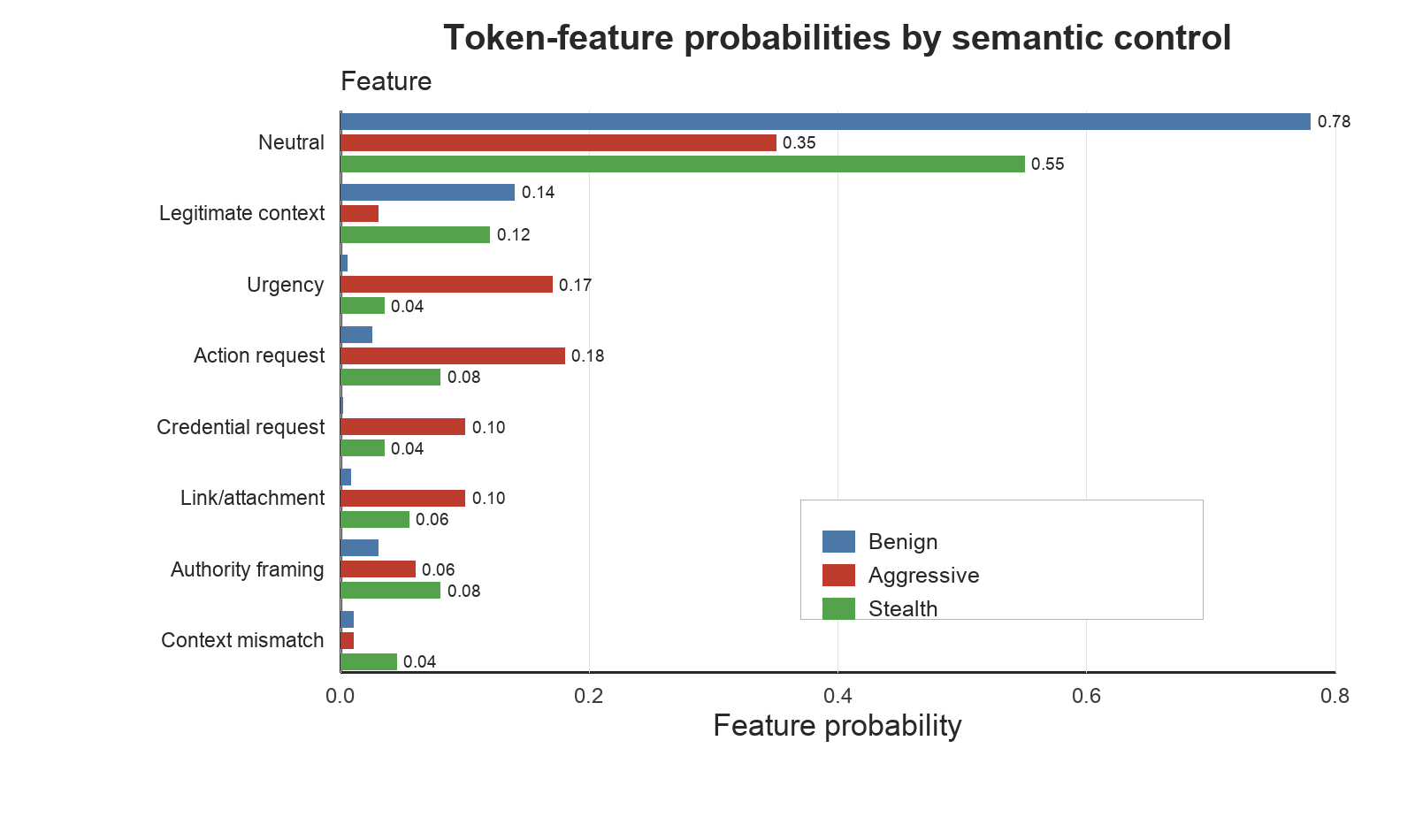
Figure 1: Feature-category probabilities induced by the three semantic controls. The stealth control reduces explicit phishing cues while retaining weaker authority, action, and mismatch cues.
Statistical Approximation and Decision Rules
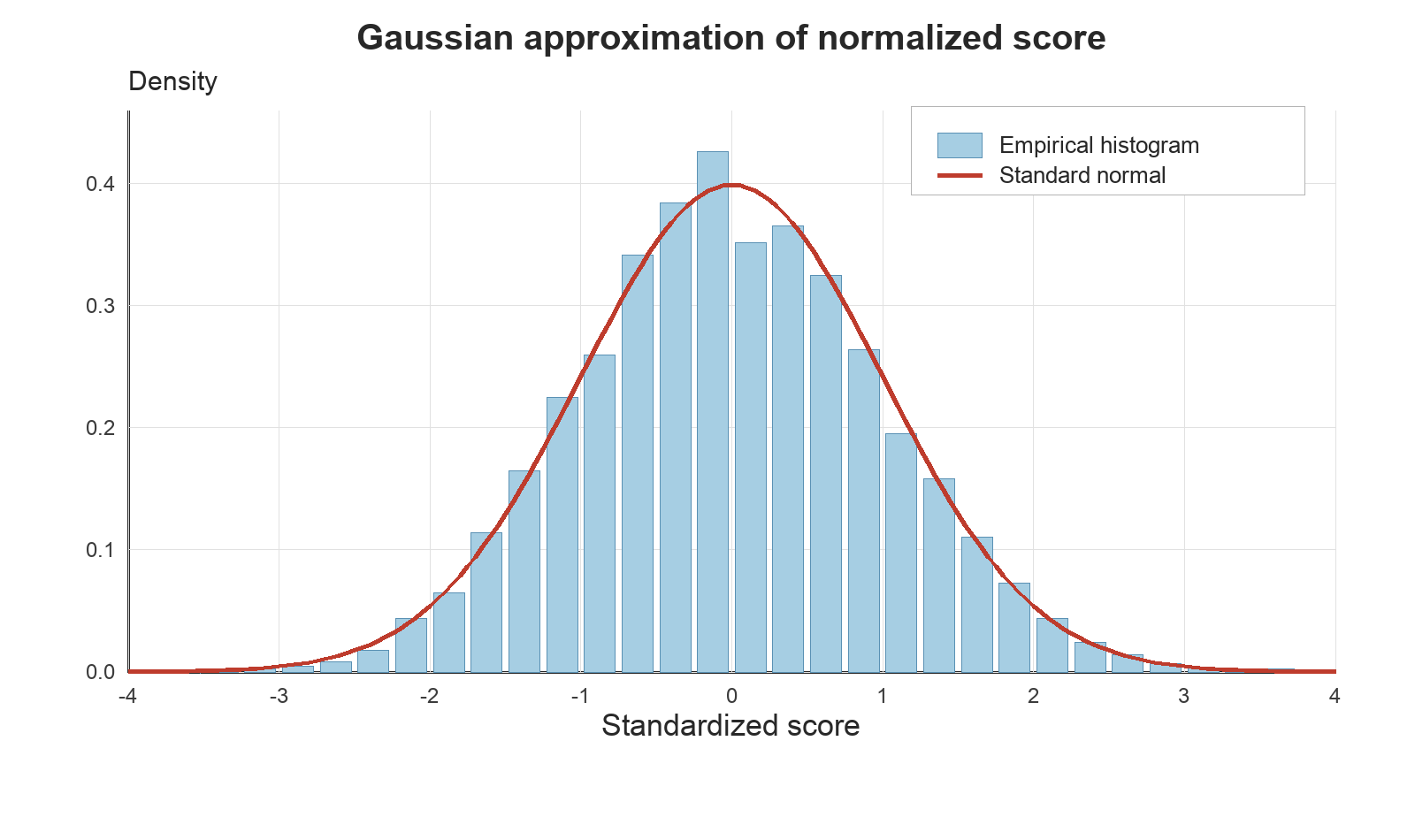
A principal analytical result is that, under mild conditions, the cumulative score θ2 over long generated messages is asymptotically Gaussian due to the martingale central limit theorem. Mean and variance depend on both the semantic control and the awareness type, allowing precise calculation of detection thresholds and error rates for various receiver populations.
Figure 2: Gaussian approximation for the normalized cumulative score under the stealth semantic control and aware receiver. The close match between the empirical histogram and the standard normal density supports the CLT approximation in the analytical model.
Leveraging this, receiver inference after observing θ3 is formulated as a likelihood ratio or threshold test, optimally partitioning the score axis based on posterior Bayes risk. Importantly, the separation between distributions under different sender types depends on the overlap of their generative token distributions and the receiver’s effective feature set. Receivers with richer θ4 functions exhibit greater type separability.
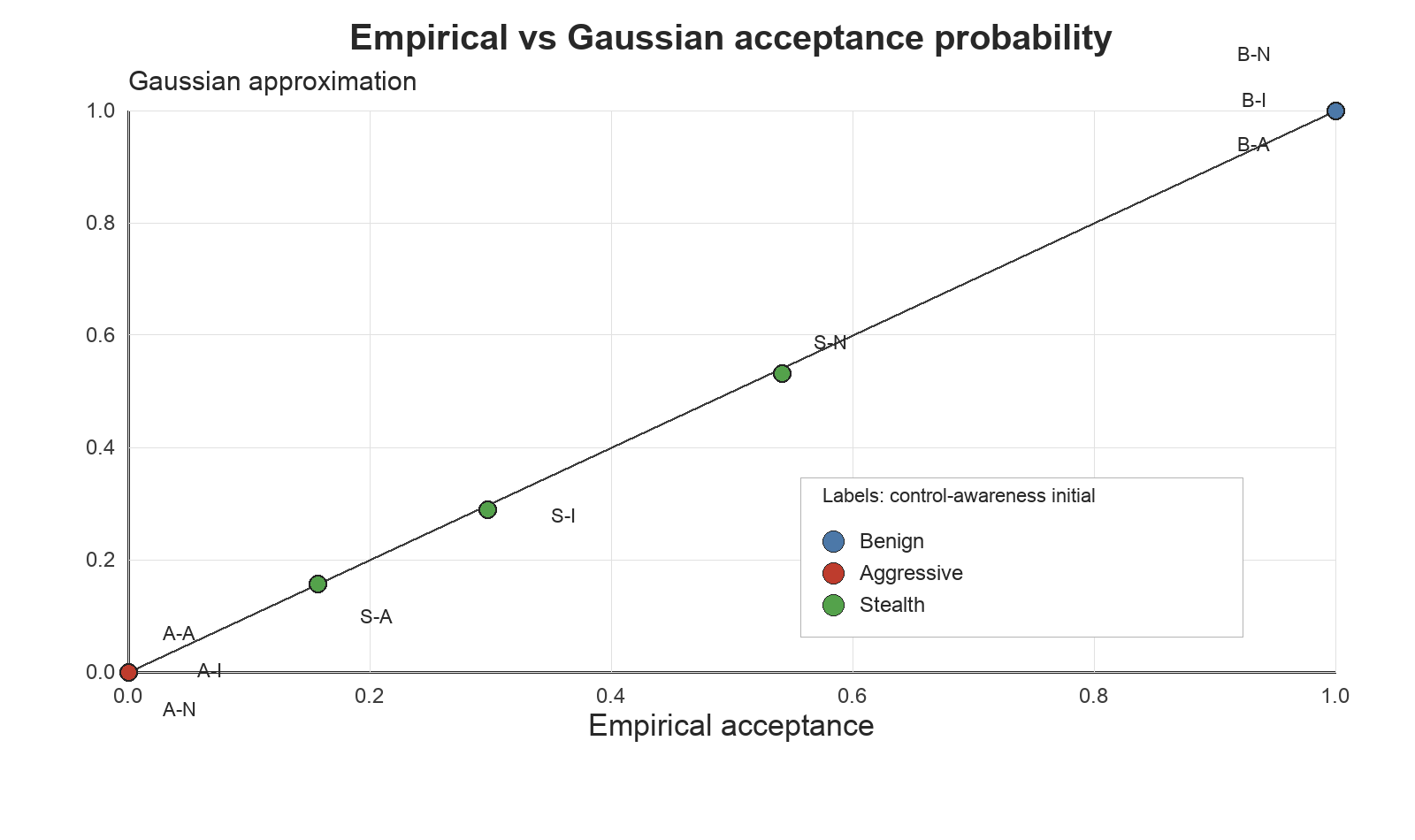
Figure 3: Empirical acceptance probabilities versus Gaussian approximations for all semantic-control and awareness-type pairs. Points near the diagonal indicate that the closed-form approximation accurately tracks empirical results.
Equilibrium and Incentive Structure
The induced Bayesian game admits a Perfect Bayesian Nash Equilibrium (PBNE), with explicit characterizations for sender and receiver strategies:
Sender Optimization: For each type, the sender selects the semantic control θ5 maximizing expected utility, aggregating over the population’s acceptance probabilities—each modulated by feature awareness, threshold, and importance weighting.
Receiver Optimality: Each receiver applies an awareness-dependent threshold rule, accepting or blocking based on their observed θ6.
Equilibrium Structure: In direct revelation settings, incentive compatibility is characterized by row-wise dominance in the sender payoff matrix. Pooling (benign-only signaling) is only equilibrium if all alternative deceptive controls are strictly suboptimal for all sender types.
Systematic Blindness and Awareness Ordering
A central theoretical contribution is the formalization of systematic blindness: receivers may be provably unable to distinguish between benign and malicious semantic strategies not due to noise, but because their scoring function omits informative features. The set of informative features θ7 (those distinguishing between types at the token or cue level) may only partially overlap with the receiver's θ8; features in θ9 are epistemically invisible.
Awareness Ordering: The paper introduces a partial order on awareness types: y0 if the score differential between types under any semantic control is at least as large for y1 as for y2. This ordering maps directly to improved statistical discrimination, lower error rates, and stricter effective thresholds.
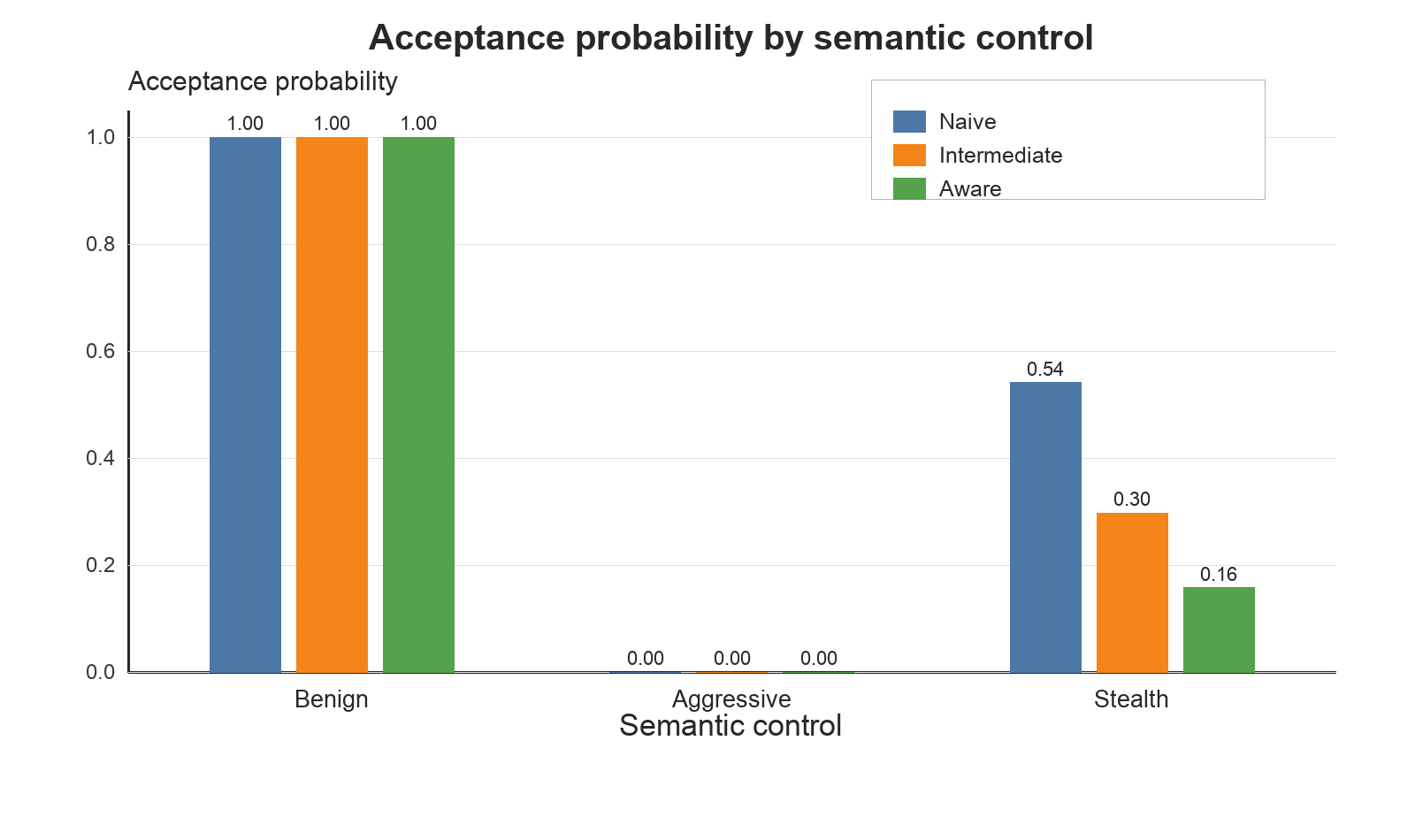
Figure 4: Empirical acceptance probability across semantic controls and awareness types. Stealth phishing selectively evades lower-awareness receivers, while increased awareness reduces acceptance, illustrating the behavioral ordering prescribed by the model.
Implications for Defense: Only expanding y3 through training or system design closes off blindness; adjusting thresholds alone cannot recover detection power if key features are not scored.
Mindset Dynamics and Adaptive Evasion
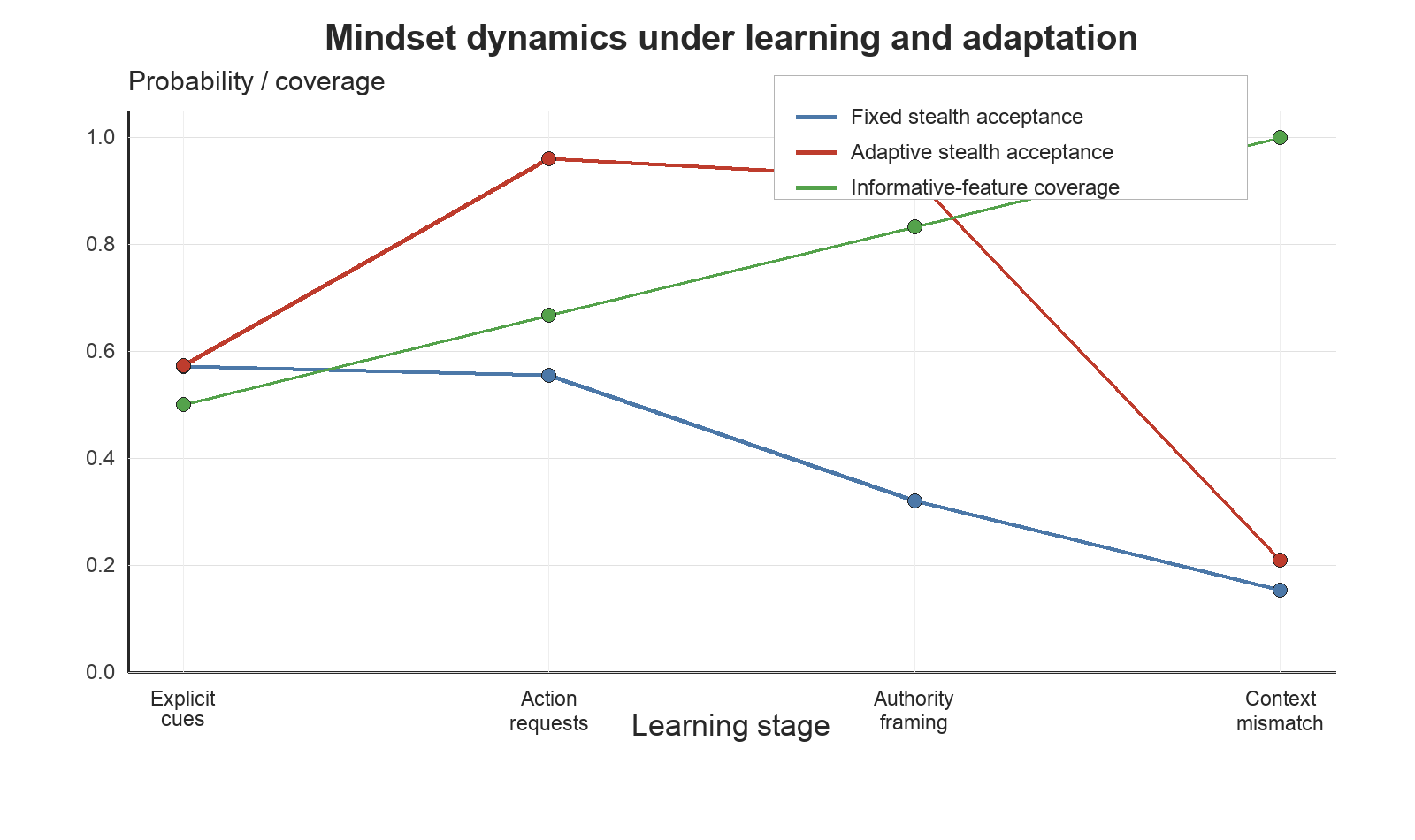
The model generalizes to dynamic settings, where receiver awareness evolves with exposure and learning. Mindset dynamics are implemented as feature set expansions y4, with the possibility for senders to adapt semantic controls correspondingly, repositioning persuasive cues into as-yet-unmonitored feature regions.
Figure 5: Mindset dynamics under feature learning and sender adaptation. Fixed stealth becomes easier to detect as y5 expands. Adaptive stealth preserves evasion as long as informative cues remain outside the receiver's feature set.
The dynamic depicts an adversarial co-evolution between feature coverage by receiver populations and evasive adaptation by the sender, highlighting the limits of one-shot interventions versus ongoing awareness expansion.
Mechanism Design: Guardrails, Population Shaping, and Pooling
The paper addresses mechanism-design levers for robust communication platforms—especially relevant for defense against LLM-enabled phishing:
Statistical Enhancement: Increasing the signal-to-noise separation of cues (by making features more discriminative or detection mechanisms more sensitive) directly reduces the profitable region for malicious sender controls.
Cost Engineering/Guardrails: Increasing the cost of generating nonbenign semantic controls (e.g., via LLM constraints, moderation, or verification workflows) can disincentivize deviation from benign behaviors.
Population Shaping: Shifting the receiver population distribution toward higher-awareness types—via training, interface design, or selective exposure—reduces system-level susceptibility to malicious controls.
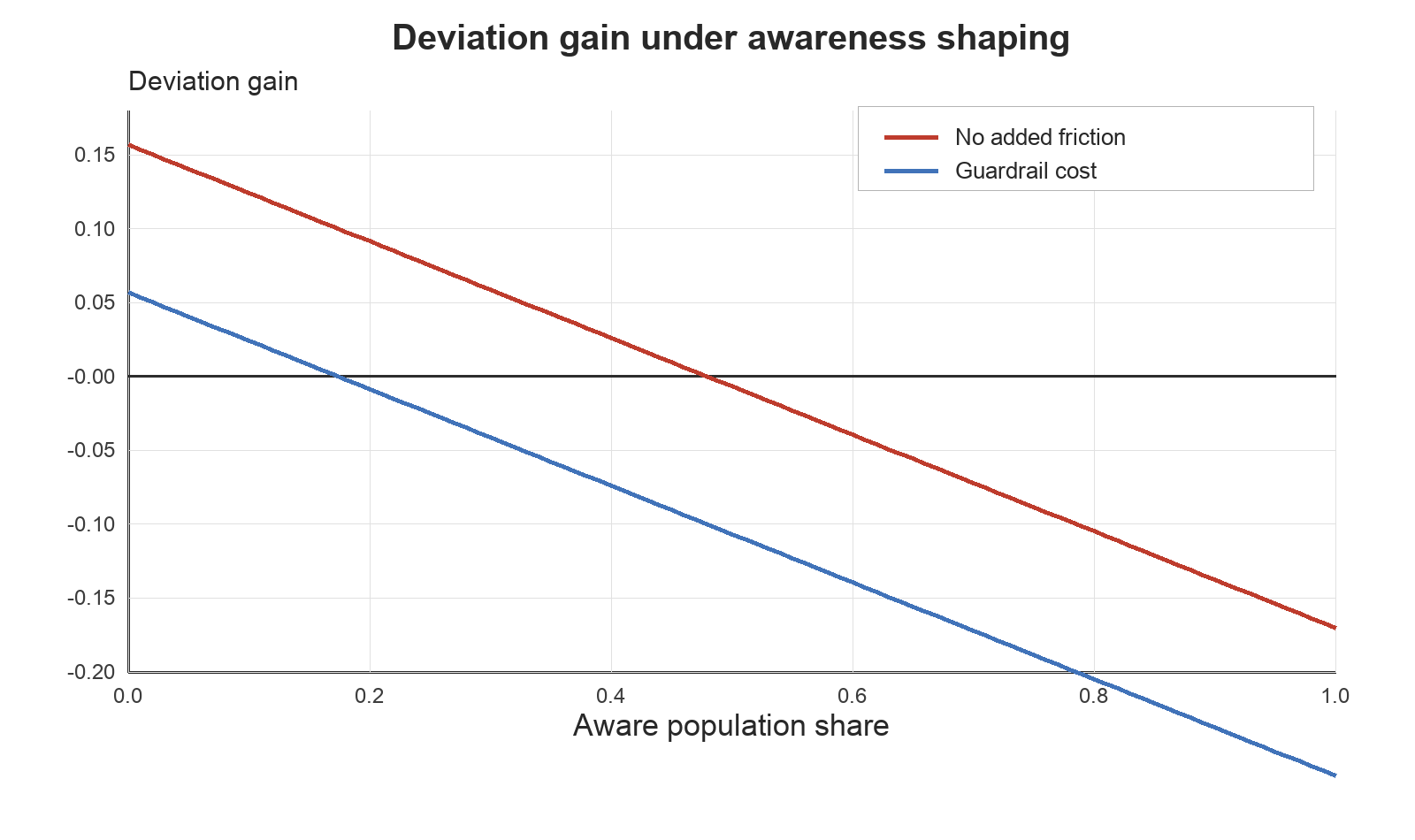
The optimal tradeoff involves minimum-information population shaping, where critical levels of aware receivers or guardrail imposition are required to eliminate any sender incentive to pick deceptive semantic controls.
Figure 6: Deviation gain for the malicious sender as the aware share of the receiver population increases. The zero line marks the boundary of the benign-pooling incentive condition. Awareness shaping and guardrail costs both reduce profitable deviations.
Numerical Study and Empirical Validation
A synthetic case study instantiates the theoretical mechanism with controlled semantic categories (benign, aggressive, stealth) and three awareness levels (naive, intermediate, aware). Empirical findings validate:
The applicability of Gaussian approximations to cumulative scores.
Behavioral ordering: naive receivers are highly vulnerable to stealth attacks, while the increment of awareness drastically reduces acceptance.
Mindset dynamics: learning and expansion of y6 sharply reduce attack success, but adaptive senders can exploit transient blind spots.
Practical mechanism design: sufficient fractions of aware receivers and moderate guardrail costs suffice to suppress profitable adversarial deviations.
Conclusion
This work advances the formal understanding of strategic natural language interactions mediated by LLMs, linking semantic control, stochastic message generation, feature-based detection, and behavioral game theory into an integrated signaling model. The results clarify how systematic blindness, as a representational boundary, fundamentally constrains detection performance and can only be overcome by expanding the receiver's feature space—not by mere thresholding.
The implications extend to real-world AI security and safety domains: robust defense requires not only technical detection but also awareness shaping, population training, and adaptive mechanism design. The equilibrium and incentive analyses provide actionable criteria for designing language platforms resistant to manipulation, with broader consequences for the theory of agentic AI systems and adversarial communication.
Future extensions could incorporate richer multi-step and multi-agent interactions, empirical parameterization with real LLM outputs, and the design of collaborative human-AI receiver teams under strategic semantic adversaries.