- The paper introduces a continuous-state decoding framework that reformulates mask prediction as x-prediction flow, enabling revisable token refinement.
- It employs per-token, confidence-adaptive asynchronous scheduling combined with a reinforcement-learned step-size policy to optimize embedding transitions.
- Empirical results on code generation benchmarks show significant accuracy gains at low decoding budgets by leveraging pretrained MDLMs with lightweight alignment.
Masked Diffusion Decoding as x-Prediction Flow: An Expert Perspective
Introduction
The paper "Masked Diffusion Decoding as x-Prediction Flow" (2606.29066) presents a reformulation of masked diffusion LLM (MDLM) decoding. Traditional MDLMs generate text by iteratively unmasking tokens, but standard decoding commits to a hard decision at each step, discarding information about alternative hypotheses and foreclosing future revisions. The authors propose a continuous-state decoding paradigm, conceptualizing mask prediction as clean-state prediction (i.e., x-prediction) and implementing a flow in embedding space that enables each token to accumulate partial progress and remain revisable. This approach is further enhanced with a per-token, confidence-adaptive, asynchronous schedule and a reinforcement-learned step-size policy. Notably, this framework delivers near full-budget accuracy with significantly reduced decoding steps on code generation benchmarks using pretrained models.
Motivation and Background
Autoregressive (AR) LLMs, while pervasive, suffer from high inference latency due to strictly sequential token generation. Masked diffusion approaches, such as LLaDA, enable parallel refinement of the output sequence, alleviating some latency issues and allowing for bidirectional context. However, current MDLM decoding is limited by its binary, position-wise commitment: a token is either fully masked or fixed to a single value, with no gradient of certainty or opportunity for late revision. This hinders sample efficiency under constrained budgets and fails to utilize the rich predictive distribution available at each step.
The paper identifies two central obstacles in applying continuous-state diffusion to language modeling:
- The lack of a semantically meaningful noise process: Unlike images, where Gaussian noise perturbations correspond to valid intermediate states, "noised" embeddings in language are not generally meaningful or within the support of the pretrained model.
- Strong, asymmetric contextual dependencies: The generation of one token in language can depend decisively on a few specific others, necessitating an adaptive, position-wise schedule.
x-Prediction Flow: Continuous Decoding in Embedding Space
The proposed solution reconceptualizes MDLM mask-prediction as an x-prediction problem in embedding space. The decoding is initiated from the deterministic mask embedding—the state on which the MDLM is explicitly trained—and iteratively drives each token's embedding toward the model's prediction of the clean embedding. The velocity field at each step is defined by the difference between the current state and the predicted clean state, modulated by the remaining decoding progress.
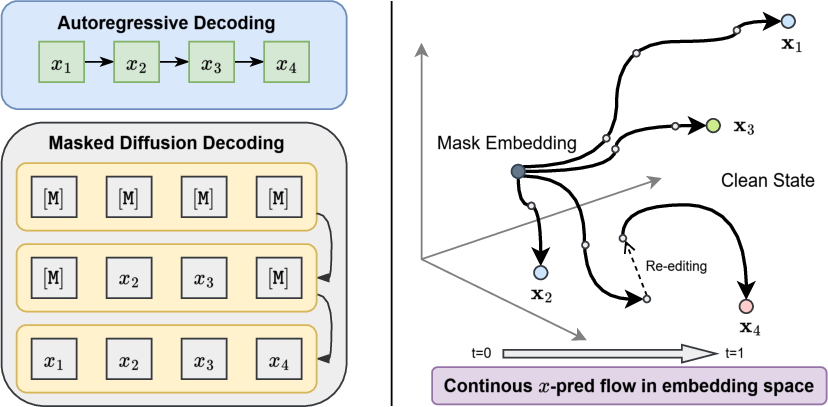
Figure 1: Evolution of all tokens in embedding space, moving from the mask embedding toward the predicted clean state via x-prediction flow.
Unlike previous attempts at soft decoding—which may use convex combinations of mask and candidate embeddings at isolated steps—the flow described here creates a persistent, token-wise trajectory, continuously refining each token embedding until the system converges or the budget is exhausted. This eliminates premature, irrevocable commitments and maximizes use of predictive information intrinsic to the model.
Confidence-Based Asynchronous Scheduling and Policy Learning
To address the asymmetric dependencies inherent in text, the framework assigns a vector-valued diffusion progress t to each token, supporting adaptive, asynchronous updates. Tokens with higher confidence advance further per step, anchoring the context and allowing less certain tokens to gather more information before major updates. The core schedule is parameterized by a step-size policy receiving per-token confidence signals and current progress, outputting log-scale step sizes.
Key mechanics include:
- Re-editing: If the model's confidence in a previously advanced token drops below the current progress, the token's state reverts toward its predicted embedding and the schedule rolls back, preserving flexibility.
- Hard commitment: The highest-confidence non-finalized token is committed at each step, anchoring the evolving context.
- Policy training: The step-size policy is optimized via GRPO, with rewards tied to trajectory-level task success and final completion of decoding progress.
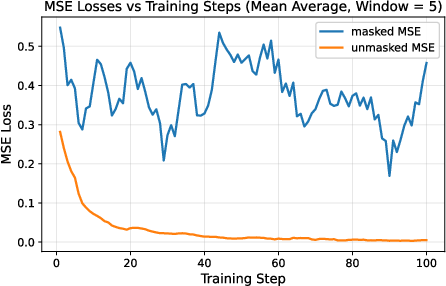
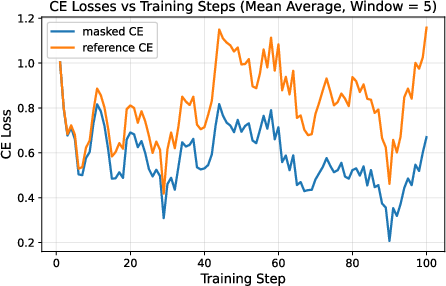
Figure 2: Mean squared error (MSE) loss curves demonstrating rapid x-prediction alignment at both masked and unmasked positions.
Training Regimen and Empirical Results
The method is primarily evaluated on code generation tasks (HumanEval and MBPP) utilizing LLaDA-8B-Instruct and LLaDA2.0-mini. Notably, only a lightweight alignment phase—hundreds of steps—adjusts the pretrained model for x-prediction flow compatibility using self-generated responses. The alignment targets stability in embedding prediction at both masked and unmasked positions, confirmed by quickly falling MSE at unmasked sites and stable cross-entropy at masked sites, underscoring minimal degradation to standard MDLM performance.
Empirically, the new decoding framework delivers:
- At 25% decoding budget, x-prediction flow recovers 97% of full-budget performance on HumanEval using LLaDA-8B-Instruct.
- Gains of 11–27 accuracy points over mask prediction at fixed low budgets across models/datasets, with the largest improvements observed in LLaDA2.0-mini.
- The learned step-size policy trained on one model generalizes to another, indicating robust, model-agnostic confidence pattern exploitation.
Ablation experiments further demonstrate that all major components—confidence-adaptive scheduling, re-editing, hard commitment, x0-prediction alignment—are vital, with removal leading to substantial drops in accuracy.
Theoretical and Practical Implications
Theoretically, the x1-prediction flow paradigm affirms that the embedding spaces of large pretrained MDLMs support meaningful continuous transitions from uncertainty (the mask) to confidence (the predicted clean embedding) and that these transitions can be modulated adaptively based on local predictive confidence. The method unifies continuous-state diffusion with discrete, context-sensitive language modeling by exploiting the native capabilities of pretrained models, bypassing the need for retraining on mixed or noisy inputs.
Practically, these results imply that pretrained MDLMs can be retrofitted to achieve high decoding efficiency with minor alignment, making them competitive in scenarios where latency or computational budget are primary constraints. The approach offers a pathway to further reduce inference costs and latency in industrial deployment without sacrificing model performance, especially on tasks requiring long-range bidirectional structure.
Future Outlook
The authors highlight a key open problem: the assumption that linear mixtures of token and mask embeddings are meaningfully interpreted by the model, empirically validated here, lacks a deep theoretical grounding. Understanding the geometry of input embedding spaces conducive to x2-prediction flows is an intriguing direction for both fundamental research and engineering optimizations. Future work may investigate improved policy learning algorithms, richer state representations, or integration with more diverse language modeling objectives.
Conclusion
The x3-prediction flow decoding framework redefines masked diffusion LM inference as a continuous, confidence-adaptive process in embedding space. By enabling partial, revisable commitment and leveraging pretrained model structure with only lightweight additional training, the approach yields substantial accuracy improvements at severely constrained decoding budgets. These advances suggest new avenues for efficient, flexible inference in non-autoregressive LMs and highlight deep connections between continuous-state generative modeling and modern LLM architectures.

