- The paper introduces iCoTASC, a framework that allocates radio resources based on feature importance for collaborative inference tasks.
- It leverages Integrated Gradients and a Weibull utility model to dynamically select and quantize embedding dimensions under variable channel conditions.
- Empirical results on Fashion-MNIST and CIFAR-10 demonstrate superior accuracy and reduced computation compared to baseline resource allocation methods.
Importance-Aware Resource Allocation in Collaborative Task-Oriented Semantic Communication
Introduction and Motivation
Collaborative task-oriented semantic communication (CoTASC) addresses the challenge of distributed multi-device inference under bandwidth-constrained, fast-varying wireless channels. Traditional wireless communication pipelines excel at faithfully transmitting raw or reconstructed signals, but these approaches are inadequate for modern edge intelligence scenarios where the aim is to maximize downstream task utility, not raw data fidelity. The iCoTASC (importance-aware Collaborative Task-Oriented Semantic Communication) framework aims to optimize the allocation of scarce radio resources based on the semantic importance of features for collaborative downstream inference tasks, especially under stringent latency and dynamic channel conditions.
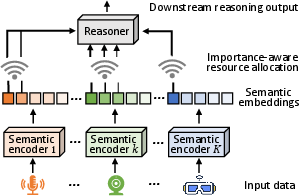
Figure 1: iCoTASC system overview—importance-aware multi-device semantic communication adapting to dynamic wireless conditions.
Empirical evidence and prior literature suggest the need for methods that (1) allow multiple devices to dynamically coordinate semantic encoding, (2) adapt their communication precision and resource allocation per-channel state, and (3) do so without computationally intensive online optimization or retraining. iCoTASC addresses these needs via a hybrid offline–online architecture that leverages attribution-based importance measures, utility modeling, and lightweight real-time scheduling.
iCoTASC considers K distributed transmitters, each encoding observations into latent embeddings and sending select information to a central receiver hosting a task inference model. Resource allocation is subject to instantaneous channel capacity per transmitter and a total system-wide resource block (RB) budget. The overall objective is to transmit, with optimal quantization, only those embedding dimensions that offer the most utility to the downstream collaborative inference task.
A unique aspect of the approach is runtime adaptation: instead of fixed or statically-trained quantization schemes, iCoTASC dynamically selects both the embedding dimensions and their precision based on per-slot resource availability and semantic impact. The semantic impact of each feature dimension is computed using Integrated Gradients (IG), yielding dimension-level importance scores. These scores directly inform which embedding subcomponents receive bitrate priority under constraint.
The joint problem—selecting dimensions, assigning quantization levels, and allocating RBs—is NP-hard, mixing knapsack-style combinatorics and nonconcave utility under a global resource coupling.
Semantic Importance Attribution and Utility Modeling
The core of iCoTASC’s allocation logic is its use of per-dimension semantic importance, estimated by Integrated Gradients. IG yields an attribution vector ak for each embedding from transmitter k, normalized to form a local importance map wk. Crucially, the attributions are computed within the context of collaborative inference, allowing for cross-device synergy and redundancy resolution.
Quantization, essential for resource economy, has a nonlinear and saturating effect on downstream accuracy. The relationship between quantization level q and task utility is empirically modeled using a modified Weibull function, capturing diminishing returns:
u(q)=u0+(u∞−u0)(1−e−(q/τ)4)
This surrogate closely matches empirical accuracy across datasets and encoder configurations.
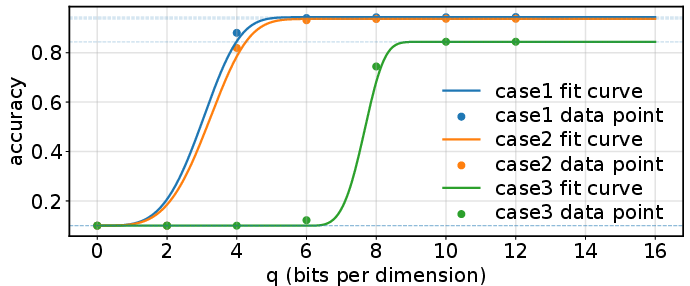
Figure 2: Fitted utility-accrual curves for quantization levels; the Weibull model tracks empirical task accuracy tightly across modalities and encoder counts.
This utility model enables fast offline pre-tabulation of the best achievable semantic utility per device and allows the online resource scheduler to operate with simple table lookups and greedy procedures.
Hybrid Offline–Online Resource Allocation Algorithm
The iCoTASC framework splits the resource allocation process into:
Offline phase: Given the trained encoder(s) and their IG-based importance maps, and with the Weibull utility model fit to validation data, each transmitter's maximum utility function Uk(x) for a bit budget x is computed. Greedy or near-greedy allocation suffices due to the utility curve's structure.
Online phase: In real time, each transmitter estimates its current channel bit payload ck. The system greedily allocates RBs to transmitters by maximizing the marginal increase in global task utility, iterating until the budget B is exhausted. Detailed embedding selection and quantization are then reconstructed by lookups in the precomputed ak0 tables.
This decomposition ensures that the online per-slot computation is minimal—approximately ak1—while adapting allocation to actual channel conditions and semantic utility.
Experimental Validation
iCoTASC is evaluated on collaborative image classification for Fashion-MNIST and CIFAR-10, with configurations involving 2–4 encoders per sample. The experimental protocol restricts computational resources to mimic an edge-like environment, and randomized channel states are simulated to reflect wireless dynamics.
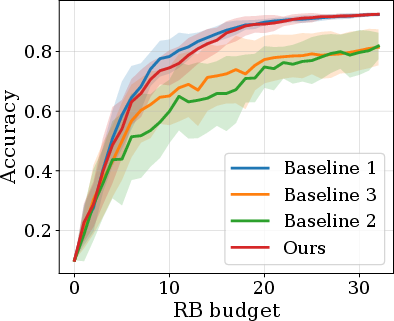
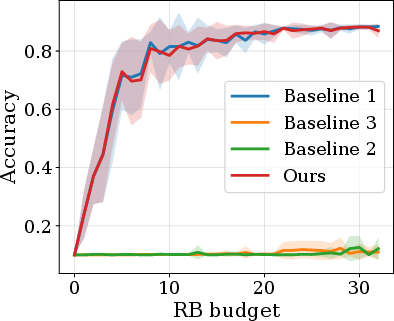
Figure 3: Fashion-MNIST accuracy for two-encoder configuration under severe RB budget constraints—iCoTASC outperforms importance-agnostic and relaxed baselines over the entire resource regime.
Performance is compared against three baselines:
- Baseline 1: Full online convex optimization for allocation.
- Baseline 2: Greedy allocation to the highest-gain channel, dimension bits assigned randomly.
- Baseline 3: Like Baseline 2 but skewed toward assigning bits to lower-precision coordinates.
Numerical Highlights and Contradictory Claims
Key quantitative results:
- On Fashion-MNIST (2 encoders), iCoTASC achieves accuracy 0.593 at RB=4 and 0.853 at RB=32, outperforming all baselines, particularly at low-resource points.
- On CIFAR-10 (3 encoders), iCoTASC achieves 0.870 at RB=32, maintaining a gap over baselines in all tested regimes.
- Runtime for online allocation is consistently sub-millisecond to a few milliseconds, markedly lower than convex or importance-agnostic baselines.
The work contradicts prior rank-based or channel-greedy scheduling by demonstrating that importance attribution substantially closes the accuracy gap under tight real-time constraints, without any need for on-the-fly retraining or re-optimization of the task model.
Implications and Future Directions
The iCoTASC framework moves distributed intelligence a step closer to practical real-time operation in dynamic, resource-constrained environments. By leveraging explainable AI (XAI) techniques for semantic attribution and empirically fitting the utility-quantization curve, iCoTASC offers a general strategy for model-agnostic, scalable, and efficient resource allocation across a range of encoding architectures and tasks.
Practically, this enables robust edge-perception systems in scenarios like autonomous vehicle teams, multi-sensor AR/VR, and federated health monitoring. Theoretically, the work suggests further research into deeper integration of XAI and communication resource scheduling, tighter bounds on importance-induced communication gain, and extensions to non-coherent, asynchronous, or privacy-constrained settings.
Further, nonconvexity in the utility scheduler is largely mitigated by empirical smoothness; future exploration of joint design with encoder retraining loops may close the residual gap to optimally robust distributed reasoning under severe communication bottlenecks.
Conclusion
iCoTASC introduces importance-aware, hybrid offline–online resource allocation for multi-device semantic communication, integrating IG-based explainability and empirical quantization-utility modeling to achieve superior inference accuracy and latency efficiency over prevailing methods. This work establishes clear advantages for attribution-driven scheduling and lays the foundation for scalable distributed AI under practical wireless constraints.
References:
- "Importance-Aware Resource Allocation for Collaborative Task-Oriented Semantic Communication" (2606.29052)