- The paper introduces a semantic-aware holographic beamforming framework that prioritizes high-importance semantic features using amplitude-controlled metamaterial antennas.
- It employs an alternating optimization method combining digital beamforming, successive convex programming, and non-traditional power allocation to enhance transmission fidelity.
- Simulation results demonstrate superior weighted PSNR and energy efficiency in multi-user Rayleigh channels compared to conventional bit-based beamforming schemes.
Introduction
The paper "Holographic Beamforming for Semantic Communication" (2606.20887) systematically addresses the integration of semantic communication with amplitude-controlled holographic beamforming, leveraging metamaterial antennas (RHS—Reconfigurable Holographic Surface) for efficient, multi-user image transmission. Unlike conventional bit-based communication, semantic communication identifies and transmits only task-relevant semantic features, substantially reducing bandwidth requirements. However, the unique requirement that different semantic features possess unequal degrees of importance mandates beamforming mechanisms that explicitly adapt transmission quality (SNR) to semantic importance.
Conventional phased array and holographic beamforming techniques, developed for uniform bit-level importance, fail to accommodate the heterogeneous importance distribution in semantic information, leading to suboptimal reconstruction accuracy. This work proposes and illustrates a framework wherein metamaterial antennas with tunable amplitude profiles are jointly optimized to provide spatial multiplexing while prioritizing high-importance semantic features in beam allocation.
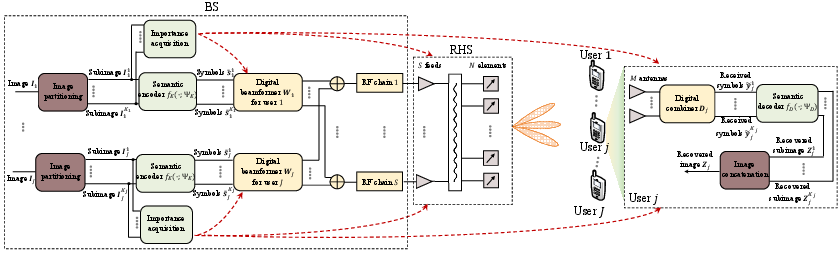
Figure 1: System model of a multi-user downlink RHS-aided semantic communication network integrating semantic importance-aware beamforming. The red curves in the figure visualize the linkage between semantic importance and beamforming decisions.
System Architecture and Semantic Importance Acquisition
The target scenario is a multi-user downlink system where each user receives images partitioned into subimages, each processed by semantic encoders, semantic decoders, and a semantic segmentation network for importance determination. Transmission occurs via a hybrid beamforming approach: digital beamforming at the BS, amplitude-controlled analog beamforming at the RHS, and digital combining at the receivers. Each semantic encoder produces complex-valued symbols for subimages, channel-coded for reliable delivery. The semantic importance is quantified using pixel-wise class segmentation, with importance weights assigned according to object relevance for the target task. The overall reconstruction loss is a weighted sum, emphasizing higher-fidelity reconstruction for regions of elevated importance.
The central technical thrust lies in formulating and solving a minimization problem for weighted semantic reconstruction loss, incorporating digital beamformer, RHS amplitude matrix, and digital combiner. Key aspects include:
- Closed-Form Performance Approximation: Empirical curve fitting (generalized logistic function) characterizes the relationship between reconstruction loss, semantic importance, and channel SNR, revealing the S-shaped dependence and saturating effects for both high and low SNR regimes. Curve parameterization explicitly encodes semantic importance.
- Alternating Optimization: The joint optimization is decomposed iteratively:
- Digital Beamforming & Combining: Block Diagonalization (BD) constructs parallel SISO streams without inter-user/inter-stream interference. Optimal channel allocation prioritizes high-importance subimages on higher-gain channels; power allocation diverges from classical water-filling, assigning nonzero power even to weak channels if semantic importance so dictates.
- Holographic Beamforming: Successive Convex Programming (SCP) adapts the RHS amplitude profile to further reinforce SNR for high-importance streams, constrained by leakage power and physical amplitude range.
- Theoretical Results: The paper analytically demonstrates that optimal semantic stream mapping and power allocation in the semantic domain differs fundamentally from bit-centric water-filling. For low SNR and ej(k)<1, every semantic stream, regardless of channel quality, must be allocated positive power to avoid catastrophic importance-weighted loss.
Simulation on multi-user image transmission over Rayleigh MIMO channels with semantic segmentation (Pascal VOC 2012; SSA framework) validates the system. Weighted Peak SNR (wPSNR) is used as the primary metric. The results establish:
- Performance Superiority: The semantic-aware RHS-based scheme outperforms both random RHS beamforming and bit-rate-optimal holographic beamforming, demonstrating necessity of importance-aware allocation.
- Resolution and Hardware Efficiency: For a fixed cost, RHS with amplitude control outperforms traditional phased-array approaches, attributed to larger apertures and higher element counts enabled by metamaterials.
- Robustness: The approach shows resilience to parameter fitting errors—the wPSNR degradation with 10% parameter offset is negligible.
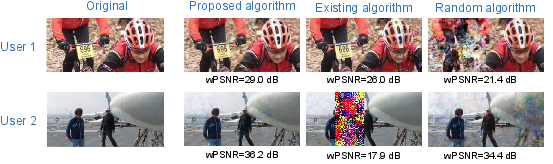
Figure 2: Original and reconstructed image examples under multiple schemes. Importance-aware RHS beamforming maintains fidelity for high-importance regions (e.g., faces), whereas water-filling and random allocation methods show significant failure in semantic-critical regions.
Allocation Schemes: Semantic vs Bit-Level
Contrasting semantic and conventional bit-level schemes, the allocation of channels and power is visualized:
- Semantic-aware allocation maps high-gain channels and ample power to high-importance subimages.
- Conventional bit-level allocation (water-filling) neglects semantic importance, leading to zero power for low-gain channels, irrespective of task relevance.
Implications, Energy Efficiency, and Future Directions
This research sets forth a theoretical and practical basis for semantic-aware holographic beamforming:
- Task-Driven Beamforming: Spatial channel and power resources are dynamically realigned for semantic objectives—adding a new layer to physical-layer optimization that is responsive to neural encoder outputs and semantic segmentation results.
- Energy Efficiency: RHS with amplitude control achieves high directive gain and real-time reconfiguration with low power consumption, further enhanced by semantic compression, which reduces the symbolic payload.
- Practical Extensions: Real-time beam alignment and adaptation are enabled by periodic CSI updates and compressed sensing-based channel estimation. The methodology is agnostic to specific semantic segmentation or importance metrics, and can readily be adapted to other modalities (e.g., text, video, sensory fusion) by redefining importance and segment-to-SNR mappings.
Conclusion
This paper advances the field by showing that metamaterial-based amplitude-controlled beamforming, when coupled with semantically-weighted optimization, provides substantial gains in image transmission tasks under bandwidth and energy constraints. Strong numerical evidence supports both the theoretical allocation principles and the robustness of the approach. The results motivate continuing work toward automated, semantic-driven resource management in large-scale wireless systems, further blurring the boundary between communication, cognition, and computation.