- The paper introduces ReGuide, a novel framework that leverages test-time guidance for iterative improvement in diffusion-based robotic manipulation.
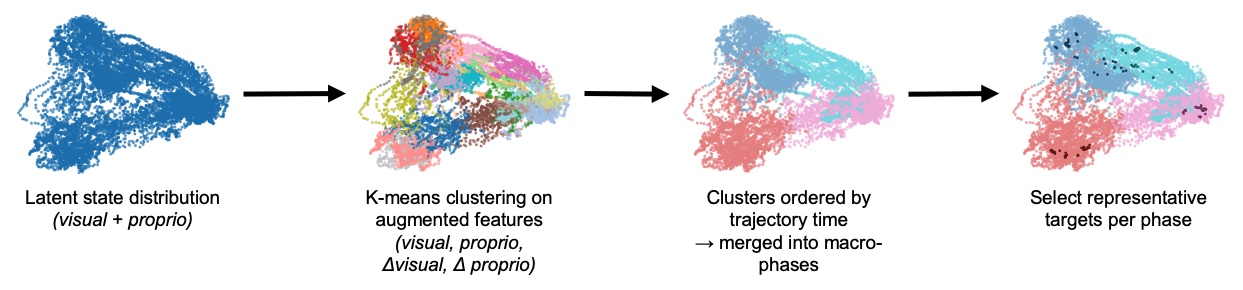
- It employs phase-conditioned latent clustering and drifted-but-recoverable region gating to selectively correct off-manifold behavior.
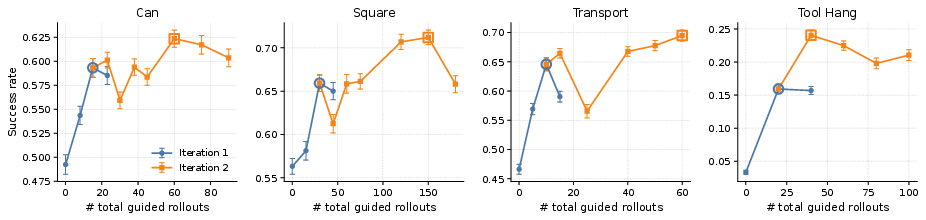
- Experimental results demonstrate up to 7.7× higher success rates on challenging manipulation tasks, validating the framework's effectiveness.
ReGuide: From Test-Time Guidance to Self-Improving Diffusion Policies
Motivation and Problem Setting
Imitation learning with behavior cloning suffers from covariate shift: small errors can accrue and push the policy distribution far from the state-action manifold defined by the demonstrations, especially in long-horizon and multimodal robotic manipulation. While modern diffusion policies increase expressivity for action modeling, they are still vulnerable to this core failure mode. Existing solutions either require continued expert corrections (e.g., DAgger) or rely on test-time guidance via dynamics models, but these approaches either involve significant annotation burdens or discard the informationally rich corrective rollouts produced during guidance. This motivates the development of an integrated approach that both utilizes test-time guidance and reuses the resulting corrective data to drive iterative policy improvement.
Framework and Methodological Contributions
The proposed ReGuide framework reinterprets test-time guidance not as a one-off inference-time crutch but as an on-policy data-generation mechanism. A policy is iteratively improved by: (1) sampling corrected rollouts using guidance, (2) filtering for successful recoveries, and (3) retraining or fine-tuning the policy to absorb this state-corrective data. At each iteration, the improved policy can then undergo further guidance and data collection, forming an effective rollout--collect--train loop.
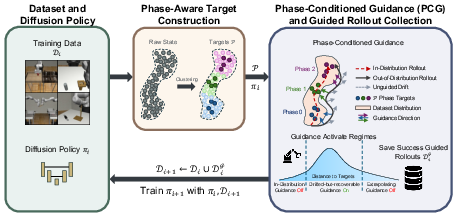
Figure 1: At iteration i, ReGuide constructs phase targets from demonstration data, collects successful guided rollouts in the drifted-but-recoverable regime, and merges those rollouts for policy update.
Key methodological elements:
Experimental Evidence and Quantitative Results
ReGuide is validated on four Robomimic manipulation benchmarks (Can, Square, Transport, Tool Hang) with challenging, low-demonstration-count regimes.
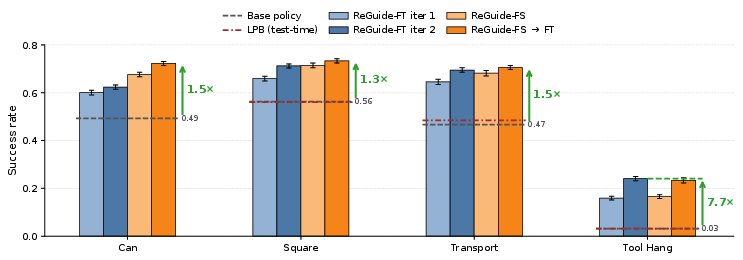
Figure 3: ReGuide (FT, FS, and their composition) consistently improves over the base policy and surpasses previous test-time guidance-only methods, with the largest gains on challenging tasks.
Principal findings include:
Theoretical and Practical Implications
From a theoretical standpoint, ReGuide provides a novel approach to covariate shift mitigation in behavior cloning, obviating the need for high-frequency expert intervention. The proposed use of phase-conditioned, multimodal latent targets demonstrates that leveraging the structure inherent in long-horizon demonstration data is crucial for effective correction and recovery. The drifted-region gating mechanism empirically validates the importance of trust regions for the utility of gradient-based guidance in action space.
Practically, ReGuide is inherently compatible with existing diffusion-policy architectures and imposes no additional expert labeling requirements beyond trajectory-level success signals. Its modular structure—separating guidance, data selection, and policy update—enables practical scalability and experimentation. Furthermore, the iterative nature of self-improvement provides a foundation for further research into adaptive (e.g., online) update schedules, more sophisticated data selection heuristics (e.g., diversity or informativeness-aware filters), and joint dynamics model and policy refinement.
Limitations and Future Directions
Notable current limitations include a fixed dynamics model that may become misaligned as the policy distribution shifts under repeated self-improvement. Exploration of uncertainty-calibrated or incrementally updated world models could further extend the lifetime and efficacy of the iterative loop. The selection heuristics for phase definition and gating thresholds are task-dependent and currently static; approaches integrating adaptive or learned segmentation and thresholding may reduce manual calibration. Finally, broader evaluation, including real-robot deployment and larger demonstration corpora, is an essential next step.
Conclusion
ReGuide reframes test-time guidance for diffusion policies from a runtime tool into a bootstrapping, self-improving feedback mechanism. Through phase-conditioned, multimodal guidance, selective correction, and modular absorption strategies, it achieves substantial and repeatable improvement in robotic manipulation policies under covariate shift. The framework establishes new best practices for integrating knowledge from guided recoveries directly into the policy, reinforcing the synergy between gradient-based control guidance and iterative imitation learning.