- The paper demonstrates that mirror dark matter compresses ordinary matter in neutron stars, reducing visible radii and modifying tidal deformability.
- It employs a two-fluid TOV framework with a unified EOS to model phase transitions and the interplay of nucleonic, hyperonic, and quark matter.
- Observational constraints from GW170817 and NICER map to a wide range of mirror dark matter fractions, revealing unique nonmonotonic tidal signatures.
Equation of State Construction and Phase Transitions
This study investigates how mirror dark matter (MDM), when coupled only gravitationally, fundamentally modifies the macroscopic observables of neutron stars. The approach begins by constructing a unified ordinary-matter EOS incorporating nucleonic matter, hyperonic matter, and quark matter (both two- and three-flavor) within the NL3ωρ mean-field and NJL effective models, respectively. First-order hadron--quark transitions are handled self-consistently using Maxwell construction, not presupposing the nature of the compact object (neutron star, hybrid star, or quark star).
Analysis of the pressure envelope P(μB) for several representative quark masses (Fig. 1) shows the stable phase is dictated by maximal pressure at each baryon chemical potential among nucleonic, hyperonic, and quark phases.
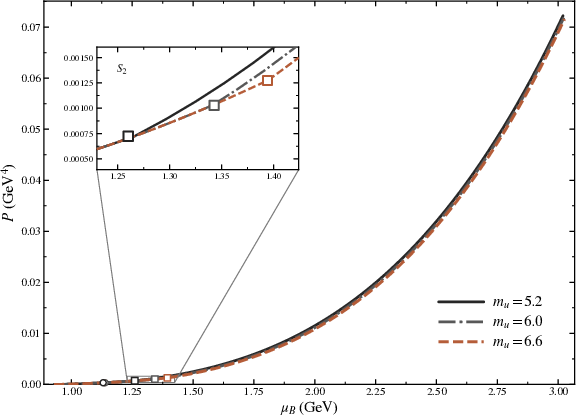
Figure 1: Pressure envelope P(μB) resulting from Maxwell construction across several light-quark masses, with highlighted phase transitions.
The Maxwell construction reveals that, for light current-quark masses mu≥5.2 MeV, the core of stable stellar configurations is dominated by hyperonic matter, with the transition to deconfined three-flavor quark matter occurring only at high density, and the appearance of macroscopic quark cores is absent. The two-flavor quark phase is never selected as stable for these parameter choices.
The ordinary-matter EOS in the ϵ−P plane (Fig. 2) exhibits a sharp energy-density discontinuity marking the hyperon-to-three-flavor quark transition, but in the relevant density regime for canonical neutron-star radii and masses, the EOS is hadronically dominated. The squared sound speed cs2 further emphasizes the microphysical differences only at high pressure (Fig. 3).
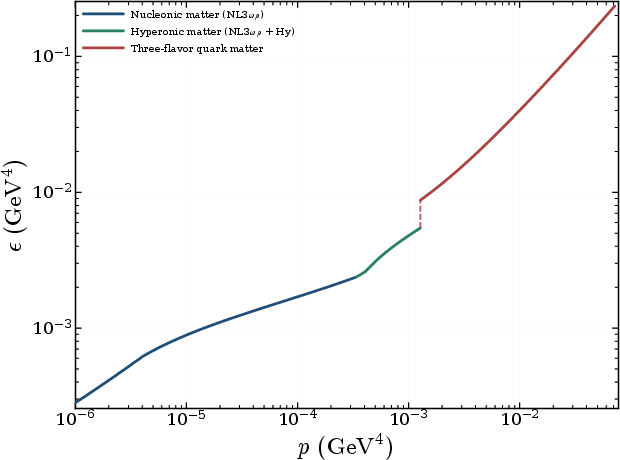
Figure 2: EOS in the ϵ-P plane showing phase transitions resolved by Maxwell construction, with energy-density jump.
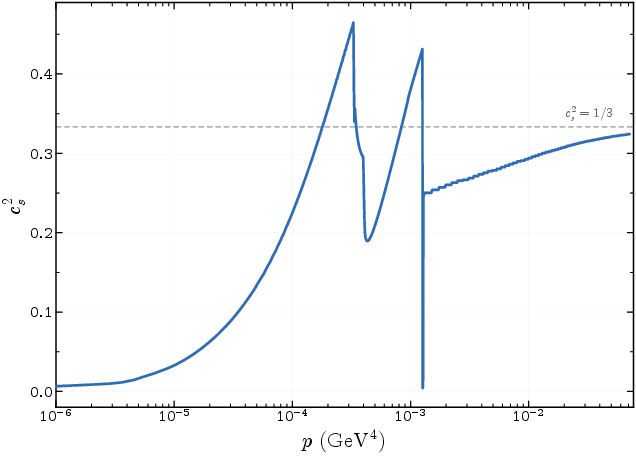
Figure 3: Squared sound speed cs2 as a function of pressure, indicating the EOS's microphysical phase structure.
Two-Fluid Stellar Structure with Mirror Dark Matter
MDM is postulated to be governed by identical microphysical laws as ordinary matter, yielding an EOS ϵD(P)=ϵQ(P), but is coupled exclusively via gravity. Stellar equilibrium is described in the two-fluid TOV framework. Each configuration is specified by central pressures P(μB)0, resulting in a two-dimensional family of equilibrium solutions parameterized by the MDM mass fraction P(μB)1.
The global distribution of stable configurations exhibits a wide spanning in radius for fixed mass, determined by P(μB)2 (Fig. 4), independent of the EOS branch changes that only affect the highest-mass regime. The P(μB)3 relation (Fig. 5) demonstrates that as P(μB)4 increases, the ordinary-matter (visible) radius P(μB)5 decreases for a fixed total mass.
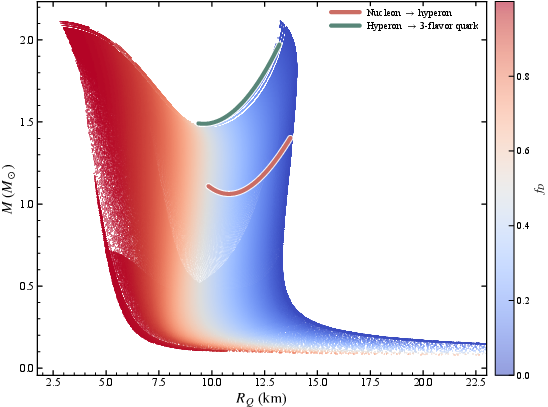
Figure 4: Population of stable neutron star models in the P(μB)6 plane as a function of MDM mass fraction P(μB)7.
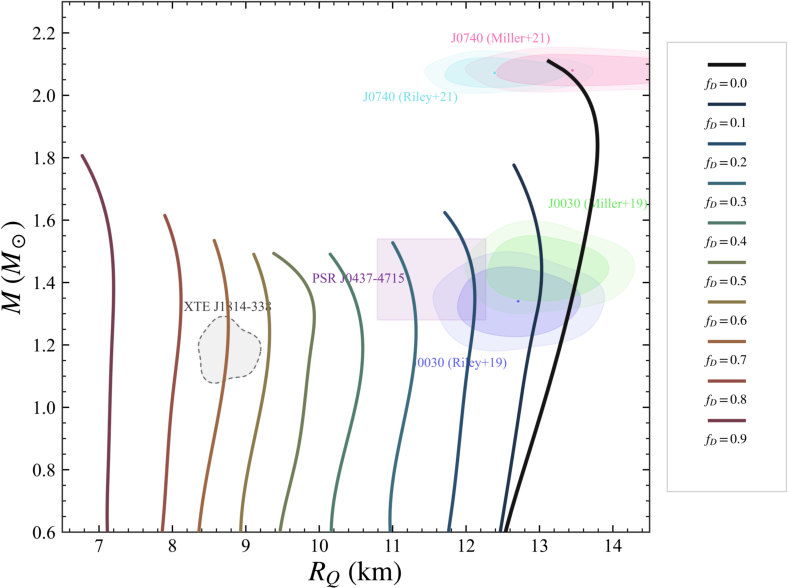
Figure 5: Mass--radius relations for several fixed values of P(μB)8 compared with X-ray and NICER constraints.
Configurations are further characterized by whether MDM occupies a central "core" (P(μB)9) or an extended "halo" (P(μB)0), impacting the relation between the visible and gravitational radii (Fig. 6).
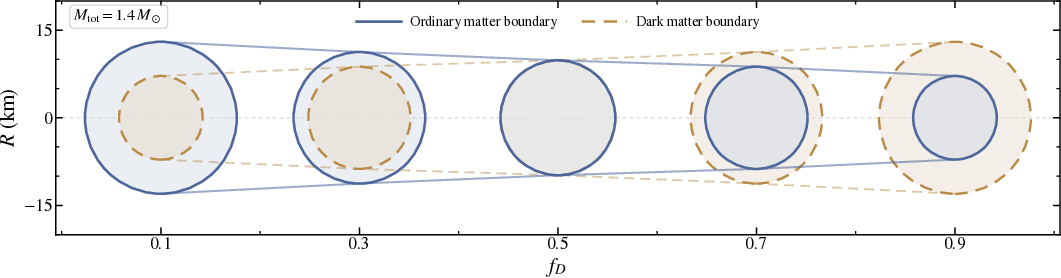
Figure 6: Schematic illustrating the evolution of ordinary-matter and MDM boundaries as a function of P(μB)1 at fixed total mass.
The dimensionless tidal deformability P(μB)2 is computed for the two-fluid models, where the relevant compactness uses the total gravitational radius P(μB)3. The P(μB)4 relation (Fig. 7) shows a strong dependence on P(μB)5, due to the strong scaling P(μB)6, enhancing even modest changes in stellar compactness.
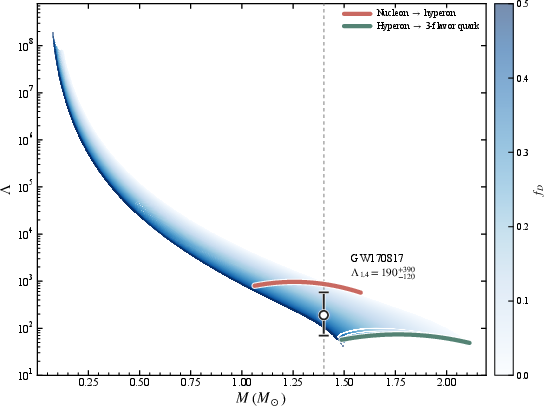
Figure 7: Dimensionless tidal deformability P(μB)7 as a function of mass, showing strong dependence on MDM fraction P(μB)8.
The GW170817 constraint P(μB)9 maps to a broad range of MDM mass fractions, mu≥5.20, within this model. The model exhibits symmetry under mu≥5.21 owing to the identical EOSs for the two fluids.
Nonmonotonicity and Diagnostic Implications
The maximum mass mu≥5.22 and mu≥5.23, after stability filtering, depend nonmonotonically on mu≥5.24 (Fig. 8). Both approach the single-fluid ordinary-matter value at mu≥5.25 or 1, peaking/deviating maximally for intermediate mu≥5.26 where the two fluids have comparable gravitational influence. This nonmonotonic behavior is a unique signature of two-fluid, MDM-admixed models, enabling observational distinction from pure hadron-quark transition scenarios.
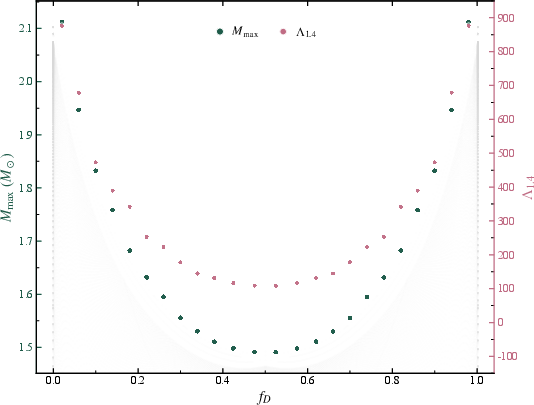
Figure 8: Maximum mass mu≥5.27 and tidal deformability mu≥5.28 as functions of MDM mass fraction mu≥5.29, highlighting the nonmonotonic behavior induced by two-fluid coupling.
Theoretical and Observational Implications
The principal theoretical result is that inclusion of a gravitating MDM component enables the reduction of visible radii and the modification of tidal response in neutron stars—without requiring a resolved quark core—by gravitationally compressing the ordinary-matter sector. This provides an alternative mechanism to hybrid or pure-quark EOS models for matching small-radius and low-ϵ−P0 emission, such as that inferred for PSR J0437–4715, XTE J1814–338, and GW170817. Importantly, the EOS parameter space (e.g., ϵ−P1) considered always fulfills the ϵ−P2 maximum-mass constraint, and MDM effects decouple radius and tidal deformability observably from the EOS's intrinsic stiffness.
From a phenomenological perspective, small-radius inferences favor nonzero ϵ−P3, while GW170817 tidal constraints are mapped to significant intervals in ϵ−P4. Simultaneous electromagnetic and gravitational wave observations have enhanced discriminatory power: the two-fluid MDM scenario predicts a symmetry and broad allowed region in ϵ−P5, which is challenging to reconcile within single-fluid EOS frameworks exhibiting stiff, hadron-only matter.
Conclusion
The model developed here demonstrates that gravitationally coupled mirror dark matter, even in the absence of macroscopic quark cores, has a pronounced impact on neutron-star mass–radius and tidal deformability relations. These effects are quantifiable, nonmonotonic functions of the MDM mass fraction, offering rich observational tests. Future research should consider alternative microphysical inputs (e.g., NJL vector interactions, phase coexistence phenomena), possible non-gravitational interactions in the MDM sector, and statistical inference with multimessenger data to further constrain or detect MDM contributions in neutron-star populations.

