- The paper introduces a continuous-time, structured policy that mitigates transfer instability and timing mismatches in UAV navigation through adaptive forgetting and explicit time-conditioning.
- It integrates LiDAR-based perception with a closed-form continuous-time recurrent core to achieve superior safety and path efficiency in both simulated and real-world tests.
- Experimental results show 100% indoor collision-free flights and robust performance at reduced control frequencies, emphasizing the framework's practical viability.
LNN-Fly: Continuous-Time UAV Navigation for Robust Obstacle Avoidance under Timing Mismatch
Motivation and Problem Setting
Recent advances in end-to-end UAV navigation have enabled impressive agility and speed in simulation, including high-performance racing and autonomous search-and-rescue. However, robust deployment in cluttered, real-world environments continues to be constrained by two fundamental bottlenecks: transfer instability in obstacle avoidance and degradation under timing mismatch in control loops. The former leads to collision risks when trained policies are deployed under distribution shift (simulator, sensor, or stack changes), while the latter emerges from real onboard systems exhibiting irregular sensing, control, and actuation intervals.
LNN-Fly addresses these challenges by proposing a continuous-time policy framework specifically designed for robust, transfer-stable obstacle avoidance under variable timing, with emphasis on deployment in real-world cluttered scenes using onboard perception and computation.
System Architecture
The LNN-Fly system integrates structured continuous-time recurrence, explicit elapsed time conditioning, and adaptive, input-driven forgetting into a lightweight neural policy for LiDAR-based UAV navigation.
The policy architecture receives sectorized LiDAR and low-level state cues, which are fused via a compact encoder and propagated by a Closed-form Continuous-time (CfC) core. The temporal core combines a contraction-based hidden state update—motivated by dynamic programming perspectives—with an observation-dependent forgetting mechanism. This design allows the internal memory to remain stable during sustained maneuvers but rapidly refresh in response to novel or hazardous stimuli.
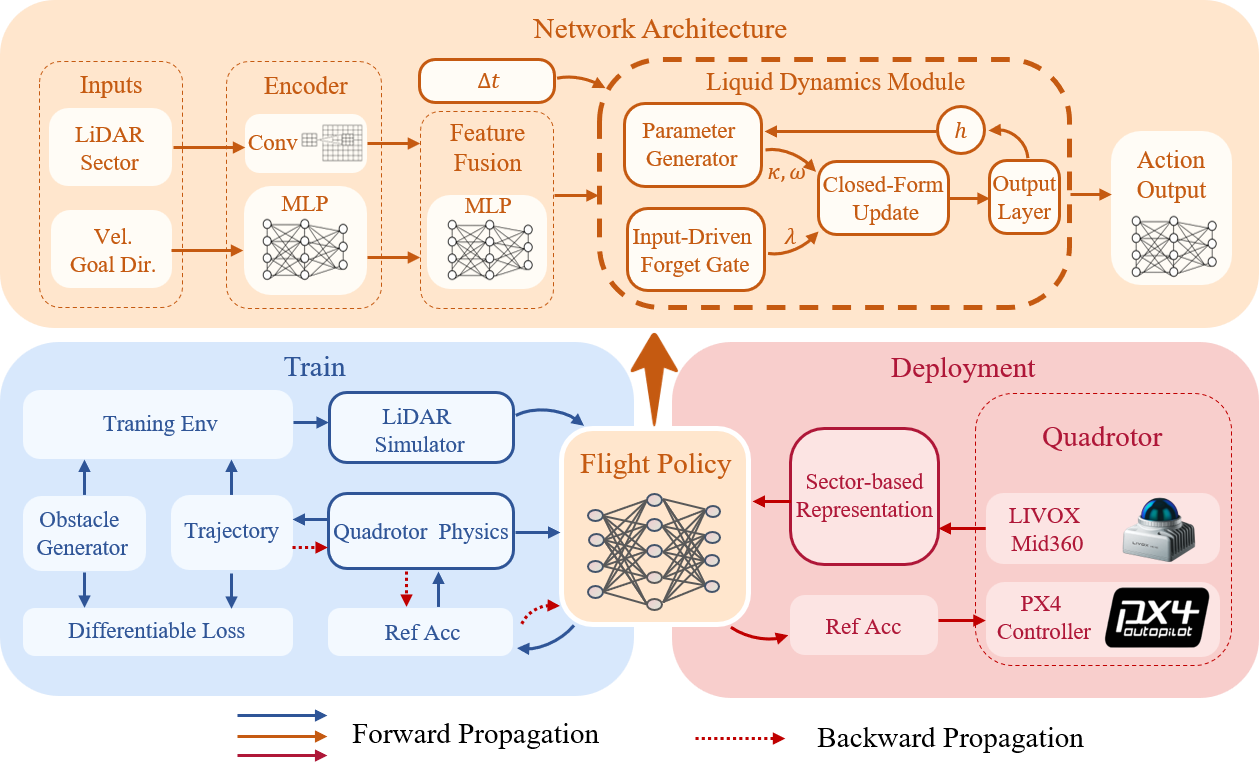
Figure 1: LNN-Fly system overview, showing sensor processing via LiDAR sectors and closed-form continuous-time recurrent core with adaptive temporal scaling.
Structured Continuous-Time Recurrence
LNN-Fly departs from classical discrete-time RNNs and generic liquid/ODE-style models by parameterizing hidden state evolution as a contraction to an observation-conditioned “local target," regulated by a channel-wise time constant. Crucially, the hidden dynamics
dtdh=ω(x,h)⊙(κ(x,h)−h)−λ(x)⊙h
allow the system to explicitly modulate memory retention and responsiveness on a per-feature basis. The Δt-aware discrete update enforces that state evolution and physical motion remain synchronized, even under variable-rate inference or perception latency. The time-conditioning is injected directly by making the dynamics’ parameters (κ, ω, λ) functions of the log-transformed control interval.
This design introduces an implicit inductive bias into learning, focusing recurrent capacity on locally consistent obstacle-avoidance behavior rather than generic sequence modeling. The adaptive forgetting mechanism λk is observation-driven, enabling selective memory refresh when necessary.

Figure 2: Visualization of adaptive forgetting; λk remains low during continuous avoidance, surges to trigger state refresh after clearing obstacles.
Differentiable Physics and Training Pipeline
Training is performed with differentiable rollouts over a simplified point-mass quadrotor dynamics, exposing the policy to deployment-relevant perturbations: variable control intervals, asynchronous LiDAR updates, delayed actuation, and noisy observations. This closes the gap between simulation and hardware, focusing optimization on resilience to system-level timing and sensing discrepancies.
The composite loss combines tracking, safety (via smooth barrier functions), smoothness (with penalties on acceleration and higher-order derivatives), and memory regulation. Backpropagation Through Time is employed over rolled-out trajectories and the structured recurrent transitions.
Experimental Results
Simulation Benchmarks
LNN-Fly was evaluated in a Gazebo+PX4 SITL workspace across three increasingly cluttered scenarios, benchmarked against Standard CfC, Diff-Fly, and EGO-Planner V2. The method is notable for its superior combination of safety (collision-free success) and path efficiency under increasing obstacle density and speed, particularly evident in the densest environments where classical planners and alternate learning-based controllers degrade more rapidly.
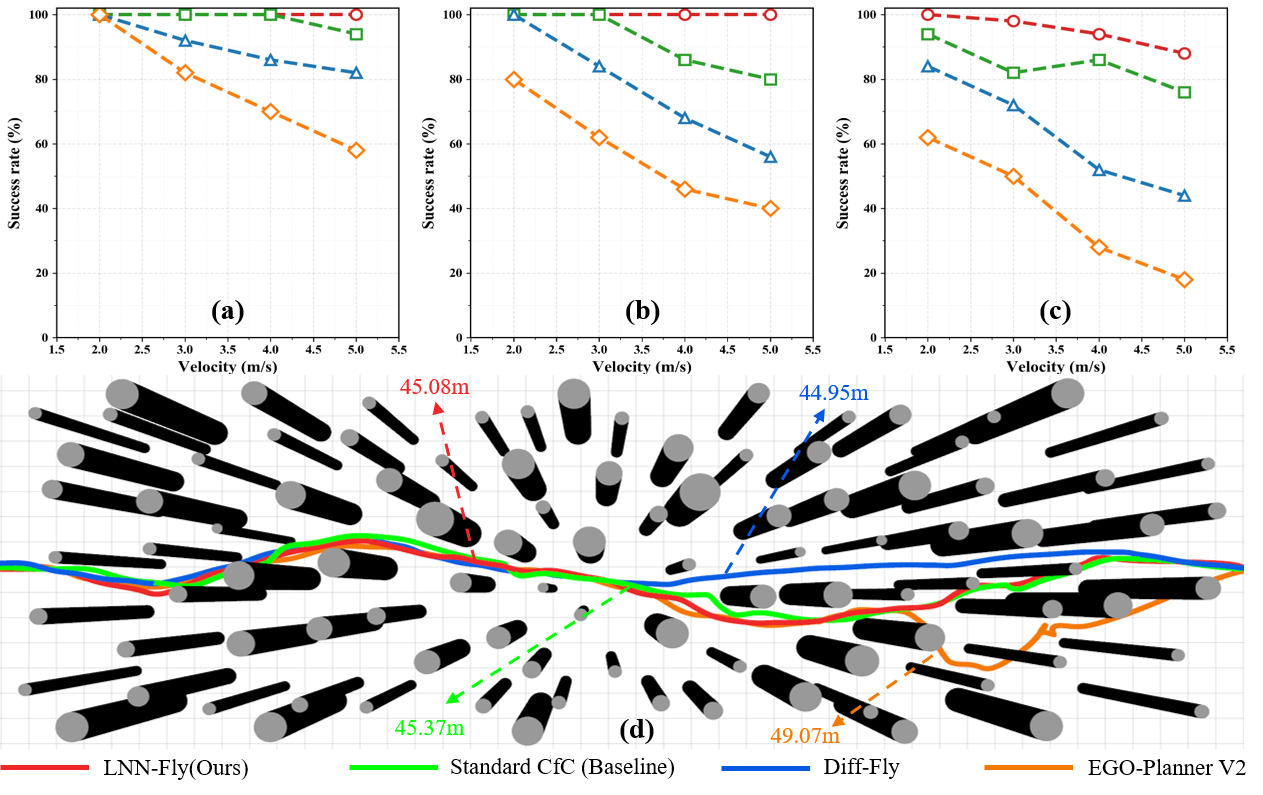
Figure 3: Benchmark comparisons; LNN-Fly consistently achieves higher success rates and longer/safer trajectories at elevated speeds and clutter densities.
Robustness to Timing Perturbations
A standout contribution is LNN-Fly’s explicit robustness to temporal mismatch, including:
- Reduced Control Frequency: LNN-Fly maintains significantly higher success rates at low update rates (e.g., 5 Hz versus training at 30 Hz), where LSTM and fixed-Δt CfC variants exhibit catastrophic failure, establishing the necessity of both continuous-time formulation and explicit Δt-conditioning.
- Perception Latency and Observation Staleness: Success rates remain robust even as observations are delayed or sparsified, demonstrating insensitivity to input timing irregularities.
- Frequency Jitter: Under simulated real-world scheduling jitter (alternating control rates), LNN-Fly outperforms fixed-step and LSTM baselines in stability and safety.
Training and Ablation Analysis
Ablation studies on key design elements confirm the complementary roles of structured contraction and adaptive forgetting: removing the forgetting gate (λ) leads to marked reductions in achievable speed and responsiveness. Substituting conventional RNNs erodes both safety and transfer stability.
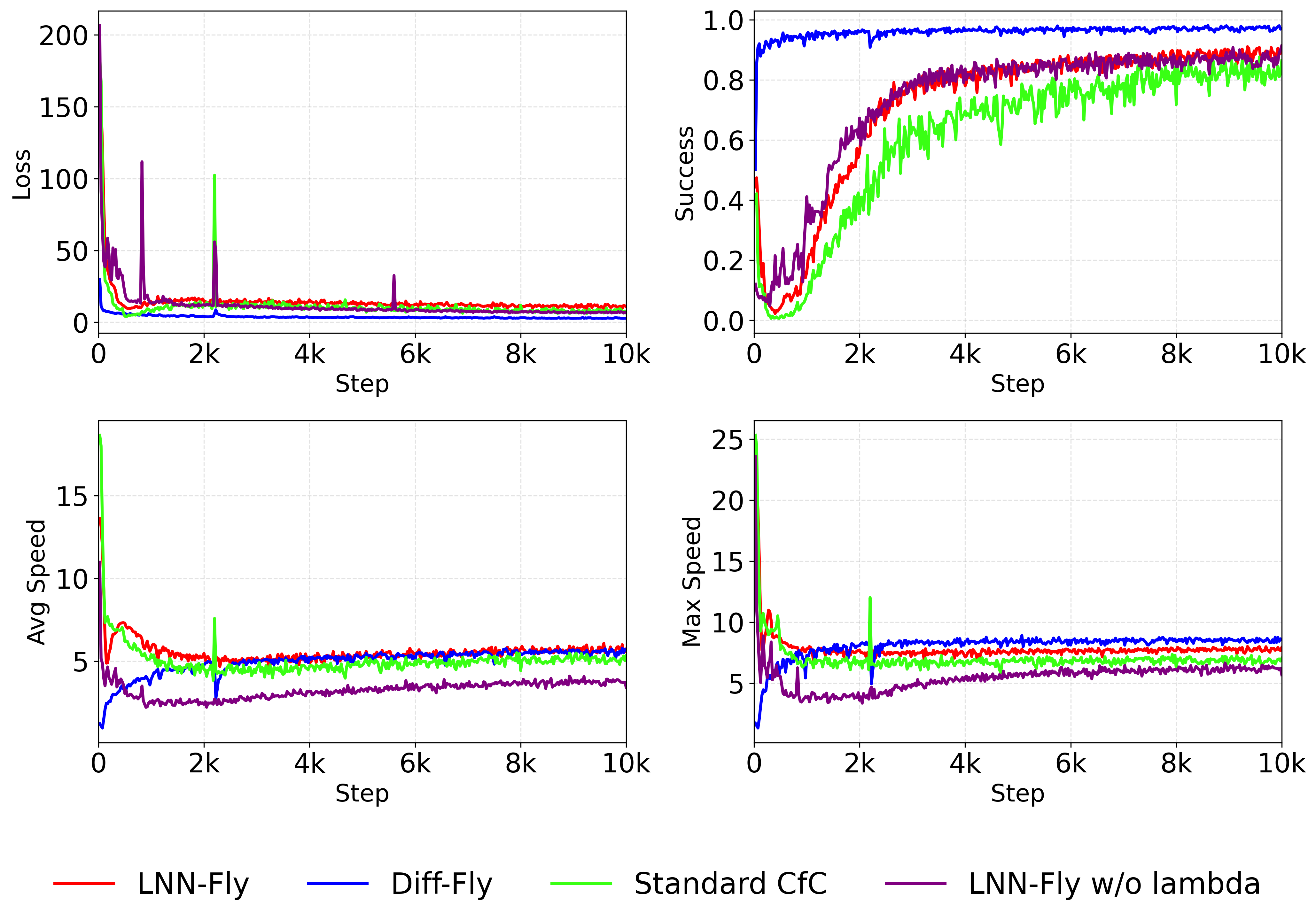
Figure 4: Training dynamics showcase LNN-Fly’s superior success rate and maintained agility throughout training compared to ablations and baselines.
Real-World Deployment
Zero-shot transfer to a physical quadrotor is demonstrated without additional fine-tuning. The policy leveraged sectorized LiDAR preprocessing to match simulation invariants, enabling robust navigation at up to 4 m/s in dense forests and reliable operation in indoor corridors at both 10 Hz and 30 Hz control frequencies. 100% success (no collisions in 20 flights) is achieved in indoor testing under cross-frequency conditions.
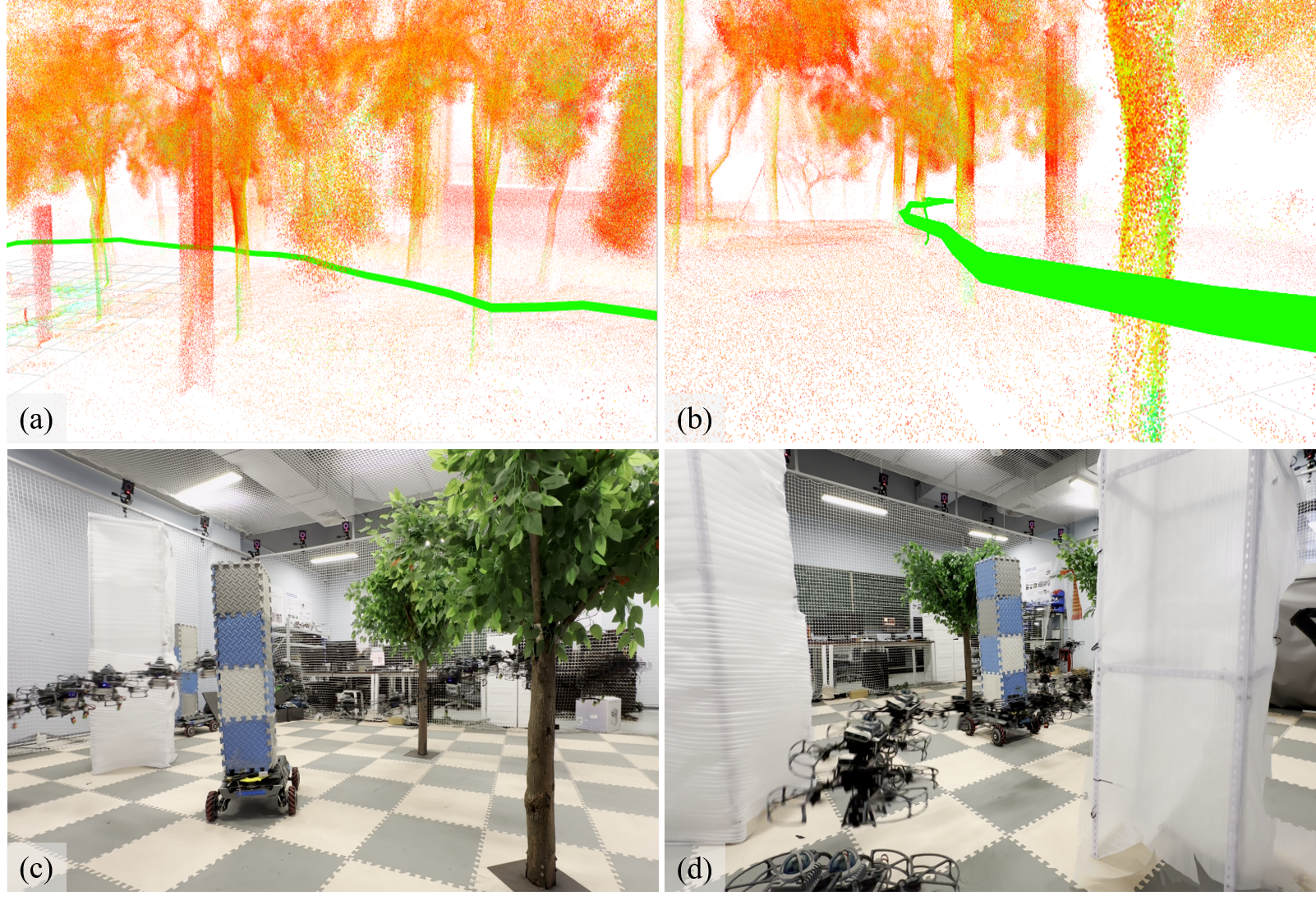
Figure 5: Diverse real-world deployments; robust navigation in both densely cluttered outdoor forests and confined indoor corridors.
Implications and Future Directions
LNN-Fly substantiates the feasibility of task-structured continuous-time policies for reliable onboard UAV navigation, especially where real-world timing and perception constraints render discrete-time methods brittle. The results reinforce that end-to-end learning benefits substantially from architectural integration of inductive structure and explicit time-awareness, particularly for safety-critical obstacle avoidance.
Practically, LNN-Fly allows compact, millisecond-latency inference on consumer CPUs, supporting real-time deployment on resource-constrained UAV platforms. The structured temporal scaling may generalize to other robotic domains with variable-rate sensor-layouts or actuation pipelines.
Theoretically, this work connects dynamic programming principles, recurrent neural differential equations, and adaptive time-scale regulation into a cohesive framework, suggesting new avenues for learning control policies robust to broader classes of system-level nonstationarity.
Current limitations include diminished performance during high-speed flights (due to reduced reaction margins and control discretization artifacts) and lack of dynamic obstacle prediction. These highlight research directions: further architectural simplification for extreme edge deployment, and integration of predictive modules for anticipatory avoidance in dynamic, nonstationary environments.
Conclusion
LNN-Fly introduces a principled, lightweight framework for continuous-time, transfer-stable UAV navigation under timing mismatch. By embedding dynamically structured, time-aware recurrence and observation-driven forgetting into the policy core, and matching the training pipeline carefully to real deployment constraints, the system achieves robust, collision-free navigation in diverse and challenging settings without per-environment retraining. This work advances the methodological foundation for safe, reliable learned UAV autonomy in cluttered and unpredictable real-world domains.